

Electricity Retailer Comparison for Solar & Battery Owners
If you already have rooftop solar and a battery, are you still comparing electricity retailers as though your home only buys power from the grid?
That's the mistake most battery owners make. They compare supply charges, usage rates and feed-in tariffs, then assume they've done a proper electricity retailer comparison. For a standard home, that approach is reasonable. For a battery-equipped home in New South Wales or Queensland, it's incomplete.
A battery isn't just a way to shift your own solar into the evening. Under the right retail structure, it can also participate in grid support and change the economics of your electricity account. That means the best plan for a battery owner may not be the plan with the lowest simple cents per kWh rate. It may be the plan that captures the highest total value from the battery asset over time.
Is Your Electricity Retailer Wasting Your Battery's Potential
A lot of homeowners spend carefully on installation quality, inverter selection and battery sizing, then use a comparison method that ignores what the battery can earn or offset after installation.
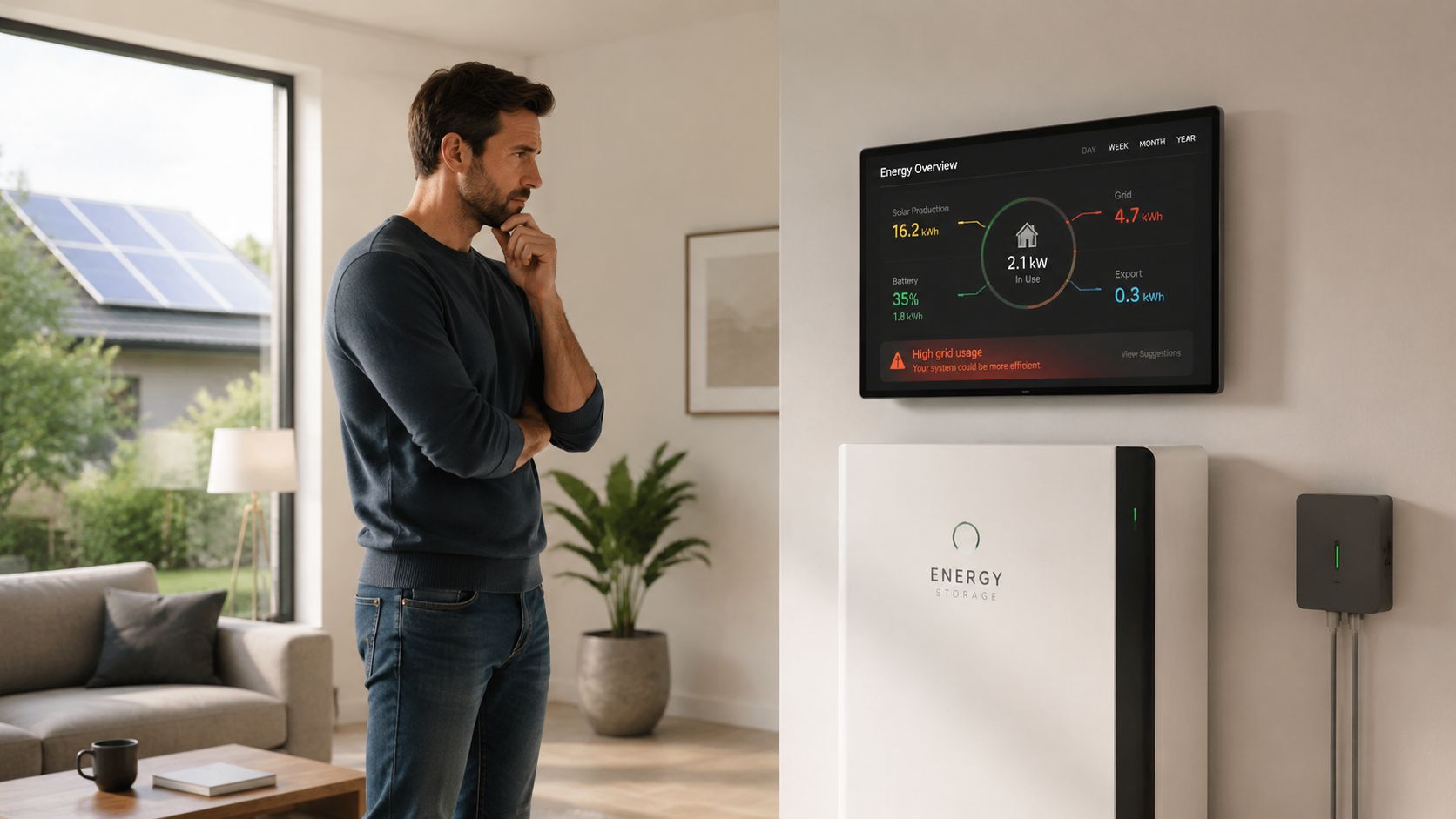
That gap matters because government comparison sites such as Energy Made Easy focus on standard usage and supply charges, but they don't factor in bill-free allowances or $0 network charge structures funded by battery grid contributions, which leaves a major blind spot for Australia's 1.5 million solar and battery households according to the Queensland Government's guidance on choosing an electricity retailer.
If your comparison method ignores battery-linked retail structures, you're not comparing total cost. You're comparing only the visible part of the bill.
Why standard comparisons miss the real value
A conventional plan comparison assumes your household is mainly a passive electricity consumer. A battery household isn't passive. It can import less, export differently, shift timing, and in some models support the grid when prices and system needs change.
That changes the analyst's question from “Which retailer has the cheapest tariff?” to “Which retailer creates the best net financial outcome from both consumption and battery participation?”
The wrong metric can make a weak plan look cheap and a strong plan look expensive.
What a modern comparison should ask
For a battery owner, electricity retailer comparison should include:
- Household self-consumption value. How much imported power does the battery avoid?
- Export value. What happens to excess solar and battery discharge?
- Grid service participation. Can the battery create extra value through a VPP structure?
- Bill design. Are there allowances, credits or alternative charge structures that change the effective bill?
- Control settings. Can you preserve reserve energy for the home?
For technically-minded homeowners, the useful comparison isn't only tariff-based. It's asset-based. Your battery is already installed. The smarter question is whether your current retailer treats it as dead capital or an operating energy asset.
Moving Beyond Traditional Comparison Metrics
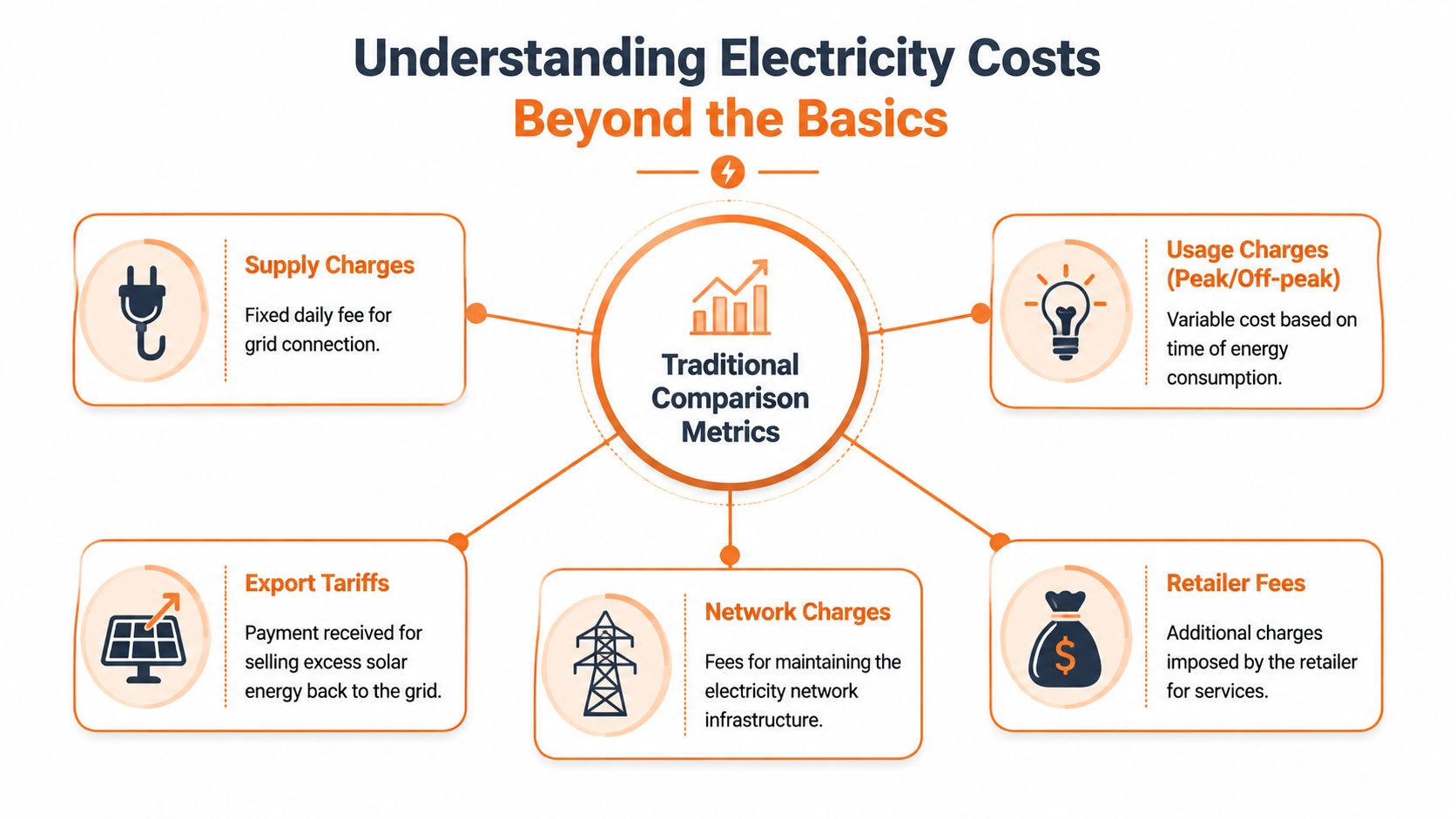
Most plan comparisons start with three familiar line items. Supply charge, usage charge, and feed-in tariff. Those still matter. They're just no longer enough.
Australia has 114 distinct electricity providers operating across the market, which means homeowners face a complex mix of tariff types and VPP structures rather than a simple cheapest-rate contest, as outlined by Compare Club's overview of major Australian electricity companies. In a crowded market like that, battery owners need a broader filter.
The old metrics still matter
A baseline comparison should still look at:
- Supply charges. The fixed daily cost of staying connected.
- Usage rates. The cents per kWh charged for imported electricity, often by time period.
- Feed-in tariffs. The payment for exported solar.
- Conditional discounts. Some plans reduce costs if conditions such as direct debit or on-time payment are met.
These inputs matter because they shape your fallback economics. If your battery is idle, full, unavailable, or your usage exceeds a bill allowance, these tariff settings still affect what you pay.
Why they're inadequate for battery owners
Battery owners should think in terms of system behaviour, not just tariff labels.
A low usage rate can still be a weak deal if the retailer gives you no path to monetise spare battery capacity. A generous feed-in tariff can still underperform if the plan treats the battery as passive storage instead of an active flexible asset. For many households, exporting midday solar at a standard rate is less valuable than using stored energy strategically across the evening or through coordinated grid events.
The reference price framework also matters. The Australian Competition and Consumer Commission requires retailers to display how an offer compares with the government-set benchmark, and consumers in NSW and QLD can use Energy Made Easy to compare plans and request a better offer if they're above the reference price, as explained on the ACCC page on electricity prices and plans. But even a plan below the reference price may not be the best outcome for a battery owner if it leaves battery value untouched.
The new metrics that matter more
For a modern electricity retailer comparison, add these filters:
- VPP participation model. Does the retailer offer fixed credits, event payments, wholesale pass-through, or an allowance-based structure?
- Bill-free allowance design. Does battery participation offset only energy usage, or also supply, network and distribution components within an allowance?
- Battery compatibility. Is your hardware supported without extra devices or replacement equipment?
- Dispatch philosophy. Does the operator preserve household needs first, or optimise primarily for retailer economics?
- Transparency. Can you see battery behaviour, event activity, forecasts or live pricing in an app?
A practical way to frame this is to ask whether your retailer is pricing electricity only, or coordinating a battery-backed energy service. That's a different commercial model.
For a closer look at how these cost layers interact, the High Flow Energy guide on deconstructing the cost of electricity is useful background reading.
Decoding VPP and Advanced Retail Offers
How should a battery owner compare retailers when the battery can earn value in several different ways, not just through avoided imports and a feed-in tariff?
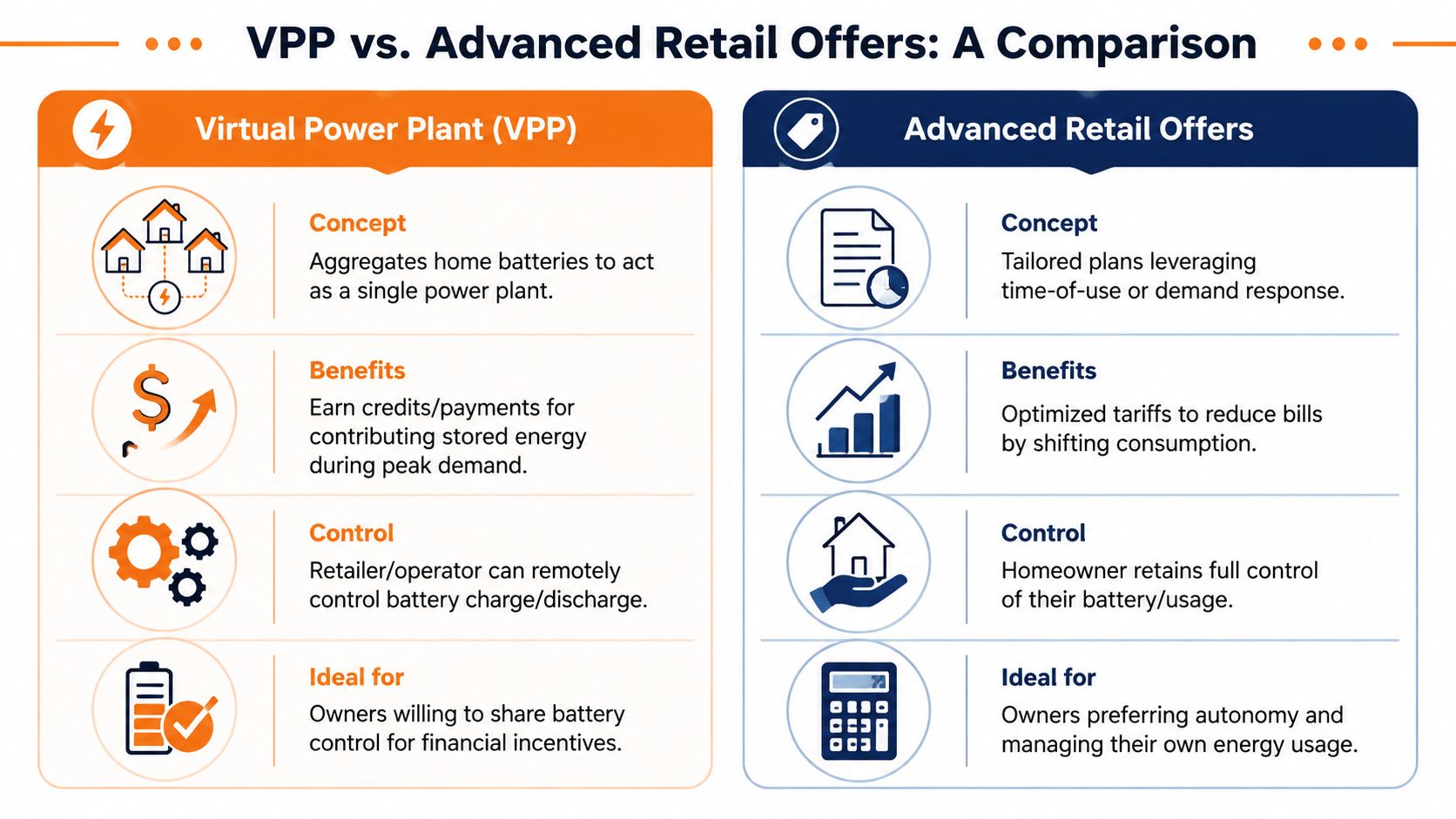
At that point, the retail offer stops being a simple energy price and starts acting like an asset-sharing agreement. The question is not only what you pay for imports. It is how much of your battery's flexibility the retailer can use, how they monetise it, and how much of that value returns to your bill.
AEMO's VPP trial work showed that battery fleets can be coordinated to charge and discharge in ways that respond to system conditions, not just household load, as described in the AEMO VPP Demonstrations knowledge sharing report. That matters because a retailer with VPP capability is not merely selling electricity. It is also buying access to a dispatchable household asset.
Traditional retailer-backed VPPs
The first model is the conventional retailer-backed VPP. The household typically receives a fixed bill credit, a scheduled payment, or event-based compensation. In return, the retailer gets limited dispatch rights over the battery.
That structure is easy to understand. It also places a ceiling on upside in many cases, because the customer's value is predefined while the retailer keeps control of optimisation across its broader portfolio. If your priority is predictability, that may be acceptable. If your priority is extracting the highest financial value from a battery, fixed-credit designs deserve closer scrutiny.
Wholesale-linked and advanced platform models
A second model passes through more market variability. Instead of paying a simple fixed credit, the offer may expose the household more directly to event payments, wholesale export opportunities, or dynamic battery dispatch outcomes.
These offers can outperform fixed-credit structures when price spikes, local network needs, and battery availability line up. They also require a higher tolerance for variability. Returns depend on software quality, battery availability, reserve settings, subscription costs, and whether the dispatch logic preserves enough stored energy for the home.
The commercial distinction is straightforward. Fixed-credit VPPs convert uncertain battery value into a predetermined customer payment. Advanced models leave more of that value variable and, in some cases, share more of it with the household.
Analyst's view: a fixed-credit VPP suits households buying certainty. A market-linked model suits households treating the battery as an actively managed asset.
Bring Your Own Battery retail models
A third model is the Bring Your Own Battery approach. Here, the retailer is designed around households that already own compatible storage. The value proposition often goes beyond export income or occasional VPP events.
The more interesting versions of this model use battery-enabled grid services to change the bill structure itself. Instead of asking only, "What is the import tariff?" or "What is the feed-in rate?", the better question is whether the battery helps fund energy allowances, offsets broader bill components, or creates a more favourable monthly billing outcome. For battery owners, that can be more valuable than a higher nominal FiT.
If you want a clear explanation of the operating model behind these programs, the High Flow Energy guide to virtual power plants sets out the basics.
Four things to examine in an advanced retail offer
1. Revenue path
Start with the source of customer value. Is the offer built on a fixed payment, wholesale exposure, event-based dispatch, or bill allowances funded by battery participation? Those are different economic models, and they produce different risk and return profiles.
2. Control rights
Read the dispatch terms carefully. A battery can create value for the grid only if the operator has some control over it, but the degree of control varies sharply between offers. Check who decides minimum reserve levels, event frequency, discharge windows, and override rules.
3. Household protection
Grid participation has to coexist with backup and self-consumption goals. A well-designed offer protects household needs first through reserve settings, transparent operating rules, and predictable exceptions. If those protections are vague, the quoted incentive may overstate the value to the household.
4. Bill impact
This is the point many comparisons miss. Export payments are only one value stream. Some advanced offers matter more because they reduce or reshape the bill in ways a standard tariff comparison does not capture. For a battery owner, the strongest offer is often the one that improves total annual bill outcome after control trade-offs, not the one with the most attractive headline rate.
Comparing Retailer Models in NSW and Queensland
New South Wales and Queensland battery owners face the same broad challenge, but the plan details can diverge sharply once you look past tariff headlines.
The first distinction is that standard feed-in tariffs are modest. Benchmark state data shows NSW at 4.9c/kWh and QLD at 5c/kWh for standard feed-in tariffs, while VPP-specific arrangements can differ materially. The second distinction is that NSW has an extra incentive lever. Joining a VPP in New South Wales can provide access to the Peak Demand Reduction Scheme, with an additional incentive of $550 to $1,100 on top of federal support according to EcoFlow's explanation of virtual power plant incentives in Australia.
That's why a battery owner shouldn't compare retailers only by looking at the import tariff or standard export rate.
Electricity Retailer Model Comparison for Battery Owners NSW QLD
| Feature | Standard Solar Plan | Traditional Retailer VPP | Modern BYOB VPP (Allowance Model) |
|---|---|---|---|
| Core bill logic | Usage-based billing with standard tariffs | Usage-based billing plus VPP credits or event payments | Bill structure may include battery-funded allowance mechanics |
| Battery role | Mostly self-consumption and occasional export | Shared between household use and retailer-controlled VPP events | Treated as an active energy asset for household and grid value |
| Export value focus | Standard feed-in tariff | Standard tariff plus VPP-specific credits in some plans | Can extend beyond standard export economics into bill offsets |
| Network charge treatment | Conventional billing applies | Usually conventional billing remains in place | Some offers may structure value around reduced network-related bill components within an allowance |
| Contract style | Standard retail terms | May involve lock-in periods or stricter participation rules | Some BYOB models operate without lock-in contracts or exit fees |
| Dispatch approach | Household-driven only | Often conservative and retailer-scheduled | Can be more dynamic, with household-first settings and software-led optimisation |
| Data visibility | Basic billing portal in many plans | Varies by retailer | Often stronger app-based visibility and control |
| Best suited to | Households without interest in active battery monetisation | Households wanting simpler fixed VPP value | Households seeking total battery value optimisation |
What changes in NSW
In NSW, the extra state incentive shifts the economics of joining a VPP. It doesn't automatically make every VPP superior, but it does mean that an electricity retailer comparison should include incentive eligibility, not just ongoing tariff terms.
NSW homeowners should also check whether the retailer's VPP structure captures enough ongoing battery value to justify participation after the upfront incentive is gone. A one-off incentive can attract attention. Long-term operational value determines whether the plan remains attractive.
What changes in Queensland
Queensland doesn't have the same PDRS factor, so the comparison often turns more directly on ongoing retail mechanics. That means battery owners should be stricter about plan design, battery compatibility, app visibility and whether the retailer's commercial model rewards active grid participation rather than passive exporting.
In Queensland, a retailer with a slightly less attractive headline tariff can still be the better choice if it extracts more total value from the battery over time.
The practical comparison lens
If you're deciding between a standard plan, a traditional retailer VPP and a modern BYOB model, compare them in this order:
- Bill architecture. How is value delivered to the household?
- Operational rights. Who controls charge and discharge, and under what conditions?
- Contract friction. Can you leave easily if the product underperforms?
- Data transparency. Can you verify the result yourself?
For households weighing retailer-backed VPPs against newer models, the High Flow Energy review of AGL's VPP structure is a useful example of how to compare commercial design rather than just marketing claims.
Common VPP Misconceptions Debunked
Battery owners often reject VPPs for the wrong reasons. The concerns are understandable. The problem is that many discussions mix older contract fears with newer software capabilities.
The VPP will drain my battery
This concern didn't appear out of nowhere. Some customers have reported batteries being drained during peak periods under VPP contracts, forcing them to buy back grid energy later, while transparency around household reserve settings has been limited across some operators, as discussed in Flow Power's explanation of how virtual power plants work.
That risk is real enough to investigate, but it isn't the whole story. Modern VPP contracts and apps can allow homeowners to set a minimum reserve level, so household energy needs stay prioritised over grid support events.
I'll lose control of my battery
That depends on the operator and the contract. Some VPPs are opaque. Others give the customer app-based visibility, reserve settings and override options. A good electricity retailer comparison should treat control rights as a primary feature, not a footnote.
If a retailer can't explain reserve logic in plain English, that's a warning sign.
More battery activity always means bad battery economics
Not necessarily. Battery use isn't automatically good or bad. What matters is whether the dispatch creates enough value, whether household needs stay protected, and whether warranty conditions remain compatible with the operating profile.
A battery sitting idle may preserve cycles, but it can also preserve underperformance. The right question isn't whether the battery is used more. It's whether it's used intelligently.
Some of the best VPP comparisons come down to software quality and contract clarity, not tariff branding.
VPPs only benefit the retailer
Some do capture most upside at retailer level. Others share value more directly through credits, event payments, wholesale-linked pricing or bill allowances. That's why “Is there a VPP?” is the wrong question. “How is value shared?” is the right one.
Your Practical Electricity Retailer Comparison Checklist
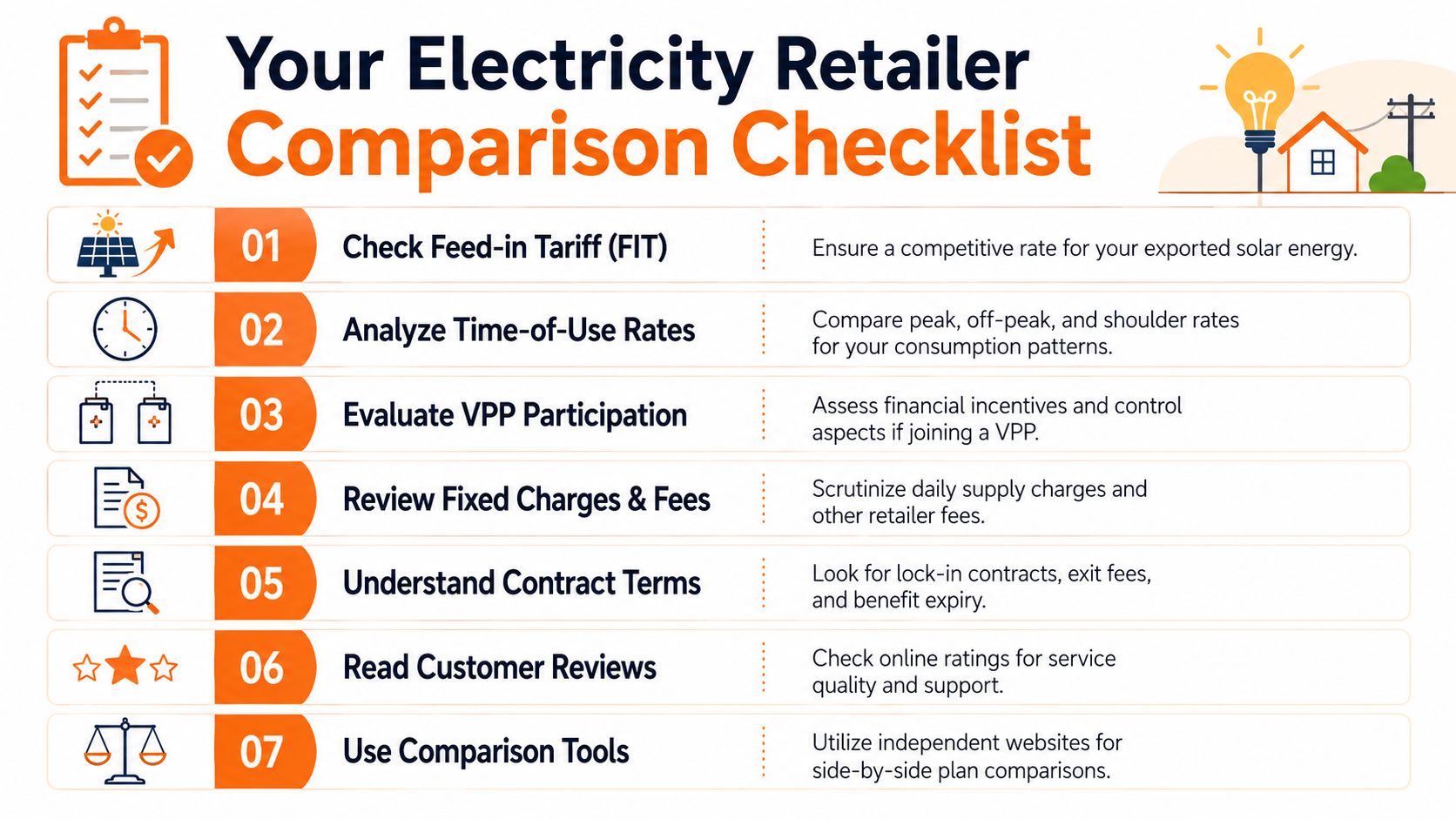
A strong electricity retailer comparison starts with your own data, not with advertised plan headlines.
Start with your real operating pattern
Gather your last year of bills and identify when your home imports most heavily, when your battery empties, and how much solar is exported midday. Annual totals alone won't tell you enough. Timing matters.
Then request your interval data from your distributor or retailer if it isn't already visible. That gives you a half-hourly or similar view of how the site behaves. Without interval data, it's hard to test how a VPP or allowance model would perform against your actual load profile.
Check battery and software fit
Not every battery is compatible with every program.
- Confirm BYOB eligibility. Check whether your battery and inverter are supported without replacement hardware.
- Verify reserve controls. Make sure the product lets you preserve backup energy for the household.
- Review app visibility. Look for live or near-live data, event history, and understandable billing logic.
Compare commercial models, not just rates
Many households often stop too early.
- Model your current plan first. Work out the effective value of self-consumption, export and peak-period imports.
- Test at least two VPP structures. Compare a fixed-credit or traditional VPP against a more performance-oriented or allowance-based model.
- Read the contract carefully. Look for lock-in periods, exit fees, and any clauses that limit battery control or obscure how value is shared.
Treat support and transparency as financial features
A retailer's technology stack isn't cosmetic. If the app is poor, the billing is unclear, or support can't explain battery behaviour, your ability to audit value drops. For battery households, transparency is part of the product.
Practical rule: if you can't explain how the retailer turns your battery into bill value, you probably can't compare the offer properly.
Maximise Your Battery's Value with High Flow Energy
Most battery owners focus on installation quality. Far fewer focus on ongoing performance and optimisation. High Flow Energy is an electricity retailer built around maximizing the full value of your existing solar and battery system.
As a Bring Your Own Battery retailer operating in New South Wales and Queensland, High Flow Energy is designed for households that want more than a standard tariff comparison. Its model focuses on turning spare battery capacity into practical bill value through an intelligent VPP structure, while keeping household energy needs first. The service is built for customers who want transparency, app-based visibility, no new hardware, and no lock-in contracts or exit fees.
If you would like to understand whether your battery is underperforming financially, request an eligibility assessment today.
Frequently Asked Questions
Does joining a VPP affect my battery warranty
It can, depending on the battery maker, inverter setup and how the VPP operates. Check the warranty terms for cycle limits, approved operating modes and third-party control conditions. Ask the retailer to explain how its dispatch approach aligns with manufacturer requirements.
Can I still keep backup power for blackouts
Often yes, but it depends on your hardware and settings. The key issue is whether the battery and software let you maintain a minimum reserve for household use.
Is a high feed-in tariff still important if I have a battery
Yes, but it's no longer the whole comparison. For battery owners, feed-in tariff is only one value stream alongside self-consumption, battery dispatch and possible VPP participation.
How do I get the usage data needed for a proper comparison
Request interval data from your retailer or distributor, or export it from your energy app if available. The more granular the data, the easier it is to compare standard plans against VPP-linked offers.
Are traditional retailer VPPs always safer than newer BYOB models
Not always. A fixed-credit structure may feel simpler, but simplicity and value aren't the same thing. The better choice depends on transparency, control settings, contract flexibility and how the retailer shares upside.
Can I compare VPP offers on government comparison sites alone
Not fully. Government tools are useful for baseline tariff comparison, but they may not capture the full value of battery-linked allowances or other advanced retail mechanics for battery households.
What matters more, tariff rates or VPP design
For homes with a battery, both matter. But if the battery is materially underused, VPP design and value-sharing structure can change the result more than a small tariff difference.
If you already own solar and a compatible battery, your electricity bill shouldn't be assessed like a standard household bill. High Flow Energy is built for battery owners in NSW and Queensland who want to understand whether their current retailer is underutilising their system. Check your eligibility, review your current electricity performance, and see whether a better-optimised VPP structure could improve the value of the battery you already own.