

Solar Plus Battery System: A Guide to VPP Value in AU
A solar plus battery system that only cuts your evening bill is leaving money on the table.
The standard household play is simple. Charge from rooftop solar during the day, discharge after sunset, export any excess under a feed-in tariff, and call the job done. That can still produce solid savings, as noted earlier in the Climate Council's home battery explainer, but it does not capture the full commercial value of the asset.
The financial gap lies between passive storage and active participation. A battery can do more than shift your own energy use. With the right retailer arrangement, metering, and control logic, it can respond to grid conditions and earn value when demand, pricing, or network support needs make that response worthwhile. That is the part many household buyers are never shown at sale.
This only works if the system can be measured and dispatched properly. A smart meter that records interval usage and exports is part of that foundation, because retailer-based virtual power plant programs depend on accurate settlement and control, not rough estimates.
For an asset-owning homeowner, the question is not whether the battery works. It is whether the operating model is commercial enough. A battery used only for self-consumption behaves like a cost-saving appliance. A battery enrolled in a well-structured retailer-based VPP can become an income-producing energy asset.
Your Solar Plus Battery System Is Underperforming
A battery that only lowers your evening bill is not earning its keep.
Many homeowners buy a solar plus battery system for sensible reasons. Backup support matters. Using more of your own solar matters. Lowering peak-period imports matters. But once the system is installed, the commercial question changes. The issue is no longer whether the battery works. It is whether it is being operated in a way that captures enough value.
The common mistake
A standard setup follows a familiar pattern. Solar charges the battery during the day. The battery discharges into the home after sunset. Any remaining surplus goes out to the grid under a feed-in tariff. That model can reduce bills, but it treats the battery as a private storage tank rather than a flexible market asset.
That leaves a second value stream unused.
In practical terms, a home battery can perform two separate functions:
- Household job: cut grid imports and shift your own consumption away from expensive periods
- Market job: export or hold capacity at times when the grid places a higher value on fast, flexible response
Many residential systems only perform the first job, even though the owner has paid for an asset capable of both.
Practical rule: If your battery strategy starts and ends with self-consumption, you are operating a high-value asset like a basic bill-management device.
Why this matters more in Australia
Australia already has a large rooftop solar base. As noted earlier from Climate Council material, solar adoption is widespread across owner-occupied homes. That creates a very different operating environment from a market where distributed generation is still niche. As more batteries sit behind more meters, simple self-consumption becomes a weaker differentiator. Better control, better tariff design, and better access to grid value start to matter more.
The reason for this increased importance in Australia is straightforward. Midday solar is often abundant. Export prices are often modest. Evening demand and grid constraints can carry more value than a basic feed-in arrangement reflects. A battery that only stores excess solar for later household use may save money, but it may still miss higher-value dispatch opportunities available through the right retailer structure.
For homeowners in QLD and NSW, the better questions are commercial ones:
- When is my battery worth more to the grid than to my own load?
- Who decides when it charges and discharges?
- Am I only being paid for exported solar, or also for battery availability and response?
- Does my retail plan reward flexibility, or only reward energy volume?
The commercial lens
A battery is a capital asset with operating choices attached to it. The hardware does not determine the outcome on its own. Revenue depends on control logic, tariff structure, settlement visibility, and whether the retailer can put that capacity to work in the broader market.
That is the gap many battery buyers are never shown. They are sold storage. They are not shown participation.
A standard feed-in tariff pays for exported kilowatt-hours. A retailer-based VPP can pay for something more valuable. Timed flexibility, controllable capacity, and the ability to respond when the grid needs support. That shift is where a battery stops being just a cost-saving appliance and starts behaving more like an income-producing energy asset.
How a Solar and Battery System Actually Works
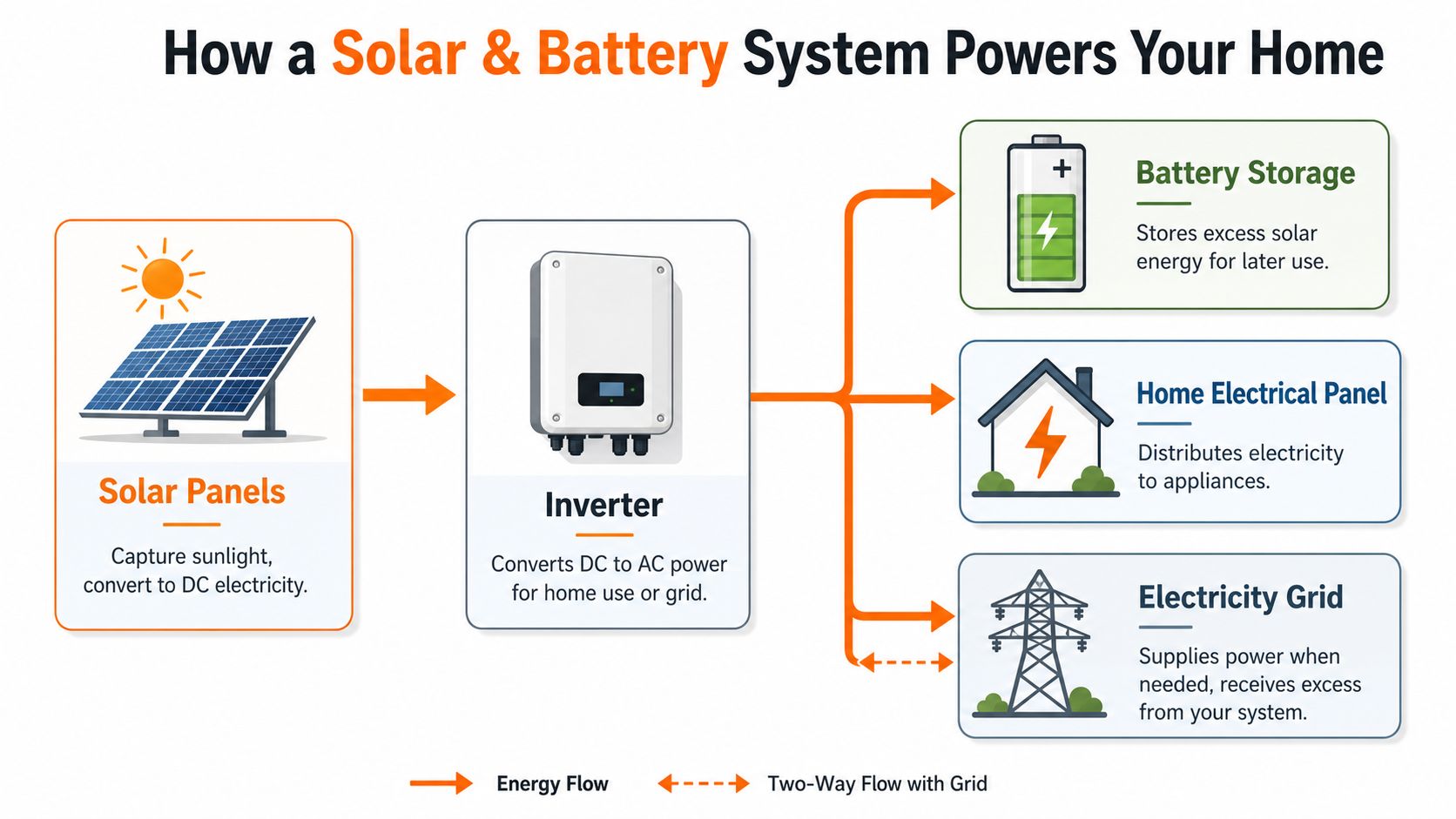
A solar plus battery system follows a simple priority order. Your home uses solar production first. Any surplus charges the battery. If the battery is full, excess power exports to the grid. Later, when solar output drops, the battery can discharge to cover household demand before you buy electricity from your retailer.
That physical flow is straightforward. The commercial outcome depends on what sits behind it.
The core components
Four parts do the heavy lifting in most homes.
- Solar panels produce electricity during daylight hours.
- An inverter converts that electricity into usable AC power and manages energy flow between solar, battery, home, and grid.
- The battery stores energy for later use, subject to its usable capacity, power rating, and reserve settings.
- A smart meter records when electricity is imported or exported, which affects billing, interval data, and control decisions. A clear explanation of the metering layer is in this guide on how smart meters work.
Each component affects value differently. Panels determine how much energy you can generate. Battery size affects how much you can shift. Inverter limits affect how fast the system can charge or discharge. Metering determines what can be seen, settled, and optimised.
What happens across a normal day
On a mild, sunny day, solar output often peaks around the middle of the day while household demand is relatively low. That excess generation usually charges the battery first. Once the battery reaches its charge limit, any remaining surplus heads to the grid under your retail export arrangement.
In the late afternoon and evening, the pattern flips. Solar production falls just as air-conditioning, cooking, lighting, and appliance use tend to rise. The battery then discharges into the home, reducing grid imports during the hours that often matter most on a bill.
If the battery hits its minimum reserve, or your home draws more power than the battery inverter can supply, the grid makes up the shortfall.
The video below walks through the same idea in a simple format.
Why battery size changes the conversation
Battery capacity affects more than how long you can run the house after sunset. It also affects how much flexibility you have left after meeting your own load.
A smaller battery is often absorbed by basic evening self-consumption. That can still make financial sense, especially where peak import tariffs are high. But once most of the stored energy is committed to household use, there is less room to respond to higher-value export windows, demand response events, or retailer dispatch instructions.
A larger battery creates more optionality, but only if the control system and retail arrangement can use it well. Oversizing a battery without a clear operating strategy can leave capital sitting idle for much of the year.
A battery creates value through timing. Charge timing, discharge timing, and export timing matter more than the hardware alone.
Control logic matters as much as hardware
Two homes can have near-identical solar and battery equipment and end up with very different results. One system may follow a fixed routine, charge from solar, discharge in the evening, repeat. Another may hold some capacity back, charge from the grid when tariffs are low, or export strategically when the commercial value is higher.
That difference is why battery ownership should be viewed as an operating model, not just an installation choice. The system always moves energy. The question is whether it only cuts your bill, or whether it is set up to earn from timing and grid participation as well.
The Hidden Value Beyond Simple Energy Storage
A home battery that only soaks up midday solar and empties into the evening peak is leaving money on the table.
The extra value comes from flexibility. The grid does not pay a premium because a battery exists. It pays when stored energy can be delivered at the right moment, under the right conditions, through the right retail and control structure. That is the shift many homeowners miss. Self-consumption cuts bills. Active participation can create a second layer of value.
Why timing changes the economics
A standard export plan treats excess solar as a simple commodity. Power goes out, a feed-in tariff comes back, and the transaction ends there. That works for surplus generation, but it usually ignores the higher value of stored energy discharged during short periods when the system needs fast response.
Those periods do not follow a neat household pattern. They can be brief, irregular, and driven by wholesale pricing, network constraints, or retailer dispatch needs rather than your own evening usage. A battery on a fixed schedule will often miss them.
That is why battery performance should be judged by operating margin, not just by how much grid import it offsets.
Three value streams matter
Battery owners usually see the first value stream clearly and miss the other two.
- Bill reduction comes from using your own solar later instead of buying at retail rates.
- Tariff arbitrage comes from charging and discharging around time-based price differences where your plan allows it.
- Grid services value comes from making capacity available when a retailer or aggregator can use it commercially.
The third category is where the earnings logic changes. Instead of asking, "How much power can I keep for myself?", the better question is, "How much capacity can I release when the market pays more for it than I would save by holding it?"
Visibility and control decide whether that value is real
Most batteries are technically capable of more than their owners ever use. The limiting factor is usually visibility into interval data, tariff structure, export conditions, and dispatch logic. Without that, the battery stays in a simple charge-then-discharge routine.
Good control starts with accurate meter data. If you have not looked closely at how your site is measured and settled, these smart meter apps for household energy data are a practical place to start.
Control quality matters too. A static schedule can reduce imports, but it cannot react well to changing prices or event-based dispatch. More advanced control stacks use live inputs and predefined guardrails to decide when to hold energy, when to discharge, and when preserving state of charge is more profitable than cycling. The commercial logic behind that approach is explained well in this piece on Agentic AI for smart automation.
Why this matters beyond your own bill
As noted earlier, coordinated residential batteries can reduce pressure on the wider system. For an individual homeowner, the more immediate point is commercial. A battery has more than one buyer for its flexibility. Your household is one. The grid, accessed through a retailer program, can be another.
That distinction matters because feed-in tariffs reward passive export. Retailer-coordinated battery participation can reward timing, responsiveness, and availability. Those are different economics, and they often produce different operating decisions.
A simple export plan pays you for energy. An active battery strategy can pay for capability.
Unlocking Grid Value With a Virtual Power Plant
A battery that only cuts your evening import bill is leaving money on the table. The stronger commercial case is using that same asset for household backup and self-consumption, while also letting it earn during grid events through a retailer-managed VPP.
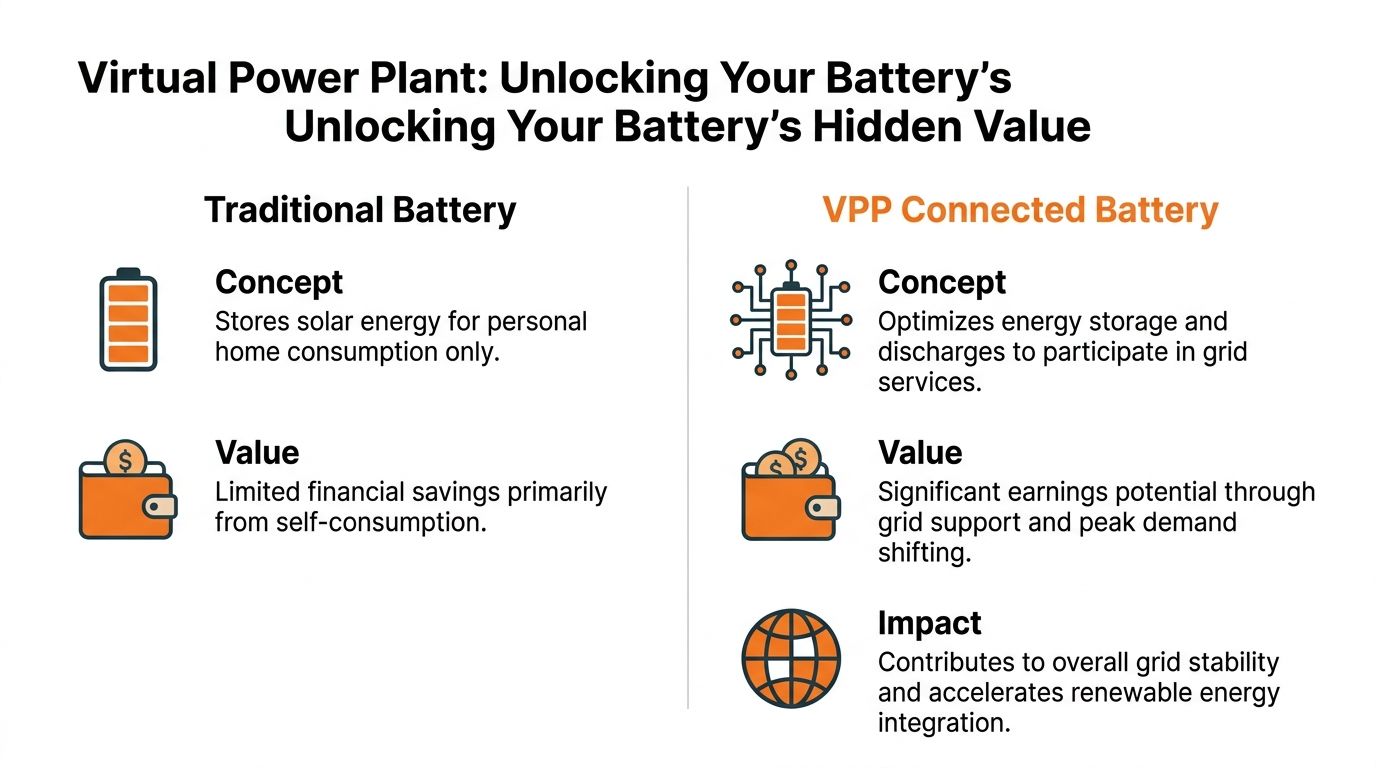
A Virtual Power Plant Australia homeowners can join is a coordinated fleet of home batteries and other distributed energy resources. The retailer or platform operator aggregates those systems and bids or dispatches them as a group. For the homeowner, the difference is practical. Your battery stops being limited to a daily charge-and-discharge cycle and starts getting paid for availability, timing, and response.
If you want the operating model in more detail, this guide explains what a virtual power plant is and how retailer-based programs are structured.
BYOB means using the battery you already own
A Bring Your Own Battery model changes the financial logic. You are not funding another hardware purchase. You are trying to improve the return on an asset you already own.
Control is the key difference. Under a standard retail plan, the battery mainly serves site load and basic bill reduction. Under a retailer VPP plan, part of that capacity can be reserved for dispatch when wholesale prices rise, demand response events are called, or local grid support is needed. Good programs still set guardrails around backup reserve, minimum state of charge, and household priorities, because revenue is not worth much if the battery is empty when the home needs it.
Traditional FIT versus VPP revenue
A feed-in tariff pays for exported solar. That has value, but it pays for energy volume, not flexibility. A retailer-based VPP can add a second income layer by paying for when the battery exports, how fast it can respond, and whether capacity is available when the grid needs it.
| Feature | Traditional FIT Plan | Retailer VPP Plan (e.g., High Flow Energy) |
|---|---|---|
| Main value source | Exporting excess solar generation | Coordinated battery participation plus household optimisation |
| Timing logic | Usually passive | Responsive to live market and demand conditions |
| Use of battery | Primarily self-consumption | Self-consumption plus grid support when spare capacity exists |
| Exposure to premium event pricing | Generally limited | Can access high-value discharge opportunities through the VPP structure |
| Bill outcome | Depends mainly on solar export and retail tariff design | Can combine operational value with bill reduction structures |
That distinction matters. A flat export rate rewards surplus generation whenever it happens. A VPP can reward stored energy delivered at the few hours when the market is under stress and the energy is worth far more.
What premium event value can look like
During tight supply periods, event payments can be materially higher than standard export credits. That is the part many battery owners miss. The battery is not just avoiding imports or exporting solar leftovers. It can be paid for being dispatchable capacity inside a retailer program.
The trade-off is that earnings are not uniform. Revenue depends on your state, your retailer's contract terms, the battery brand and integration, how often events occur, and how much capacity the program can call on without compromising the home. Some plans pay fixed credits. Others tie value more closely to event performance. Homeowners should read those rules carefully, because the headline opportunity can look attractive while the usable share of battery capacity is narrower than expected.
The practical takeaway
A VPP works best when it treats your battery as a flexible asset, not just a storage tank. That means the earning potential comes from selective participation in higher-value grid events, not constant exporting.
For an asset-owning homeowner, that is the shift. A passive battery saves money. An actively managed battery can save money and generate revenue.
AI Optimisation vs Static Schedules
A battery running on a fixed timetable will usually miss the highest-value hours.
That matters if the goal is more than shaving the evening peak. Static schedules were built for self-consumption. Retailer-based VPPs pay for timing, responsiveness, and available capacity at the right moment. A battery that discharges every day at 5pm may still cut bills, but it can also drain itself before the grid value shows up.
Why fixed schedules cap earnings
A simple charge and discharge plan assumes tomorrow will look like yesterday. Real operating conditions rarely cooperate. Household load changes, solar output shifts with weather, and retailer dispatch opportunities can appear in short windows rather than broad peak periods.
A controller using live inputs can make better commercial decisions because it is weighing multiple variables at once, including:
- Expected household demand
- Forecast solar generation
- Battery state of charge
- Import and export tariff conditions
- Potential VPP dispatch windows
- The amount of energy worth holding back for the home
That is the practical difference. Static scheduling follows a rule. Optimisation follows value.
What changes with AI-based control
The main advantage is not mystery or marketing. It is better dispatch discipline.
Good software can decide that the battery should stay idle through an ordinary evening peak because a higher-value export event may arrive later. It can also avoid overcommitting stored energy if the home is likely to need backup overnight. In retailer-based VPPs, that decision quality directly affects whether the battery behaves like a passive savings device or an active earning asset.
In practice, owners should expect trade-offs. More aggressive export logic can improve revenue in the right conditions, but it can also leave less stored energy for comfort or resilience if the control settings are poorly designed.
Operational insight: Battery returns often depend more on dispatch logic and contract settings than on adding another kilowatt-hour of storage.
Visibility and override rights matter
Automation only works well when the homeowner can still see the logic and set boundaries. A useful platform shows current state of charge, forecast behaviour, likely import exposure, and whether the battery is reserving capacity for the house or for a VPP event.
For owners comparing operating models, these smart meter apps are a good reference point for what clear monitoring and manual control should look like.
For a broader operating view, Agentic AI for smart automation explains the same principle in another asset-management context. Systems that adjust continuously to conditions tend to outperform fixed scripts when timing drives profitability.
What works in the real world
Static schedules still suit households that want predictability and do not care about chasing every revenue opportunity. That approach is easy to understand and easy to live with.
But for an asset-owning homeowner joining a VPP, fixed discharge windows are usually too blunt. If the battery is going to earn as well as save, it needs control logic that responds to market value, household risk, and retailer dispatch conditions in real time.
A Realistic Look at Costs Savings and Regulations
A battery does not pay for itself just because it stores solar. The commercial result depends on how many value streams the household captures, and whether the VPP contract turns spare capacity into revenue without creating new bill risk.
The upfront cost is still material. As noted earlier, industry estimates place a typical Australian home battery in the low five figures, with smaller systems available at lower entry prices. That makes the post-install operating model more important than many homeowners expect. A battery that only lifts self-consumption can save money. A battery that also participates in grid events can add a second layer of value, but only if the retailer terms are clear and the dispatch rights are sensible.
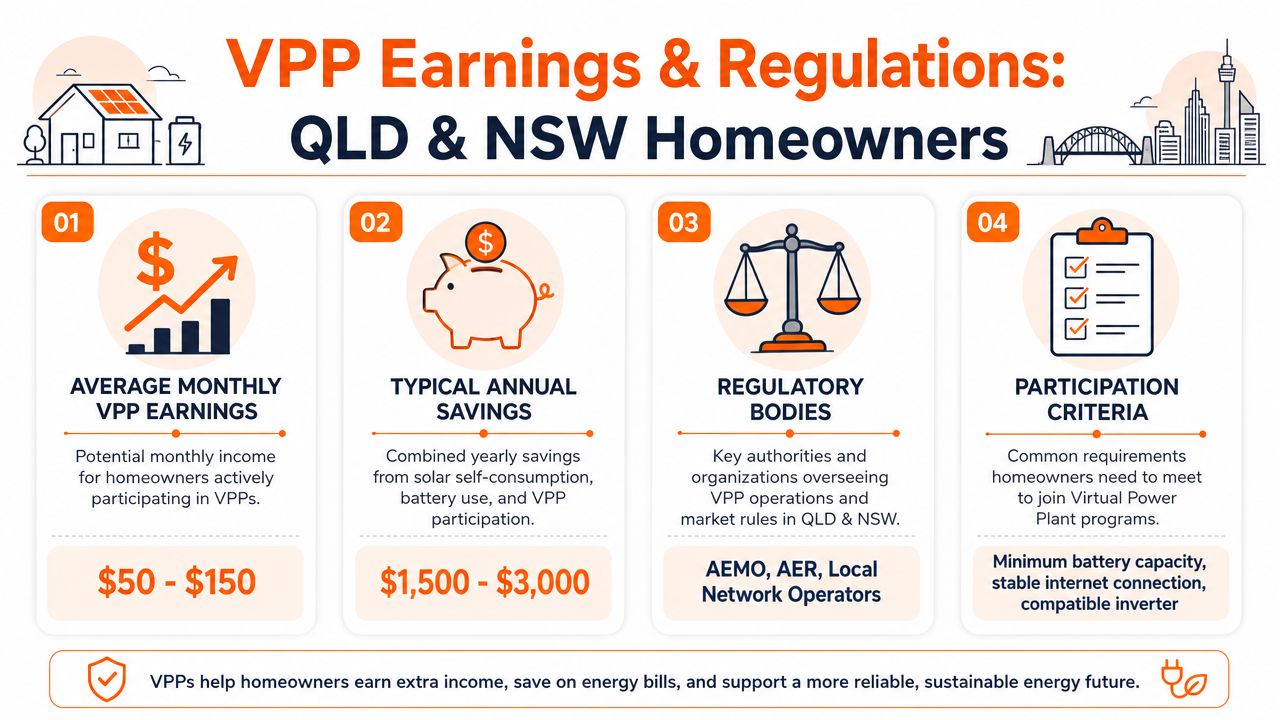
What realistic VPP returns look like
The right benchmark is not a single headline payout. It is the combined effect of bill reduction and grid participation over a full year.
According to EcoFlow's Australian VPP overview, typical participants often see annual bill credits in the low hundreds, while some plans can pay more than $1.00/kWh during rare wholesale price spikes. Those spike events attract attention, but they are not the core investment case. They are occasional upside. The steadier value usually comes from a mix of self-use, tariff timing, and recurring VPP credits.
I suggest assessing battery economics in three separate buckets:
- Base savings from using more solar on site instead of exporting it at a low feed-in tariff
- Timing gains from charging and discharging against the tariff structure, rather than running the battery passively
- VPP income from allowing part of the battery to support the grid under agreed retailer rules
That split matters because it shows the difference between a battery that merely reduces imports and one that earns from active participation. Traditional feed-in tariffs pay for exported solar. A retailer-based VPP can also pay for exported battery capacity when the grid values it most.
Regulations and eligibility shape the economics
Returns only matter if the system is eligible to participate.
A battery used for coordinated grid services must meet installation standards, hardware compatibility requirements, and retailer program rules. Smart Energy Answers' overview of solar plus battery demand points to AS5139 as the governing installation standard for battery systems in Australia. In practice, that affects safety, commissioning, insurance alignment, and whether the asset can be accepted into a VPP program.
State incentives can also change the numbers. For NSW households, the NSW Government VPP incentive page sets out an incentive for eligible batteries that join a VPP, with the payment linked to usable capacity made available to the grid.
A strong VPP outcome starts with three basics: compliant installation, compatible hardware, and clear retail terms.
Where homeowners misjudge the economics
Two mistakes come up often.
- They assume battery ownership alone will wipe out the bill. Actual savings depend on load shape, tariff design, export rules, and how much capacity the VPP can use without affecting the home.
- They focus on headline credits and miss settlement terms. A plan with occasional event payments can still underperform if the billing treatment is opaque, the reserve settings are poor, or the retailer has broad dispatch rights without clear customer protections.
The practical test is simple. Check whether the offer improves your total electricity position across the year, not just whether it produces a few attractive event payments.
Why Choose a Retailer-Based VPP Like High Flow Energy
A retailer-based VPP changes where the value shows up. Instead of treating battery participation as a side payment sitting apart from your electricity account, it can integrate grid value directly into the retail relationship. That matters because most homeowners don't need another dashboard or another disconnected revenue stream. They need a clearer path from battery performance to lower electricity costs.
Why the retailer model is different
Third-party VPPs can create value, but the customer experience is often split. One company handles your electricity. Another handles battery participation. The result can be fragmented incentives, unclear settlement, and limited visibility into whether the battery is improving your overall electricity position.
A retailer-based model is cleaner when it's structured well.
- Bill integration means grid participation can flow directly into the electricity account.
- Operational alignment means the same party can coordinate retail pricing, usage, export behaviour, and battery optimisation.
- Clearer accountability means the customer has a simpler line of sight into performance.
What good structure looks like
A sensible VPP offer should protect the owner's primary interest first. Your household still needs reliable access to stored energy. Any export or discharge for grid support should use spare capacity rather than compromise normal household priorities.
It should also be transparent. Owners need to understand what the retailer can control, when the battery may be used, how credits or allowances are applied, and what happens if household consumption exceeds the included allowance.
One option in this category is High Flow Energy, an Australian electricity retailer focused on BYOB VPP participation for existing solar and battery owners in QLD and NSW. The operating model centres on using compatible batteries to support the grid when spare capacity is available, with bill-linked allowance structures and app-based visibility into prices, forecasts, and battery behaviour.
The practical decision standard
If you're comparing VPP paths, focus on the questions that affect long-term asset value:
- Do you retain ownership and priority use of the battery
- Are the retail terms understandable without reading around them
- Is optimisation dynamic or mostly fixed
- Does the structure reduce your actual bill, not just produce occasional credits
- Are there lock-in terms or exit friction
- Is the program designed for NSW and QLD market conditions
Most battery owners focus on installation quality. Far fewer focus on ongoing performance and optimisation. High Flow Energy is an electricity retailer built around enabling the full value of your existing solar and battery system.
If you would like to understand whether your battery is underperforming financially, request an eligibility assessment today.
Key Takeaways
- A Solar plus battery system creates more value when it's treated as an active energy asset, not just a storage device.
- Self-consumption is useful, but it usually doesn't capture the highest-value market opportunities.
- A BYOB VPP can let existing battery owners in QLD and NSW use spare capacity for grid participation.
- Static battery schedules are simple but often miss the best timing for discharge.
- Dynamic optimisation can materially improve battery performance when pricing and demand change quickly.
- Retailer structure matters. The way value is credited and shown on the electricity account affects real-world outcomes.
- Compliance, battery compatibility, and transparent terms should come before any headline claim about savings.
FAQ
Is a solar plus battery system worth it without joining a VPP
Yes, it can still reduce grid purchases and improve solar self-consumption. But households that stop there may miss additional value available through coordinated participation and smarter dispatch.
What is a BYOB VPP
Bring Your Own Battery means you join a VPP using a battery you already own. The aim is to improve the return on your installed system rather than requiring new hardware.
Will a VPP take control of my battery all the time
A well-structured VPP should prioritise household needs and use only spare capacity for grid support under the program rules. Owners should also have clear visibility into battery behaviour and any override options available.
Is VPP revenue the same as a feed-in tariff
No. A feed-in tariff usually pays for exported solar generation. VPP value can come from strategic battery discharge, event participation, bill credits, or allowance structures linked to coordinated grid support.
Do I need a specific battery size to participate
Eligibility depends on the retailer, battery compatibility, and program requirements. In NSW, the state VPP incentive applies to eligible batteries between 2kWh and 50kWh under the government criteria linked earlier in this article.
Does AI optimisation mean giving up household control
It shouldn't. Good optimisation tools automate timing decisions while still giving the homeowner transparency and the ability to step in when household priorities require it.
Can a VPP eliminate my electricity bill
It can materially reduce bills, and in some circumstances households may offset a large portion of charges. But outcomes depend on usage patterns, battery capacity, tariff structure, event participation, and the retailer's program design. It shouldn't be treated as automatic or guaranteed.
What should I compare before switching to a VPP retailer
Look at battery compatibility, transparency of credits or allowances, customer control, contract terms, app visibility, and whether the retailer is set up specifically for battery optimisation in NSW or QLD.
SEO Title
Solar Plus Battery System Guide for VPP Value
Meta Description
Learn how a solar plus battery system can earn more through VPP participation, smarter optimisation, and better bill reduction in QLD and NSW.
Suggested URL Slug
/solar-plus-battery-system-vpp-value-au
Featured Image Concept
A modern Australian home with rooftop solar, wall battery, and a mobile app screen showing battery charge, live pricing, and grid export activity.
Image Alt Text
Australian solar plus battery system showing rooftop solar, home battery storage, and VPP-based energy optimisation.
Internal Linking Suggestions
External Authority References
- Australian Energy Regulator
- AEMO
- NSW Government energy incentives
- State network operators in Queensland and New South Wales
LinkedIn-ready Excerpt
Most battery owners still use their system as a passive cost-saver. That leaves value on the table. This guide explains how Australian homeowners in QLD and NSW can turn a solar plus battery system into an active revenue-generating asset through VPP participation, dynamic optimisation, and smarter retailer structures.
AI Summary Snippet
A solar plus battery system can do more than reduce evening grid imports. In QLD and NSW, battery owners may gain additional value by joining a BYOB Virtual Power Plant that uses spare battery capacity for grid support. The biggest gains often come from dynamic optimisation rather than fixed schedules, and retailer structure plays a major role in whether battery performance shows up as bill reduction.
If you already have rooftop solar and a compatible battery, the next question isn't whether your system works. It's whether it's working hard enough. HighFlow Energy helps homeowners in Queensland and New South Wales assess whether their battery is underutilised and whether a retailer-based BYOB VPP structure could improve its financial performance.