Environmental Certification: A Guide for Australian
When a Queensland homeowner sees a label that says environmental certification, does it tell them anything useful about a battery, a retailer, or a Virtual Power Plant, or is it just another green badge on a website?
The answer depends on what has been certified, who checked it, and whether the claim is tied to a standard you can verify. In practice, environmental certification can describe an organisation, a product, a building, or a supply chain, and each of those means something different when you're comparing energy services, solar-related products, or a VPP offer.
What Environmental Certification Means
Why does one label deserve trust while another is just a marketing claim?
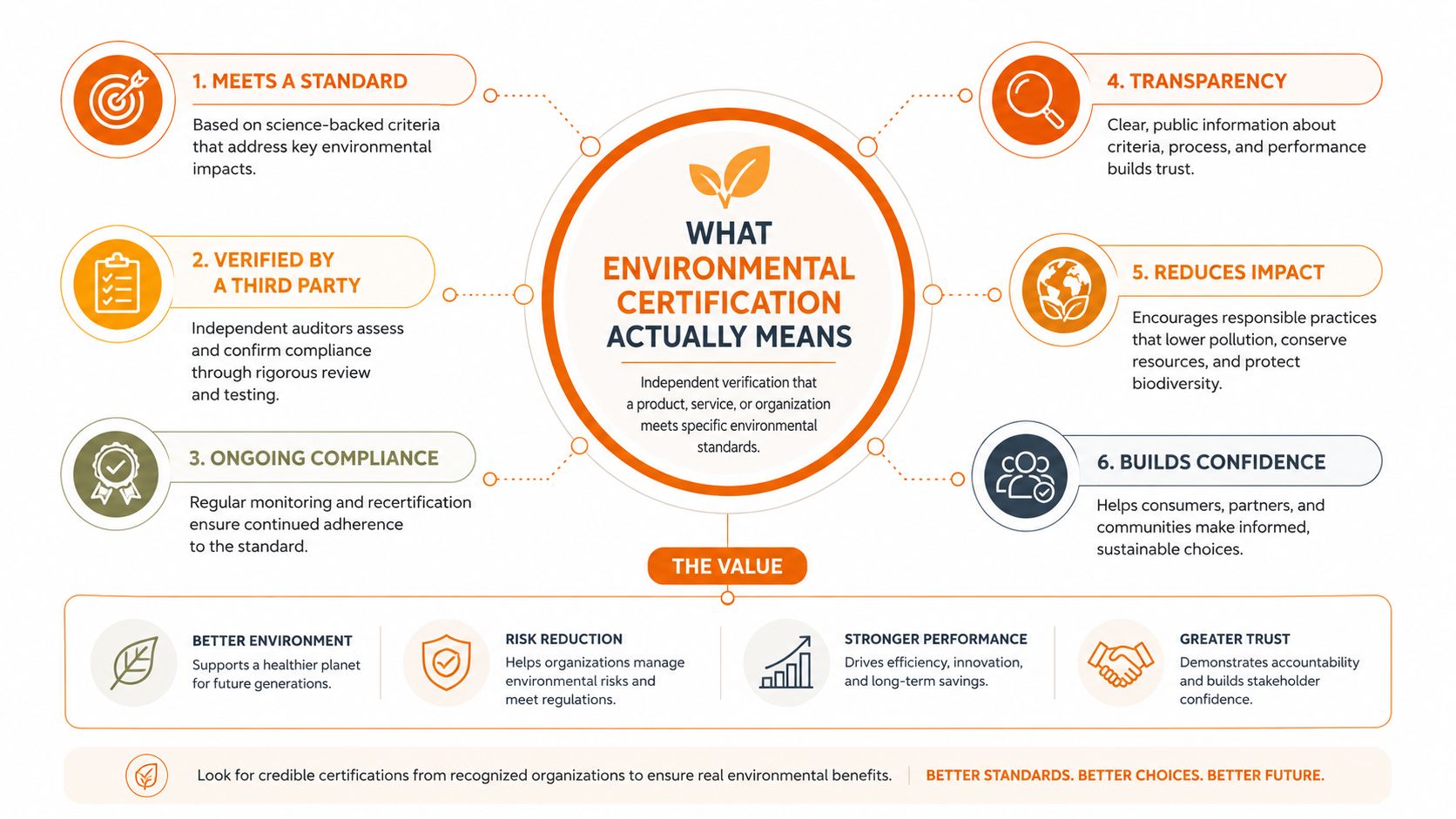
In plain English, environmental certification is a third-party check that says a product, process, building, or organisation meets a recognised environmental standard, rather than relying only on its own promotional wording.
The difference between a claim and a certification
A claim can be broad and self-declared. A certification should be tied to named criteria, an audit process, and a scheme owner. That distinction matters because ISO 14001 is the only certifiable standard in the ISO 14000 environmental management family, and it is built around a continual-improvement environmental management system applied across an organisation's activities, products, and services, not a vague promise to be greener. ISO 14000 family overview
For a Queensland or NSW homeowner comparing solar gear, battery offers, retailer pages, or a Virtual Power Plant, the useful question is simple, certified to what standard? A statement like “we're environmentally responsible” tells you almost nothing. A statement tied to a recognised scheme gives you something you can check.
The same habit helps when a product page leans on test language without showing the paper trail. A practical starting point is to verify SGS test results through an independent source trail, not by taking a logo at face value. That approach matters whether you are checking a home-energy product, a battery program, or a wider sustainability claim.
For energy services, certification can also intersect with retailer comparisons. If you are reviewing claims about cleaner supply or greener options, a useful reference point is how to compare Australia's greenest energy providers, because the label only matters if you can trace what it verifies.
Practical rule: if the wording is broad but the standard is missing, treat the claim as marketing until proven otherwise.
The Main Types of Environmental Certification Explained
The easiest way to avoid confusion is to sort certification into categories. Once you do that, the label on a product or retailer page becomes easier to read. A management system, a product label, a building rating, and a supply-chain certificate all answer different questions.
A simple comparison
| Type | What it verifies | Who issues it | Typical scope |
|---|---|---|---|
| Environmental management system | How an organisation manages environmental risks and continual improvement | Independent certifier | Whole organisation |
| Type I product label | Product performance against predefined environmental criteria | Third-party scheme body | Specific product or product group |
| Building rating | Design, operation, or performance of a building | Rating body or certifier | Building or project |
| Supply-chain certification | Traceability and verified sourcing through the chain | Independent certification system | Materials, sourcing, custody |
Type I product labels are especially important because Type I environmental labels under ISO 14024 are built on third-party verification plus life-cycle-based criteria, with predefined, multi-attribute criteria rather than self-declared attributes such as eco-friendly or green. ISO 14024 standard That means the claim has to be checked against criteria set in advance, rather than a company deciding for itself that the product sounds sustainable.
For homeowners, the key question is scope. A building label can say a lot about energy or water performance, but not necessarily about the retailer supplying your electricity. A supply-chain label can say something about materials, but not about your household bill. A management system can show that a company has controls in place, but it won't automatically tell you the actual impact of every service it sells.
The Australian market already uses these distinctions in practice. For a useful local reference point on how environmental claims show up in energy choices, compare the broader market context in finding Australia's greenest energy provider.
Why Certification Matters for Australian Homes
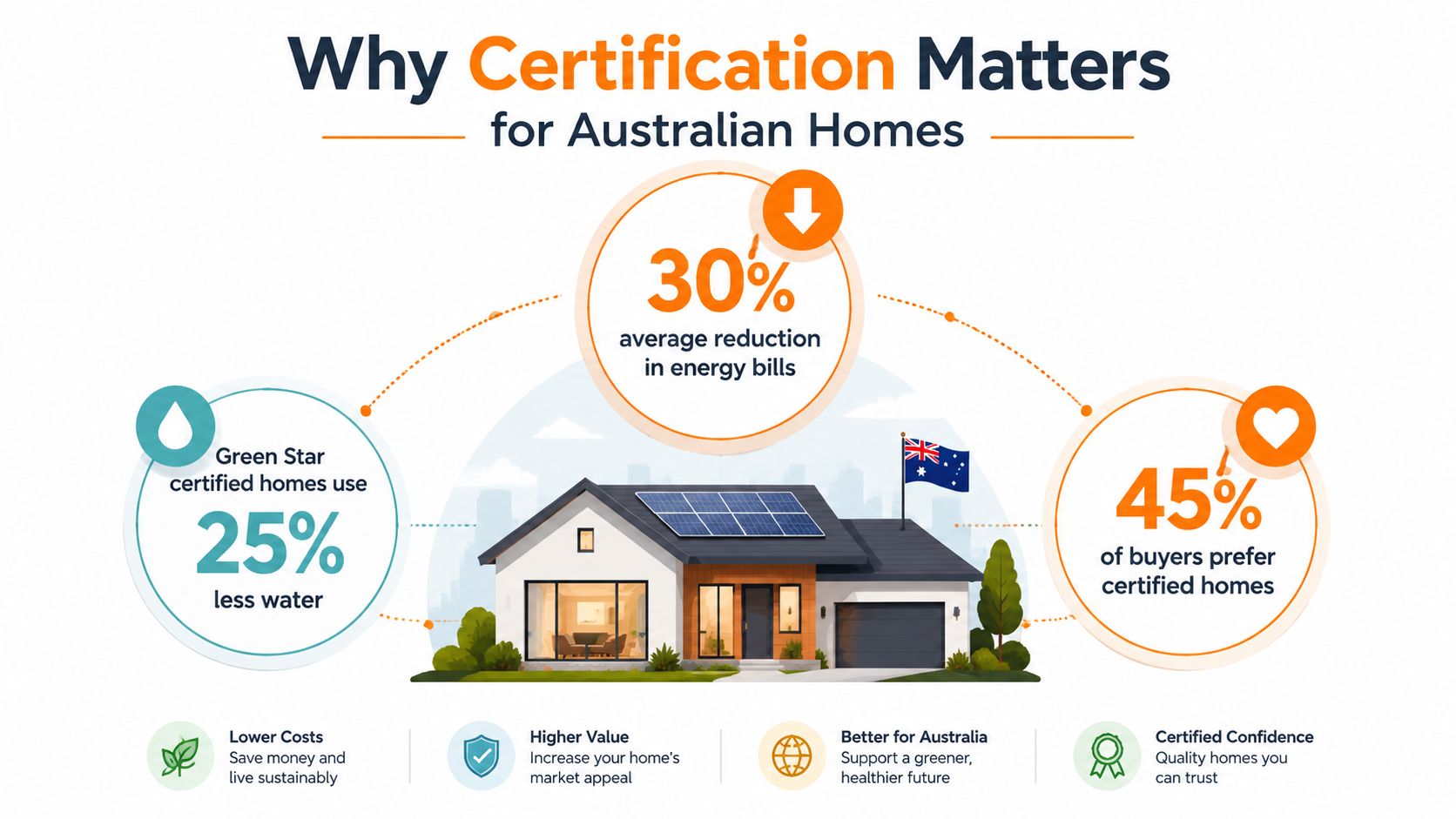
For a Queensland or NSW homeowner, certification matters because energy decisions aren't made in a vacuum. You're comparing retailers, VPP offers, battery programs, and sometimes products that all use environmental language differently. Some claims are about management. Others are about assets, buildings, or supply chains.
Why the signal is getting louder
Environmental certification isn't fringe anymore. Global building certification data show more than 372,000 residential and non-residential buildings certified worldwide in 2024, a 28% increase from 2022 to 2024, which shows the market has moved toward mainstream proof mechanisms for sustainability outcomes. Global building certification data That doesn't make every badge meaningful, but it does explain why buyers now expect evidence.
Australian building performance gives the same message. Green Star certified buildings reportedly produce 62% fewer greenhouse gas emissions than average Australian buildings and use 51% less potable water, with cumulative savings equating to about 625,000 tonnes of CO2 per annum. Green Star environmental benefits Those figures are about buildings, not home batteries, but they show why certification has become a serious market signal in Australia.
What a homeowner should ask
A certification label becomes useful when it answers a decision question. Does it cover the retailer's operations? Does it cover the device in your garage? Does it cover the service that dispatches your battery into the grid? If the answer is yes, the claim has some practical value. If the answer is unclear, the badge is less useful than it looks.
Certification is most useful when it narrows uncertainty. It's least useful when it sits there without a scope statement.
That's especially relevant for households evaluating energy retailers, because a label on a website doesn't always tell you whether the claim applies to the product you're buying, the company behind it, or some unrelated part of the business. The more tightly the certification links to your actual home-energy decision, the more it matters.
Where Environmental Certification Falls Short
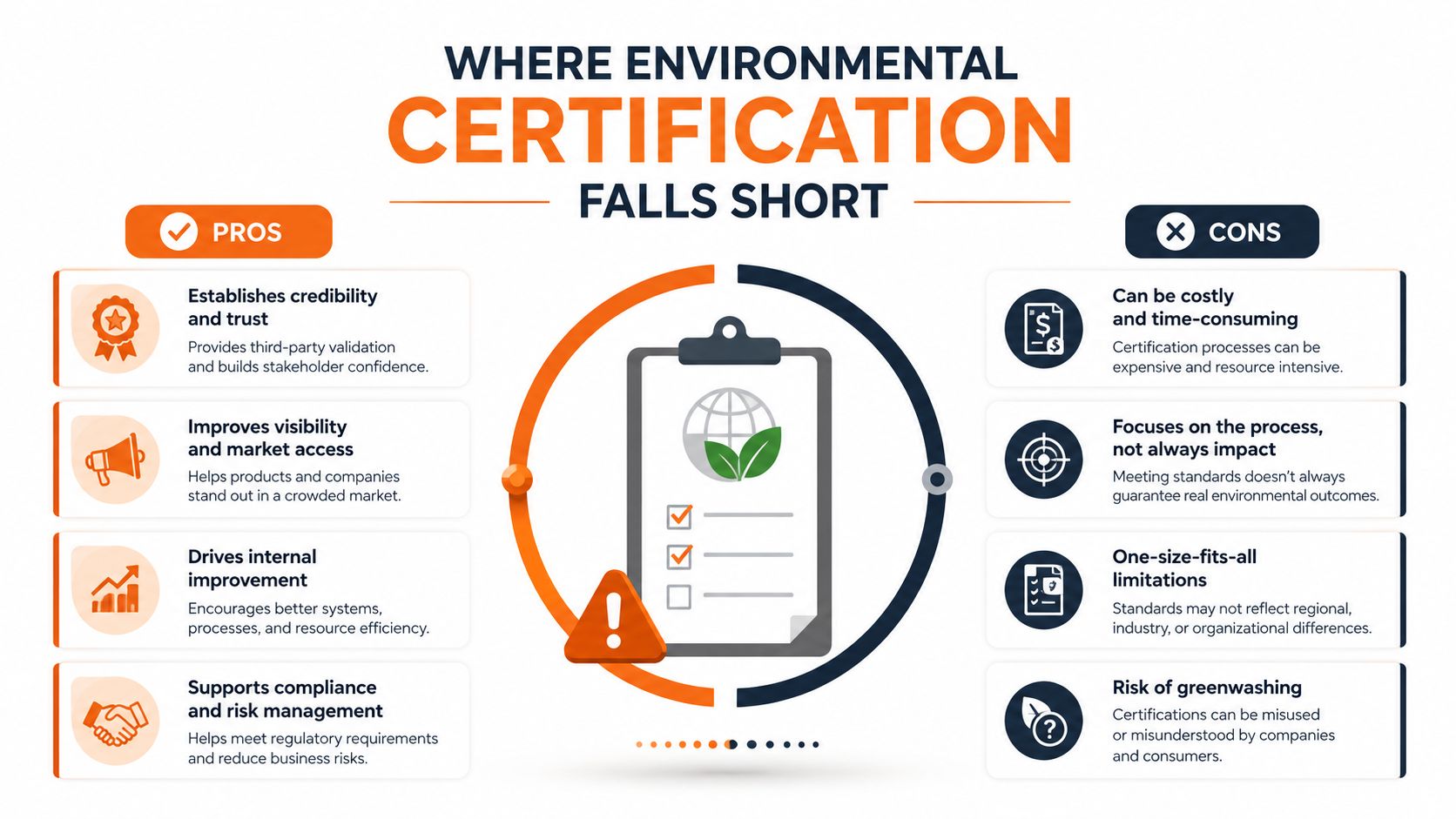
Certification can help, but it doesn't automatically prove deep environmental performance. That's the part many glossy pages leave out. A badge can mean a company has a system, a process, or a verified product attribute, while the actual environmental outcome may still be limited or narrow.
What the evidence says
A major evidence review of sustainable certification identified only 14 methodologically credible studies, and just 6 of those found environmental or socioeconomic benefits, leading the authors to conclude that empirical evidence for significant benefits is limited. Environmental certification evidence review That's a caution against treating certification as automatic proof of impact.
A separate review from the Global Environment Facility and STAP found a similar pattern, with 8 of the 14 most rigorous studies finding no observable impact, and the review stating that the evidence for improved environmental outcomes is very weak. STAP environmental certification review In plain terms, certification may improve accountability, but it doesn't guarantee that every certified operation delivers the environmental gains people assume.
Scope is where people get caught
One of the most most common mistakes is to assume one certificate covers everything. It usually doesn't. A scheme might cover energy use, while saying little about water, sourcing, embodied carbon, or product end-of-life. That's why the key question is not whether something is certified, but what exactly is covered.
An Australian homeowner should be careful with any claim that sounds broad but points to a narrow standard. A retailer might have one certified management system while the service itself relies on separate commercial terms, network rules, and dispatch arrangements. A battery product might have a relevant product certification, while the financial logic of a VPP depends on a totally different set of controls.
Bottom line: certification reduces uncertainty, but it doesn't replace reading the scope.
Five Checks to Verify Any Environmental Claim
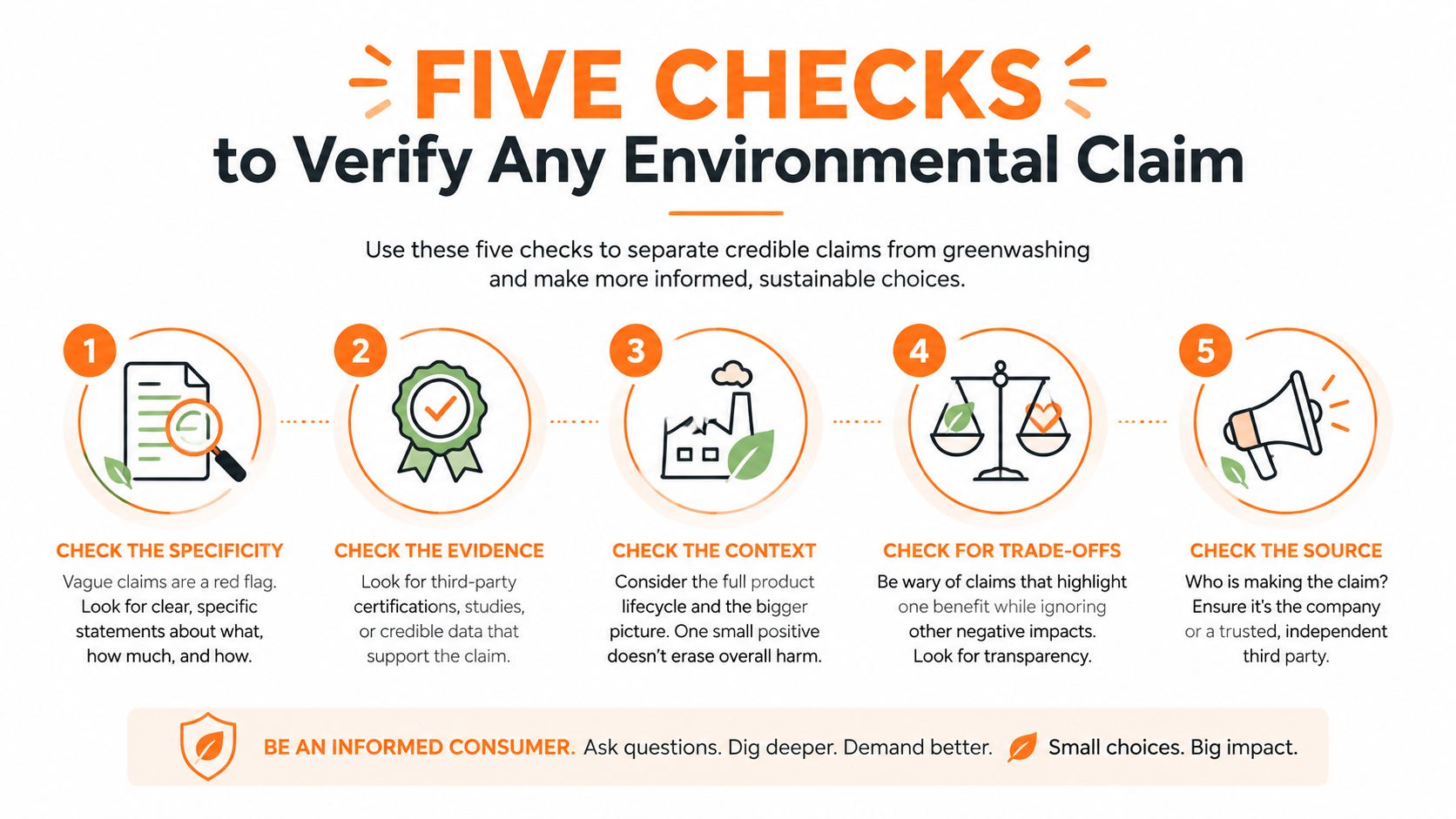
A good environmental claim should survive five checks. If it fails even one, you should slow down and ask more questions. A homeowner can move from passive trust to active verification.
The five checks
Name the standard.
If the scheme isn't named, the claim is too vague. A proper label should tell you whether it's ISO-based, a building rating, a product label, or a supply-chain system.Check who did the verification.
Independent third-party verification matters because self-assessment doesn't carry the same weight. If a provider can't name the certifier or the accreditation path, keep digging.Read the scope statement.
The scope outlines what is included and what is not. For a battery or VPP offer, it might cover company operations but not the financial effect of your household participation.Look for ongoing evidence.
One certificate issued years ago is weaker than an active reporting trail. A dashboard, audit record, or current compliance document is more persuasive than a static badge.Cross-check against Australian authorities.
When the claim touches energy, networks, or retailer conduct, compare it with the applicable Australian framework and regulator guidance, rather than relying on the promotional page alone.
The practical habit here is simple. When you see a green claim tied to solar, batteries, or a VPP, ask what you would need to see if you were challenged on that claim in a dispute. If the answer is “just the badge,” the claim is thin.
You can also make verification easier by looking for structured reporting tools. A practical example is a performance reporting dashboard, which can help a homeowner track what's happening rather than relying on a slogan.
Using Certification Literacy to Choose Better Energy Services
Certification literacy is useful because it changes how you compare offers. Instead of asking whether a retailer or VPP sounds green, you can ask what part of the service is certified, what part is only claimed, and what part is only commercial positioning. That's a much better way to compare a battery program in Queensland or NSW.
What matters for different parts of the offer
For the retailer's own operations, an ISO 14001 certificate can show that there's an environmental management system in place, but it doesn't automatically tell you how your battery will be dispatched or how your bill will change. For the hardware, product-level certification is more relevant, because that's where manufacturing and product attributes are checked. For the VPP service itself, the important issue is whether the claims are backed by real operating data and a clear scope statement.
That matters because a battery owner still owns the battery. Certification doesn't transfer ownership, and it doesn't replace the household's priority use of stored energy. The central question is whether the program structure supports your home first, then uses spare capacity for grid support under the relevant rules.
One option in the Australian market is HighFlow Energy, which operates as an electricity retailer for homeowners with rooftop solar and a compatible home battery, connecting spare battery capacity into a Virtual Power Plant structure. The service proposition is about using existing assets more efficiently, not about selling hardware.
Practical rule: a certified claim about the retailer is not the same thing as a verified claim about the battery dispatch model.
A comparison mindset for homeowners
When you compare offers, separate them into three buckets.
- Retailer credibility: Does the company have an environmental management standard or equivalent internal controls?
- Service integrity: Does the VPP or battery program show auditable performance, clear dispatch rules, and transparent billing?
- Product or asset proof: Does the battery, building, or related equipment carry a recognised certification that fits the claim being made?
That way, you don't over-credit a single badge. A strong-looking sustainability page can still hide unclear scope, while a modest page with tight evidence can be more trustworthy.
For households weighing offers, a structured electricity retailer comparison can be more useful than a slogan-led landing page, because it forces the relevant distinctions into view.
Key Takeaways and What to Ask Next
Environmental certification is useful, but only when you know what's being certified, who checked it, and what scope it covers. The strongest approach is to treat it as one input in a decision, not as a finish line. In Australia, that matters for homes with solar and batteries because energy offers often mix product claims, retailer claims, and service claims in the same pitch.
The main things to remember are simple. First, certification comes in different forms. Second, some schemes verify management systems, while others verify products, buildings, or supply chains. Third, the evidence base is mixed, so you still need to check scope and current reporting. Fourth, verified environmental outcomes matter more than polished wording.
FAQ
Does environmental certification reduce greenwashing risk?
Yes, but only if the certification is independent, current, and tied to a clear scope. A badge without verification details doesn't solve the problem.
Can a home battery be environmentally certified?
A battery can carry relevant product certification or be part of a broader certified scheme, but the exact meaning depends on the standard. The certificate needs to match the claim.
What should I look for in a VPP that claims to be green?
Look for a clear explanation of what is certified, what is audited, and how the service is monitored. Also check whether the claim refers to the retailer, the program, or just the branding.
How does the National Electricity Market affect these claims?
The market rules shape what a retailer or VPP can do with your battery, so any claim about grid services should sit inside that regulatory context, not outside it.
If a company has ISO 14001, does that mean its energy product is sustainable?
No. It means the organisation has a certified environmental management system. The product or service still needs separate scrutiny.
Global building certification data show more than 372,000 residential and non-residential buildings certified worldwide in 2024, a 28% increase from 2022 to 2024, which is a good reminder that certification has become mainstream, but also more crowded. Global building certification data The more crowded the market gets, the more important it becomes to read the scope instead of the slogan.
Most battery owners focus on installation quality. Far fewer focus on ongoing performance and optimisation. High Flow Energy is an electricity retailer built around the full value of your existing solar and battery system. If you want to understand whether a certification-backed energy offer is improving your household outcome, visit HighFlow Energy and request an eligibility assessment.