


Virtual Power Plant Software Explained for Homes
You've invested in rooftop solar and a home battery, yet your battery may still be sitting idle during valuable market periods. It might charge when the sun is available and discharge when your household needs power, but that basic routine doesn't account for wholesale price volatility, demand events, network constraints or the value of coordinated grid support. Virtual power plant software provides the missing coordination layer, turning compatible household batteries into part of a managed fleet while keeping household needs at the centre.
For Australian owners in Queensland and New South Wales, the important question isn't whether a battery can store energy. It's whether the system can make sensible decisions about when to charge, when to discharge, when to export and when to preserve stored energy. This guide explains how market-facing orchestration works, what software needs to do inside the NEM, how customer control is protected, and how to assess whether a BYOB VPP can improve the value of an existing battery.
Why Your Battery Needs Software to Earn Its Keep
At 6 pm, your household starts cooking, the air conditioner comes on and electricity demand rises. Your battery has stored energy, but its default settings may only respond to household consumption. It may discharge gradually, preserve an arbitrary reserve or follow a fixed time-of-use schedule that knows nothing about wider grid conditions.
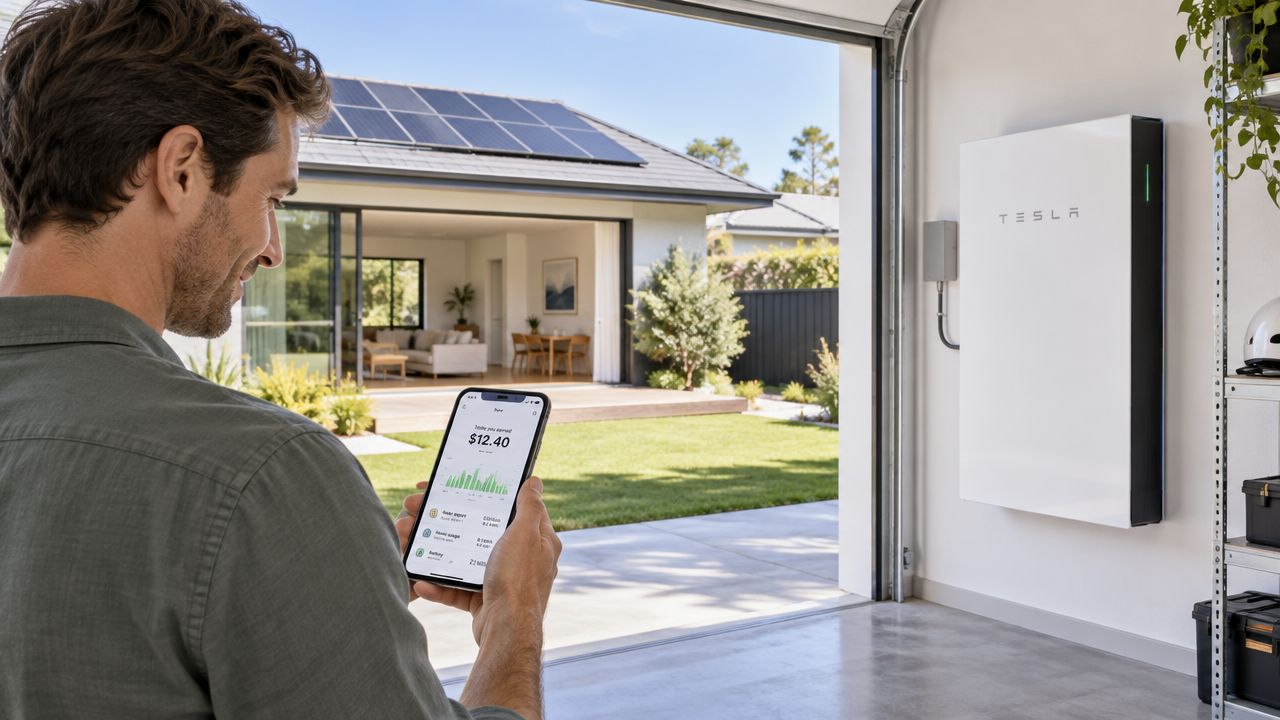
A VPP operator adds another layer of decision-making. Software can combine information about battery state, household demand, solar production, weather, network conditions and market signals. It then coordinates many individual systems so they can support customers first while contributing available flexibility to the electricity system.
That distinction matters because a battery is a physical asset, but its financial performance depends on decisions made over time. A battery can reduce imports from the grid, but a coordinated programme may also use spare capacity for demand response, energy market participation or frequency control services. Those activities require accurate telemetry, dispatch logic and a commercial structure that explains how value is shared.
From self-consumption to coordinated participation
Self-consumption is straightforward. Solar charges the battery, the battery supplies the home, and excess energy may be exported. This approach can work well, but it treats the home as an isolated system.
A VPP connects the home to a broader portfolio. The operator can preserve a customer's priority access while using agreed flexibility for grid support. The software must decide how much capacity is available, how long it can be sustained and whether a proposed action would conflict with household needs, export limits or battery operating constraints.
Practical rule: A battery optimisation plan should explain not only how it earns value, but also when it will hold energy back for the household.
High Flow Energy's role is built around this optimisation problem. It doesn't sell or install solar panels or batteries. Its retailer-based BYOB model is designed for eligible owners of existing solar and compatible batteries who want software and market participation to work harder after installation.
What Virtual Power Plant Software Actually Does
Start with one home battery. Its inverter measures power flows, the battery management system monitors its state and a local controller decides whether to charge or discharge. That's battery management, but it isn't yet a VPP.
Now connect many homes in different suburbs. Each system has different solar production, household demand, battery capacity, connection settings and export restrictions. A VPP platform gathers that information, applies operating rules and sends coordinated instructions. The result is a portfolio that can behave as one flexible resource without pretending that every home is identical.
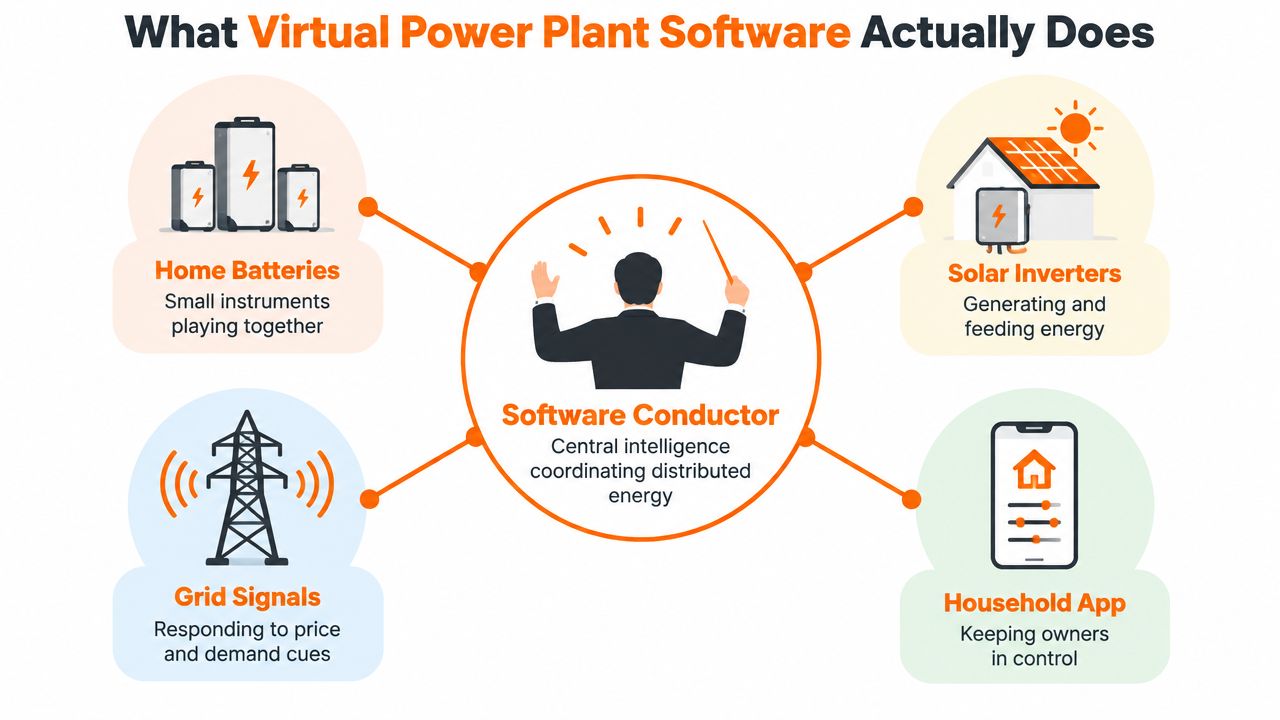
The conductor analogy is useful. Each battery, inverter and controllable load is an instrument. The software conductor doesn't replace the instruments. It coordinates their timing, limits and contribution so the group can produce a reliable result.
The operating sequence
Connect the asset. The operator identifies the inverter, battery, metering arrangement and communications path. Compatibility matters because different manufacturers expose different controls and operating data.
Register and classify the device. The platform records where the asset is connected, what it can do and what limits apply. AEMO's DER register framework required device data to be provided within 20 days of system commissioning or activation, creating a practical data-management obligation for operators (Energy Magazine's coverage of the DER register launch).
Aggregate multiple connection points. AEMO's NEM VPP Demonstrations design required portfolios with controllable assets across more than one connection point. That requirement focused on proving portfolio-level coordination, not merely remote control of a single battery (AEMO's final VPP demonstrations design).
Dispatch the fleet. The software sends instructions that respect each customer's settings and device limits. Some homes may charge, some may hold energy and others may discharge, depending on their local conditions.
AEMO has historically required batteries above 5 MW and generating systems above 30 MW to enter central dispatch as scheduled resources, while noting that equivalent provisions didn't exist for aggregations of smaller batteries collectively exceeding those thresholds (AEMO's VPP demonstrations knowledge-sharing report). That gap shows why aggregation software matters. The platform must turn many small assets into a coordinated market-facing resource rather than relying on one large generator model.
The Australian evidence is no longer limited to a theoretical model. AEMO's VPP Demonstrations brought together eight VPP portfolios across all mainland NEM states and about 7,150 participating consumers. The programme finished with 31 MW of VPP capacity operating in the NEM, demonstrating that software can aggregate household assets into dispatchable grid support at utility scale (AEMO's VPP demonstrations report).
Inside the Software Stack That Orchestrates Your Battery
A battery can respond to a price signal in milliseconds, yet a VPP operator still has to answer a harder question: which homes can respond together, by how much, and without breaching customer settings or NEM dispatch requirements? The software stack handles that coordination. Aggregation creates the fleet, forecasting explains what the fleet can safely do, market integration turns that flexibility into an actionable service, and customer controls keep participation accountable.
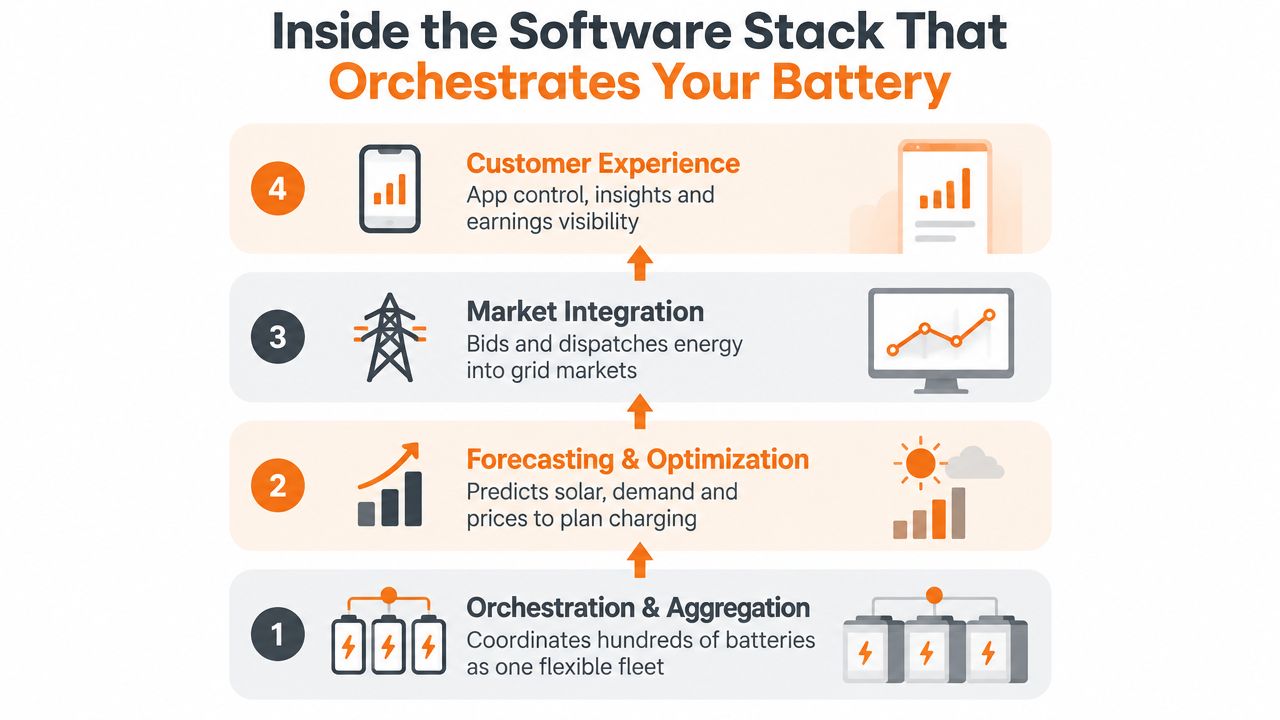
Orchestration and aggregation
The orchestration layer keeps a live operating view of every participating asset. It tracks which devices are online, how much battery capacity is available, whether a homeowner has applied an override, and whether inverter or network limits restrict a response.
AEMO's WA DER Program offers a practical example. Project Symphony is designed to orchestrate about 900 distributed energy resources across 500 homes and businesses. Its software platforms must register, aggregate and coordinate customer DER for on-market and off-market services in a simulated-market environment (AEMO's Project Symphony information).
The platform acts like a translator between a market instruction and many household devices. A battery does not need to interpret every market process itself. The software converts the instruction into device-level actions, then records whether those actions occurred.
Forecasting and optimisation
Forecasting software estimates solar output, household demand and the flexibility that batteries can offer. It uses weather forecasts, recent consumption, current state of charge and scheduled dispatch obligations to build an operating plan.
Forecasts remain uncertain. Cloud cover can change, a household may consume more than expected, or a communications link may fail. Optimisation therefore needs reserve logic and fallback behaviour. It must not promise the same stored energy to both the homeowner and the market.
High Flow Energy describes this broader role through its AI energy management system, which combines automated planning with customer-facing visibility. The useful test is not whether software carries an “AI” label. The test is whether it explains its decisions and revises them when conditions change.
Market integration
A market-facing VPP requires software for bidding, dispatch, metering, settlement and compliance. Its value appears when an operator converts available household flexibility into a service that the relevant market or retailer arrangement can recognise and settle.
AEMO's earlier VPP work illustrates why this layer matters. In 2019, AEMO launched a 12 to 18 month VPP integration trial funded by ARENA with AU$2.46 million to demonstrate energy and frequency control ancillary services. The same policy push included an additional AU$10 million ARENA commitment to accelerate software that registers consumer energy assets and makes them visible to the grid (Energy-Storage.News coverage of the trial).
The policy setting has since changed. In December 2024, the AEMC made a final determination allowing VPPs to compete directly with large-scale generators in the energy market. In February 2024, it modelled potential savings of up to $2 billion net present value from integrating VPPs between 2025 and 2050 (the ACCC's June 2026 NEM report). Forecasting, bidding and dispatch software now affect whether a VPP can participate reliably, not merely whether a battery can be controlled remotely.
Security and compliance
A VPP controls physical equipment and processes household energy data. The platform needs clear permissions, dependable communications, device authentication, access controls and an audit trail showing each instruction and outcome.
Compliance also covers accurate DER records, customer consent, warranty-aware operating limits and understandable terms. A platform that dispatches a battery without explaining its permissions, limits and results creates operational and commercial risk.
How Software Connects to Home Batteries and Your App
From the homeowner's perspective, the VPP should feel less like a remote operator taking over and more like a managed set of preferences. The battery, inverter, meter and internet connection provide the operating data. The platform uses that data to create a schedule, while the app shows the customer what the system is doing.
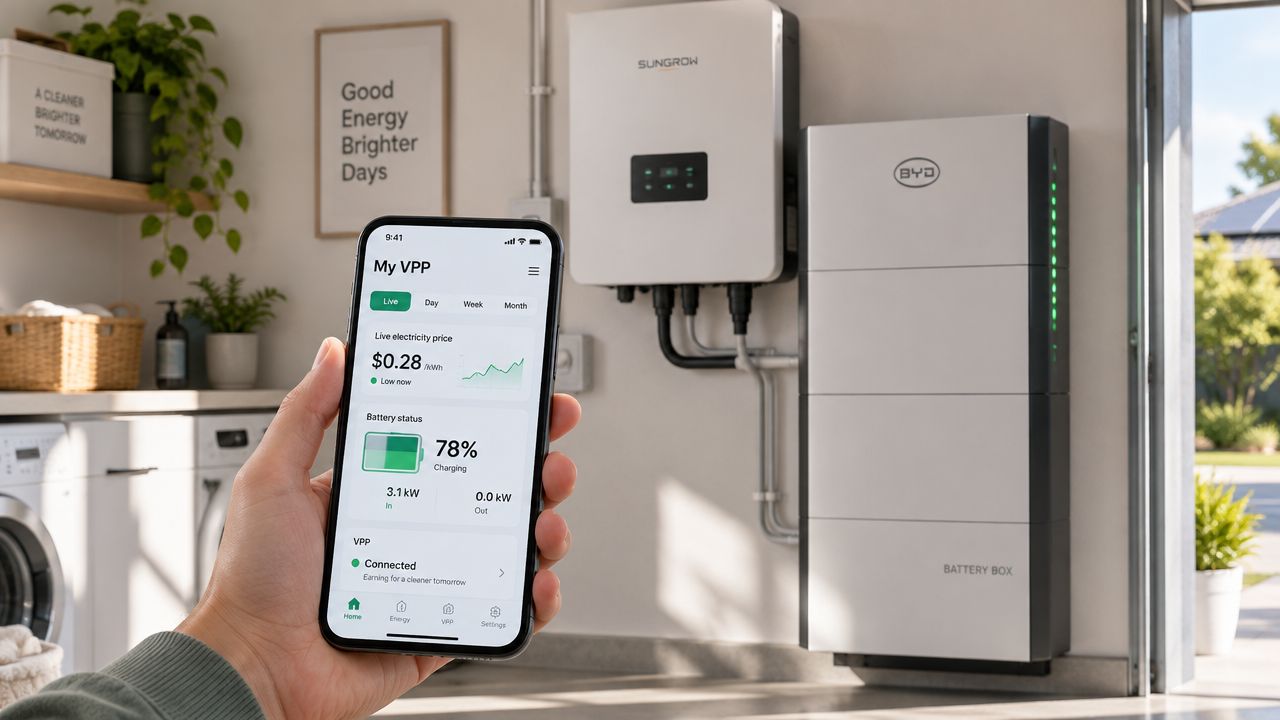
A typical daily journey may look like this:
- Morning: The software checks the battery's state, household demand and expected solar production. It may preserve capacity for midday solar or prepare for anticipated evening demand.
- Middle of the day: Solar production can serve the home, charge the battery or export within the system's limits. The platform avoids treating every spare kilowatt-hour as automatically available.
- Late afternoon: The system assesses household needs, time-of-use settings, price signals and any approved demand event. It may retain a reserve rather than discharge everything.
- Evening: The battery supports the home first, while any separate grid-support action follows the customer's agreed operating rules.
- Afterwards: The app should show energy flows, dispatch activity and relevant financial information in language a household can understand.
Household priority and override controls
Participation doesn't mean surrendering all control. A properly designed BYOB VPP should state how customers can prioritise backup energy, pause participation or override an automated plan.
The trade-off is real. More frequent discharge may create additional market value, but battery cycling affects the asset's operating profile. A sensible platform therefore needs to balance electricity bill reduction, grid services, export limits, backup preferences and manufacturer conditions.
The Clean Energy Regulator states that a VPP is a network of small DERs linked and controlled using smart software so they behave like a single power plant. It also says on-grid solar batteries, including inverters, must be VPP-capable at installation to claim STCs under the Small-scale Renewable Energy Scheme. Participating households need an ongoing internet connection and the ability to respond to grid signals (the Clean Energy Regulator's VPP guidance).
That means eligibility isn't only about battery brand. It can depend on inverter compatibility, communications, installation settings, network arrangements and the operator's ability to register the device correctly. High Flow Energy's system integration requirements provide an example of the kind of technical information a homeowner should review before enrolling.
How to Evaluate Virtual Power Plant Software Performance
Marketing language can make every platform sound similar. A better approach is to evaluate the software as an operating system for a physical asset. Ask how it connects, how it makes decisions, how it communicates those decisions and how the operator accounts for results.
| Evaluation Criteria | What Good Looks Like | Questions to Ask |
|---|---|---|
| Device compatibility | Clear support for your battery, inverter and meter arrangement | Is my exact system supported, and which controls are available? |
| Aggregation | Portfolio logic that coordinates separate connection points | How does the platform combine devices with different limits? |
| Forecasting | Forecasts that inform charging, discharge and reserve decisions | Does the operator explain how weather, demand and prices affect the plan? |
| NEM integration | Defined processes for dispatch, bidding, metering and settlement | Which market-facing services can the platform support? |
| Customer control | Priority settings, overrides and understandable operating terms | Can I pause participation or preserve backup energy? |
| Battery protection | Dispatch rules that respect manufacturer and warranty conditions | How does the software manage cycling and state-of-charge limits? |
| Network awareness | Logic that considers export limits and local constraints | How are NSW and Queensland network conditions handled? |
| Reporting | Accessible records of energy flows, events and financial outcomes | Can I see what the battery did and why? |
| Compliance | Timely DER registration and clear customer permissions | Who maintains device records and handles compliance obligations? |
| Security | Controlled access, reliable communications and auditability | How are data and remote commands protected? |
Retailer-based and standalone models
A standalone platform may focus on software licensing or portfolio control, while a retailer-based VPP can connect orchestration with electricity billing, market exposure and customer allowances. Neither structure is automatically superior. The question is whether the commercial model is transparent and whether the customer can see how battery activity affects the bill.
Traditional feed-in tariffs pay for exported energy under a defined retail arrangement. A VPP may create other value through coordinated discharge, demand response or ancillary services, but those activities introduce operating rules and trade-offs. Compare the total structure, not just the advertised export rate.
Performance evidence matters
Ask for portfolio-level evidence rather than a generic claim that the software is “smart”. The AEMO demonstrations showed that a VPP can operate at aggregated scale, but a homeowner still needs to understand how a particular operator handles device availability, local constraints and customer overrides.
A useful performance reporting dashboard should make outcomes visible. Look for records of participation, battery behaviour, household energy use and the financial treatment of any allowance or reward.
Common Misconceptions About Virtual Power Plant Software
A VPP takes control away from the homeowner
A VPP can send control instructions, but that doesn't mean the homeowner loses all authority. Customer priority, reserve settings and override controls should be defined before enrolment.
The practical distinction is between delegated automation and unrestricted control. You allow the software to manage an agreed operating range, while retaining the ability to protect household needs.
AI optimisation creates value by itself
AI can improve forecasting and scheduling, but it can't create a market opportunity that the operator doesn't have access to. A strong forecast still needs a compliant dispatch process, suitable customer terms and a way to measure and settle the resulting activity.
Software is only commercially useful when its decisions connect to a real operating and settlement structure.
Joining a VPP always requires new hardware
A BYOB programme is specifically designed around eligible systems customers already own. That doesn't mean every battery is compatible. Inverter controls, internet connectivity, registration data and manufacturer conditions can determine whether the system can participate.
The Clean Energy Regulator's guidance also makes clear that VPP capability and ongoing connectivity matter for participating households. Hardware replacement shouldn't be assumed, but technical eligibility should be checked.
Feed-in tariffs always maximise battery value
A feed-in tariff rewards exported energy, but it doesn't necessarily capture every opportunity available to a flexible battery. Coordinated dispatch can consider household demand, market conditions, grid services and the timing of export.
That benefit comes with trade-offs. Customers should compare allowance structures, export arrangements, cycling policies and priority access instead of focusing on one tariff line.
A battery can optimise itself without a VPP
A local battery controller can perform useful self-consumption optimisation. It usually doesn't manage a portfolio across separate connection points, interact with market processes or coordinate grid support at fleet level.
That's the difference between device optimisation and market-facing orchestration. Both have a role, but they solve different problems.
Choosing the Right Virtual Power Plant Software for Your Home
A battery owner in Queensland or New South Wales can begin with the system already installed. Confirm that the battery and inverter are compatible, test the internet connection, review backup and override settings, and ask how the operator manages export limits and local network conditions. These details determine whether the software can coordinate your equipment reliably when conditions change.
The commercial structure deserves the same attention. Check whether the benefit is provided as a bill allowance, direct payment, tariff adjustment, or another defined arrangement. Ask what happens when household use exceeds the allowance, how additional energy is charged, and whether the programme includes lock-in or exit conditions.
A VPP is also a market-facing orchestration layer, not just a battery control app. Its software must combine many small systems, forecast their available energy, and coordinate dispatch within NEM requirements. Recent rule changes make those forecasting and bidding functions more important, because an operator must translate household flexibility into a dependable fleet response.
Participation is growing, although many battery owners remain outside VPP programmes. The ACCC's July 2025 report identified 38,200 participating customers across New South Wales, South-East Queensland, Victoria and South Australia (the ACCC's July 2025 NEM report). The figure indicates rising adoption while leaving room for homeowners to assess whether coordinated operation suits their equipment and priorities.
Installation quality gets attention. Ongoing software performance deserves it too. High Flow Energy is an electricity retailer that uses existing solar and compatible battery systems through a BYOB VPP structure, with household priority and app-based visibility. Visit High Flow Energy to review whether your battery may be underused and assess eligibility.