

How Many Watts Does a Kettle Use and What It Costs
Most Australian household kettles are rated at 1,850 to 2,400 watts, typically 2,200 to 2,400 watts, and a full boil usually uses about 0.10 to 0.14 kWh, costing a few cents. The exact result depends more on how much water you heat and how long the kettle runs than on the wattage printed on its base.
You flick the switch while the house is still quiet. A few minutes later, the water is ready for coffee, tea or breakfast, and the kettle has done its job. The natural follow-up question is whether that short burst of high power is adding meaningfully to your electricity bill.
For most households, a single boil is a relatively small energy event. The confusion comes from seeing a number such as 2,200W and assuming the kettle uses that much electricity every time. Watts describe the rate at which the kettle draws power. Your bill is based on energy used over time, measured in kilowatt hours.
That distinction matters in Queensland and New South Wales, particularly for households with rooftop solar, a battery, a time-of-use tariff or an interest in better electricity management. A kettle is a useful everyday example because its power draw is high, but its operating time is short.
This guide moves from watts, to kilowatts, to kilowatt hours, then applies the calculation to common Australian kettle sizes. It also explains why water volume usually matters more than the nameplate rating, how to avoid unnecessary reboiling and where kettle use fits into broader household energy optimisation.
Introduction How Many Watts Your Kettle Really Uses
A kettle rated at 1,850W draws power at a lower rate than a 2,400W model, but both are built to heat water quickly. The number on the base describes the kettle's electrical demand while the element is running. It does not represent the energy used by every boil.
For a 1.7-litre boil, energy use is generally around 0.10 to 0.14 kWh, with a typical heating time of roughly three to four minutes. A higher-wattage kettle may finish sooner, while a lower-wattage model may run longer. Heating the same volume to the same temperature requires a similar amount of energy, so the difference between nameplate ratings is often smaller than it first appears.
The morning decision that affects energy use
Suppose you need one mug but fill the kettle to its maximum line. The element must heat the unused water as well. If that extra water is boiled again later, the added energy comes from the additional volume and repeat heating, not from the kettle's high wattage.
Water volume is therefore the practical starting point for reducing kettle energy use. The rating tells you how quickly the kettle can transfer energy. The fill level determines how much water receives that energy.
A standard household outlet also places a practical limit on ordinary kettle power. Common Australian sockets are generally suited to kettles in the 2,300 to 2,400W range, while the detailed voltage and current calculation belongs with the wattage comparison later in this guide. C Power's Australian appliance power reference provides background on typical appliance power ratings.
The useful question isn't only “how many watts does a kettle use?” It's “how much water am I heating, for how long, and what does that consume in kWh?”
The calculation follows a simple chain: read the kettle's rating, convert watts to kilowatts, multiply by running time in hours, then multiply the resulting kWh by your electricity tariff. This shows the cost of one boil and places kettle use in context with larger household decisions, such as avoiding wasted heating and using available solar generation effectively.
Understanding Watts Kilowatts and Kilowatt Hours Simply
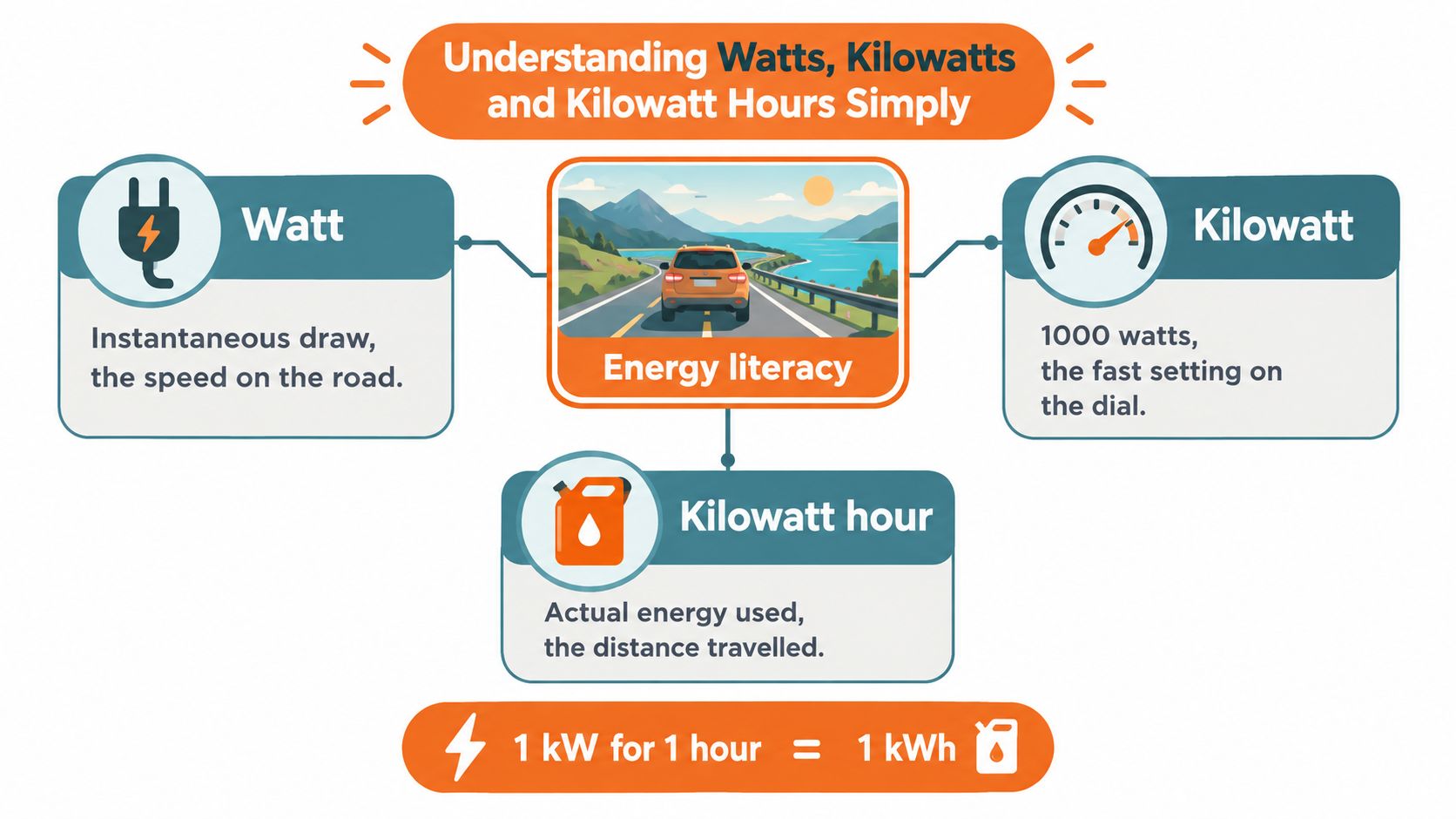
The easiest way to understand kettle electricity is to compare it with travel. Watts are like speed, while kilowatt hours are like distance travelled. A car travelling quickly can still cover a short distance if it only drives briefly. A kettle works in much the same way.
A watt measures the rate of electrical power being drawn at a particular moment. A kettle marked 2,200W is drawing power at a rate of 2,200 watts while its heating element is operating. It doesn't mean the kettle uses 2,200 units of electricity every boil.
A kilowatt is 1,000 watts. Divide the nameplate rating by 1,000 to convert it:
- 1,850W becomes 1.85kW.
- 2,200W becomes 2.2kW.
- 2,400W becomes 2.4kW.
A kilowatt hour, written as kWh, measures energy. This is the unit that appears on an electricity bill. One kilowatt hour represents a one-kilowatt load operating for one hour, or an equivalent amount of energy used through a different combination of power and time.
Why a powerful kettle can still use little energy
A 2.4kW kettle running for only a few minutes may use less energy than a much lower-powered appliance that operates for a long period. The kettle has a high short-term demand, but its total operating time is limited.
The basic calculation is:
Energy used in kWh = power in kW × operating time in hours
For example, a kettle rated at 2.2kW that runs for a fraction of an hour uses the 2.2kW rate only during that operating period. The shorter the run time, the lower the total kWh, although heating more water will normally extend the run.
You can read a more detailed explanation of this relationship in High Flow Energy's guide to kilowatts. The key point is simple: watts describe the draw, while kWh describes the energy consumed.
Power is the rate. Energy is the accumulated use. Your bill measures the accumulated use.
This distinction also explains why comparing appliances by wattage alone can lead to poor decisions. A kettle, toaster and heater may all draw substantial power while operating, but their energy contribution depends on how long each one runs and what task it performs.
Typical Kettle Wattage in Australia and Why It Clusters So High
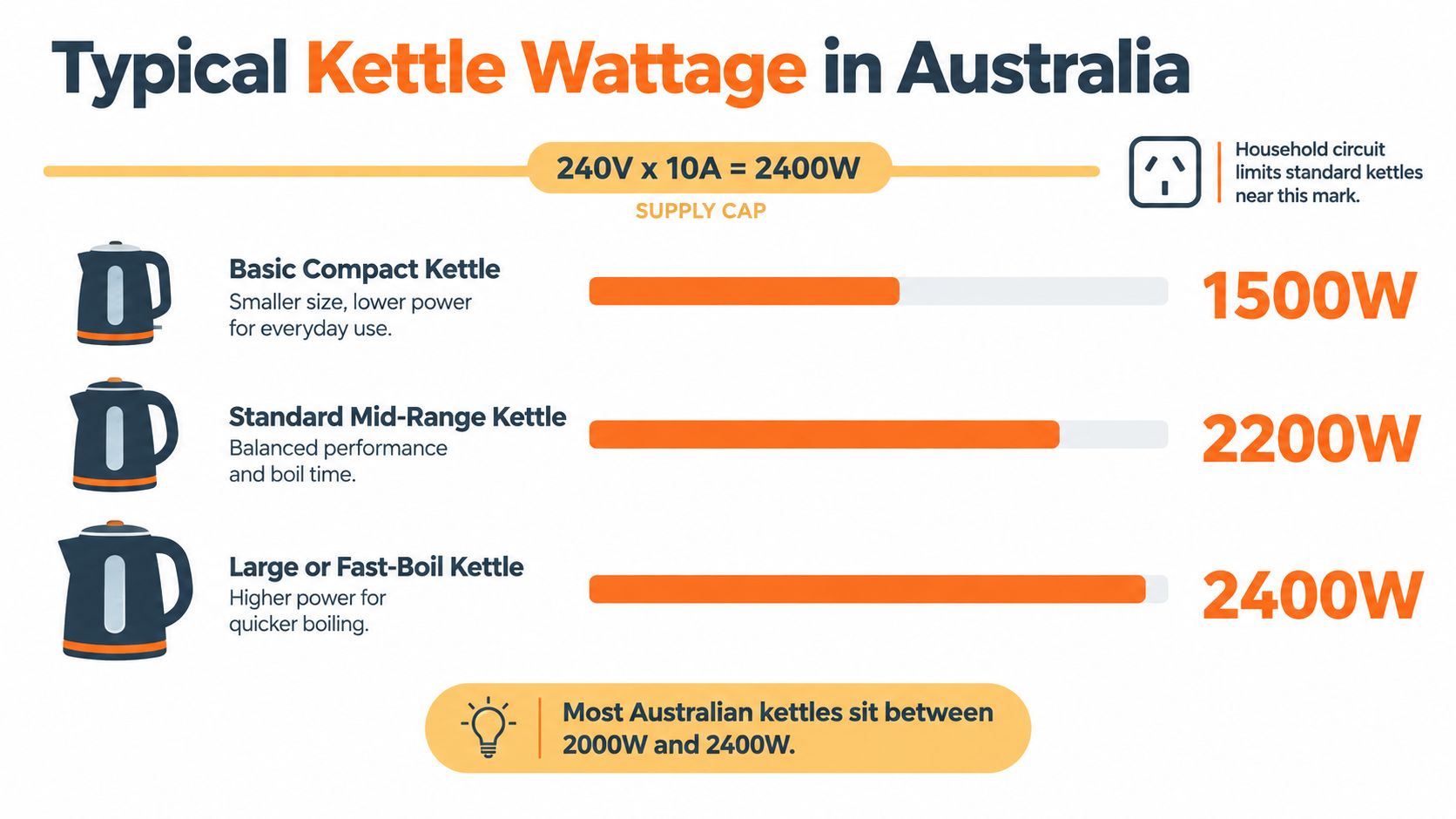
A kettle on an Australian kitchen bench commonly carries a rating between 1,500W and 2,400W. Compact and travel-style models tend to sit near the lower end, while mainstream household kettles often cluster around 2,200W to 2,400W.
That clustering reflects a practical compromise. A higher rating can heat water faster, but the appliance must still operate within the socket limits explained earlier. Australian appliance references also show a broader range from 1,500W to 2,200W, so there is no single wattage that every kettle must use. Capacity, heating-element design and the desired boiling speed all influence the label.
Why Australian models cluster near the upper end
The Australian market favours quick-boil kettles because a higher wattage shortens the wait for a full jug. Many household models therefore sit close to the upper range that a normal outlet can support. A lower-powered kettle places less demand on the circuit at any instant, but usually needs more time to heat the same volume.
The difference matters mainly for timing and peak electrical demand. It does not automatically determine the cost of a boil. Heating a small mug and heating a full 1.7-litre jug require different amounts of water to be raised to boiling, just as carrying a light bag or a full suitcase requires different effort. The kettle's wattage is the rate of heating, while the water volume largely determines how long that heating continues.
Where common kettle types fit
A compact model around 1,500W may suit a person who usually boils one cup and has no need for rapid heating. A family-sized 1.7-litre kettle is more likely to use 1,850W to 2,400W, supporting faster boiling when the jug is full.
The practical buying question is therefore not “Which kettle has the lowest wattage?” Check the usual fill level first, then consider boiling speed and the available socket capacity. A 2,200W kettle can use a similar amount of energy to a lower-rated model for the same volume of water if it finishes sooner. The water volume, rather than the label alone, is the better starting point for comparing cost per boil and its place in the household electricity bill.
How to Convert Kettle Watts to Energy and Cost Per Boil
You only need two calculations to estimate a kettle's running cost.
First, convert the rating into kilowatts and multiply it by the time used:
kW × hours = kWh
Second, multiply the kWh by your electricity tariff:
kWh × tariff = cost
The kettle's label gives you the first input. You can measure the run time with a phone timer, or use the approximate boiling duration for the volume you normally heat. Your bill or retailer account gives you the tariff. If you want to compare this method with a broader household energy calculation, Utah energy upgrade savings insights offers useful background on translating appliance use into energy costs.
A worked example
Take a 2.2kW kettle. If it runs for three minutes, convert three minutes into hours by dividing by the number of minutes in an hour. Then multiply 2.2kW by that operating time. The result is the energy used for that particular boil.
For a more grounded Australian example, EnergyAustralia's kWh guide estimates that a 2.2kW kettle heating 1.5 litres from 20°C to 100°C uses about 0.14kWh per boil and costs roughly 3.9 cents at the electricity price used in that estimate.
A full 1.7-litre boil at around 2,200W is commonly estimated at approximately 0.11 to 0.17kWh, depending on conditions and the precise operating time. The range is a reminder that water volume and heating duration matter more than the label alone.
| Kettle and volume | Estimated kWh per boil | Estimated cost per boil |
|---|---|---|
| 2.2kW kettle, 1.5L | About 0.14kWh | Roughly 3.9 cents in the EnergyAustralia example |
| 2.2kW kettle, full 1.7L | About 0.11 to 0.17kWh | A few cents, depending on tariff and actual use |
| 2.4kW kettle, full boil | About 0.10 to 0.14kWh for a typical full boil | A few cents, depending on tariff and run time |
The table is an estimating aid, not a universal bill calculation. Your retailer's usage rate, the starting water temperature, the filled volume and the kettle's efficiency all affect the final result. For a household-level view, use High Flow Energy's Australian energy cost calculator and enter your own tariff rather than relying on a generic price.
Why one cup costs less than a full kettle
A kettle doesn't know whether you're preparing one drink or filling several mugs. It heats the water you put inside it. If you use the cup markers and add only the required amount, the element has less water to raise to boiling temperature, so the kWh figure falls.
That is the most useful cost insight in the entire calculation. Choosing between a 2,200W and 2,400W kettle may change boiling time, but filling a full kettle for one cup changes the volume being heated.
What Really Changes How Much Energy Your Kettle Uses
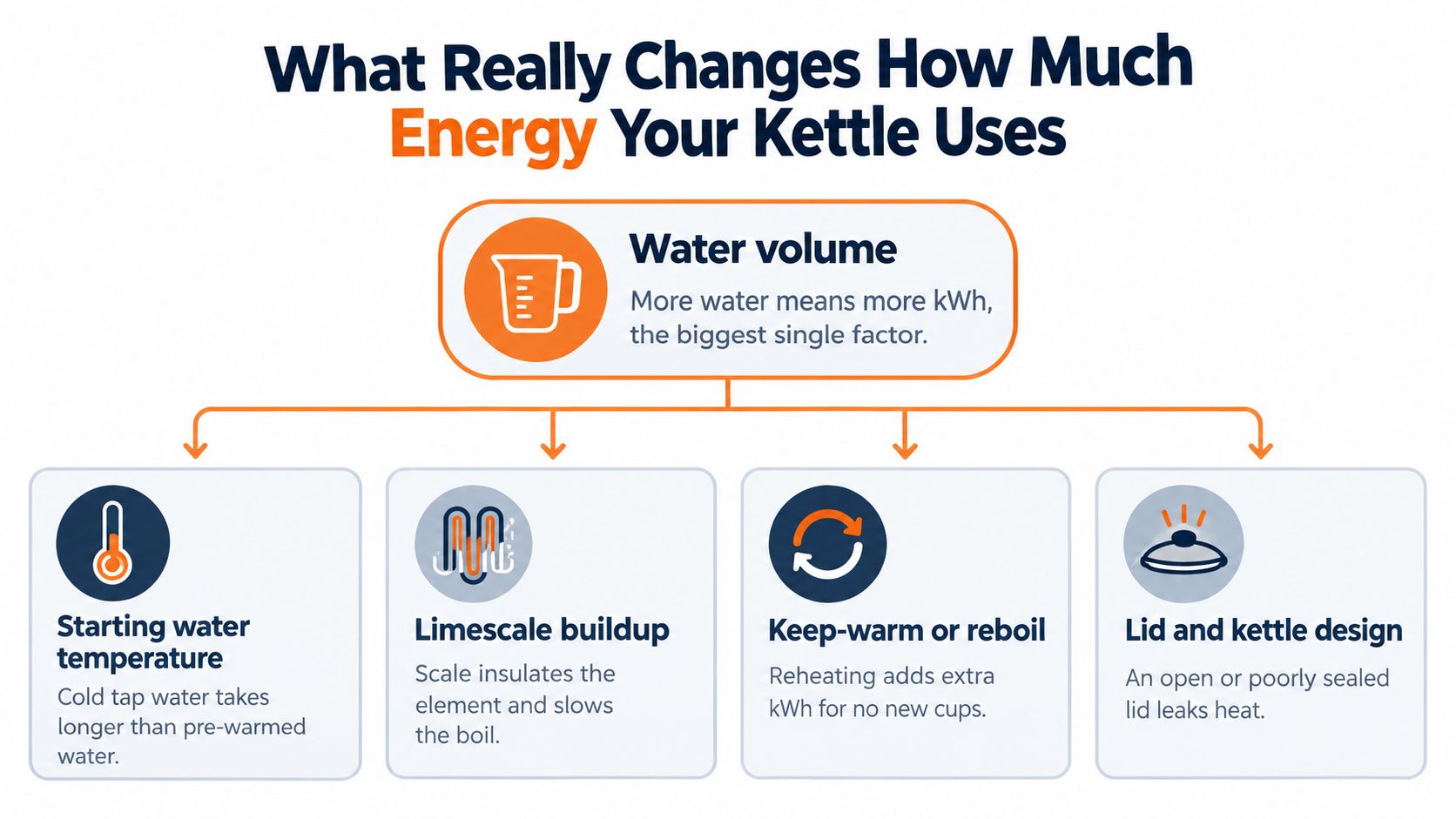
The wattage label answers only one part of the question. Energy per boil is mainly determined by the quantity of water and the heat the kettle must add to it. A high-wattage kettle can finish sooner without using dramatically more energy for the same volume.
Water volume comes first
Water volume is the dominant variable. Heating more water requires more energy, so a full 1.7-litre boil will normally use more kWh than a single-cup boil. The kettle's capacity doesn't force you to use all of it, but an overfilled kettle turns unused water into avoidable energy demand.
Starting temperature also matters. Cold tap water needs more heating than water that begins warmer, although the exact difference varies with the household and conditions. A kettle used repeatedly during the day may begin with water that hasn't fully cooled, but reheating still consumes energy.
Heat transfer affects the result
Several physical and behavioural factors change the amount of energy drawn:
- Limescale buildup: Mineral deposits can insulate the element, slowing heat transfer and extending the boil. Descaling helps the element work more effectively.
- Lid and kettle design: A closed lid limits heat escaping through the top. Steam and warm surfaces still release heat, but a well-sealed design reduces unnecessary loss.
- Reboiling: Switching the kettle on again to reheat water adds energy without creating additional hot water for new drinks.
- Keep-warm operation: A keep-warm function can continue using energy after the initial boil, depending on the appliance and setting.
- Automatic shut-off: A working shut-off prevents the element from continuing to heat after the water reaches the intended temperature.
The result is a useful correction to a common assumption. Higher wattage usually means a faster heat delivery rate, not automatically a higher cost for every boil. If a 2.4kW kettle completes the task sooner than a 1.5kW kettle, the operating time offsets some of the higher instantaneous draw.
If you're comparing kettle use with another hot-drink appliance, PureHQ's explanation of coffee maker electricity use provides a separate point of comparison. The same principle applies: power rating alone doesn't tell you total energy use.
Measure the water before you compare the wattage. The volume often explains more about the bill than the number on the appliance label.
A kettle also loses energy through its body, base and steam. No domestic appliance converts every unit of electricity into useful water heating, so two models with the same rating can still produce slightly different results in everyday use.
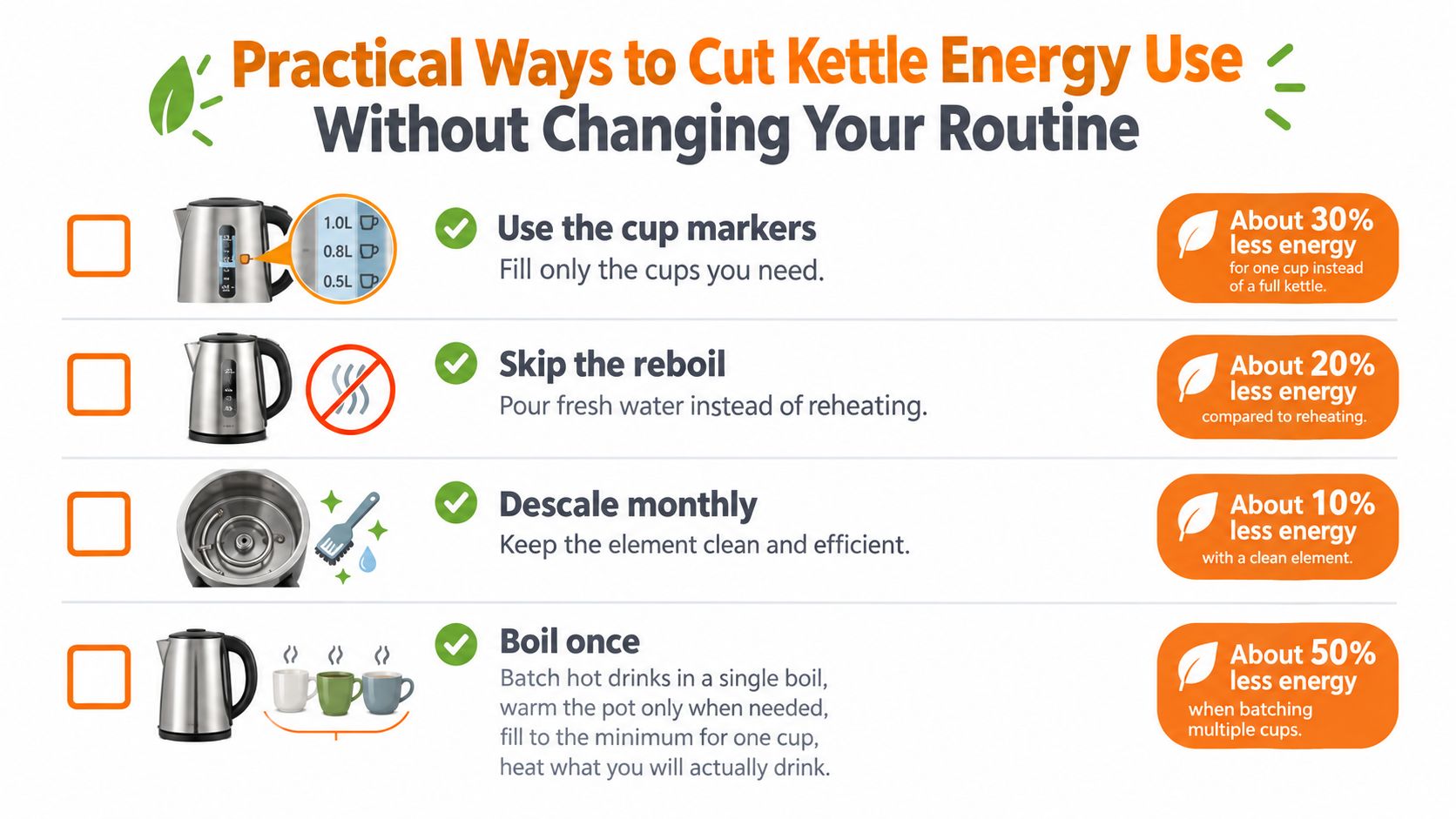
Practical Ways to Cut Kettle Energy Use Without Changing Your Routine
The lowest-effort savings come from changing the amount of water you heat, not from replacing a functioning kettle. Small habits work because they reduce the operating time and the energy transferred to water you won't use.
Match the boil to the drink
- Use the cup markers: Fill the kettle to the level needed for the mugs you're making. Measuring with the mug itself can be more accurate when the markings are difficult to read.
- Avoid automatic top-ups: Don't refill the kettle to the maximum line because it's empty. Add only the water required for the next use.
- Batch hot drinks: If several people want tea or coffee at the same time, one appropriately sized boil can avoid repeated heating cycles.
- Skip unnecessary reboils: If the water is still warm, use it rather than starting another full cycle. A thermos or insulated mug can help retain heat.
- Keep the lid closed: Use the supplied lid during boiling so less heat escapes through the opening.
- Descale regularly: Scale on the element can slow the boil. Follow the manufacturer's instructions and use a suitable descaling method.
Solar and battery households can also think about timing. If your system is producing surplus solar during the day, running flexible appliances then may align consumption with generation. A battery's control strategy can further affect whether a brief high-power appliance load is supplied by stored energy or the grid.
A plug-in energy meter can help confirm what your own kettle draws. High Flow Energy's power usage monitor guidance is relevant for households that want to test an individual plug load instead of relying only on the nameplate.
The meter won't replace the kWh calculation, but it can reveal the actual operating pattern, including how long the kettle runs and whether a keep-warm function remains active.
Key Takeaways and Smarter Energy Use for Australian Homes
A kettle's nameplate wattage tells you how quickly it can heat water, not what each boil costs. For a typical full boil, energy use is usually about 0.10 to 0.14kWh, with the final figure shaped mainly by how much water you heat and how long the cycle runs. The 2.2kW example heating 1.5 litres uses about 0.14kWh, costing roughly 3.9 cents per cycle under the EnergyAustralia example. Your tariff and water volume determine the amount on your bill.
The most useful habit is simple: boil only the water you need. Filling the kettle for one mug when you need only a cup is like driving a larger route than necessary. The kettle may finish quickly, but it still heats the extra water, so reducing the fill level usually matters more than choosing between similar high-wattage models.
A kettle is a small household load, yet repeated boils form part of the wider pattern across hot water, refrigeration, cooking, heating and charging. Solar and battery households in Queensland and New South Wales can also consider whether flexible appliance use matches solar production or battery settings. Time-of-use prices, wholesale volatility, demand events and network constraints affect how stored energy is valued, so appliance decisions work best within a whole-home view.
A retailer-based VPP can coordinate battery charging and discharge while keeping household access to stored energy as a priority. It may also use available capacity for grid support, subject to eligibility, system compatibility and the authorised retail framework.
HighFlow Energy helps existing solar and compatible battery owners assess underused system capacity and connect to a BYOB Virtual Power Plant without selling or installing new hardware. Visit HighFlow Energy to check eligibility and review possible ways to improve current electricity performance.