


Feed in Tariff Australia
The most popular advice about feed in tariff Australia is also the least complete: find the retailer offering the highest export rate. That advice treats every exported kilowatt-hour as equally valuable, ignores supply and usage charges, and overlooks the structural decline in daytime solar value. For many households in Queensland and New South Wales, the more important question is not how much the retailer pays for surplus electricity, but how much value the household can retain, shift and coordinate before export occurs.
A feed-in tariff is a bill credit, not a guaranteed income stream. Its value depends on the plan, the state, the network, the time of export and the household's ability to avoid buying electricity during more expensive periods. Battery owners should therefore assess solar battery value, battery optimisation and Virtual Power Plant Australia options alongside a conventional energy retailer comparison.
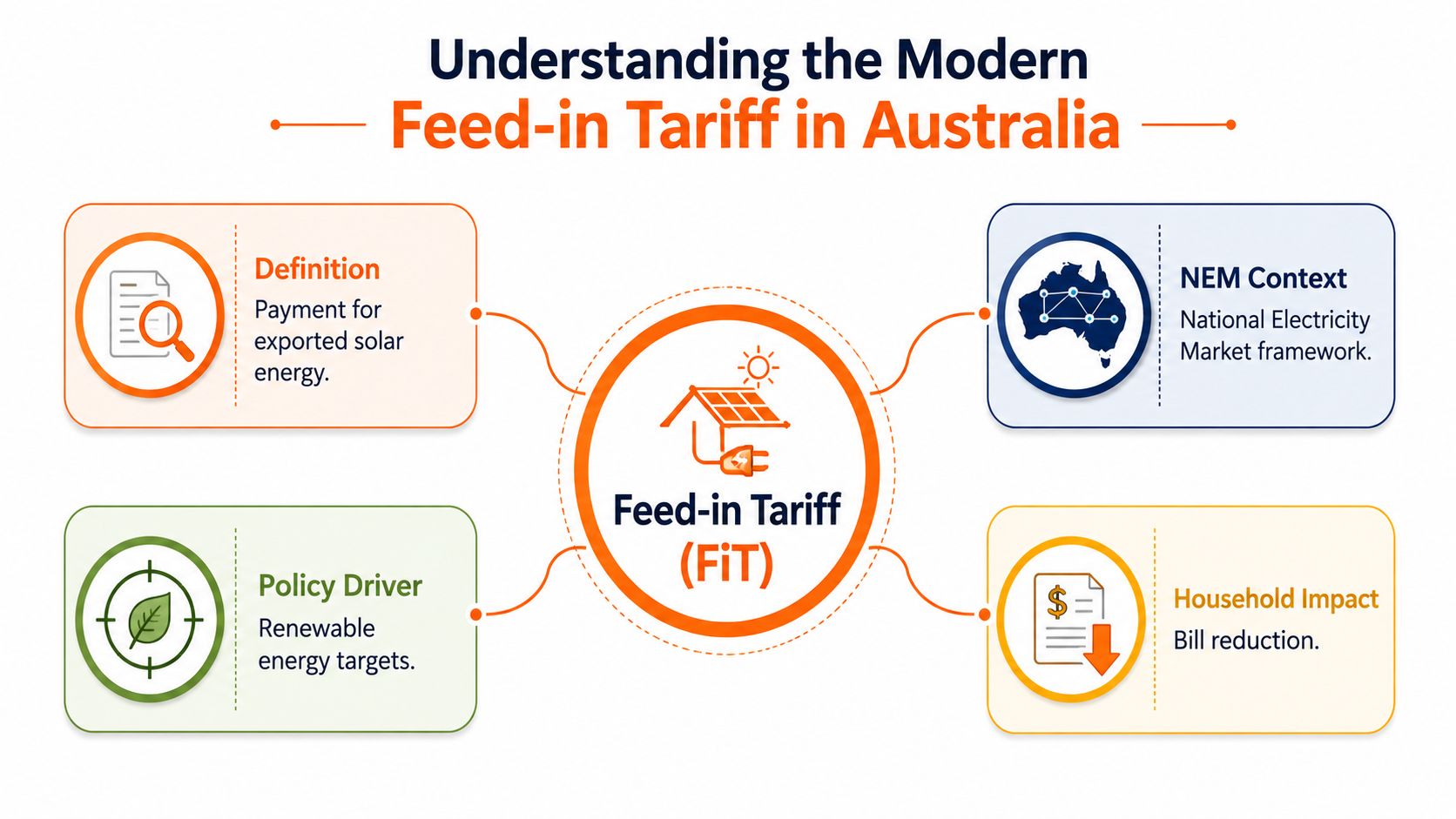
Understanding the Modern Feed-in Tariff in Australia
A feed-in tariff, or FiT, is a bill credit for solar electricity exported from a grid-connected home. A bidirectional meter measures energy entering the property and surplus energy leaving it. The retailer applies the agreed cents-per-kilowatt-hour rate to the exported volume, subject to the plan's terms. Most plans use one rate, while some apply block feed-in tariffs that change after an export threshold. The Australian Government explanation of electricity pricing plans and tariffs outlines these pricing mechanics.
The physical process is straightforward:
- Solar generation exceeds household demand.
- The surplus passes through the meter to the grid.
- The retailer records the exported energy.
- The agreed FiT appears as a credit on the electricity bill.
The commercial value is less straightforward. Solar households often export at the same time, particularly around the middle of the day, when demand can be relatively low. High supply can therefore weaken the wholesale value of daytime exports. Retailers price FiT plans around that market value and the risk they assume, rather than treating every exported kilowatt-hour as a premium product.
From policy incentive to market credit
Queensland's early Solar Bonus Scheme shows how sharply the policy context has changed. It began in July 2008 and initially paid a gross 44 c/kWh for eligible exports. Applications received by 9 July 2012, with systems installed by 30 June 2013, could still qualify. Later applications moved to 8 c/kWh, and the scheme closed to new entrants on 1 July 2014. Eligible customers will retain the 44 c/kWh entitlement until 1 July 2028, according to the historical overview of Australian feed-in tariffs.
Legacy entitlements still shape consumer expectations. A household comparing a current retail offer with a policy-created payment may be comparing two different economic systems. Premium state schemes of 40 c/kWh and above remain limited to legacy customers in South East Queensland and South Australia, with those arrangements scheduled to end in 2028, as the same historical reference explains.
Practical rule: Treat a FiT as one input in a household energy plan, not as the business case for the entire solar system.
For modern solar households, the stronger calculation starts with energy retained on site. Self-consumption avoids a retail purchase, while a controlled export captures whatever FiT value remains. A battery can shift solar into higher-value periods, and a VPP can coordinate that battery with market or network needs. Neither creates value automatically. Results depend on dispatch settings, electricity prices, household demand, export limits, network conditions and the retailer or VPP contract.
The structural conclusion is direct: chasing the highest nominal FiT is often weaker than reducing low-value daytime exports. Battery optimisation and VPP participation address timing and flexibility, which are the constraints that a headline export rate cannot solve.
Current Feed-in Tariff Benchmarks in NSW and Queensland
The current benchmark data in New South Wales and Queensland shows why the old export-first strategy has weakened. For 2026–2027, IPART's all-day solar feed-in tariff benchmark in NSW is 3.4 to 6.5 c/kWh, as set out in its NSW solar energy benchmark information. That benchmark reflects the limited wholesale value commonly associated with solar exports during daytime generation periods.
Regional Queensland provides a different regulatory reference point. Outside South East Queensland, the mandated flat FiT fell from 12.377 c/kWh in 2024–25 to 8.660 c/kWh from 1 July 2025. Ergon's published rate is $0.08660/kWh for exports from that date, according to the Queensland Government feed-in tariff guidance.
South East Queensland remains more variable because market offers differ between retailers and plans. Reported 2023–24 offers ranged from 0.8 c/kWh to 8.0 c/kWh, with an average of 5.1 c/kWh, as summarised by Energy Matters' feed-in tariff analysis. These are not interchangeable with regulated regional Queensland rates, and they shouldn't be treated as a universal Queensland benchmark.
The export credit versus the avoided purchase
| Region / Network | Benchmark / Regulated FiT (c/kWh) | Typical Peak Usage Rate (c/kWh) | Net Financial Position |
|---|---|---|---|
| NSW, 2026–27 IPART benchmark | 3.4 to 6.5 | Plan dependent | Export credit is modest, so self-consumption can be more valuable |
| Regional Queensland, Ergon network | 8.660 from 1 July 2025 | Plan dependent | Regulated export payment remains below the value of avoiding later grid purchases |
| South East Queensland market offers | 0.8 to 8.0 reported for 2023–24 | Plan dependent | Retail plan design determines whether a higher FiT improves the bill |
The table exposes the central weakness in simple FiT comparisons. A credit for exporting at midday may be less valuable than the saving created by keeping that energy for later household use. The difference isn't just a matter of rate shopping. It reflects the timing of generation, wholesale solar saturation, household demand and the cost of importing electricity when solar production has ended.
A useful feed in tariff NSW comparison should therefore include the full bill, not just the export line. For Queensland households, the same applies to the distinction between regional regulated arrangements and South East Queensland market offers. High Flow Energy's guide to the best feed-in tariff in NSW is relevant as a comparison starting point, but any decision still requires an assessment of actual usage, supply charges and battery behaviour.
The Hidden Trade-offs in High Feed-in Tariff Plans
A higher advertised FiT can be commercially useful, but it can also distract from the costs that determine the final bill. Retailers may balance a generous export rate with a higher daily supply charge, more expensive usage rates, conditions on eligibility or a block structure that pays the premium only for part of the exported volume.
That doesn't make every high-FiT plan poor. It means the headline export rate isn't the correct unit of analysis. The correct unit is the household's net electricity cost after credits, supply charges and imported usage.
Read the plan as a cash-flow model
Start with the electricity fact sheet and isolate four elements:
- Export rate: Identify whether the rate is flat, time based or divided into blocks.
- Supply charge: Check the daily connection cost, which applies independently of solar production.
- Usage rates: Separate the prices that apply when the household imports electricity, particularly during evening demand.
- Eligibility conditions: Look for battery, system, meter, network or customer restrictions.
The most important calculation is not “How much did the retailer pay for exports?” It's “What did the household pay overall after exporting?” A plan that credits more for surplus solar may still produce a weaker result if the home imports heavily after sunset or pays a larger fixed charge every day.
A FiT comparison that excludes supply and usage charges is a partial calculation, not a household energy analysis.
Battery owners should also examine whether the retailer values the battery as a flexible asset or merely treats it as another source of exports. A passive plan credits energy after it reaches the grid. A more advanced arrangement may coordinate charge and discharge timing, respond to demand events and use available flexibility when the grid places a higher value on it. Those are different commercial models, even if both appear on a retail electricity bill.
A conventional energy retailer comparison should include the full annual usage pattern, solar exports, battery state of charge and likely dispatch behaviour. High Flow Energy's Origin Solar Boost Plan analysis can help readers understand why the advertised FiT must be assessed alongside the rest of the plan.
The deeper issue is that high export rates can preserve the wrong household habit. They encourage owners to maximise exports even when retaining energy, shifting demand or participating in controlled grid services could create more value. The best plan isn't necessarily the one with the largest number beside “solar feed-in”. It's the plan that aligns the household's energy flows with the moments when electricity has greater financial value.
How Virtual Power Plants Outperform Standard Export Rates
A Virtual Power Plant, or VPP, connects many distributed batteries through software so they can respond to market and grid conditions as a coordinated resource. Each household retains its physical battery. The VPP operator manages agreed flexibility across participating systems, subject to household settings, technical limits and the terms of the program.
Standard FiT arrangements pay for exported energy. A VPP can create additional value by coordinating battery discharge during demand events, responding to wholesale price volatility, supporting constrained network areas or shifting energy away from periods when export value is weak. The distinction is commercial: the battery isn't limited to behaving like a passive solar export device.
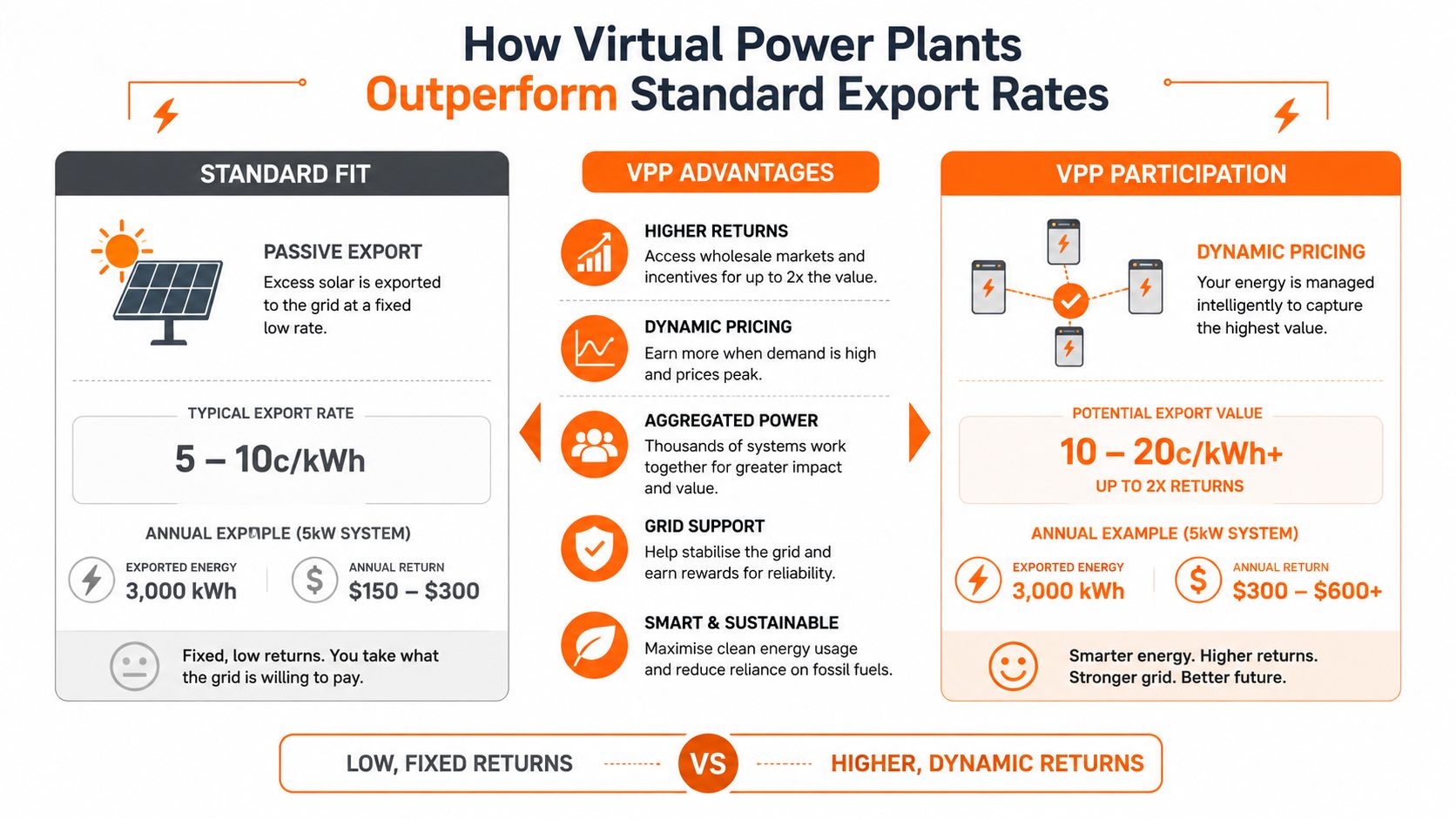
Comparing the two value models
| Feature | Standard FiT | BYOB VPP |
|---|---|---|
| Primary mechanism | Credit for exported solar | Coordinated use of battery flexibility |
| Timing | Usually linked to export | Can respond to demand, prices and grid needs |
| Household role | Passive exporter | Asset owner with agreed operating limits |
| Revenue logic | Export credit | Retail, wholesale and grid-support value where available |
| Hardware requirement | Existing solar and meter | Compatible existing battery, control integration and approved participation |
A BYOB VPP, or Bring Your Own Battery VPP, doesn't require the customer to buy a new battery as part of the participation model. The commercial question is whether the existing battery has spare capacity, compatible controls and sufficient flexibility for the program. Battery optimisation software can then decide whether to store solar, serve the home, preserve a reserve or support the grid.
The allowance model is particularly important. A retailer may convert the value of coordinated grid participation into a monthly bill-free electricity allowance, subject to the program's terms. That allowance can address supply charges and eligible usage up to its limit, rather than relying only on a low daytime export credit. High Flow Energy describes its solar battery Virtual Power Plant model as a retailer-based approach for existing solar and battery owners.
This structure doesn't guarantee a particular financial outcome. Results depend on eligibility, battery compatibility, household consumption, dispatch opportunities, retailer terms and the customer's use beyond any allowance. It does, however, address a weakness in traditional FiTs: a battery's value can come from flexibility, not only from the number of kilowatt-hours exported during the solar peak.
Maximising Battery Value Without Compromising Household Needs
Battery participation only works if the control system respects the home's operating priorities. A household needs energy after sunset, and a battery that repeatedly discharges without preserving an appropriate reserve can increase grid imports at inconvenient times. Good battery optimisation begins with those constraints, rather than treating every stored kilowatt-hour as available for market dispatch.

What an intelligent dispatch system considers
A capable control platform can combine several inputs:
- Household demand: Forecast likely evening consumption and protect priority use.
- Solar forecast: Estimate whether the next charging opportunity will refill the battery.
- Time-of-use pricing: Compare the cost of importing electricity at different periods.
- Network constraints: Respect export limits and local operating requirements.
- Battery limits: Follow manufacturer settings, reserve levels and warranty conditions.
- Customer control: Allow the owner to set boundaries or override automated actions.
The key is not to maximise cycling. It's to select dispatch events where the expected value justifies using available battery flexibility. A shallow grid-support event may be operationally different from a deep daily discharge, and the program should make those operating rules visible before enrolment.
Households also retain an important practical safeguard when they choose a program with explicit priority settings. The customer should be able to understand the reserve level, the situations that trigger dispatch, the treatment of backup capacity and the process for overriding an automated plan. Those details matter more than a broad claim that artificial intelligence will optimise everything.
The companion app is useful when it exposes live prices, forecasts, battery status, allowance use and the reason for a dispatch decision. Transparency turns automation into an auditable service. Without that visibility, a customer may struggle to distinguish genuine optimisation from unexplained battery activity.
A retailer-based VPP can also combine the bill with the battery service. In a BYOB arrangement, the household keeps ownership of the battery and receives priority access under the agreed settings, while the operator uses spare capacity for coordinated grid support.
The right comparison isn't “control versus no control”. It's manual, passive battery use versus transparent, rules-based coordination. Owners should review warranty requirements, cycling limits, export constraints, contract terms and exit conditions before joining any VPP.
Common Feed-in Tariff and Battery Misconceptions
Many solar households still evaluate batteries using assumptions formed during the high-FiT period. Those assumptions can lead owners to export too much energy, ignore battery settings or choose an electricity plan based on one attractive line item.
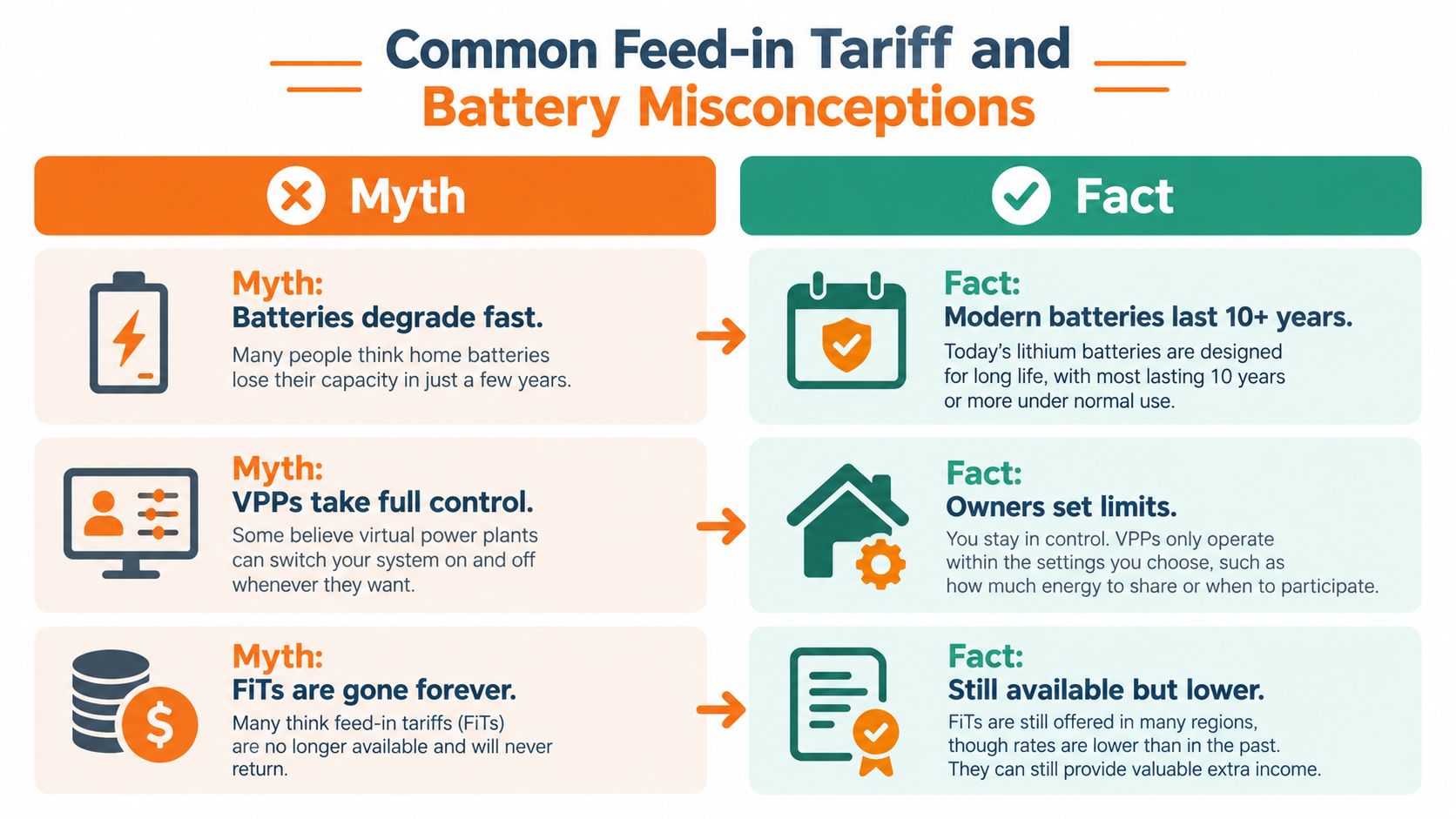
Myth one, the highest FiT is always best
Fact: The household's net bill matters more than the export rate alone. Supply charges, usage prices, export blocks, battery dispatch and evening imports can outweigh the extra credit from a higher FiT.
Myth two, a battery earns value only by exporting
Fact: A battery can create value through self-consumption, time shifting, demand response and coordinated grid services. Exporting surplus at a low daytime rate is only one possible outcome.
Myth three, VPP participation means losing control
Fact: A properly documented VPP sets operating boundaries. Owners should retain priority household use, understand reserve settings and know when manual overrides apply. The exact protections depend on the program terms and compatible battery controls.
Myth four, standard solar exports will eliminate every bill
Fact: A FiT is a credit. It doesn't guarantee that supply charges and imported usage will disappear. A VPP allowance may reduce eligible charges and usage up to its limit, but customers can still pay standard rates for energy beyond that allowance.
Myth five, battery safety can be ignored because software manages dispatch
Fact: Software cannot replace compliant installation, maintenance and safe operating practices. Owners should understand battery placement, ventilation, manufacturer requirements and emergency procedures. For a technical overview of lithium battery explosion causes, consult the Knight Tek safety resource.
The warranty question requires the same discipline. A VPP should disclose how dispatch interacts with the battery manufacturer's warranty, operating envelope and cycle limits. Customers shouldn't rely on informal assurances. They should request the relevant technical and contractual information before granting an operator access to battery controls.
Strategic Takeaways and Next Steps for Battery Owners
The modern feed-in tariff market rewards a different decision process. Export credits still matter, but they no longer provide a sufficient measure of solar or battery performance. The household must evaluate where energy goes, when it moves and which party captures the value created by flexibility.
A practical assessment sequence
Start with the bill. Record the supply charge, imported usage, export credits and any time-based rates. A high FiT can look attractive until the household compares the total bill after all charges.
Then inspect the battery. Review the battery's charge and discharge history, reserve setting, evening contribution and periods of inactivity. Many owners have a technically capable asset that spends much of its time following a basic self-consumption schedule.
Test the export strategy. Ask whether midday surplus is exported because it creates value or only because the battery is full. Check whether the retailer offers a flat rate, blocks, time-based pricing or a coordinated VPP service.
Review network conditions. Queensland and NSW households can face different retail arrangements, network requirements and export constraints. A plan that appears attractive in one area may not produce the same result in another.
Check the VPP terms. Confirm battery compatibility, household priority, reserve controls, warranty treatment, allowance rules, usage beyond the allowance, customer data access and exit arrangements. A transparent provider should explain how the service earns and distributes value.
Key takeaways
- A FiT is a credit, not guaranteed income.
- Daytime export value is structurally weaker than the legacy rates many households remember.
- NSW and Queensland use different benchmark, regulated and market arrangements.
- The highest advertised FiT doesn't necessarily produce the lowest bill.
- Battery value comes from timing, flexibility and controlled dispatch, not export volume alone.
- A BYOB VPP can create a different value stream without requiring new hardware, subject to eligibility and program terms.
- Household priority, warranty protection and transparent controls should be essential.
Most battery owners focus on installation quality. Far fewer focus on ongoing performance and optimisation. High Flow Energy is an electricity retailer built around revealing the full value of an existing solar and battery system, using a BYOB VPP structure that coordinates eligible battery flexibility and applies the resulting value through its allowance model.
If you want to understand whether your battery is underperforming financially, review your current bill and request an eligibility assessment through HighFlow Energy.