

Electricity Allowance for Working from Home in Australia
A hybrid worker finishes an eight-hour day with a laptop, monitor, modem and air conditioner running, then opens the electricity bill and asks a reasonable question: who pays for the extra energy? The answer depends on whether you're dealing with an electricity allowance for working from home, an employer payment, an ATO tax deduction or a bill credit from an energy retailer.
The distinction matters even more if you own solar and a battery. Your home office may use solar generation during the day, draw from stored energy later, or import electricity from the grid during a high-price period. Those are different costs, and the ATO's work-from-home deduction isn't the same thing as money taken off your bill.
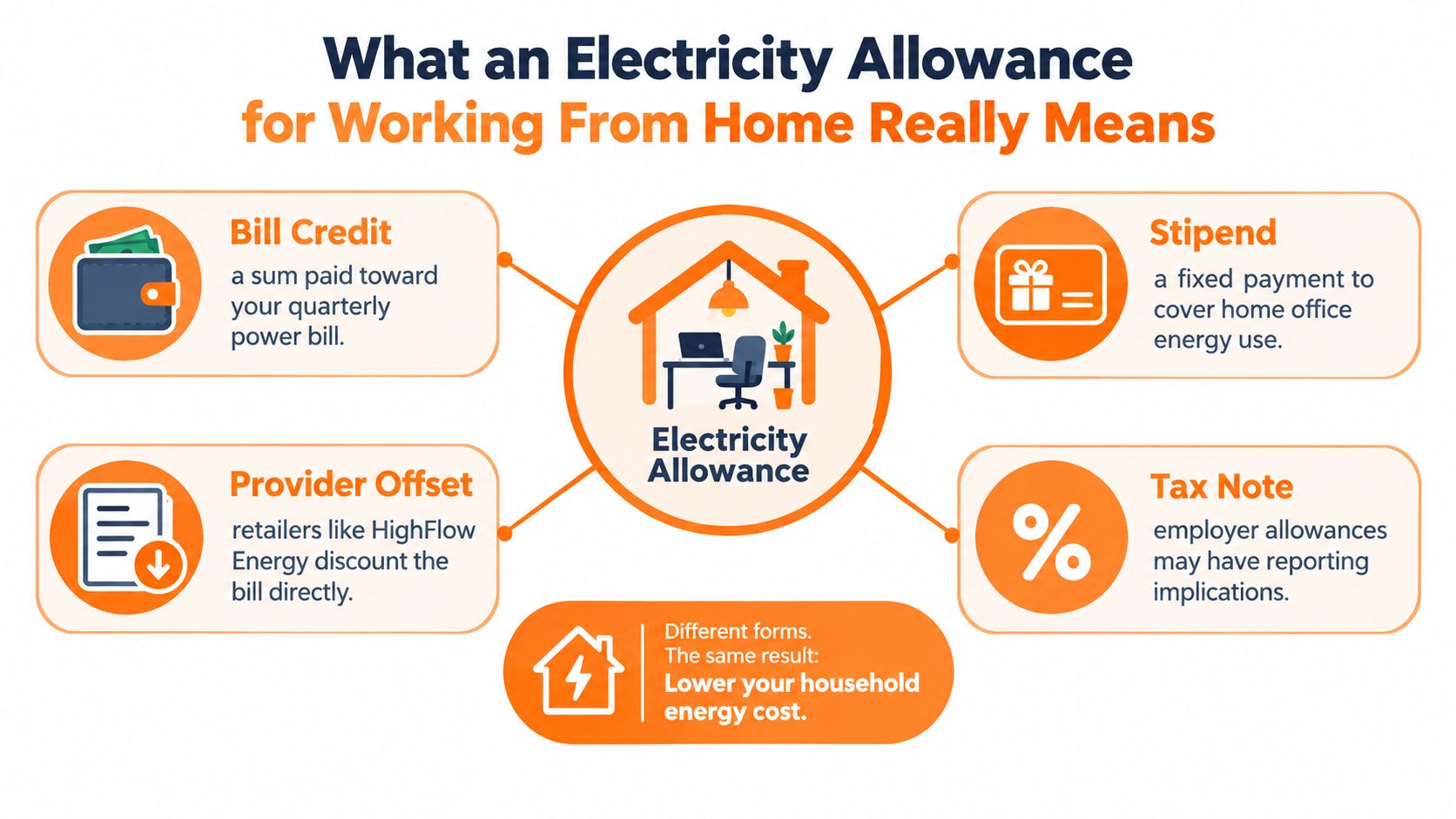
What an Electricity Allowance for Working From Home Really Means
An electricity allowance is a contribution towards the energy costs of working from home. It might be paid as cash, reimbursed against an invoice, or applied as a credit to an electricity account. An employer may provide it as part of a workplace arrangement. An energy retailer or VPP operator may provide a bill credit based on a household's participation in an energy programme.
That makes an allowance different from a tax deduction. A bill credit reduces the amount you owe the retailer. A tax deduction reduces your taxable income, so its after-tax value depends on your circumstances. An employer payment may be taxable income, while an expense reimbursement can operate differently depending on the arrangement and supporting records.
Three arrangements to keep separate
You'll usually encounter three separate mechanisms:
- ATO deduction: The Australian Taxation Office allows eligible employees to claim certain working-from-home costs through a prescribed method or an actual-cost method.
- Employer reimbursement or allowance: Your employer may contribute to home-working costs. The tax treatment depends on how the payment is structured and your own return.
- VPP-funded credit: A retailer-based Virtual Power Plant may apply a credit to your electricity account in return for coordinated access to an enrolled battery or other flexible energy assets.
Solar and battery households need this separation because daytime grid imports can be low without being cost-free. Solar electricity used in the office could otherwise have been exported or stored. Battery discharge can also involve charging losses and a replacement cost that changes with the tariff period.
Practical rule: Treat the ATO deduction as a tax calculation, and treat a retailer credit as an electricity-account calculation. Don't combine them into one supposed per-hour electricity rate.
A household allowance can be expressed in dollars, or sometimes in energy terms such as kilowatt-hours. The ATO fixed-rate method shouldn't be interpreted as proof that each hour of remote work consumed a fixed amount of electricity.
How Allowances Are Calculated and Applied to Your Bill
A useful calculation starts by identifying what the allowance measures. An employer might agree to a fixed payment for each hour worked at home. A retailer might calculate a credit against measured usage, an agreed product benefit or participation in a VPP. The written terms should explain whether the credit can offset usage charges, daily supply charges, or both.
An electricity bill normally has two relevant components. The usage charge reflects energy imported, while the daily supply charge applies for access to the network and electricity service. Solar can reduce grid usage, but it doesn't automatically remove the supply charge.
For an actual-cost estimate, the ATO's engineering-style approach combines appliance demand in kilowatts, the electricity price in dollars per kilowatt-hour and recorded operating hours. Its worked example uses a 1.09 kW heating or cooling load, an electricity cost of 28 cents per kilowatt-hour and 768 hours, producing an attributable energy expense of $234.39, or approximately 30.52 cents per operating hour for that appliance alone. See the ATO actual-cost worked example for the underlying calculation.
A simple measurement framework
Don't assume that a laptop, monitor and air conditioner have the same energy profile. Heating and cooling can dominate office consumption, while a modem and LED lighting usually contribute a smaller load.
| Appliance | Power draw (W) | Hours / day | Monthly kWh |
|---|---|---|---|
| Laptop | Measure at the appliance | Record actual use | Calculate from measured data |
| Monitor | Measure at the appliance | Record actual use | Calculate from measured data |
| Router or modem | Measure at the appliance | Record operating time | Calculate from measured data |
| Heating or cooling | Measure or use rated demand | Record seasonal use | Calculate separately |
A smart plug or home energy monitor can help you create a baseline. For solar-and-battery homes, record whether the office load was supplied by rooftop generation, battery discharge or the grid. That won't by itself determine the correct tax claim, but it can improve the household cost model.
Daily supply charges can be easy to overlook. A resource such as this guide for property owners on delivery charges can help explain why an electricity account contains fixed network-related charges even when imported usage is low.
For a practical way to understand the structure of a residential account, compare the line items in this electricity bill example. Align the allowance period with the billing cycle where possible. Otherwise, a credit or reimbursement may be split across periods, making the result harder to reconcile.
The ATO Fixed-Rate Deduction vs a Real Electricity Allowance
The ATO fixed-rate method is often described casually as an electricity allowance, but that description is incomplete. For the 2024–25 and 2025–26 income years, eligible taxpayers can claim 70 cents per actual hour worked from home under the fixed-rate method, subject to the ATO's eligibility and record-keeping requirements. The rate covers additional electricity and gas for heating, cooling and lighting, as well as internet and data, mobile and home-phone use, stationery and computer consumables. See the ATO fixed-rate guidance.
That 70 cents isn't a cash payment. It is a deduction from taxable income. At 1,000 work-from-home hours, the bundled deduction is $700, not $700 credited to an electricity account. The after-tax value depends on the taxpayer's marginal tax rate and tax position.
| Method | 100 hours claim | Net benefit for a 30% taxpayer | Net benefit for a 37% taxpayer |
|---|---|---|---|
| ATO fixed-rate method | $70 deduction | Depends on tax position | Depends on tax position |
| Real electricity bill credit | Credit defined by provider | Credit applied to account | Credit applied to account |
The table illustrates the central difference, not a personal tax result. A bill credit has a direct relationship with the electricity account. An ATO deduction may reduce tax payable, but the outcome depends on eligibility, taxable income, tax liability and the deduction method selected.
The actual-cost alternative
The ATO actual-cost method requires a reasonable calculation of work-related energy use. You need to consider appliance power, the relevant tariff and recorded operating hours, while separating work use from private use. The ATO's actual-cost method guidance provides the framework.
Solar and battery owners face an extra accounting question. A home office may use self-generated solar while the household forgoes an export payment, or it may use battery energy that could have been stored for later. The cited ATO guidance doesn't provide a simple solar-and-battery allocation rule covering every situation. Keep the tax calculation separate from the household energy economics, and seek professional tax advice where the distinction affects your return.
How a VPP-Backed Allowance Works in Practice
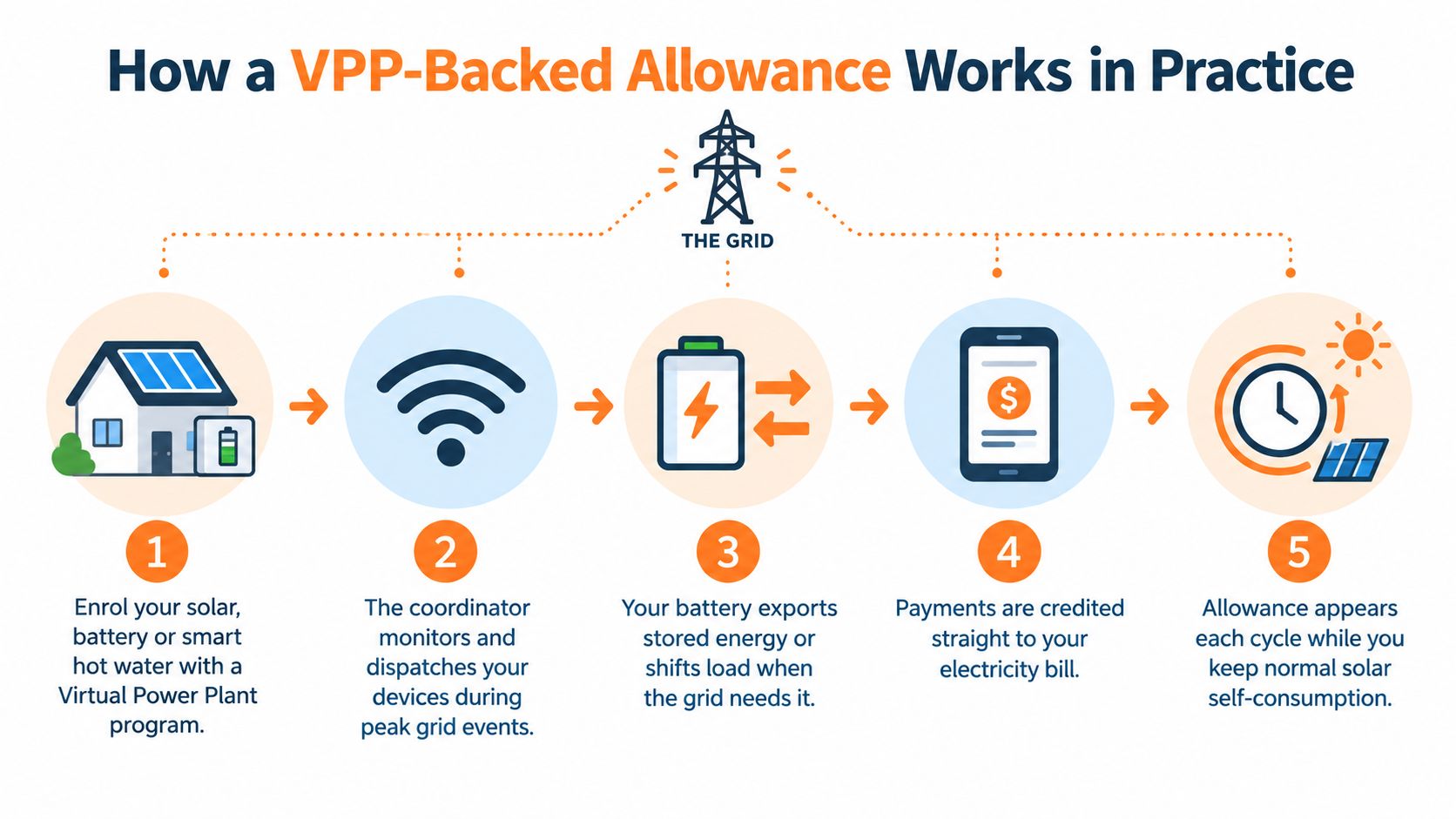
A Virtual Power Plant connects separate household energy assets through software. A coordinator can monitor enrolled batteries, solar inverters or other flexible devices and schedule their operation when the grid needs support. The household still uses its own energy, but some available capacity can participate in coordinated demand response.
The financial model differs from an employer reimbursement. A VPP provider may receive value from wholesale market participation, grid support or other retail arrangements, then return some of that value as an account credit. The exact amount, timing and eligibility rules depend on the provider's offer and the customer's contract.
What happens during a dispatch
A typical process looks like this:
- You enrol an eligible battery or other flexible device in a VPP.
- The coordinator monitors market conditions, network needs and the device's available capacity.
- The system may discharge stored energy, change charging behaviour or shift another flexible load.
- The provider calculates the customer's agreed benefit.
- The benefit appears as an account credit according to the settlement schedule.
The household's priority use should be clearly stated in the agreement. A responsible arrangement explains the minimum reserve, dispatch conditions, battery warranty considerations, export limits and the circumstances in which the customer can override the schedule.
Wholesale price volatility is central to the model. A VPP can create value by responding when energy is scarce or when network demand is high, but participation also involves trade-offs. Discharging at one time may leave less stored energy for later household use. Battery cycling, export constraints and time-of-use pricing all affect the outcome.
For Queensland and New South Wales households, a retailer-based BYOB VPP can therefore be evaluated as an additional value stream, not as a replacement for good solar self-consumption. Review the service terms and compare the credit with the opportunity cost of using or exporting the energy.
The solar and battery Virtual Power Plant overview offers a further explanation of how an enrolled system can participate in coordinated energy services.
The following video provides another visual introduction to the operating model:
What Daily Supply Charges and Typical Work From Home Usage Look Like
A work-from-home allowance should be tested against the whole electricity account, not just the office appliances. The usage component changes with appliance demand, weather, tariff period and the amount of solar generation available. The supply component continues as a recurring account charge.
This is particularly important for a battery household. A battery can reduce imports during an evening work period, while a VPP credit may be capable of offsetting part of the account balance under the provider's terms. Neither outcome should be assumed without checking the retailer's bill structure.
A state-by-state comparison needs real bill data
Queensland and New South Wales customers can face different tariffs, network arrangements, export limits and time-of-use structures. Victorian households also have different retail conditions. Because these values vary by plan and location, a generic state average can mislead a customer comparing an allowance.
| State | Daily supply charge | Average usage rate | Monthly supply cost | Monthly usage cost for office load | Net after allowance |
|---|---|---|---|---|---|
| Queensland | Check current offer | Check current tariff | Calculate from bill | Calculate from measured kWh | Subtract eligible credit |
| New South Wales | Check current offer | Check current tariff | Calculate from bill | Calculate from measured kWh | Subtract eligible credit |
| Victoria | Check current offer | Check current tariff | Calculate from bill | Calculate from measured kWh | Subtract eligible credit |
Use your actual bill rather than a headline comparison. Look for the daily supply charge, usage rate, controlled-load or demand components, feed-in tariff and any conditional discounts. A customer with low grid imports can still have a meaningful account balance if fixed charges remain and the plan provides limited value for exported solar.
The daily supply charge explainer can help separate the fixed access cost from variable consumption. Then compare the allowance rules: does it reduce usage charges only, or can it also reduce supply and network-related charges?
A transparent calculation should show three lines: the home office's measured or estimated energy, the household's actual tariff exposure, and the allowance or credit applied. That format makes it easier to compare a traditional retail plan, an employer arrangement and a VPP offer without treating them as interchangeable.
Why Most Battery Owners Are Underusing Their Asset
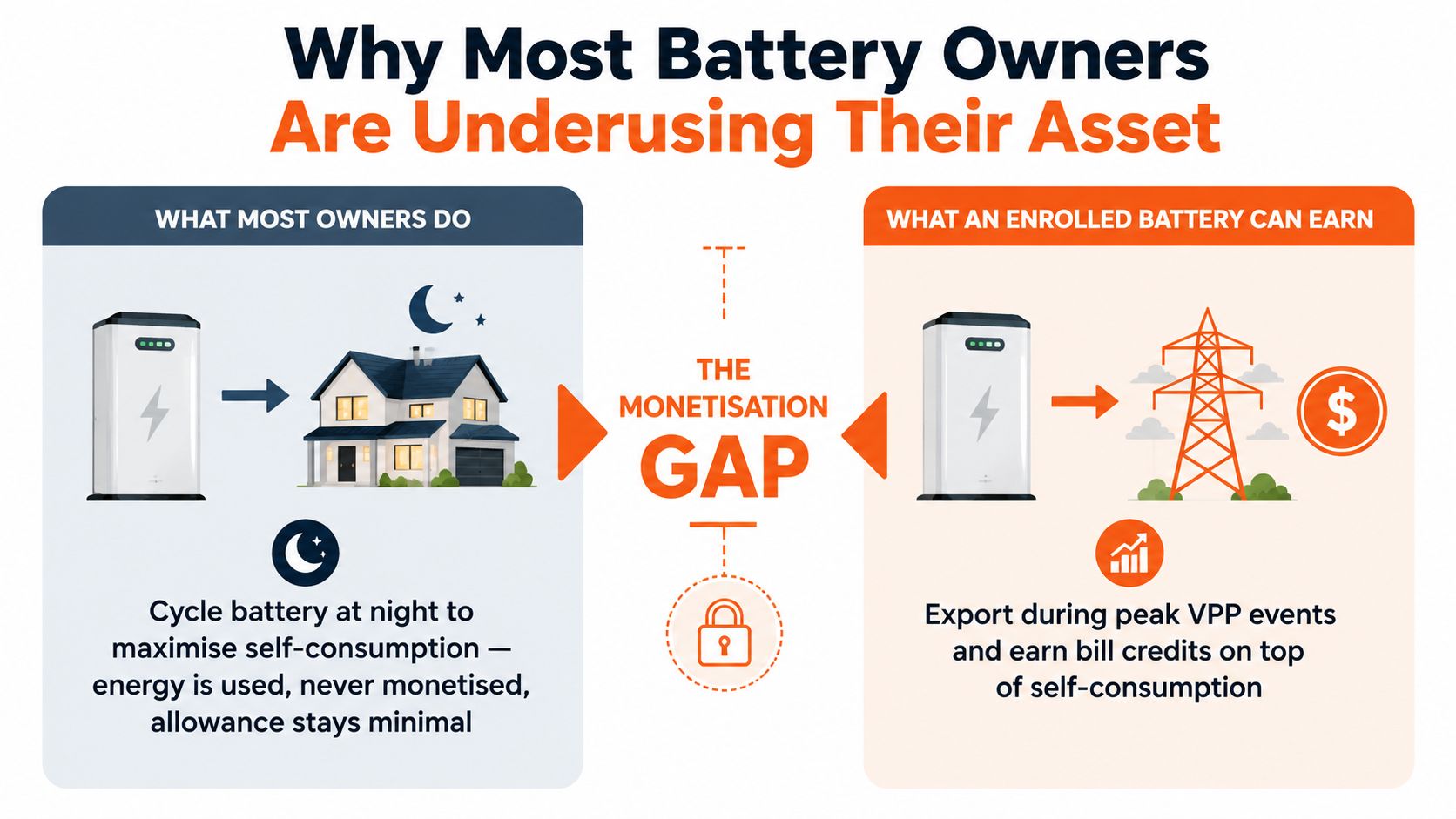
Owning a battery doesn't automatically mean the system is earning its full potential. Many households use stored energy to reduce evening imports, which can be sensible, but that operating pattern captures value only through avoided purchases.
A battery can be managed in several ways:
- Self-consumption: Store surplus solar and use it later in the home.
- Time-of-use optimisation: Charge or discharge around different tariff periods.
- VPP participation: Make some available capacity respond to grid or market conditions in return for an agreed benefit.
Each mode involves a different trade-off. Self-consumption provides direct household value. Time-of-use optimisation depends on the tariff. VPP participation introduces a further revenue stream, but it requires clear limits around dispatch, reserve energy, cycling and customer override rights.
The capacity question
The relevant question isn't only whether a battery is full. It is whether the system has spare capacity after meeting the household's expected needs. A battery that discharges for grid support too early may leave the home exposed later. A battery that never participates may miss opportunities to convert flexible capacity into account value.
Network congestion and export limits add another layer. In some circumstances, exporting more solar isn't possible or isn't the most valuable action. Coordinated discharge, controlled charging or delayed load can create a different form of value, depending on the VPP design.
The key distinction: A battery can reduce electricity purchases without generating a separate payment. A VPP attempts to add a revenue stream, but the contract must explain how that value is shared.
That connects directly with working from home. The same stored energy that can support an office during a high-demand period may also be available for a coordinated grid event. A household should compare the value of keeping that energy for private use with the benefit offered for making it available.
Key Takeaways
- An electricity allowance for working from home can be a cash payment, reimbursement or direct bill credit.
- The ATO fixed-rate method is a tax deduction, not a retailer reimbursement.
- For 2024–25 and 2025–26, the ATO fixed rate is 70 cents per actual hour worked from home, subject to eligibility and records.
- The ATO rate bundles electricity with internet, phone, stationery and computer consumables.
- A solar-and-battery household should separate tax compliance from the economic cost of self-generated or stored electricity.
- A VPP credit may provide a direct account benefit, but the dispatch rules, reserve requirements and settlement terms matter.
- Compare any offer with your actual bill, measured office load, tariff structure and battery priorities.
Frequently Asked Questions
Is the ATO working-from-home rate an electricity allowance?
No. The ATO fixed-rate method is a tax deduction. It covers several home-working expenses and reduces taxable income. It isn't a direct payment from an electricity retailer and shouldn't be treated as a fixed electricity reimbursement.
Can I receive an employer allowance and claim a deduction?
Possibly, but the result depends on how the employer payment is treated, your eligibility and the deduction method you use. An employer-paid allowance may need to be declared as assessable income, while eligible work-related deductions may be claimed separately. Keep records and obtain tax advice for your circumstances.
Does the 70-cent rate represent electricity consumed per hour?
No. The rate is a bundled deduction covering energy and other listed expenses. It isn't proof that the home office consumed 70 cents of electricity during each hour worked.
How should solar households calculate the work-from-home energy cost?
Use the appropriate ATO method for your tax claim and keep the household energy model separate. For economic analysis, consider whether office electricity came from the grid, solar generation or a battery, and whether solar energy used on-site could otherwise have been exported or stored.
Can a VPP credit be combined with an ATO deduction?
They are different mechanisms. A VPP credit affects the electricity account, while an ATO deduction affects taxable income. Whether both apply to your circumstances depends on the relevant terms and tax rules.
Does a battery VPP always prioritise the home?
A suitable arrangement should clearly state household priority, reserve levels, dispatch rights and override controls. Read the contract before enrolling, especially if your battery is needed for evening loads, backup or medical equipment.
What should I compare before accepting an allowance?
Check whether the benefit is taxable, whether a bill credit offsets usage or supply charges, how often it is settled, whether it expires, and what happens when the agreement ends. For a VPP, also review battery cycling, export limits, warranty considerations and exit terms.
Tips to Maximise Your Allowance and Spot the Right Deal
Start with the contract, not the headline amount. A nominal rebate may apply only to usage, while another credit may reduce a wider part of the account. The product disclosure statement should explain eligibility, calculation, settlement timing, expiry rules and whether the provider can change the offer.
Build a household baseline
Measure the office separately for a representative period. Include the computer, monitor, modem, lighting, heating or cooling and any device that operates specifically because someone is working from home. Then compare the measured load with the bill's tariff and the timing of solar production.
A battery owner should also identify the source of each kilowatt-hour:
- Solar generation: Electricity used on-site may displace exports.
- Battery discharge: Stored energy may have charging losses and an opportunity cost.
- Grid imports: The household pays the applicable usage rate and may face a higher price during a peak period.
The baseline doesn't replace ATO records. It gives you a clearer commercial view of whether an allowance reflects the cost you face.
Test the VPP terms
Ask who controls dispatch, what minimum reserve remains for the household, how the provider shares revenue and whether the battery manufacturer's warranty permits the operating schedule. Check whether the service works with your inverter, battery model and network connection in Queensland or New South Wales.
A transparent provider should also explain how it handles demand events, export constraints, wholesale exposure and customer overrides. The offer should distinguish normal solar self-consumption from energy made available for grid support.
Watch for common traps
- One-off rebates: Confirm whether the benefit is ongoing or expires after an introductory period.
- Restricted credits: Check whether the credit applies only to usage and excludes supply charges.
- Unclear settlement: Find out when the credit appears and how corrections are handled.
- Battery trade-offs: Make sure dispatch doesn't undermine the reserve you need at home.
- Tariff mismatch: Compare the offer against single-rate and time-of-use pricing where available.
The right deal isn't necessarily the one with the largest advertised allowance. It's the one whose payment rules match your actual electricity use, solar profile, battery capacity and household priorities.
HighFlow Energy is an Australian electricity retailer that connects eligible existing solar and battery systems to a BYOB Virtual Power Plant, with coordinated battery participation and bill credits structured around the value created by those energy assets. Visit HighFlow Energy to check eligibility and assess whether your current battery is being fully utilised.