


Solar Power Savings Australia
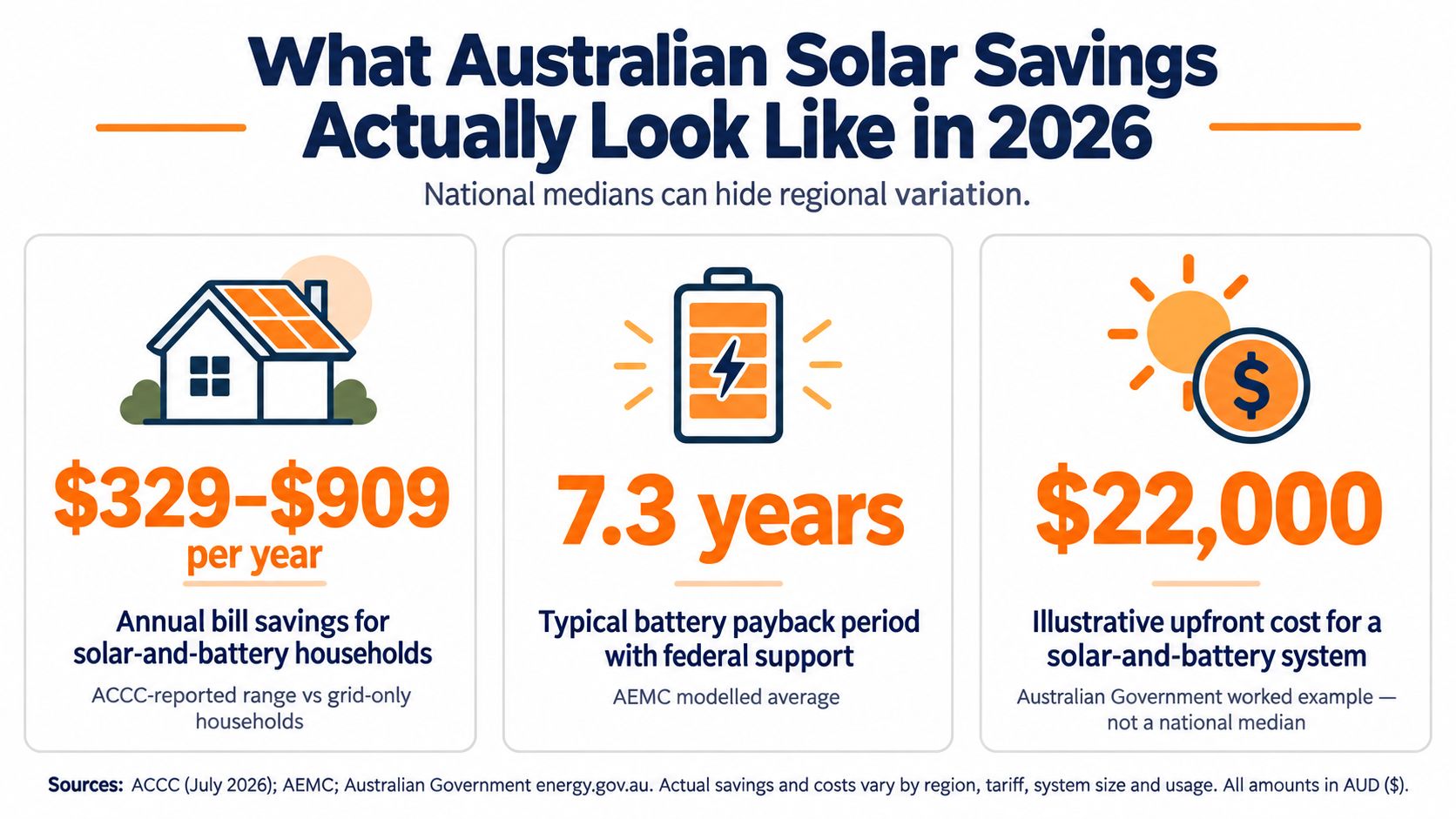
Households with rooftop solar and a home battery paid a median $936 a year in 2023–24, roughly 40% less than grid-only households. That figure is a useful baseline for Australian solar power savings, not a promise for every home in Queensland or New South Wales.
Your result depends on what your system does with each kilowatt-hour. Solar can reduce retail purchases, earn a feed-in tariff for exports, and create additional value through coordinated battery services. The mistake is treating those outcomes as one simple savings number.
Australian rooftop solar is now a major household energy asset. More than 4 million homes and businesses had adopted rooftop photovoltaic systems by 2024, and the Clean Energy Council says those installations save Australian households more than $6 billion each year on energy bills. An average family can reduce annual electricity costs by about $1,500 through rooftop solar alone, although household results vary significantly. (Clean Energy Council data on rooftop solar uptake)
For battery owners, the important question isn't “How much solar do I generate?” It's “What is each unit of energy worth at the moment I use, export or dispatch it?” This guide breaks that value chain into practical decisions for QLD and NSW households.
What Australian Solar Savings Look Like in 2026
The gap that matters is not one headline savings figure. It is the spread between what a kilowatt-hour saves you in the home, what it earns on export, and what a battery can add when it is coordinated well.
Start with the bill baseline. The ACCC found that in 2023–24 the median annual electricity bill was $1,565 for a grid-only household, $1,279 for a household with rooftop solar, and $936 for a household with rooftop solar and a home battery. That puts the solar-and-battery group at about 40% less than grid-only households, while solar alone was about 18% lower. (ACCC household bill analysis)
Use those figures as a reference point, not a promise. Two homes on the same street in Brisbane, regional Queensland or NSW can land very different results because usage timing drives value. Roof orientation, shade, system size, tariff design, battery control settings, network charges, and evening demand all change the outcome.
Three streams create the result
If a retailer quotes “solar savings”, make them separate the value into these streams:
- Avoided retail purchases: Solar used in real time cuts the electricity you would otherwise buy at your retail rate.
- Feed-in tariff income: Excess generation sent to the grid earns a retailer export credit.
- Coordinated services: A battery can also earn an allowance, payment or bill credit when a VPP operator dispatches it under program terms.
This distinction matters more in QLD and NSW than many sales pitches admit. A home with strong daytime consumption will often get the best value from direct self-consumption. A home with heavier evening use may do better by storing solar for later. A battery owner with access to coordinated dispatch may have a third option, let the system export or discharge when that action is worth more than keeping the energy for routine evening use.
That is the decision rule running underneath your bill. Export when the export value is better. Store when evening replacement value is better. Let a VPP dispatch only when the program credit outweighs the flexibility you give up.
Australia's rooftop solar base is already large enough that these choices matter at system level as well as household level. More than 4 million homes and businesses had installed rooftop PV by 2024, according to Clean Energy Council national solar data.
For a household view, use a solar savings calculator that separates consumption, exports and battery behaviour instead of relying on one blended estimate.
How Solar Savings Are Actually Created
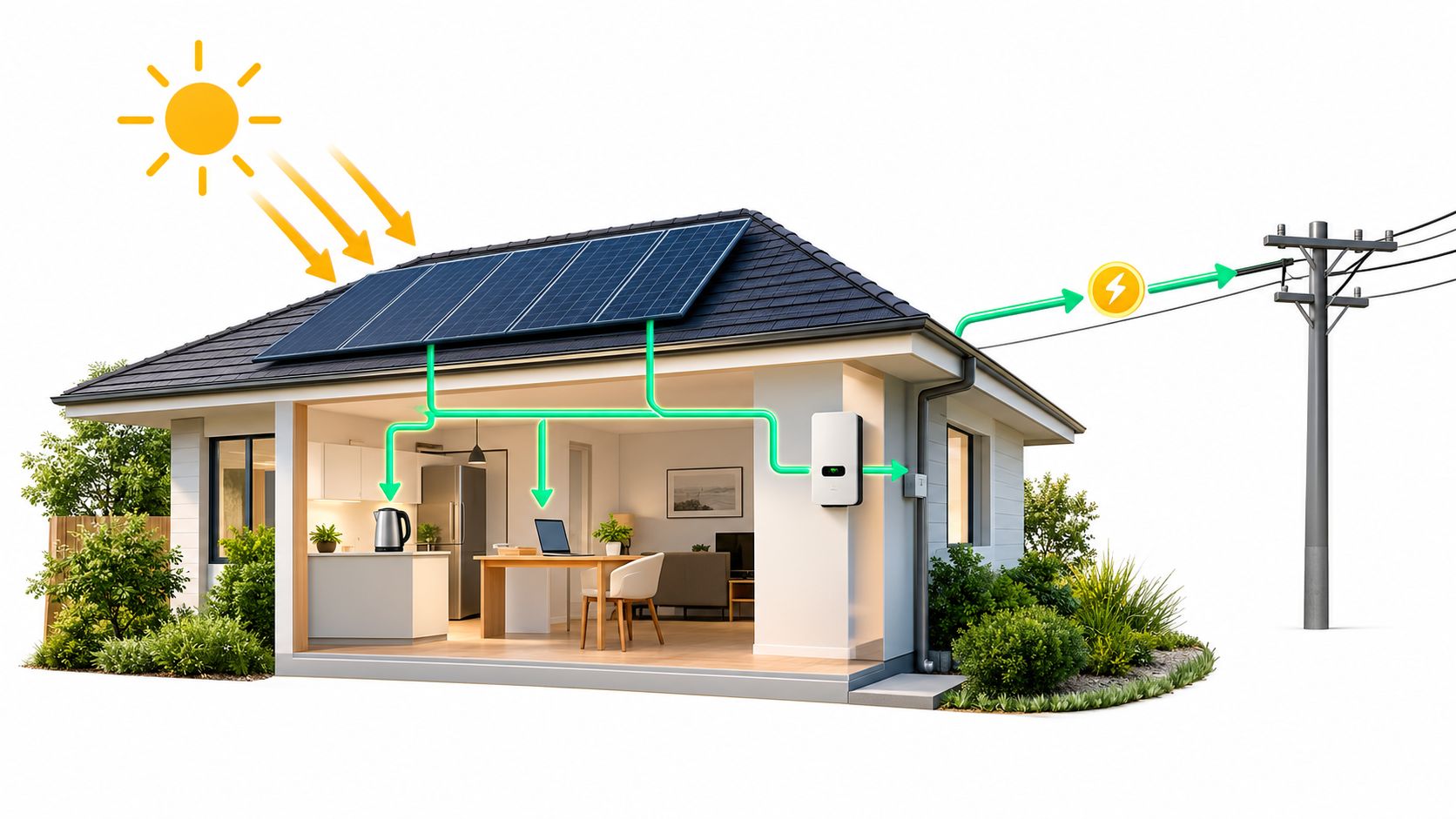
Every kilowatt-hour your system produces has four possible jobs. It can run your home straight away, charge your battery, go out to the grid, or be dispatched under a VPP. Your savings depend on which job creates the most value in that interval.
Start with self-consumption. When solar output lines up with daytime demand, your appliances use that energy before you buy from the grid. That is usually the strongest base saving on a standard household bill because it cuts imported usage at the retail rate, not at a lower export credit.
The second layer is storage. If your panels are producing more than the house needs, a battery can hold that surplus for later. That helps homes with heavier evening demand, but only if the stored energy replaces a purchase you would otherwise have made. Storing power is not automatically better than exporting it. The battery gives you timing control, and timing is where the value sits.
Exports are the third movement. Once the home is covered and the battery has room only for so much, excess solar goes to the grid and your retailer applies a feed-in tariff. That credit matters, but it is only one part of the value chain. Treating total solar savings as one blended number hides the actual decision. A kilowatt-hour used in the kitchen at midday, a kilowatt-hour stored for the evening peak, and a kilowatt-hour exported for a credit do not have the same value.
Then there is coordinated dispatch through a VPP. Under some programs, spare battery capacity may be used for grid support in return for a bill credit, allowance or other payment. That can improve returns, but only if the program payment beats the value of keeping that energy for your own later use.
A simple way to read the bill is this:
- Solar used on site lowers imported usage charges.
- Battery discharge later lowers imported usage if it offsets grid purchases.
- Exports show up as a feed-in credit.
- VPP activity appears under the retailer or program billing structure.
Use that order when making decisions. Self-consume first where you can. Store when later replacement value is higher than the export credit. Let a VPP dispatch only when the payment covers battery losses, wear, and the flexibility you give up.
Why QLD and NSW Feed-In Tariffs Change the Math
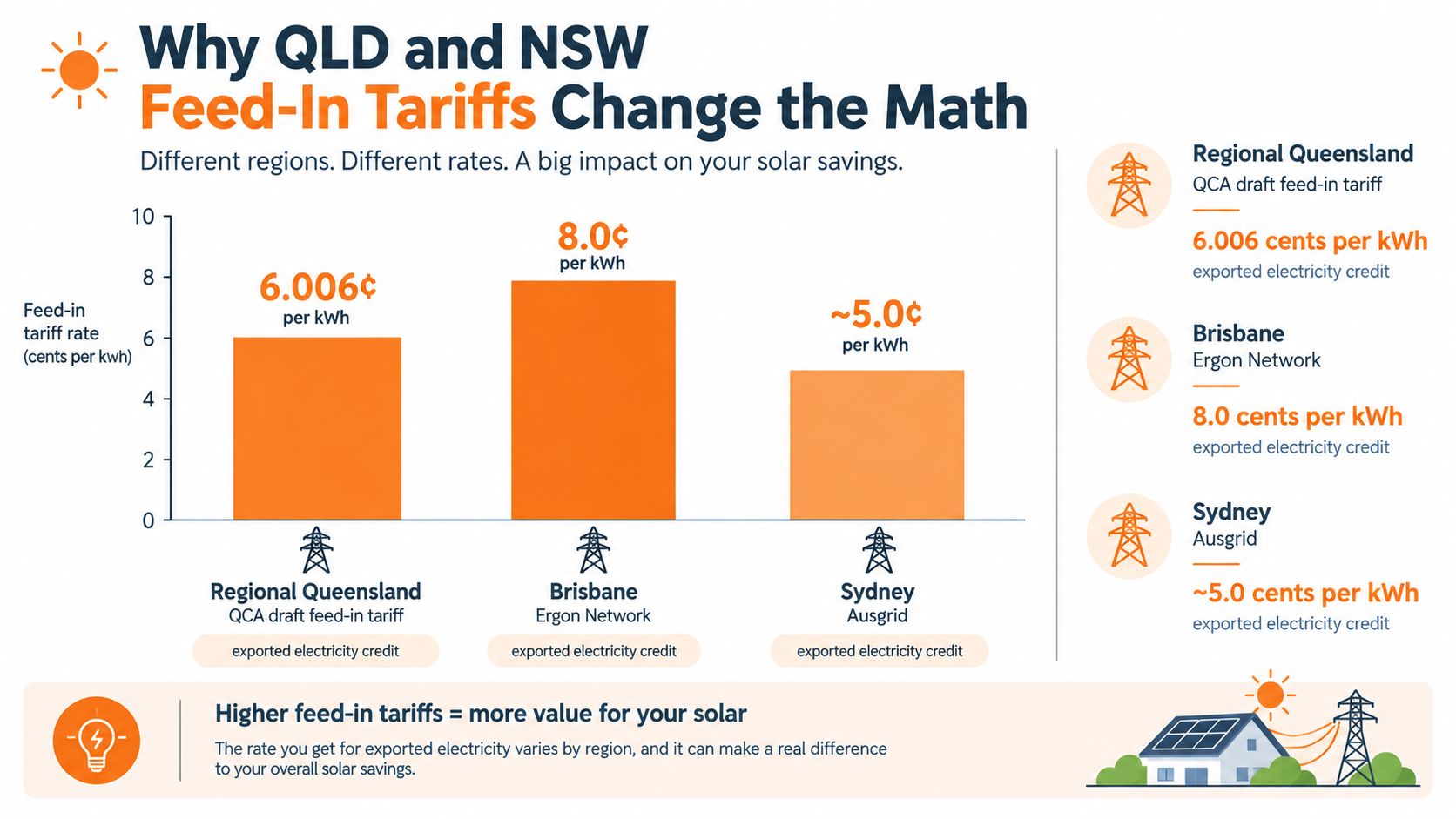
In regional Queensland, the export credit itself is getting weaker. The Queensland Competition Authority's draft regional feed-in tariff for 2026–27 is 6.006 cents per kilowatt-hour, down from 8.660 cents in 2025–26, a reduction of roughly 31%. That one change is enough to shift the battery decision away from automatic export and toward tighter control of when energy is used, stored, or released. (Queensland Competition Authority draft determination)
That matters because solar savings are not one number. A daytime export, an evening battery discharge, and a VPP event can all involve the same kilowatt-hour, but they do not produce the same return.
Queensland and New South Wales also do not reward exports the same way. Queensland has a clearer regional benchmark. NSW is more fragmented. A Sydney household may face very different export pricing, network settings, and retailer structures from a home elsewhere in NSW, so copying a headline tariff from another suburb is poor practice. Compare your own bill settings, not someone else's screenshot. For a retailer-by-retailer view in Queensland, check current Queensland feed-in tariff options.
Here is the rule that works for battery owners. Value each possible use of the next stored kilowatt-hour, then pick the highest one after losses and wear are accounted for.
CSIRO and AEMO modelling uses approximately 85% round-trip efficiency, an 85% limit on usable rated capacity, residential battery capacities around 11 kWh, and annual usable-capacity degradation of about 1.6%. Those assumptions are useful because they stop homeowners from treating the nameplate battery size as if it were fully available every day. (CSIRO and AEMO small-scale solar PV and battery projections)
So the operating order should be strict. Store solar when it will offset a higher evening import. Export when the credit is competitive for that interval. Let a VPP dispatch only when the payment beats the value of keeping that energy for your own later load or backup needs.
Modelling Payback for a Typical QLD or NSW Home
For a typical QLD or NSW household, battery payback comes down to one question. How often does stored solar replace expensive evening imports instead of low-value daytime exports?
Start with a representative home using a 6.6 kW rooftop solar system and an 11 kWh battery. As noted earlier, the battery should be modelled on usable output, not the nameplate number on the brochure. Operating limits, conversion losses and gradual degradation all reduce what the household can draw on over time. That matters because payback is created by the value of each discharged kilowatt-hour, not by battery size alone.
A practical way to model it is to run the numbers in order, using your own interval data rather than a retailer estimate.
- Measure imported energy. Use the last quarter's bill or interval data.
- Split demand by timing. Separate daytime usage from evening and early-morning usage, when solar output has faded.
- Value each avoided import. Apply your actual retail usage rate to the energy the battery would cover.
- Subtract what the battery costs you to operate. Include round-trip losses, degradation and the export credit you gave up by storing that solar instead.
- Add VPP income only if the rules are clear. Count it only when the payment or credit is stated and the dispatch terms are understandable.
- Compare annual net value with the battery investment. As a rule of thumb, a simple payback under roughly 8 years is usually worth pursuing for an 11 kWh battery. If the payback pushes well beyond that, the battery needs a stronger tariff setup, better evening usage alignment, or a VPP arrangement that lifts annual value.
That last step is the decision rule many households miss. A battery is more likely to stack up when the home has reliable evening demand and regularly avoids higher import prices. A household that exports a lot, uses little power after sunset, and rarely cycles the battery properly will struggle to get an attractive result, even with a weak feed-in tariff.
Tariff choice can improve or damage the outcome. A time-of-use plan can increase the value of stored solar, but only if the battery is charged and available at the right times. If it empties too early, the household can end up buying back power during the most expensive window.
Use a solar battery payback assessment to test your own interval profile, tariff settings and likely battery value before you commit.
The Hidden Gap Between Battery Owners and VPP Participants
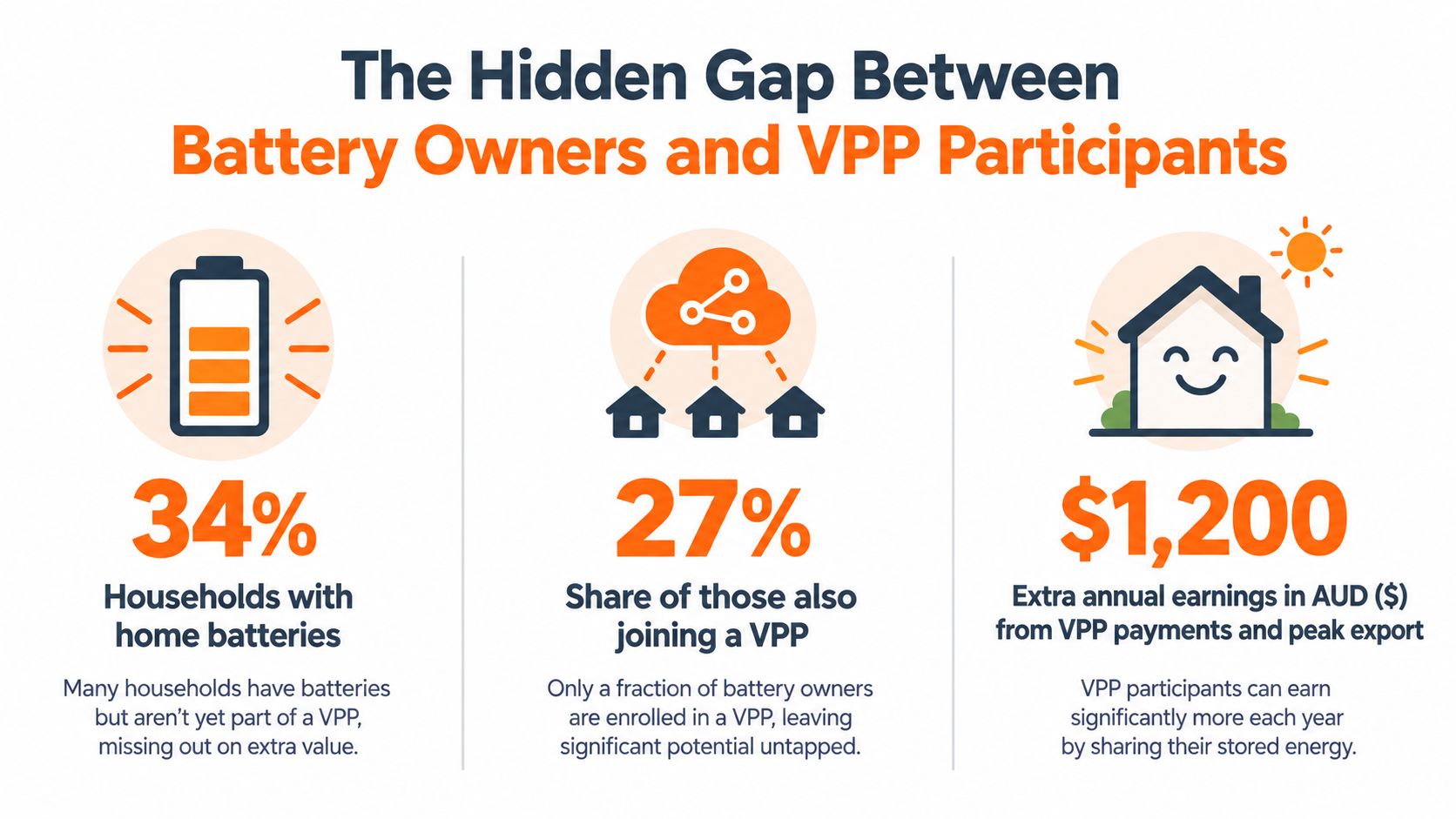
Only 24% of Australian households with solar and batteries had joined a VPP in reporting on ACCC analysis, even though participating households were associated with lower median annual bills than households without solar or batteries. (ACCC VPP analysis reporting)
That gap matters because owning a battery is not the same as using it well. A battery can cut imports on its own. A Virtual Power Plant goes further by coordinating many batteries through software and communications so they charge, discharge and respond as a fleet.
The Australian Energy Market Operator tested exactly that through its demonstration program. The trials examined whether aggregated household batteries could provide Frequency Control Ancillary Services, respond to wholesale price signals and support local network conditions. (AEMO VPP demonstration program)
For homeowners in QLD and NSW, the takeaway is simple. A battery sitting idle through the wrong hours leaves value on the table. A VPP can improve that outcome, but only when the operator's rules are clear and the battery still serves the household first.
What gets coordinated varies by program. The operator may schedule charging when surplus solar is available, trigger discharging when household demand or wider system conditions make stored energy more valuable, hold reserve levels back for the home, and use fast battery response to help manage frequency. At fleet level, hundreds or thousands of small systems can be dispatched like one larger resource.
A real example shows the scale. ARENA's Simply Energy VPP project received $7.7 million in funding and had a total project cost of $23.73 million. It was designed to connect up to 1,200 Tesla Powerwall 2 batteries, representing approximately 6 MW of residential storage, plus a further 2 MW of demand response from 10 commercial businesses. (ARENA Simply Energy VPP project)
That does not mean every VPP is automatically a good deal. Some programs offer useful bill credits and sensible control settings. Others ask for too much flexibility in exchange for too little value. If the payment method is vague, the dispatch conditions are hard to follow, or the minimum backup reserve is weak, skip it.
A Decision Rule for Battery Owners
Battery savings are not one number. For a home in QLD or NSW, each unit of stored solar has three possible jobs, and the best one changes by interval: use it in the home, export or discharge when value is higher, or keep it in reserve.
Start with self-consumption. In most homes, the first priority is avoiding an evening grid purchase, because that usually beats sending the same energy out for a modest feed-in credit. Earlier modelling discussed in this article makes the same point. home batteries earn much of their value by soaking up daytime solar that would otherwise be exported, then covering later household demand.
When to store
Store surplus solar when your evening usage is predictable and heavy enough to use that energy after sunset. That is the default rule for a lot of households. If the avoided import price is better than the export credit, after allowing for battery losses and wear, keep the energy.
For many battery owners, this is the cleanest decision of the day. Charge from rooftop solar through the middle of the day, then discharge into your own evening load first.
When to export or let a VPP dispatch
Exporting is not wrong. It is only worth doing when the value on offer is clearly higher than the value of keeping that energy for your own later use.
That can happen in two cases. The first is a strong export or discharge signal that beats your likely avoided retail purchase. The second is a VPP event with a payment, bill credit or allowance structure that leaves you better off than just holding the charge for the evening. If a VPP cannot show what the event is worth, how much state of charge it will use, and what reserve it will leave behind, do not hand over control.
When to hold reserve
Keep reserve when backup matters, your evening demand is uncertain, or a proposed dispatch would leave the battery too low for the hours when your home actually needs it. A battery is not just a market asset. It is a household reliability tool.
Before you join any VPP in Queensland or New South Wales, ask these questions:
- What is the minimum state of charge?
- Is backup protection available during an outage?
- What dispatch limits apply?
- Can you override an automated event?
- How does the program treat battery wear?
- What happens if grid support conflicts with household demand?
- What are the exit conditions?
- Is the payment fixed, variable or tied to market performance?
The federal Cheaper Home Batteries Program is designed to provide about a 30% upfront discount for eligible batteries, and the Clean Energy Regulator says the 2026 STC factor changes from 8.4 during January to April to 6.8 during May to December (Clean Energy Regulator Cheaper Home Batteries Program guidance).
More battery installations make clear operating rules more important. Not less.
Traditional Retailer Versus a Retailer-Based BYOB VPP
A conventional retailer arrangement usually pays a static feed-in tariff for exported energy. That model is simple, but it may provide limited visibility into wholesale price signals, network constraints or the value of coordinated dispatch.
A retailer-based Bring Your Own Battery VPP, or BYOB VPP, uses an existing compatible battery. It can combine household bill management with fleet coordination, provided the customer understands the allowance, reserve settings and override rights.
HighFlow Energy is one example of this model. It operates as an electricity retailer and VPP operator for eligible existing solar and battery owners in Queensland and New South Wales, with a bill-free electricity allowance that can cover supply charges and usage up to the allowance. Network and distribution charges on that portion are set to $0 under the stated service structure, while usage beyond the allowance is charged at standard rates.
| Dimension | Traditional retailer + FiT | Retailer-based BYOB VPP, such as HighFlow |
|---|---|---|
| Hardware | Uses the customer's existing solar system and may include a battery | Uses an existing compatible battery, with no new battery purchase required |
| Main value path | Export credit for surplus generation | Household bill allowance plus coordinated battery services |
| Price visibility | Often limited to the retail plan and export rate | Can include live prices, forecasts and dispatch information |
| Battery control | Customer or basic inverter settings | Automated charge and discharge plans, with customer override where offered |
| Household priority | Depends on the battery and retailer settings | Should be stated clearly in the contract and operating rules |
| Contract terms | Vary by retailer | Check lock-in, exit fee, allowance and dispatch conditions |
| Export calculation | Usually based on exported kilowatt-hours | May combine self-consumption, allowance value and grid-service revenue |
| Main risk | Leaving battery flexibility unused | Accepting dispatch rules without understanding reserve and payment treatment |
The right choice depends on your preference. A static feed-in tariff suits a homeowner who wants simplicity and accepts that the battery may sit idle outside household use. A BYOB VPP suits an owner willing to permit controlled dispatch in exchange for a stated allowance or payment.
No model should claim that every event is beneficial. The contract should explain what happens when household demand conflicts with grid support, and the app should make automated decisions visible.
Five Checks to Run This Week and a Clear Next Step
Queensland and NSW battery owners can run a useful diagnostic without changing equipment:
- Review the last quarter's bill. Compare imported energy, exported energy and total charges. A large export volume with substantial evening imports suggests underused storage.
- Confirm the current feed-in tariff. Check the rate in your plan, not an old comparison page. The export credit may have changed.
- Check battery activity. Look at whether the battery regularly charges and discharges or spends long periods idle.
- Read the current agreement. Identify lock-in terms, exit fees, allowance rules and any battery-wear provisions.
- Verify override control. Confirm that you can preserve household energy, adjust reserve settings or override dispatch when required.
A good result isn't maximum cycling. It's a battery schedule that matches household demand, tariff conditions, export value and backup priorities.
The ACCC's national evidence shows that solar plus battery households can achieve materially lower median bills than grid-only households, but your own result depends on operating discipline and contract design. Review performance before chasing another tariff.
HighFlow Energy helps eligible Queensland and New South Wales homeowners with compatible solar and batteries assess whether their existing system is underutilised and access a retailer-based BYOB VPP allowance. Visit HighFlow Energy to check eligibility and review how household priority, dispatch control and current battery performance could affect your electricity bill.