


Battery Arbitrage in Australia: How It Works
The popular advice on battery arbitrage is too simple: charge cheaply, sell when prices rise, collect the difference. For a Queensland or New South Wales household, that trade can leave you worse off if exporting stored energy means buying it back later at a higher retail rate. The right question isn't whether your battery can trade. It's whether each trade improves your household's net position.
What Battery Arbitrage Really Means for an Australian Home
Battery arbitrage means charging a battery when electricity is cheaper and discharging when that energy has greater value. That value might come from avoiding an expensive retail import period or receiving compensation for an export. Australian Government battery guidance identifies time-of-use and dynamic tariffs as relevant arrangements, alongside solar self-consumption and VPP participation.
The distinction matters. Saving money by supplying your own evening demand isn't the same transaction as selling electricity into a wholesale price event. Both use stored energy, but they expose you to different prices and contractual terms.
Recent Australian evidence also undermines the assumption that wide wholesale spreads will remain available indefinitely. As battery deployment increases, operators compete for the same opportunities. A sensible household strategy must work without assuming yesterday's exceptional trading conditions will return.
A timing trade, not a savings guarantee
A Virtual Power Plant, or VPP, coordinates distributed solar and battery systems through software. For an owner, joining one means allowing an operator to make some battery decisions under an agreed operating and compensation structure.
Evaluate those decisions against your household's alternative use for the energy:
- Keep it: Supply appliances later and avoid purchasing electricity.
- Export it: Receive the compensation specified in your electricity or VPP agreement.
- Reserve it: Preserve capacity for household needs or another permitted service.
Practical rule: A profitable market transaction isn't automatically a profitable household decision.
My recommendation is to treat arbitrage as a value stream, not the investment case by itself. An optimiser should compare available uses of the battery, account for costs, and decline a trade when retaining the energy is worth more.
That's particularly important for existing battery owners. You don't need a more impressive dispatch graph. You need evidence that automated decisions improve the financial performance of the system you already own.
How Battery Arbitrage Works in the National Electricity Market
Consider a Queensland home with surplus daytime solar and evening electricity demand. Its battery controller must decide whether to store solar, charge from the grid, supply the home or export. The useful decision depends on both the market opportunity and the customer's electricity agreement.
The process below illustrates the trading sequence, not a promise of profit.
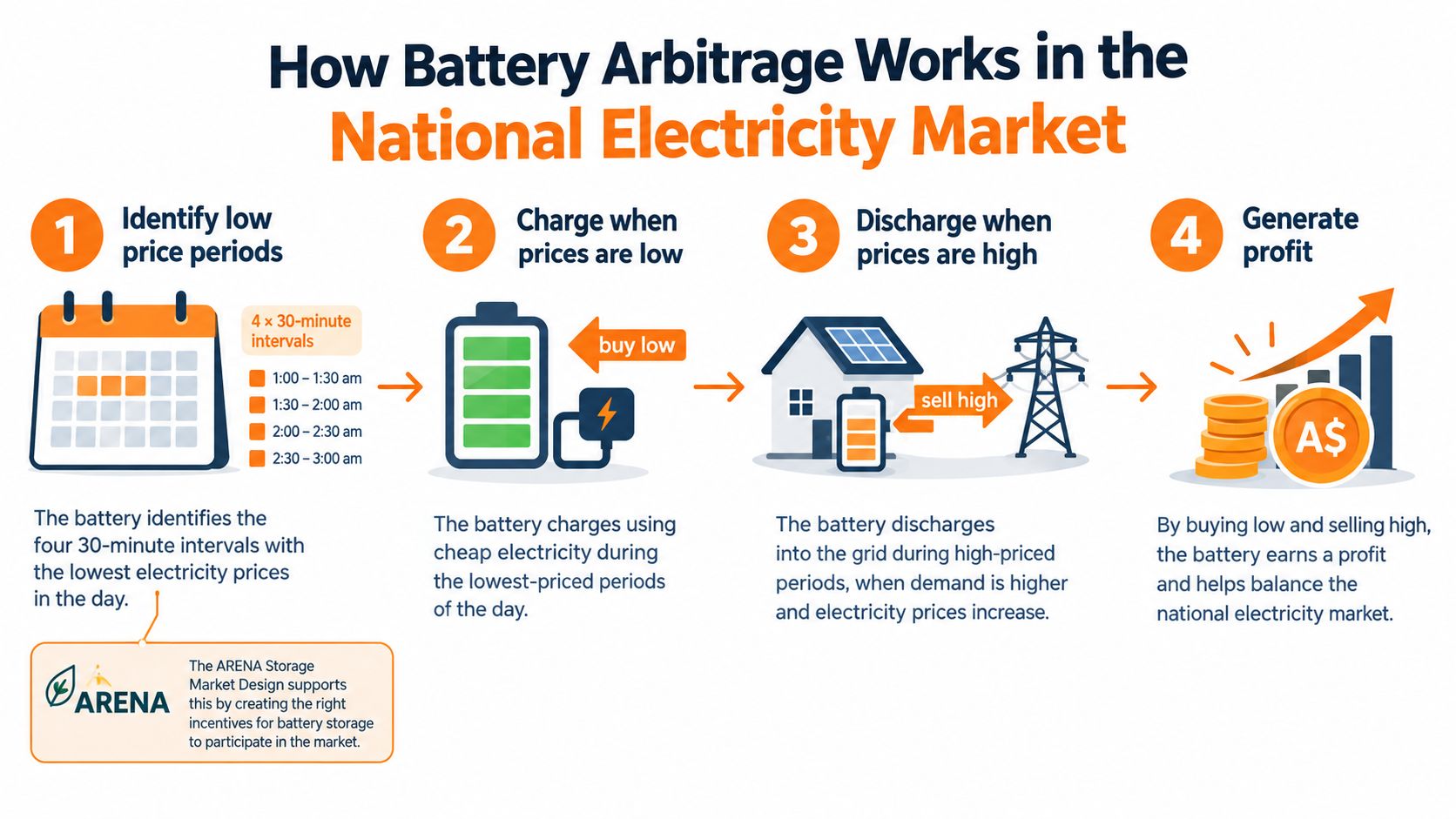
Follow the energy and the money separately
An ARENA-supported storage-market design illustrates arbitrage by buying during the day's four lowest-priced 30-minute intervals and selling an equivalent energy quantity during the four highest-priced intervals, with daily settlement under that design. Those intervals needn't be consecutive.
That's a trading illustration, not a universal residential dispatch schedule. Its equal purchase and sale quantities make it energy-neutral on paper. A physical battery must also cover conversion losses and respect operating limits.
| Part of the transaction | What the household should examine |
|---|---|
| Charging | The actual cost of energy entering the battery |
| Discharging | The payment or avoided purchase cost |
| Operation | Losses, available charge and equipment constraints |
| Reconciliation | What the customer receives after contractual deductions |
Wholesale exposure and retail exposure aren't interchangeable. A low wholesale charging price doesn't necessarily mean your retail plan lets you charge at that price. Equally, a high wholesale discharge price doesn't establish what your retailer pays you.
Forecast before committing capacity
A controller also needs to estimate what happens after the immediate opportunity. Discharging too early can leave insufficient energy for a later evening peak, while preserving everything can mean missing a worthwhile event.
AEMO's Q1 2026 analysis describes how daytime battery charging and peak-period discharge changed supply requirements and evening prices. For households, the implication is practical: dispatch should account for future demand, forecast uncertainty and the cost of cycling, rather than responding to price differences alone.
Understanding electricity price forecasting helps explain why a fixed charge-and-discharge timetable isn't equivalent to battery optimisation. A useful forecast informs a decision; it doesn't remove uncertainty.
The 100 Cent Per Kilowatt Hour Opportunity and Why It Is Hard to Capture
The headline opportunity was substantial. The Australian Energy Market Commission's residential battery analysis identified a maximum theoretical arbitrage opportunity of approximately 100 cents per kilowatt-hour in NSW on 12 November 2024.
That figure measured the difference between the lowest available charging price and the highest potential discharge value during that day. It wasn't a household's realised saving, an average daily return or a rate available continuously.
Why the maximum isn't the outcome
To capture the full theoretical difference, a battery would need energy available at the right moment and sufficient discharge capability throughout the valuable window. Residential equipment and household requirements make that an exacting proposition.
The AEMC analysis identifies practical constraints that change what an owner can capture:
- Brief price events: The most attractive discharge window may be short and unpredictable.
- State of charge: An empty battery can't respond, regardless of the price.
- Inverter limits: Available energy and deliverable power are different constraints.
- Competing household demand: The home may need electricity during the same event.
- Network export limits: A connection's permitted export can restrict participation.
- Round-trip losses: Purchased or generated charging energy doesn't all return as usable output.
For Queensland and NSW customers, the relevant network constraint is the one attached to their own connection. A regional price opportunity doesn't override a household's export permission.
A theoretical price spread describes what was available in the market. It doesn't establish what was available to your battery.
Where coordinated control earns its place
A managed battery program can combine forecasting with automated dispatch to respond more reliably than manual intervention. It can also preserve energy for the home instead of treating every price spike as an instruction to empty the battery.
That is a sound reason to consider a VPP. It isn't a reason to accept optimistic savings claims without examining the underlying assumptions.
Ask any provider presenting an exceptional trading day to show the complete customer outcome: energy exported, compensation received, and subsequent grid purchases. Without that reconciliation, the example demonstrates market potential, not household benefit.
Why NEM Spreads Are Compressing and What That Means for Your Battery
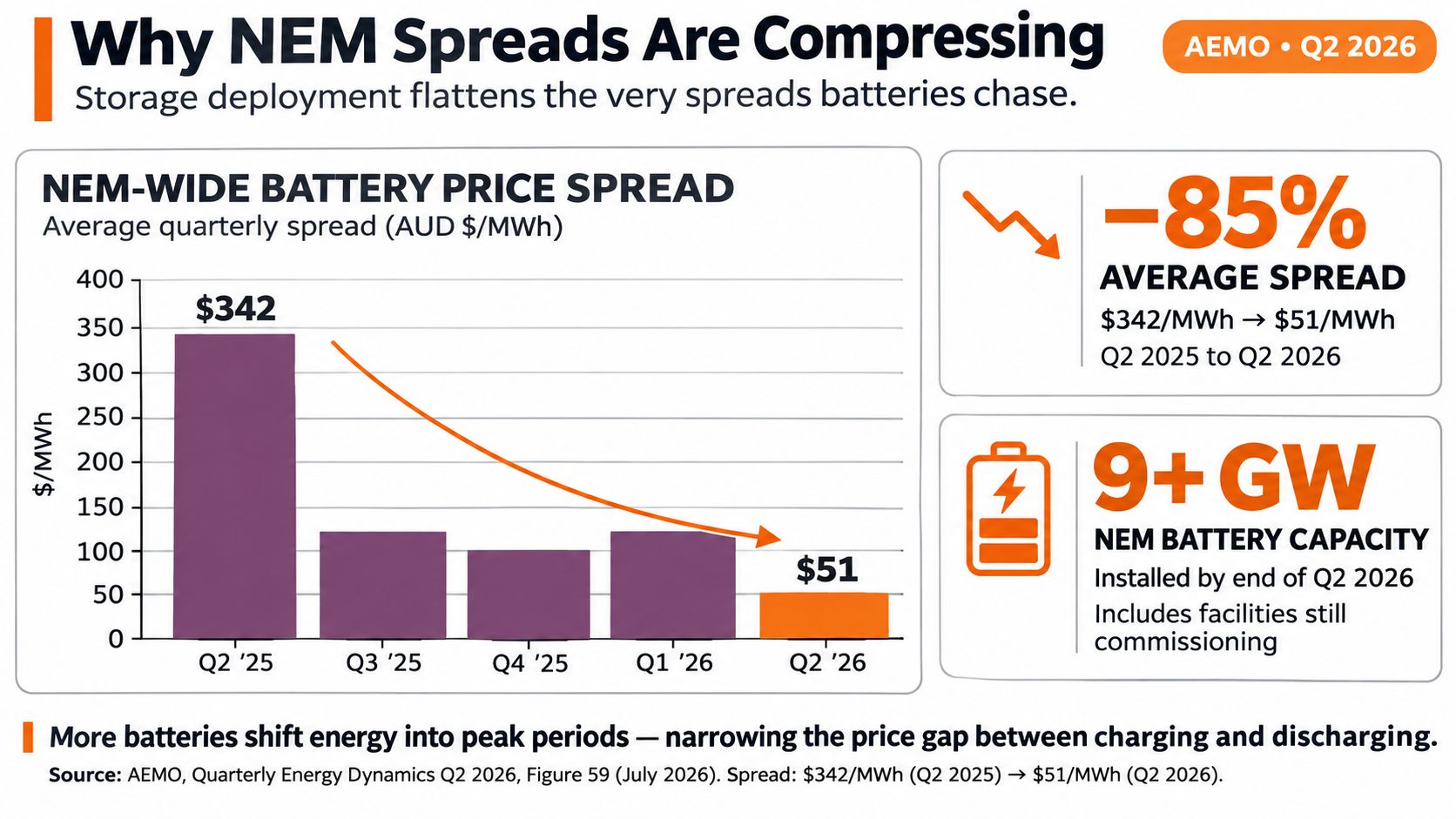
Each new battery connected to the NEM makes arbitrage harder for every battery that follows. Fleets charge on the same cheap daytime supply and discharge into the same expensive evening window, which lifts the low prices and caps the high ones.
The recent shift is steep. AEMO's battery-market analysis, reported by Energy-Storage.news, puts the NEM-wide average charging-to-discharging spread at AU$51/MWh, down 85% from AU$342/MWh a year earlier.
The chart shows how quickly that compression arrived.
More activity doesn't guarantee more earnings
The same analysis recorded net energy-arbitrage revenue falling 56% quarter-on-quarter to AU$52.8 million, even though charging and discharging volumes increased.
The mechanism is straightforward. Operators charging together raise demand during hours that used to be cheap. Operators discharging together add supply during hours that used to be expensive. Both moves cut into the gross opportunity, and the effect compounds as more capacity connects.
For a homeowner, a busier battery is not automatically a more profitable one. Each cycle has to pay for itself.
| Weak performance measure | More useful question |
|---|---|
| Total energy exported | What net customer value did those exports create? |
| Number of dispatch events | Which events justified the additional cycling? |
| Highest observed price | What compensation reached the customer? |
| Attractive historical graph | Does the proposal still work under narrower spreads? |
Build for ordinary conditions
Compressed spreads do not mean arbitrage has vanished. They mean a plan built on energy trading alone is exposed.
Any proposal worth signing should separate customer bill savings from operator market revenue. It should also name which other services the battery can technically provide and how their value reaches the household. A fixed allowance can deliver a more stable compensation structure, but the contract decides whether it does.
The video below adds context for weighing up battery participation.
My recommendation: stress-test any offer against subdued trading conditions, not just standout days. If the claimed household benefit relies on frequent price spikes, treat it as fragile rather than dependable bill reduction.
Arbitrage Versus Self-Consumption and Other Value Streams
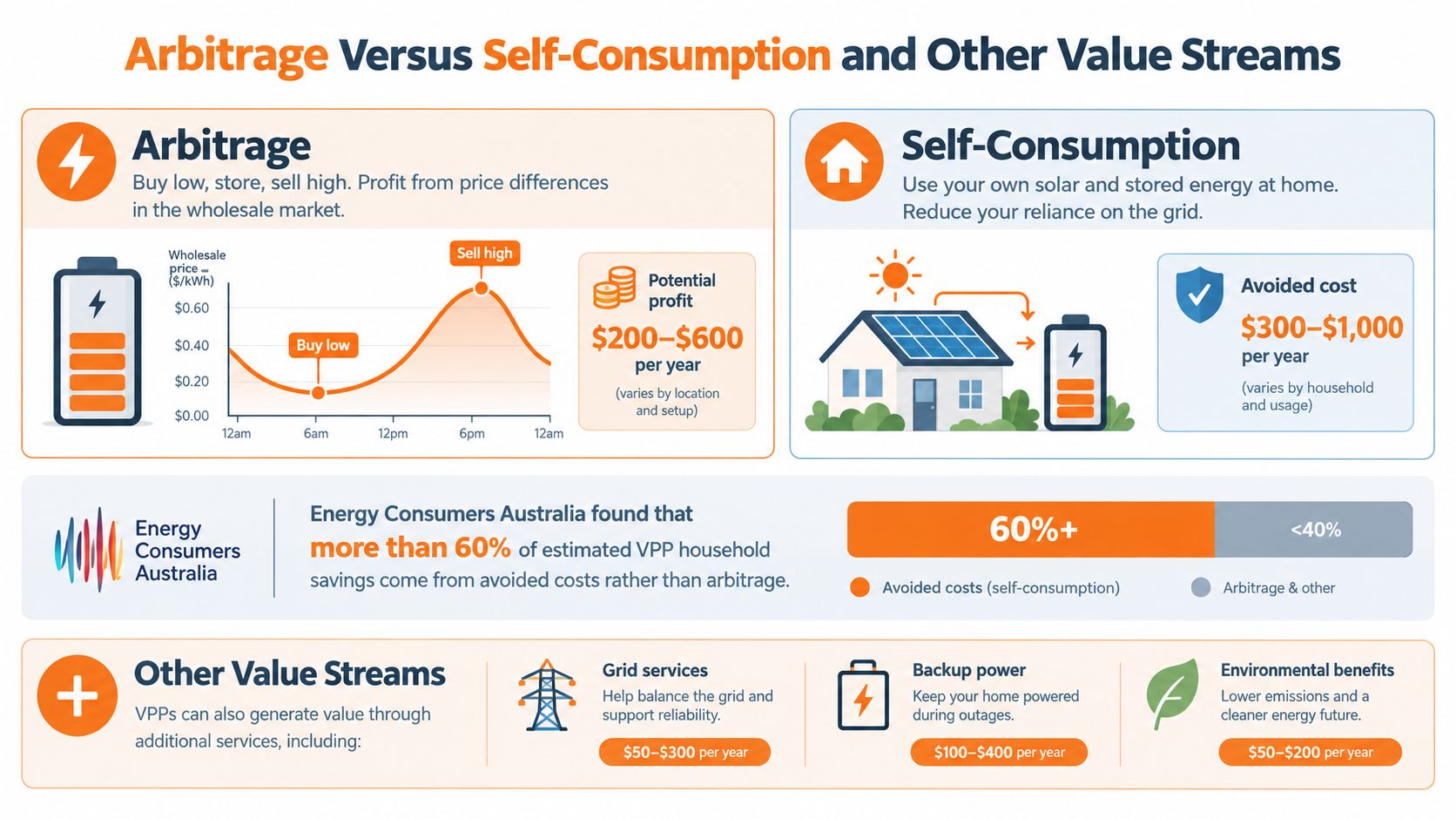
For many households, the strongest battery benefit is avoiding an electricity purchase, not earning an export payment. Energy Consumers Australia's household battery and VPP research found that more than 60% of estimated VPP household savings came from avoided grid-consumption charges, while median VPP credits were about AU$55 per quarter.
That finding doesn't establish what every customer will save. It does challenge the assumption that a VPP's main household benefit must come from trading.
The comparison below highlights the difference between earning a payment and avoiding a cost.
Use a transparent break-even test
Compare both options from the same starting state of charge and over the same household-demand period:
Incremental value of exporting = customer export compensation + other incremental credits − additional later import costs − incremental fees, losses and degradation.
If the result is negative, retain the energy for household use. If there's no later household demand to displace, the opportunity cost of exporting is different.
For grid charging, first calculate the delivered energy cost:
Delivered charging cost = charging expenditure ÷ usable energy discharged.
That calculation incorporates round-trip efficiency. Don't subtract the same losses again elsewhere in the comparison, and don't count an allowance and the revenue funding it as separate customer benefits.
Compare the complete value stack
| Value stream | Household benefit | Main qualification |
|---|---|---|
| Solar self-consumption | Avoided retail imports | Depends on usable stored energy and later demand |
| Traditional feed-in tariff | Payment for eligible exports | Doesn't by itself describe coordinated battery value |
| Energy arbitrage | Compensation from shifting energy | Must exceed the alternative household use |
| Demand reduction | Lower relevant demand exposure | Depends on the customer's tariff |
| Contingency FCAS | Value from grid stabilisation services | Requires eligible participation and compensation terms |
| Allowance structure | Defined coverage of electricity charges | Coverage and excess-use terms matter |
ARENA's AEMO VPP demonstrations found that small-battery fleets could respond to contingency Frequency Control Ancillary Services, follow wholesale signals and sometimes provide multiple services simultaneously.
Value stacking means combining compatible benefits, not selling the same capacity twice. A retailer-based VPP should explain how it balances those services with household supply. Compare that explanation with your current retailer's actual battery provisions, rather than assuming every retail plan performs the same optimisation.
How to Evaluate a VPP or Battery Program on More Than Headline Savings
Start with control rights, then examine compensation. A projected saving has little meaning if the operator can use the battery in ways you wouldn't knowingly accept.
An IEEFA submission published by the AEMC warned that batteries may be operated to benefit VPP operators more than customers and raised concerns about limited transparency. That is a submission's warning, not an AEMC finding against every program.
Use the following checklist when comparing any offer.
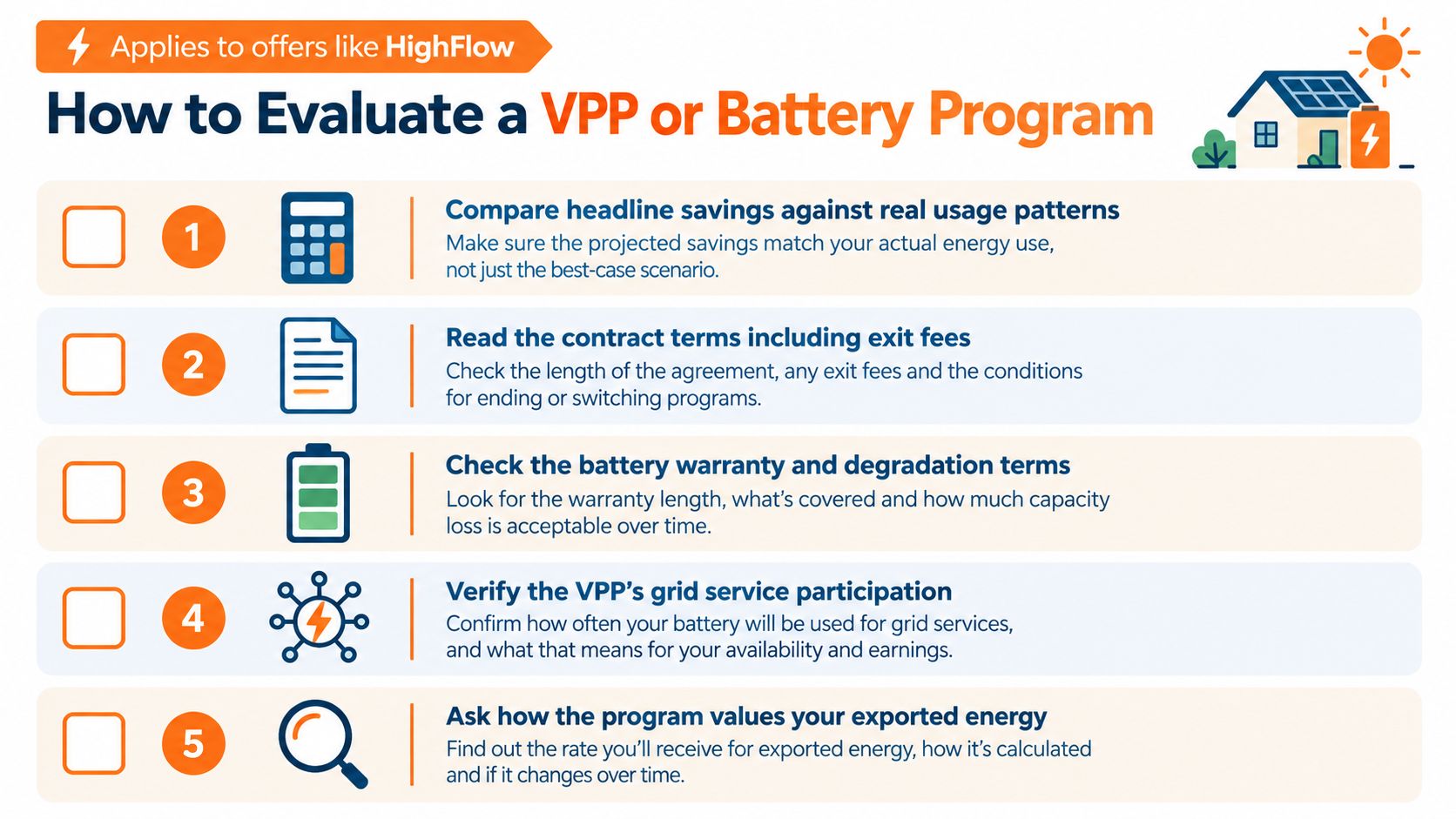
Require evidence and enforceable controls
- Household-priority reserve: Ask how the minimum state of charge is set and whether market dispatch can change it.
- Override rights: Establish what you can stop, how quickly control changes, and whether overriding affects compensation.
- Outage protection: Confirm how reserve settings interact with your system's actual backup capability.
- Dispatch records: Request timestamps, state of charge, exported energy, realised prices, fees and estimated degradation costs.
- Compensation basis: Identify whether payments reflect gross market revenue, a defined allowance or another contractual method.
- Warranty and exit terms: Check cycling permissions, warranty conditions, lock-in provisions and exit fees.
Australian Government guidance on battery financial benefits warns that increased cycling may reduce battery life and that exports can reduce blackout reserves unless capacity is protected.
Use an energy tariff comparison to examine the complete electricity arrangement, including supply charges, import rates and export compensation. Also confirm which legal entity provides retail services under the applicable authorised energy retail framework.
Ask for reconciliation: Show what the household received, not just what the operator earned.
Frequently asked questions
Is battery arbitrage guaranteed to save money?
No. The customer's net result depends on compensation, costs and what the stored energy would otherwise have done.
Do I receive the wholesale price when my battery exports?
Only if your agreement provides that exposure. Check the payment formula and deductions.
Will a VPP empty my battery?
That depends on its operating rights and reserve rules. Require a clear household-priority setting.
Can I override automated dispatch?
Check the specific program. Confirm both the control mechanism and any contractual consequences.
Does VPP participation affect battery warranties?
Check your manufacturer's conditions against the proposed operating regime. Don't accept a general assurance instead of that comparison.
Can an allowance eliminate my electricity bill?
It can cover eligible charges within its defined scope. Consumption or charges outside that scope may remain payable.
Where HighFlow Fits and How to Put This Into Action
A Bring Your Own Battery, or BYOB VPP, should be assessed as an operating arrangement for an existing asset. Compare it with retaining your current retailer, using a different VPP or managing the battery primarily for household consumption.
The retailer-based option described here is available to eligible solar and battery owners in Queensland and New South Wales. It coordinates compatible existing batteries without new hardware, prioritises household needs and provides app-based prices, forecasts and savings information.
Understand the allowance before enrolling
Grid-services value funds a monthly bill-free electricity allowance covering daily supply charges and usage within the allowance. Network and distribution charges aren't charged on that covered portion. Electricity used beyond the allowance is payable at standard rates.
That's a defined coverage arrangement, not an unconditional promise that every household will receive no bill. The eligibility assessment should explain the allowance offered, what it includes and how your consumption compares with it.
Customers retain ownership of their battery. The service includes override control for automated plans, no lock-in contracts and no exit fees. Those features are relevant comparison points, but you should still obtain the operating terms and reserve settings in writing.
Key takeaways
- Judge net benefit: More exports and more cycling aren't proof of better performance.
- Protect household use: A market opportunity shouldn't automatically displace more valuable self-consumption.
- Demand transparency: Compensation, reserve settings and control rights belong in the assessment.
- Check actual fit: Compatibility, network permissions and usage patterns matter more than an optimistic forecast.
Before requesting an assessment, gather your recent electricity bills, battery and inverter details, tariff information and available usage records. Ask for a comparison against your current arrangement and an explanation of outcomes when trading conditions are less favourable.
Installation quality matters, but ongoing performance deserves the same scrutiny. The useful question is whether your existing battery is underperforming financially, and whether a different operating arrangement can improve that without compromising household priorities.
HighFlow Energy offers a retailer-based BYOB VPP that uses coordinated battery services to fund a defined electricity allowance while preserving household priority and override control. Visit HighFlow Energy to request an eligibility assessment and review whether your existing battery could deliver greater net household value.