


Cheaper Home Batteries: How to Cut the Real Cost in 2026
An upfront discount doesn't tell you whether a battery will pay its way. The Australian Government's household battery estimates put the battery's own contribution to annual electricity savings at approximately $300 to $900, depending on the household and system. For homeowners comparing cheaper home batteries, that variation matters as much as the purchase price.
The useful comparison is installed cost per usable kilowatt-hour, followed by the value that capacity can realistically deliver. In Queensland and New South Wales, that means examining evening electricity purchases, solar surplus, equipment compatibility and any contracted Virtual Power Plant value, rather than choosing the biggest advertised rebate.
The Levers That Lower a Battery's Real Cost
The economics have improved substantially. The Climate Council's battery report puts average battery payback at approximately 19 years in 2016 and 8.3 years in 2024, with entry-level systems starting at roughly $4,000 for 5 kWh and a typical household system costing approximately $13,000 in 2025.
Those figures describe different products and periods, not interchangeable quotes. The Clean Energy Council's rooftop solar report put the average home-battery cost at approximately $12,000 to $15,000 in 2024.
What makes cheaper home batteries genuinely cheaper
A battery reduces purchases when it supplies electricity the household would otherwise import. Higher retail tariffs can increase that avoided cost, while lower feed-in tariffs reduce the revenue sacrificed by storing solar instead of exporting it.
Neither change guarantees a good investment. A household still needs sufficient solar surplus, demand at the right times and equipment that can deliver the required power.
Cost levers for Queensland and NSW homeowners
| Lever | What it changes | Typical effect | Check before you rely on it |
|---|---|---|---|
| Federal Cheaper Home Batteries Program | Upfront discount based on usable capacity, generally applied by the retailer or installer | Around 30% of eligible upfront cost, scheduled to decline through to 2030, according to the government program guide | Approved installation and eligible equipment within the program's approximately 5 to 100 kWh capacity range |
| NSW VPP incentive | Additional support for connecting an eligible battery to a VPP | Reported to nearly double from 1 July 2025; the same Climate Council state-incentive guide records Queensland's former rebate closing in May 2024 | Confirm the battery, VPP and application meet current requirements |
| Queensland state battery rebate | Former state discount for new installations | Closed, rather than an available contribution to a new quote | Assess federal eligibility instead of including the former rebate |
| Right-sizing | Avoids purchasing capacity the household won't use | Reduces capital committed to idle storage | Compare usable capacity with a full year of interval consumption |
| VPP participation | Adds potential grid-service value | A contractual allowance or payment, subject to eligibility and operating conditions | Compatibility, dispatch permissions and exit terms |
Our Australian solar battery rebate guide provides additional context for assessing installation support.
Practical rule: A rebate reduces the purchase cost. Utilisation determines whether the remaining investment earns a return.
Apply a simple purchasing test: identify the support available in your state, establish whether the proposed system qualifies, and compare its usable storage with your evening demand. If the last test fails, a larger discount doesn't fix the underlying mismatch.
How to Size a Battery Around Your Usable Capacity
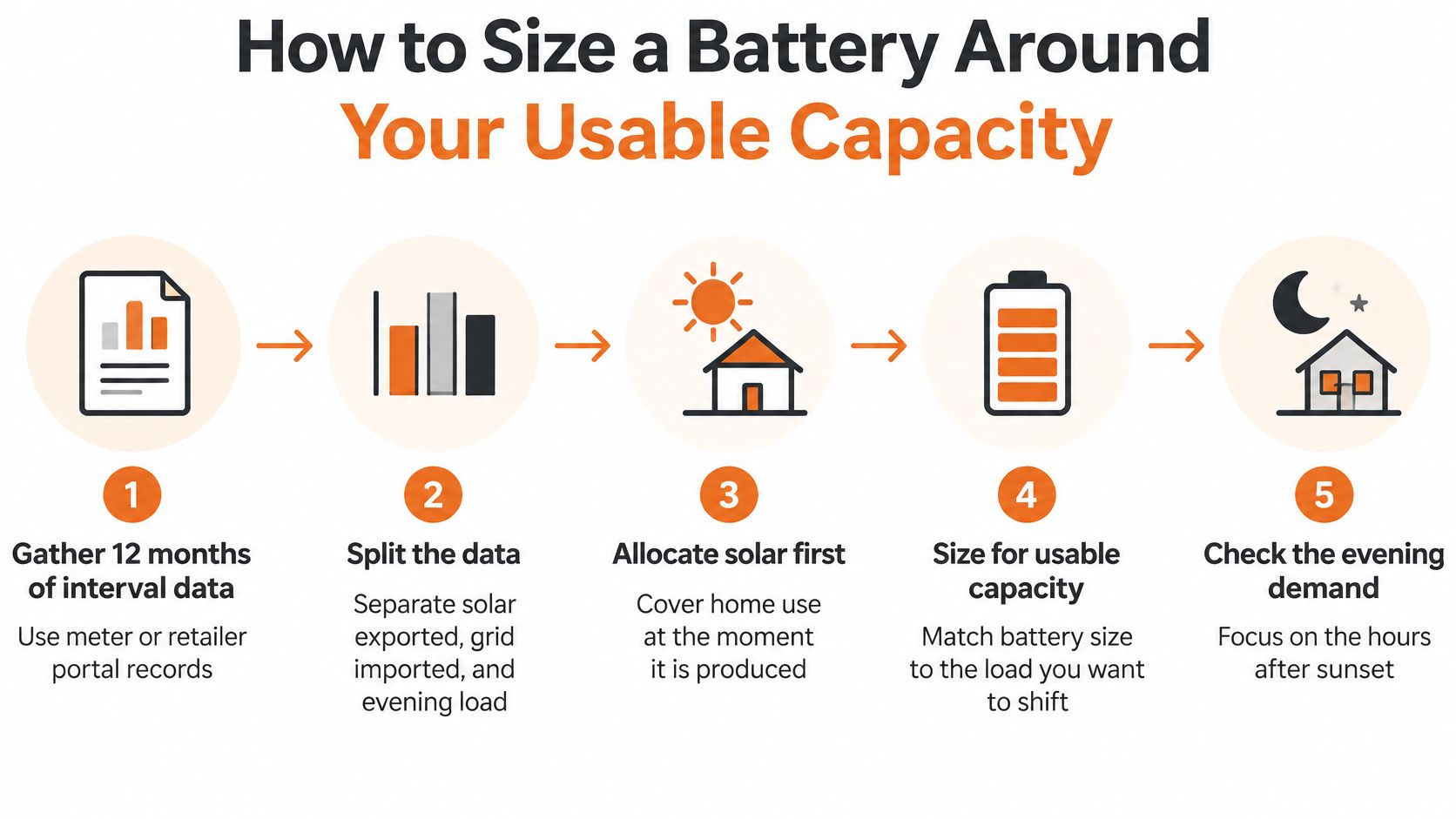
Start with a full year of interval records from your meter or retailer portal. Separate grid imports, solar exports and evening consumption, keeping the timestamps rather than relying on annual totals.
An annual bill can show how much electricity you bought. It can't show whether a battery would have been charged when you needed it.
Build a dispatch model before choosing capacity
Allocate solar to immediate household demand. Only the remaining surplus is available for charging in a solar-only charging model. Otherwise, you risk counting the same solar generation as both direct consumption and stored energy.
Discharge against actual evening and overnight imports. Value the electricity delivered at the import tariff avoided at that time. Deduct the export revenue forgone when solar enters the battery, rather than treating charging energy as having no alternative value.
Allow for conversion losses and ageing. The AEMC residential battery modelling appendix uses 85% round-trip efficiency and 4% annual capacity degradation, meaning a nominal 10 kWh example returns approximately 8.5 kWh per full cycle initially and 8.16 kWh after a year under those assumptions. Treat these as modelling benchmarks, not specifications for every product, and don't apply the same loss twice to a manufacturer's already adjusted figure.
Test low, median and high evening-load cases. Keep seasonal solar production and tariff timing in the model. A battery that looks well utilised during a sunny period may spend much longer partly charged during other conditions.
Look for the point where extra capacity stops earning. Add storage incrementally and inspect the additional avoided imports. If the extra capacity rarely discharges, its purchase cost remains while its household bill benefit is limited.
Reconcile the model with the written design. Require usable capacity, inverter power, chemistry, warranty throughput, backup switching, network approval and existing-inverter compatibility. The Australian Government's investment guidance also identifies Solar Accreditation Australia approval for the installing tradesperson as a program requirement.
The sizing workflow helps keep consumption records ahead of product selection.
Separate storage capacity from power
Kilowatt-hours describe stored energy. Kilowatts describe how quickly equipment can deliver it. A large battery paired with a restrictive inverter might not cover simultaneous cooking, heating and other evening loads.
Usable capacity also differs from nameplate capacity. Our explanation of battery depth of discharge helps distinguish the advertised storage figure from the portion available for operation.
For household bill reduction, the defensible starting point is the smallest usable capacity that covers typical evening demand. Adjust that choice for explicit backup requirements, seasonal conditions and separately modelled grid participation, not an assumption that every additional unit of storage will earn equally.
Comparing Quotes and Avoiding Costly Shortcuts
Solar and battery households had annual electricity bills approximately 20% to 52% lower than grid-only customers, according to the ACCC's review of growing battery uptake. The review also identified difficulties comparing offers, switching providers and finding compatible battery and VPP products.
A low equipment price may be offset by extra control hardware, limited retailer choice or incompatibility with the VPP you plan to join. Compare the full installed cost and the value the system can deliver, not just the sticker price or rebate.
Use a comparable quote sheet
Quote criteria that change real cost
| Criterion | What to request in writing | Why it changes real cost |
|---|---|---|
| Installed price after incentive | Total installed price, with the federal discount separately stated in dollars | Establishes the actual outlay |
| Cost per usable kWh | Installed price divided by documented usable capacity | Makes different storage sizes comparable |
| Round-trip efficiency | Stated efficiency and the conditions under which it applies | Determines how much charging energy reaches household loads |
| Degradation and warranty throughput | Capacity-retention terms, exclusions and cycle or throughput limits | Defines protection as the battery ages |
| Inverter and backup switching | Power rating, backed-up circuits and switching equipment | Shows whether the quoted system meets intended loads |
| VPP compatibility | Written approval for the exact battery and inverter combination | Reduces the risk of buying equipment that cannot join the intended service |
| Exit and control terms | Dispatch permissions, disconnection process and charges | Clarifies the practical cost of changing arrangements |
Cost per usable kWh is a screening measure, not a complete investment result. A cheaper unit of storage may deliver less value if the inverter restricts discharge or the software prevents the intended operation. Compare those limits with the household's expected use and any planned VPP participation.
Safety documentation belongs in the comparison
Ask the installer to identify the applicable approval pathway and provide installation clearances, ventilation arrangements, shutdown instructions and emergency guidance. The handover should also cover smoke-alarm and fire-planning considerations.
Approval should apply to the exact product being quoted, not just a familiar brand name. Confirm the model and proposed configuration in writing before comparing prices.
A larger rebate can conceal a worse purchase
The Gridly home-battery guide estimates that typical 10 to 13 kWh batteries cost roughly A$8,000 to A$12,000 before incentives, with an estimated federal reduction of A$2,500 to A$3,300. These are market estimates, not a quote for a particular home.
An incentive can lower the purchase price without making extra capacity useful. Compare the net cost of each size against the household's expected demand and the value its usable capacity can earn. Oversizing can leave capital tied up in storage that is rarely used, while an incompatible system may forgo VPP value altogether.
Before accepting a quote:
- Confirm approval: Get written confirmation for the exact model and proposed configuration.
- Show the discount: Require the incentive amount in dollars and the assumed installation date.
- Test added capacity: Buy extra storage only when its expected use justifies its additional net cost.
Missing compatibility, warranty or safety documentation leaves key costs and risks unresolved, even when the headline price looks attractive.
Refurbished Batteries and Financing Options
A refurbished battery costs less upfront, but its value depends on how much usable capacity remains and how long that capacity is covered by warranty. A low price can disappear as a saving if the unit has limited service life, uncertain performance or incompatible controls.
Assess the unit you're buying
Ask for a documented assessment of usable capacity, cell age and service history. Check whether the warranty transfers, what cycle or throughput limit applies, and whether the specific battery and inverter configuration can participate in the intended VPP. Use the measured capacity, rather than the original specification, when estimating household use and potential value.
A refurbished battery's advertised capacity describes its original specification. Its measured remaining capacity determines what you're buying.
Confirm whether the unit qualifies for any federal support before deducting an incentive from its price. If eligibility is uncertain, assess the purchase without that discount. Also establish whether the warranty transfers if the home is sold, and obtain end-of-life documentation explaining who is responsible for removal and disposal.
Test finance against conservative value
Use this sequence before signing:
- Establish the principal. Deduct only a confirmed incentive from the amount financed.
- Compare equivalent periods. Convert estimated annual avoided-import value into a monthly amount before comparing it with repayments.
- Calculate the full borrowing cost. Include establishment and ongoing fees, plus total interest over the loan term.
- Exclude uncontracted earnings. VPP income that is not guaranteed should not make an otherwise unaffordable repayment appear manageable.
For a general budgeting perspective, a guide to choosing manageable loan repayments offers a way to think about repayment size. Its examples concern New Zealand lending, so they do not establish Australian credit terms or battery eligibility.
Earning From Your Battery Through a VPP
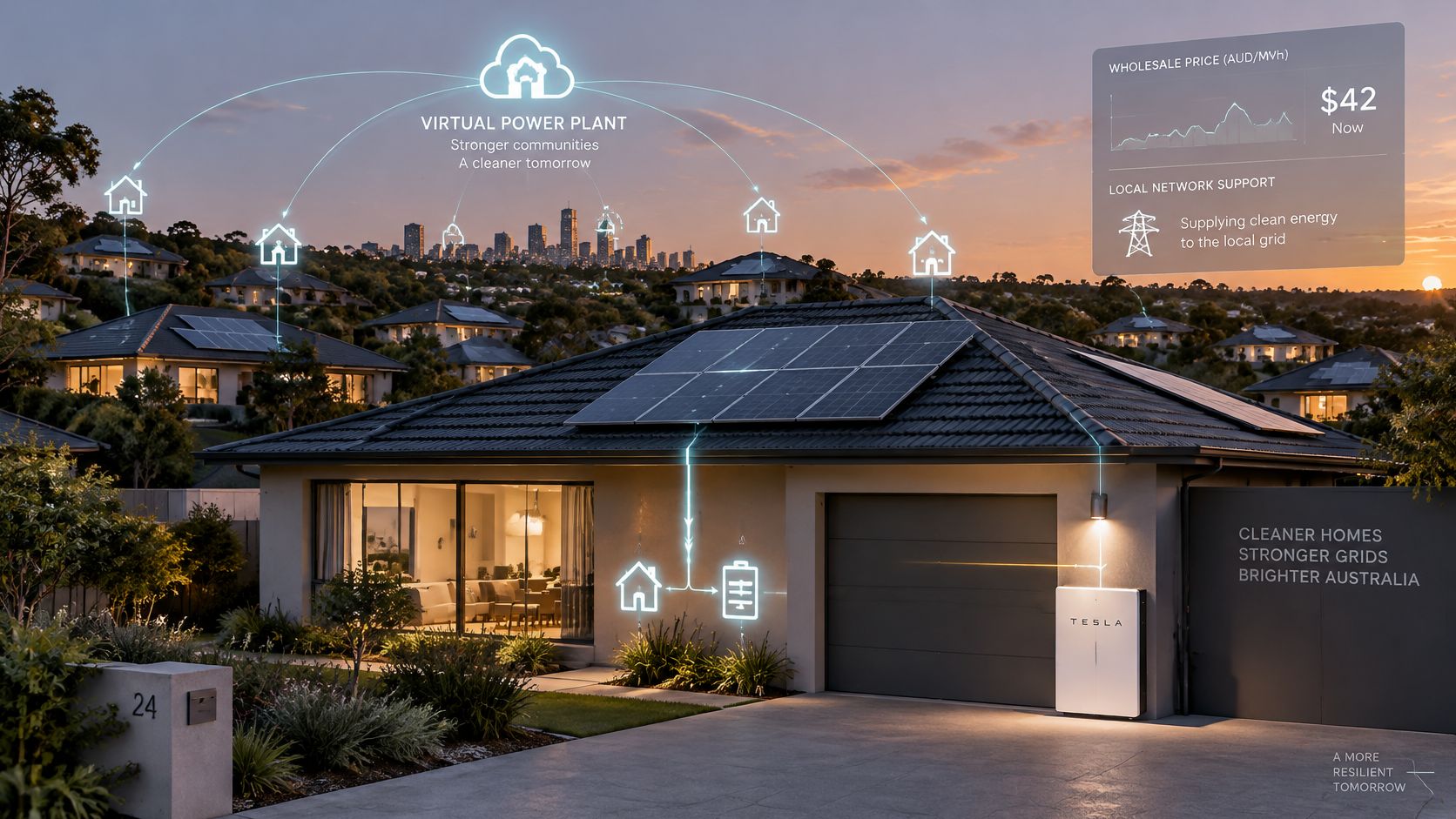
A Virtual Power Plant coordinates distributed batteries and other controllable equipment so they can act together. The AEMO VPP demonstrations, documented by ARENA, showed coordinated systems responding to wholesale price signals, delivering local network services and supplying contingency Frequency Control Ancillary Services, sometimes simultaneously.
The physical arrangement still consists of individual household systems.
Where the additional value comes from
A feed-in tariff pays for exported electricity. A VPP can also coordinate when batteries charge or discharge and provide rapid responses that help stabilise the electricity system.
In the National Electricity Market, wholesale conditions change with demand, generation availability and network constraints. A retailer-based VPP combines electricity supply with coordinated dispatch, but the customer's financial benefit depends on the retail contract, not just the wholesale revenue the operator earns.
That distinction prevents a common modelling mistake: counting a wholesale trading opportunity as though the household automatically receives its full value. Retail rates, fees, allowances and dispatch conditions determine what reaches the bill.
Standalone battery compared with a VPP-enrolled battery
| Question | Standalone battery | Battery in our VPP |
|---|---|---|
| Who controls charging | You or your chosen controller set operating rules | We coordinate spare capacity automatically, with household use prioritised |
| Ownership | You own the battery | You retain full ownership and control |
| Warranty | Manufacturer's terms apply | Joining our BYOB VPP doesn't affect your battery warranty |
| Guaranteed reserve | You configure the reserve subject to equipment capability | Participation doesn't guarantee minimum charge or outage backup |
| If the battery is removed | No VPP allowance is involved | The allowance stops and standard retail pricing applies unless you leave |
| State incentive stacking | Installation support requires separate eligibility | Eligible NSW VPP support can combine with federal installation support |
Our solar battery Virtual Power Plant explanation describes the coordinated operating arrangement.
The following video accompanies the explanation of participation.
Household priority isn't a backup guarantee
We use spare battery capacity, with the home's energy use coming first. Remote charging and discharging can nevertheless affect how much stored energy is available at a particular moment, so household priority mustn't be confused with a guaranteed emergency reserve.
Network export limits also constrain delivery. An operator can't assume that installed battery capacity is always available for export through a congested or restricted connection.
For broader household bill-review habits, utility insights from My Money Mentor Plus can complement a technical assessment. Keep that general budgeting perspective separate from the actual retail contract.
For an existing compatible battery, the relevant decision isn't whether to buy more storage. It's whether coordinated participation adds net value after accounting for electricity rates, operating conditions and the energy the household still needs.
Check Whether Your Battery Is Earning Its Keep
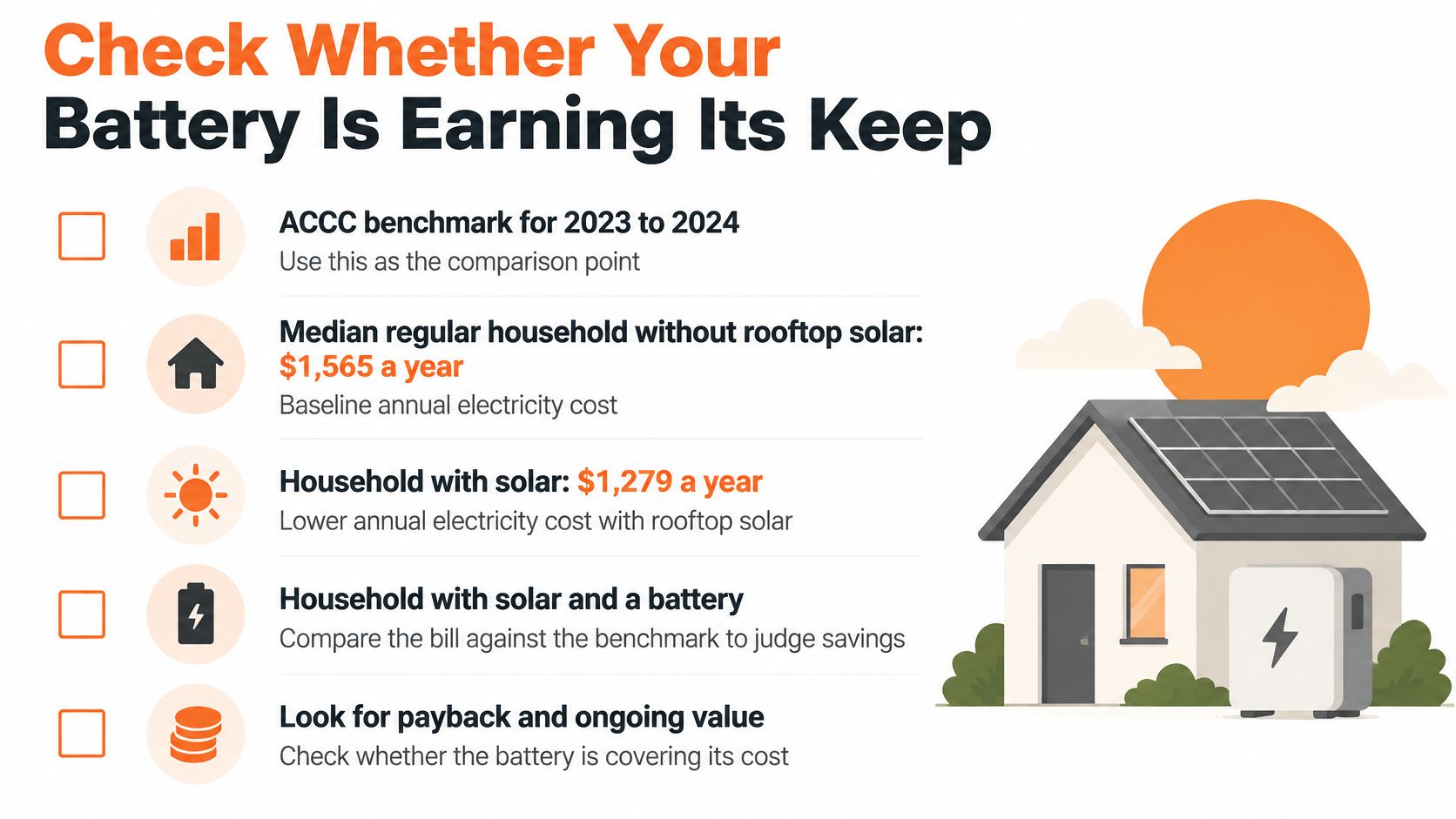
For the National Electricity Market in 2023–24, the ACCC's electricity-market review reported median annual bills of $1,565 for regular households without rooftop solar, approximately $1,279 with solar, and about $936 with solar and a battery, the latter being 40% below the regular-user benchmark.
These are household-group medians, not a controlled estimate of what adding a battery will save your home. In particular, the difference between grid-only and solar-plus-battery bills isn't a battery-only return.
Use the benchmarks to prompt a review, not to declare that a higher bill proves equipment failure.
Review actual operating performance
- Collect bills and interval records: Use a full annual period and separate electricity charges, credits and government rebates.
- Locate remaining imports: Identify evening purchases and whether the battery was empty, power-limited or deliberately holding energy at those times.
- Establish eligibility: Our BYOB participation requires a home in Queensland or New South Wales, compatible solar and battery equipment, and an internet connection for the battery.
- Request household-specific modelling: Keep avoided imports, supply-charge treatment and contracted grid-service value distinct.
Our participation process has four steps: bring your existing solar and battery, connect the battery to our VPP, provide grid support using spare capacity only when available, and receive a monthly bill-free electricity allowance. This is an allowance-based arrangement, not an unconditional promise that every electricity bill will disappear.
Customers remain connected to the grid and retain control without needing daily monitoring or behavioural changes. A performance review should still inspect whether the agreed arrangement suits changing household consumption.
Why High Flow Energy
We're an Australian electricity retailer and performance-driven VPP operator focused on existing solar and battery assets, rather than an installation proposition. Our BYOB arrangement requires no new hardware, has no lock-in contracts and no exit fees; the current retail terms remain the basis for checking eligibility, charges and obligations before joining.
An energy retailer comparison should therefore assess the whole arrangement, not just an export rate. Authorised retail-service obligations, clear billing and transparent dispatch permissions matter alongside financial performance.
Installation quality determines whether a battery works safely. Ongoing performance determines whether its owner receives the value the system can deliver.
Frequently Asked Questions and Key Takeaways
Is the cheapest battery the best value?
No. Compare installed cost per usable kWh, expected utilisation, warranty protection and compatibility. A low sticker price can conceal limited usable capacity or a mismatch with your solar system, reducing the value you can get from the battery.
Does the federal discount depend on battery size?
Usable capacity can affect the incentive, along with eligibility and installation timing. Ask for a dated calculation based on the proposed system rather than assuming the same discount applies to every configuration.
Can I join a VPP without buying a new battery?
Yes, if your existing solar system and battery meet the compatibility requirements. HighFlow Energy's Bill-Free Electricity offer requires you to bring your own battery; HighFlow does not supply one under this plan.
Does a VPP guarantee backup power?
No. VPP participation does not guarantee a minimum battery charge or power during an outage. A battery's stored energy can vary, and backup capability depends on the system.
What happens if I move or remove the battery?
HighFlow Energy's VPP is available to eligible customers in Queensland and New South Wales. If your battery is removed or stops working and you no longer meet eligibility requirements, your allowance stops and standard retail pricing applies unless you leave.
Is a refurbished battery worth considering?
It may be, if its remaining capacity, warranty, compatibility and price make sense for your household. Check those factors before relying on the advertised capacity or assuming the battery qualifies for an incentive.
Key Takeaways
- Compare usable storage: Cost per usable kWh gives a clearer comparison than sticker price alone.
- Match capacity to demand: Extra storage needs a practical use. Otherwise, a larger battery can raise costs without adding equivalent value.
- Check compatibility: Confirm that the battery and inverter meet the requirements of the system or VPP you plan to use.
- Compare ownership and operation: Battery ownership, grid dispatch and outage backup are separate considerations.
HighFlow Energy connects eligible existing batteries to a VPP, using spare capacity to support the grid and fund a monthly electricity allowance. For eligible customers, the Bill-Free Electricity offer provides a $0 daily supply charge and $0 electricity usage within a confirmed monthly allowance while eligibility continues. If you use more than the allowance, standard retail rates apply to the extra usage. To check whether your equipment meets the requirements, visit HighFlow Energy.