


Benefits Calculator for Solar and Battery Households
Does your battery reduce the whole electricity bill, or just the energy you buy from the grid? A benefits calculator should answer that question before it promises savings. For solar and battery households in Queensland and New South Wales, the useful result is an annual dollar range built from actual usage, fixed charges, tariff periods and the conditions of any electricity allowance.
The distinction matters. Avoiding an expensive evening import isn't the same as removing a daily supply charge, and earning value through a Virtual Power Plant isn't the same as receiving a solar feed-in tariff. A credible estimate keeps those components separate, then checks that they haven't been counted twice.
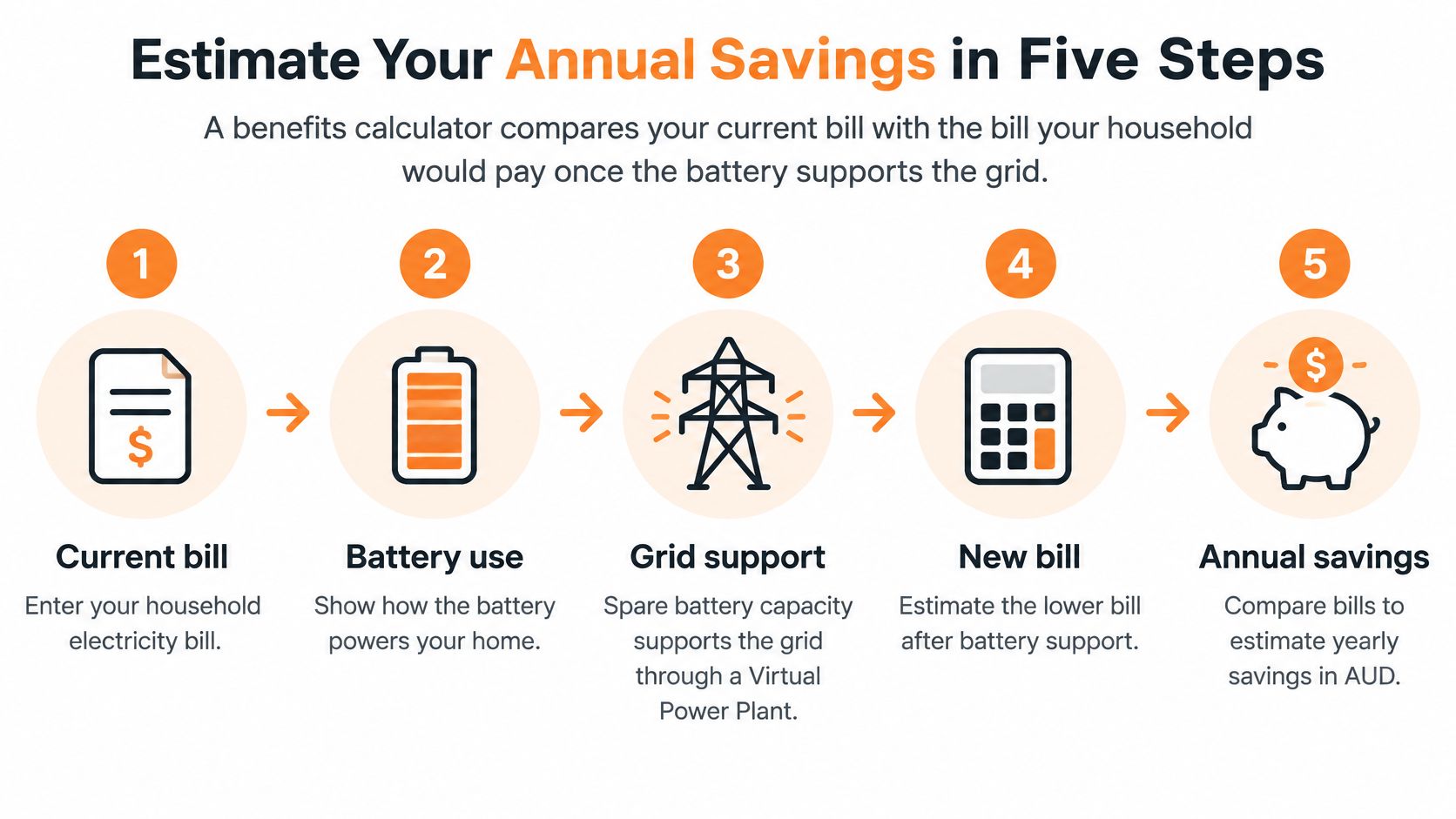
Estimate Your Annual Savings in Five Steps
Which part of your bill changes when a battery supports the grid: the fixed supply charge, your electricity usage, or both? A benefits calculator should compare the whole bill under consistent household demand, separating fixed charges from usage costs and modelling battery-driven savings against the applicable allowance.
- Collect your consumption history. Download a year of smart-meter data or gather the corresponding bills. Interval readings show how much electricity you import in each time period, allowing the calculator to price peak and off-peak use separately.
- Identify your distributor and tariff. Find the network name and tariff details on your bill. The distributor sets the network pricing context, while your retail offer determines the charges used in the estimate.
- Separate fixed and usage charges. Record the daily supply charge in dollars per day and each time-of-use rate in cents per kilowatt-hour. This keeps fixed costs distinct from charges that may change when battery dispatch reduces grid imports.
- Enter the system specifications. Use your installation certificate to identify solar capacity, battery capacity and equipment details. These inputs help determine eligibility and the applicable allowance tier.
- Compare annual bills under different operating conditions. Use the same consumption history while modelling stronger and weaker battery availability. The result should be an annual range grounded in your meter data, rather than a single percentage saving.
Inputs a benefits calculator needs
| Input | Where to find it | Why it matters |
|---|---|---|
| Annual electricity usage | Smart-meter data or last year of bills | Sets the consumption baseline for the comparison |
| Distributor and network zone | Network name on the bill | Establishes the applicable network pricing context |
| Daily supply charge | Tariff section of the bill, in dollars per day | Identifies the fixed charge an allowance may cover |
| Time-of-use rates | Energy plan, in cents per kWh by period | Prices imports across different usage periods |
| Solar and battery size | Installation certificate or system label | Helps determine eligibility and the allowance tier |
A month may have no amount payable when eligible charges fall within the confirmed allowance and offer conditions. Usage above the allowance is charged at the applicable excess rate, so the annual estimate should model each month separately rather than average usage across the year. Bills are still issued regularly, including when the amount payable is $0.
Practical rule: Base the estimate on your household's consumption pattern and tariff inputs. Battery capacity alone cannot represent the whole-bill result. For a separate utility-bill context, see Superchat's AI help with DEWA bills.
Network Zones That Set Your Baseline Bill
Which network serves your property? Its distribution pricing helps set your starting bill, while your retail contract determines the rates you pay. Similar homes can therefore have different bills because they sit in different network zones, use different tariffs or consume electricity at different times.
The Australian Energy Regulator's Default Market Offer material provides the 2026–27 reference benchmarks below. They show network-specific benchmark usage and indicative annual costs for flat-rate standing offers. Treat them as comparison points, not personalised quotes or guaranteed future bills.
Default Market Offer benchmarks by New South Wales network
| Network zone | Benchmark usage (kWh per year) | Indicative annual cost |
|---|---|---|
| Ausgrid (NSW) | 3,900 | $1,899 |
| Endeavour Energy (NSW) | 4,900 | $2,328 |
| Essential Energy (NSW) | 4,600 | $2,604 |
The costs are not a direct measure of network price differences because benchmark usage varies by network. To compare locations, a calculator must price the same consumption profile against each applicable tariff.
Higher usage than the local benchmark may mean more spending on usage charges, but it does not guarantee greater battery savings. Savings depend on whether stored energy can replace grid imports at the times your household uses electricity. A household with lower annual usage may still have costly evening demand.
Queensland requires its own reference
Queensland's distributors include Energex and Ergon Energy. Use the current reference and pricing arrangements for the property's network rather than applying a New South Wales benchmark.
HighFlow Energy's guide to electricity network charges explains how distribution costs relate to the retail prices on your bill. Use your own interval data in the estimate when available, keeping the published benchmark as a reasonableness check.
How Battery Dispatch and Allowance Tiers Change the Result
How much of your battery's capacity is available for grid support after household needs are met? HighFlow Energy's Virtual Power Plant uses spare battery capacity to support the electricity grid, and the value generated funds a monthly allowance. The allowance covers daily supply charges, usage within its limit, and network and distribution charges on that allowance.
Current Bill-Free Electricity allowance tiers range from 300 kWh to 1,000 kWh per billing month, depending on solar and battery system size. Use the installed system specifications when checking which tier may apply.

Capacity isn't the same as availability
Household energy needs take priority. The HighFlow app uses price, weather, solar-generation and usage forecasts to plan battery operation, with a manual override available at any time.
A whole-bill estimate should separate the allowance from household usage above it. The allowance resets monthly; any usage exceeding it is charged at the applicable excess usage rate. Battery capacity alone does not establish how much energy will be available for dispatch.
Key inputs include:
- Available energy: Stored electricity remaining after household demand and backup reserves.
- Discharge power: How quickly the battery can deliver stored energy. The battery discharge rate affects how much can be supplied during a given period.
- Export permission: Connection limits and applicable network constraints.
- Timing: Whether spare energy is available when dispatch occurs.
- Operating conditions: Seasonal generation and equipment settings.
Feed-in tariffs and coordinated dispatch measure different value
A feed-in tariff pays for exported electricity. VPP coordination uses spare battery capacity to support the grid, and the value generated funds the customer's monthly allowance. These are different inputs to a bill estimate, so wholesale market value should not be treated as a direct customer return.
Allowances may change if the system configuration changes or eligibility requirements are no longer met. HighFlow Energy communicates any changes clearly.
Working Through a Fixed and Usage Example
How much of an estimated saving comes from a lower fixed charge, and how much depends on battery use? A whole-bill estimate keeps those effects separate.
Fixed charge and usage example
A hypothetical daily supply charge of $1.76 adds up to $642.40 a year:
Fixed component
$1.76 × 365 days = $642.40 per year
For a separate, hypothetical usage calculation, assume an energy rate of 24.04 cents/kWh outside peak and 60.20 cents/kWh during a 3 pm to 9 pm peak period. Replace these example rates with the rates and time periods on your own plan. They are not identified as rates for a particular network or property.
What peak avoidance is actually worth
If a battery replaces 2 kWh of peak grid imports each day, the gross avoided purchase cost is:
Peak component
2 kWh × $0.6020 × 365 days = $439.46 per year, or about $439.
This assumes that energy is available for displacement every day. The figure excludes charging costs, conversion losses, foregone export income and operating restrictions.
| Component | Illustrative annual effect | Qualification |
|---|---|---|
| Daily supply charge removed | $642.40 avoided | Requires an applicable supply-charge benefit |
| Peak imports displaced | $439.46 gross avoided purchases | Assumes the hypothetical daily displacement |
| Charging and lost export value | Deduct from gross usage benefit | Calculate from actual energy flows |
| Applicable allowance | Recalculate remaining payable charges | Don't add benefits already included elsewhere |
The arithmetic is not the final saving. If your current battery settings already avoid those peak imports, include that benefit in the existing-bill baseline. Count only any additional reduction against that baseline.
Count each avoided charge once. An allowance covering a charge and a battery avoiding that same charge are not separate savings.
Repeat the calculation without double counting
Use your own tariff and meter data to substitute actual inputs:
- Fixed charge: Calculate the amount your current plan charges regardless of consumption.
- Non-peak imports: Price actual imports in the relevant tariff periods.
- Peak imports displaced: Include only additional displacement compared with current battery operation.
- Allowance treatment: Apply the confirmed allowance rules to charges that remain.
- Offsets: Deduct charging costs or export revenue forgone where relevant.
The fixed-charge calculation is more predictable while the relevant charge and eligibility remain unchanged. Usage savings vary with household demand, weather and the energy available from the battery.
Use these inputs to build an annual range, not a single percentage saving. The range should reflect different assumptions about battery dispatch and charging, with fixed charges kept separate from battery-driven usage savings.
Concessions and Account Rules That Shift the Figure
Services Australia's Payment and Service Finder estimates potential Centrelink payments, Family Tax Benefit and child care fee assistance. Its operational guidance says completion takes about five minutes, signed-in users may have details prefilled, and results are a guide rather than a guarantee of eligibility.
Separate estimator guidance confirms that entered details don't update the customer's record and a separate claim is required. Discovering possible assistance isn't the same as receiving it.
Establish eligibility before subtracting a rebate
The Queensland Government's electricity and gas rebate guidance generally requires the applicant to be the account holder and live at their principal residence. Eligible categories include Queensland Seniors Cards, Pensioner Concession Cards, Health Care Cards, Veteran Gold Cards and certain asylum-seeker documentation for electricity rebates.
A calculator can therefore overstate assistance when the concession holder isn't named on the account. Renting isn't automatically disqualifying, but account arrangements need checking; reduced grid consumption also means the calculator must apply assistance correctly rather than assume a generic deduction.
Collect these details before calculating the household outcome:
- Account holder: Confirm whose name appears on the electricity account.
- Residence: Establish whether it is the principal home.
- Jurisdiction: Apply the relevant state's requirements.
- Tariff and payment type: Identify the applicable billing and assistance rules.
- Solar and exports: Check how credits interact with the bill.
Keep crisis assistance separate
Recurring concessions aren't interchangeable with Queensland's Home Energy Emergency Assistance Scheme, which addresses short-term financial crises. Nor should an ongoing electricity estimate treat one-off relief as recurring annual income.
Our concessions, rebates and relief schemes guidance explains available support pathways. We automatically credit eligible concessions or rebates to customers' accounts, and provide payment plans and support under our Hardship Policy for customers having difficulty paying.
Common Calculator Mistakes and How to Avoid Them
Quoting one percentage saving. A percentage can conceal when the household imports electricity and when the battery has spare capacity. Use an annual range that includes stronger and weaker operating conditions, with the assumptions visible beside the result.
Assuming every month will be free. The allowance resets each month, and electricity above it is charged at the applicable excess usage rate. Don't let a low-use period mathematically cancel a high-use period unless the contract expressly permits that treatment.
Treating the estimate as a guaranteed bill. We issue bills regularly even when the amount payable is zero. They show allowance, usage, bill-free amounts and any excess charges, allowing you to compare modelled performance with actual billing.
Test contrasting seasons
Run a high-use winter period and a lower-use spring period through the model, then compare both with your billing history. These are test scenarios, not an assumption that every household follows the same seasonal pattern.
- Check inputs first: Reconcile imported energy, dates and tariff periods.
- Check operation next: Review reserve settings, export constraints and manual overrides.
- Change system assumptions last: Don't enlarge the modelled battery just to force an attractive result.
A calculator is useful when it exposes why a result changes, not merely when it produces a lower number.
Check Your Eligibility Before You Compare Offers
Does your battery qualify, and what would the allowance mean for your bill? Check your system details and eligibility before comparing offers, then assess the result against your own consumption records and tariff.
Key takeaways
- Compare incremental value: Count existing battery savings in your baseline so they are not mistaken for savings from a new offer.
- Check household priorities: Review backup settings and any warranty conditions that apply to your system.
- Read the offer documents: HighFlow Energy's Basic Plan Information Documents outline key pricing details, eligibility requirements and important conditions.
- Check the confirmed allowance: HighFlow provides it when you join, includes it in your welcome information and shows it on each electricity bill.
Frequently asked questions
Is an electricity benefits calculator a Centrelink calculator?
No. An electricity calculator estimates energy costs and potential savings. Government concessions and rebates are separate forms of assistance.
Does a larger battery guarantee greater savings?
No. The result also depends on household demand, available battery capacity, discharge power and export limits.
Can I retain control of my battery?
The HighFlow app supports manual override, and household needs are prioritised.
Will joining guarantee a zero-dollar bill?
No. Your bill depends on eligibility, the confirmed allowance, electricity used above it and any applicable additional fees. Bills are issued regularly even when the amount payable is $0.
What should an eligibility check establish?
It should confirm whether your system qualifies and which offer conditions apply. HighFlow can help you check in just a few minutes.
Why HighFlow Energy
HighFlow Energy connects eligible existing solar and battery systems to a Virtual Power Plant. Grid-support value funds a monthly bill-free electricity allowance, with electricity above that allowance charged at standard rates.
Before comparing offers, check how the allowance fits your household's consumption and account terms. Cord-cutting picks from HearSmart cover a separate household expense, so keep those costs outside an electricity comparison.
HighFlow's eligibility criteria are published, allowance tiers are clearly explained, and pricing outside the allowance is shown upfront. Visit HighFlow Energy to check whether your system qualifies.