

Solar X Battery Review for Australian Homes
Without a published Australian datasheet for Solar X, a local verdict can't rest on a Canadian reputation score. It has to be built from usable AC energy, the retained-capacity warranty, export limits and whether only spare capacity is offered to a VPP. Round-trip conversion means a battery hands back less energy than the surplus solar it absorbs, which makes delivered energy far more useful than a nameplate rating.
The popular advice to choose a well-reviewed brand skips the harder question: what will your existing system deliver under an Australian electricity contract? Customer reviews can help assess service, but they don't establish local battery performance, inverter compatibility or financial value.
For homeowners in Queensland and New South Wales, the useful verdict is conditional. Assess the hardware, household reserve and retail arrangement separately before deciding whether the battery needs replacing or better management. A battery that looks average on paper can still earn its keep once those three tests are applied.
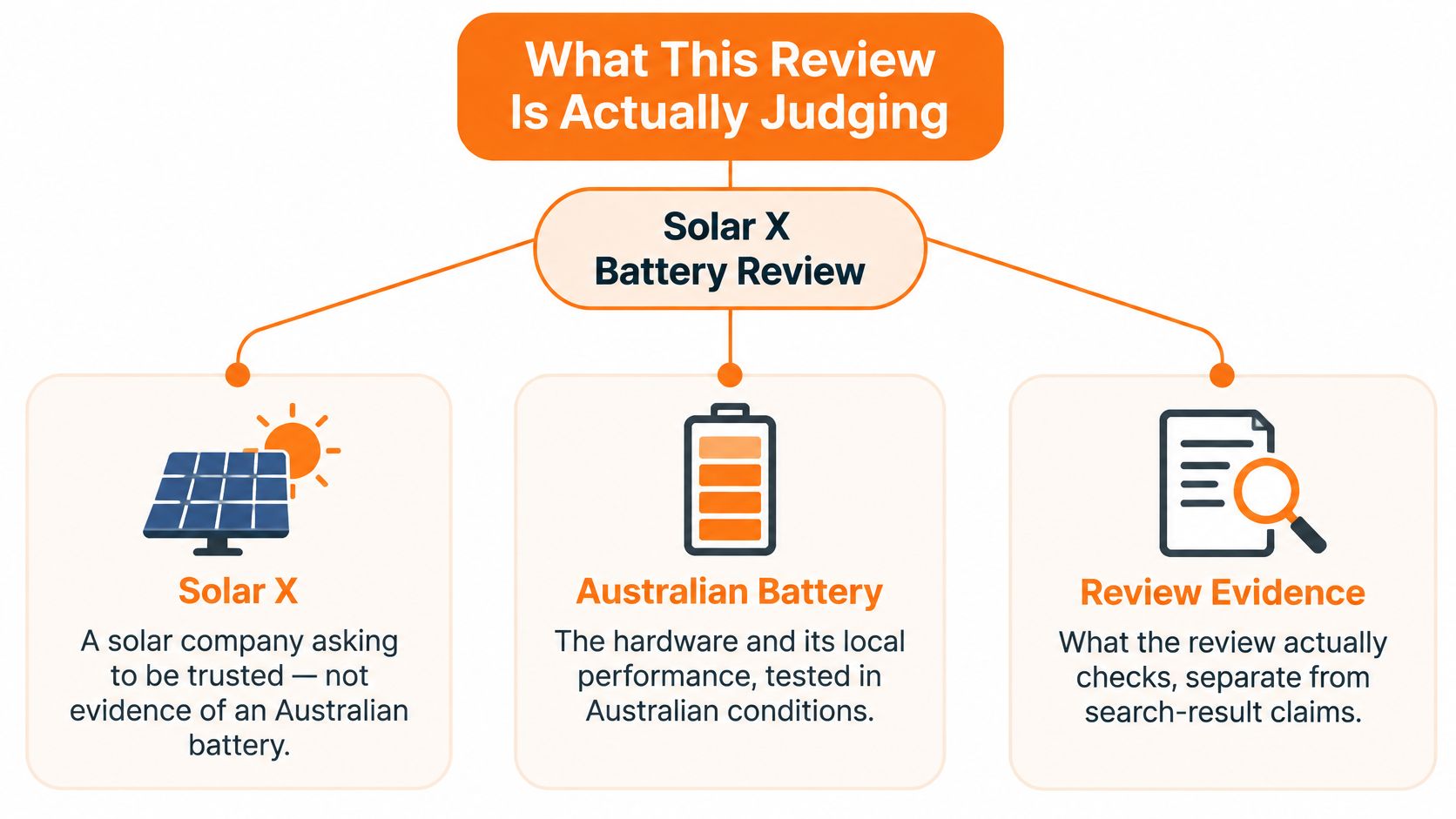
What This Review Is Actually Judging
Say a homeowner searches for Solar X after another electricity bill arrives despite having rooftop solar and a battery. They encounter a solar company's reputation claims, battery specifications from unrelated products and explanations of virtual power plants. Those aren't interchangeable evidence.
Solar X, in the Canadian company material associated with this search, is a solar business asking customers to trust its services. That doesn't establish an Australian battery model, local installer network or compatibility with an Australian VPP.
A home battery stores electricity behind the meter, commonly charging from surplus rooftop generation and discharging when the household needs energy. Its usefulness depends on how much energy it can deliver, how quickly it can deliver it and which appliances it can support.
The battery and the operating agreement
A Virtual Power Plant, or VPP, uses software and communications to coordinate distributed solar, batteries and controllable loads. Think of the battery as a household water tank and the VPP as an agreement to lend spare water to the street after setting aside what the household needs.
The agreement matters as much as the tank. Physical capacity, usable capacity, household reserve and capacity available to the operator are different quantities.
Frequency Control Ancillary Services, or FCAS, help restore grid frequency after a sudden imbalance between supply and demand. ARENA's AEMO VPP demonstrations tested aggregated household resources providing these services, responding to wholesale prices and supporting local networks. VPP value therefore isn't limited to charging cheaply and exporting later.
Why Australian operating conditions matter
According to ARENA's community battery explainer, rooftop solar supplied 12.4% of Australia's electricity in 2024, while only 8.5% of rooftop-solar households also had battery storage; it also reports AEMO's projected NEM requirement of 56 GW of storage power capacity and 660 GWh of energy storage by 2050.
The geographic focus is practical: the Clean Energy Council's rooftop solar and storage report identifies NSW as having the largest cumulative rooftop-PV capacity at 7.1 GW, and Queensland the largest installation count at approximately 1.1 million.
A useful review judges energy delivered, money retained and control preserved. A company's reputation can't substitute for any of them.
Solar X Battery Review Scorecard
Searchable Solar X company-review material centres on a Canadian solar business and BBB-style trust claims, not a published Australian battery datasheet, installed price or verified capacity rating. There's no defensible basis here for assigning Solar X an Australian hardware score.
That doesn't prevent a useful assessment. It changes the verdict from a star rating into six pass-or-query tests.
What decides a Solar X battery review in Australia
| Review question | Measure | Australian benchmark | Verdict effect |
|---|---|---|---|
| Nominal versus usable energy | AC kWh delivered at the connection point | Cell efficiency about 95–98%; residential DC round-trip about 85–95%, so 10 kWh in may return 8.5–9.5 kWh before further conversion losses | Nameplate kWh overstates evening energy |
| Retained-capacity warranty | Percentage remaining and cycle definition | No Solar X Australian warranty figure is established here; don't assume constant output | Degradation changes payback |
| Capacity offered to a VPP | kWh left after the household reserve | NSW incentive calculation caps available capacity at 28 kWh; eligible batteries can be up to 50 kWh | A bigger battery isn't automatically a lower bill |
| Export and network limits | DNSP export cap and tariff | Check the connection agreement and local export limit before valuing exports | Constrained export cuts arbitrage |
| Control during price events and outages | Reserve, override speed and internet-loss behaviour | Remote participation doesn't itself guarantee minimum charge or backup | Household priority needs explicit operating terms |
| Bill outcome | Allowance or credit against supply and usage charges | Government material reports median VPP bills 57–63% lower, with provider differences and increasing complaints | A median isn't a promise |
The efficiency, incentive and bill-outcome benchmarks require their qualifications, explained below. They aren't Solar X product specifications.
AC means alternating current, the electricity your household appliances use. DC means direct current, the form stored within the battery. A DC efficiency result isn't a measurement of all the energy ultimately delivered to household appliances.
Turn missing information into a decision
For each query, request the document that resolves it:
- Energy delivery: A model-specific datasheet stating nominal and usable capacity, operating limits and the measurement boundary.
- Warranty: The retained-capacity threshold, throughput or cycle conditions, exclusions and claim process.
- Network access: The distributed network service provider's connection approval, including export restrictions.
- Commercial value: The retail plan, VPP access conditions and treatment of credits, allowances and excess consumption.
An export limit is especially easy to overlook. A brochure may describe an attractive discharge capability, but your network connection can restrict how much reaches the grid.
The decision rule is straightforward: buy or join only when the usable energy left after household needs can justify the operating contract. An unresolved specification is a query, not permission to assume the best result.
Usable Energy Losses and Battery Wear
Start with surplus solar rather than battery size. A battery receiving 10 kWh may return approximately 8.5–9.5 kWh before additional household conversion losses, using the residential round-trip range discussed in the CSIRO energy-storage overview and associated Australian testing context.
That difference affects the value of every charging decision. You've given up the option of using or exporting the incoming energy, but you don't receive all of it back later.
Where a stated battery efficiency shrinks
| Layer | Reported figure | How to use it |
|---|---|---|
| Lithium-ion cell | About 95–98% | Too high to use alone in a household savings model |
| Small residential pack, DC round trip | About 85–95% | Account for management, inverter, cabling and standby losses at their relevant measurement boundaries |
| Worked surplus of 10 kWh | About 8.5–9.5 kWh returned | Compare delivered energy, not nameplate capacity |
| Grid-scale point of connection, Darlington Point NSW | 82% over six months; performance-test result 89.8% | A warning about field losses, not a home-battery rating |
| Degradation example, the same NSW project | About 7% full-pack degradation; 93.3% performance remaining in February 2025 | Model declining output without copying this rate onto a home battery |
The residential figures distinguish cell efficiency from pack performance. Don't treat an inverter-inclusive AC measurement and a DC measurement as equivalent, or deduct the same loss twice.
For the field example, ARENA's Darlington Point operations report records 82% all-inclusive point-of-connection efficiency over the six months to March 2025, compared with a 89.8% performance test, and approximately 7% estimated full-pack degradation with 93.3% performance remaining in February 2025. This is a grid-scale installation, not a forecast for residential equipment.
Wear belongs in the financial model
Throughput, idle time, temperature, inverter operation and reserve settings can change delivered value. CSIRO also cautions that time-of-use arbitrage can introduce unnecessary cycling, losses and wear without a grid-side need.
Time-of-use arbitrage means charging during a cheaper tariff period and discharging during a more expensive one. The price gap must cover energy losses and additional wear before the cycle creates a worthwhile household benefit.
Practical rule: Don't approve an extra cycle merely because the selling price exceeds the buying price. Compare the reward with lost usable energy, foregone household use and additional wear.
Request the warranty's definition of retained capacity and its cycle or throughput conditions. Model savings with declining usable output rather than repeating the first year's performance indefinitely.
Our round-trip efficiency guide helps distinguish these measurement boundaries. For VPP dispatch, the operating test is whether automation respects the agreed household settings and avoids events whose reward doesn't justify their cost.
VPP Value After the Household Reserve
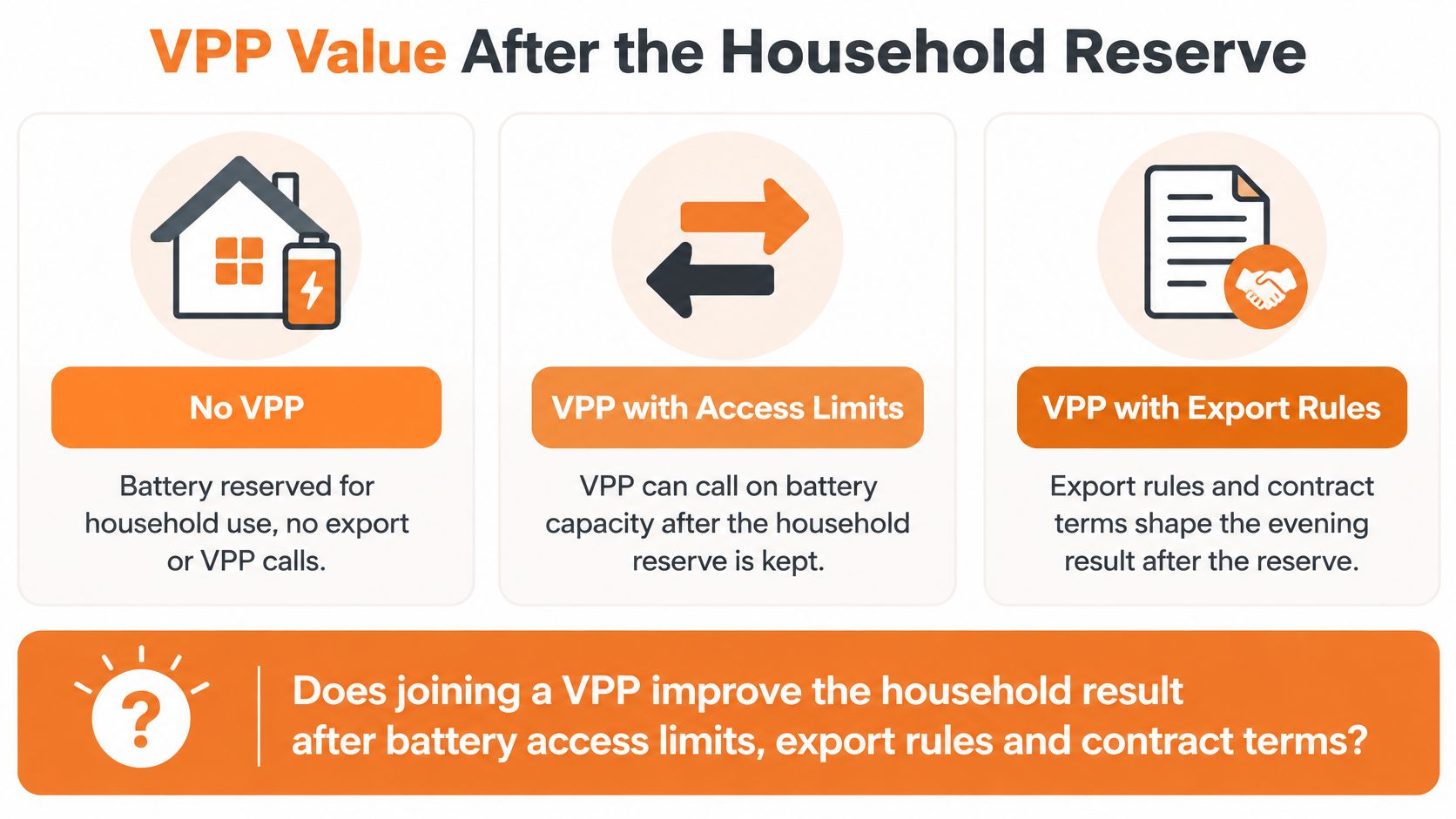
Does joining a VPP improve the household result after access limits, export rules and contract terms? The answer starts with evening consumption, not the battery's advertised size.
A household that uses little electricity after sunset has a different opportunity from a household running air conditioning, cooking appliances and other substantial loads through the evening. Backup expectations can reduce available capacity further.
Evening use and what is left for a VPP
| Evening pattern | Reserve choice | Spare capacity | Value test |
|---|---|---|---|
| Low evening use | Small household reserve | More spare kWh | Grid support or export only after round-trip losses |
| Medium evening use | Moderate reserve | Partial availability | Credit or allowance must beat lost self-consumption |
| High evening use | Large reserve | Little spare kWh | Self-consumption dominates; VPP value may be small |
| Outage-priority home | Reserve sized for backup expectations | Often little or none | Don't assume participation preserves backup power |
For the medium-use household, the opportunity cost is the household electricity purchase that stored energy would otherwise have avoided. Holding more reserve also has a cost: it leaves less capacity available for paid grid participation.
Under NSW's VPP incentive guidance, the incentive uses capacity made available to the grid, capped at 28 kWh, while eligible batteries can be up to 50 kWh; participation also requires compatible equipment, internet, remote-access contract terms and a compatible electricity retailer.
Feed-in tariff versus retailer-based VPP value
A feed-in tariff pays for electricity exported through your meter. Network congestion and connection limits can restrict those exports, regardless of the battery's discharge capability.
A retailer-based VPP combines retail supply with coordinated battery participation. The operator may earn value from wholesale-market activity and grid services, then return value through the retail offer rather than a simple export payment.
HighFlow Energy's Bring Your Own Battery, or BYOB VPP, uses existing compatible solar and storage without new hardware. Spare-capacity participation funds a monthly electricity allowance, rather than requiring the household to manage wholesale trading directly.
Our Bill-Free Electricity allowance tiers range from 300 kWh to 1,000 kWh per billing month, according to system size. The allowance resets monthly, and usage above it is charged at standard rates without penalties; the current Energy Plan determines the applicable rates.
Compare the whole retail outcome, not just the export rate or the largest advertised allowance.
Retail supply remains subject to authorised energy retail frameworks. An allowance is a defined plan benefit, not an unconditional guarantee that every household will have no electricity bill.
Dispatch Conflicts and Eligibility Checks
A battery can look comfortably charged at lunchtime and be less useful by dinner. A high-price event may trigger discharge before unexpected cooking and air-conditioning loads arrive, or before an outage interrupts grid supply.
AEMO's VPP demonstration report distinguishes household self-consumption from contingency frequency response and records that heavy daytime charging reduced available contingency-lower capacity. Charging strategy affects which services a battery can provide.
Test the operating promises
Ask these questions before accepting remote dispatch:
- Reserve: Can a minimum reserve be configured, and what limits apply?
- Override: How quickly does a customer override take effect?
- Outages: Which circuits have backup capability, and under what conditions?
- Internet loss: What operating mode continues without communications?
- Notifications: Are dispatches explained before or after they occur?
- Compensation: What payment or allowance covers battery access and associated charges?
The Australian Government's VPP assessment reports median annual bills 57–63% lower for VPP customers than regular customers, but also identifies provider and usage-profile differences and increasing complaints. That's a reason to inspect the contract, not a household savings forecast.
Eligibility is model-specific
Our system integration requirements address compatible equipment and connectivity. Eligibility requires a Queensland or NSW home with solar, a compatible battery meeting usable-capacity and inverter requirements, internet access and an ongoing electricity bill.
Our VPP uses spare capacity with household energy use first. We may remotely charge or discharge the battery for market participation, affecting stored energy at any moment; participation doesn't guarantee minimum charge or backup during an interruption.
You retain ownership and control, and joining our BYOB program doesn't affect your battery warranty. Our app provides manual override, but that isn't a substitute for a separately verified backup design.
If the battery stops working or is removed and eligibility is lost, the allowance stops and standard retail pricing applies unless you leave. Canadian trust accreditation doesn't establish Australian electrical or retail approval, and a brand name isn't a compatibility certificate. Consult the Australian Energy Regulator for retail obligations and AEMO for NEM operating information.
Check Whether Your Battery Is Underused
The useful question isn't whether every battery should join a VPP. It's whether your system has spare capacity that your present retail arrangement doesn't value.
Gather your electricity bill, battery and inverter model numbers, connection approval and monitoring records. Compare imports, exports and stored energy across ordinary weekdays and weekends, not just a sunny day with unusually low consumption.
Why HighFlow Energy
Our retailer-based process follows a defined sequence:
- Bring your existing system: Use the solar and compatible battery you already own.
- Join if eligible: Connect the battery to our coordinated VPP.
- Support the grid: Make spare capacity available when the battery is available.
- Receive an allowance: Use the monthly electricity allowance funded by that participation.
You remain grid-connected and keep ownership and control. The allowance covers daily supply charges, electricity usage within the allowance, and network and distribution charges on that portion.
Our app shows live prices and home energy, uses forecasts to plan battery operation and allows manual override. Use the performance reporting dashboard guide to frame your ongoing performance review.
For independent context, ARENA's VPP explainer describes how aggregated household batteries can support the electricity system.
Key takeaways
- Usable energy: Assess capacity remaining after household needs.
- Losses: Don't value stored electricity as though every incoming unit returns.
- Incentives: Available grid capacity matters more than nameplate size alone.
- Bill outcomes: A median result isn't an individual guarantee.
- Backup: VPP participation doesn't promise outage protection.
Most battery owners focus on installation quality. Far fewer focus on ongoing performance and optimisation. We're an electricity retailer built around improving the value of existing solar and battery assets, so an eligibility assessment should test whether your system is financially underused, not assume it is.
Frequently Asked Questions About Solar X Battery Reviews
Is Solar X an Australian home battery brand?
No Australian Solar X datasheet, warranty figure, price or VPP compatibility certificate is established by the public material assessed here. Verify the exact manufacturer and model rather than treating a Canadian company review as Australian product evidence.
What is a virtual power plant?
A VPP coordinates distributed energy resources through software and communications. You retain your household equipment; you don't acquire ownership of a central power station.
Does the NSW incentive cap mean every battery must match that capacity?
No. The incentive cap applies to capacity made available to the grid, not a compulsory battery size. The scheme separately sets eligible battery requirements.
Does a bigger battery lower my bill?
Not automatically. A larger battery can still deliver poor value if there's insufficient surplus solar to charge it, limited evening demand, restrictive exports or unfavourable retail terms.
Does an allowance mean a zero bill?
No. Our monthly allowance has defined coverage, and electricity used above it is charged at standard rates under the applicable plan. Assess ordinary and high-consumption months before deciding whether the arrangement suits your household.
Will my battery power my home during a grid outage while in a VPP?
That isn't guaranteed. Backup depends on the equipment, installation, supported circuits and available stored energy, and participation doesn't promise a minimum charge level during an interruption.
HighFlow Energy offers a Bring Your Own Battery VPP for eligible Queensland and New South Wales households with existing solar and compatible storage. To turn this Solar X battery review into a practical assessment of your usable energy, system compatibility and potential monthly allowance, visit HighFlow Energy and request an eligibility assessment.