


Batteries for Solar Panels Price in Australia
A typical 10–13 kWh home battery in Australia costs about A$10,000–A$18,000 installed in 2026. The federal rebate can reduce that purchase price by roughly A$2,500–A$3,300, depending on system size and eligibility.
That makes actual batteries for solar panels price closer to A$7,000–A$15,500 for many eligible households, but the final figure depends on the installation date, battery capacity, inverter arrangement, installer, and whether the system is operated for ongoing value after installation. A battery isn't automatically a good investment because the quote looks reasonable. It needs to reduce grid purchases, avoid low-value exports, and potentially participate in a properly structured Virtual Power Plant.
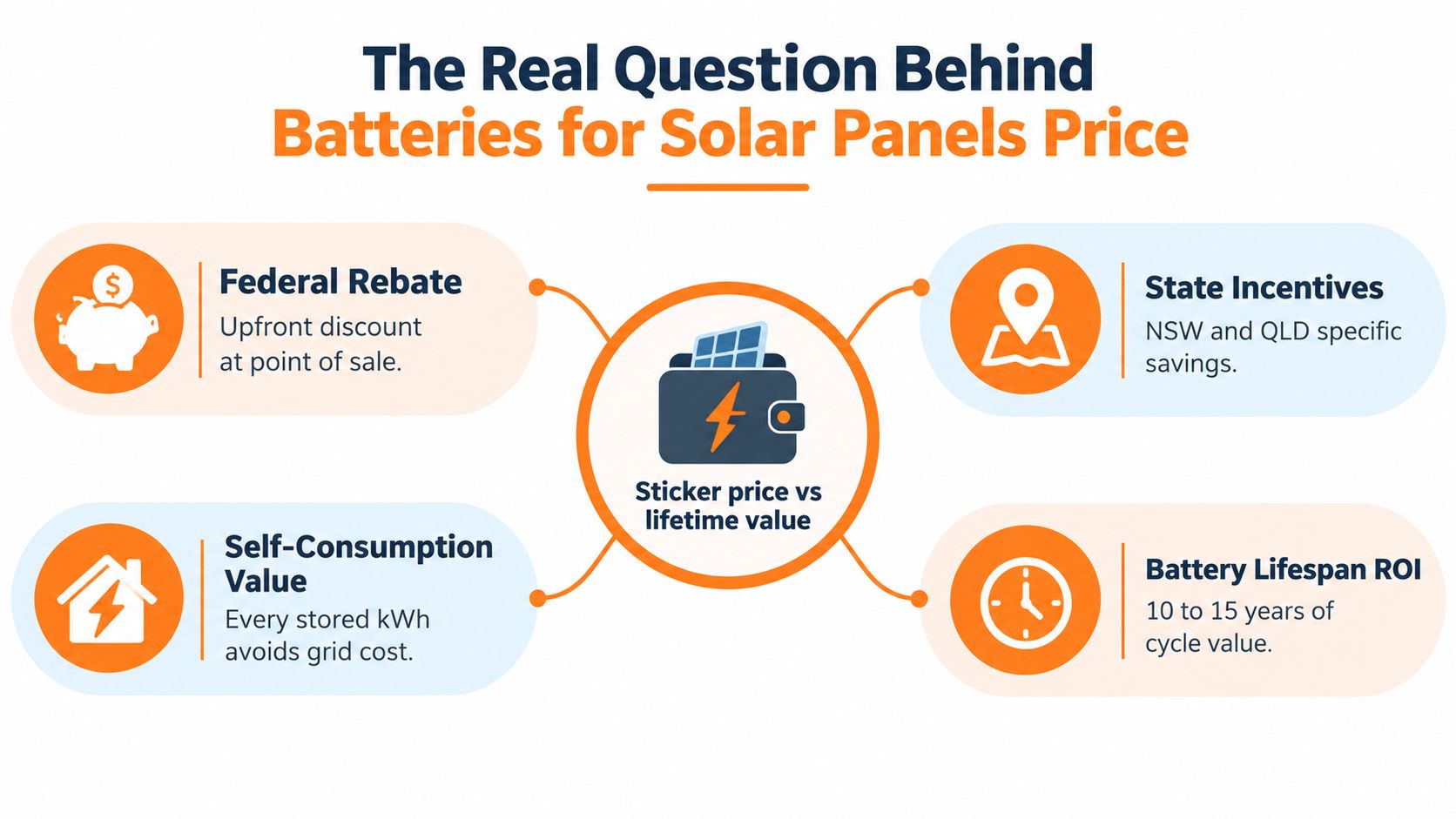
The Real Question Behind Batteries for Solar Panels Price
The headline price is only the first number in the decision. The more useful question is: what will this battery cost after rebates, and how much value will it create once it's operating?
Two households can pay a similar amount for storage and achieve very different outcomes. One may use most stored energy in the evening, avoid expensive imports, and participate in a VPP. Another may have low evening demand, export surplus energy at a modest feed-in rate, and leave much of the battery unused.
The purchase decision should therefore follow four steps:
- Start with the installed quote. Check whether it includes the battery, inverter, switchboard work, monitoring, commissioning, and all labour.
- Subtract eligible incentives. A federal or state programme can change the amount paid at installation.
- Estimate useful battery activity. A battery creates more value when it stores surplus solar and discharges when the household would otherwise buy electricity.
- Assess ongoing optimisation. Smart dispatch can respond to demand events, wholesale price volatility, time-of-use tariffs, export constraints, and network conditions.
Price is not the same as cost
The installed price is what appears on the quote. The effective cost is what remains after eligible support. The lifetime value is the financial benefit produced through self-consumption, tariff management, backup capability, and grid participation.
For Queensland and New South Wales homeowners, timing now matters more than it did when battery rebates had a simpler structure. The federal Cheaper Home Batteries Program began on 1 July 2025 and changes the support available by battery capacity. The relevant installation date, not merely the date on a quote, can affect the final invoice.
A sensible buyer compares net outcomes rather than choosing the cheapest hardware. That means checking chemistry, usable capacity, inverter compatibility, warranty terms, expected household demand, and the retailer's approach to VPP control.
Practical rule: Don't compare battery quotes until every quote shows the same usable capacity, rebate treatment, backup scope, and ongoing operating assumptions.
What a Home Battery Actually Costs in 2026
The current Australian market has a wide spread. A typical 10–13 kWh residential lithium-ion battery system costs about A$10,000–A$18,000 installed, equivalent to roughly A$1,000–A$1,400 per kWh of usable capacity. The same market summary places pricing at about A$1,600–A$2,000 per kWh in 2022 and above A$2,500 per kWh in 2018, showing that installed battery pricing has fallen by well over half per usable kWh over that period. (Australian market summary)
NSW provides a broader local benchmark. The NSW Government states that residential batteries typically cost between A$6,000 and A$24,000, reflecting differences in capacity, brand, installation complexity, and whether the battery is being added to existing solar or installed as part of a new system. (NSW battery guidance)
| Battery size or market segment | Low estimate | Typical estimate | High estimate | Effective price per usable kWh |
|---|---|---|---|---|
| Typical 10–13 kWh installed system | A$10,000 | Not stated separately | A$18,000 | About A$1,000–A$1,400 |
| NSW residential battery market, all stated sizes | A$6,000 | Not stated separately | A$24,000 | Depends on capacity |
| 5 kWh battery-only installation | Not stated separately | Not stated separately | Not stated separately | About A$1,128 |
| 15 kWh battery-only installation | Not stated separately | Not stated separately | Not stated separately | About A$825 |
The last two figures are battery-only comparison points, not complete installed-system prices. They show why a larger system can have a lower unit cost. Inverter capacity, protection equipment, communications, commissioning, and switchboard work can be shared across the system, so adding usable storage doesn't always add the same cost per kWh.
A retrofit can also cost more than a straightforward installation because the installer may need to integrate a battery inverter with an existing solar inverter, modify protection equipment, or complete additional switchboard work. Ask the installer whether the design is AC-coupled or DC-coupled, and whether the quoted price includes the changes required to make the system compliant.
What to check on a quote
A credible quote should identify:
- Usable capacity, not only nominal capacity.
- Inverter arrangement, including whether the existing solar inverter remains in place.
- Backup scope, such as selected circuits or broader household supply.
- Monitoring and gateway equipment, including commissioning.
- Rebate assumptions, with eligibility and installation timing stated clearly.
- VPP capability, if you may join a retailer programme later.
Queensland and NSW generally sit within the national pricing picture, but regional labour, travel, switchboard condition, and installer availability can still move the final number. Treat an unusually low quote as a prompt to check what it excludes, not as proof that you have found better value.
How the Cheaper Home Batteries Program Changes Your Price
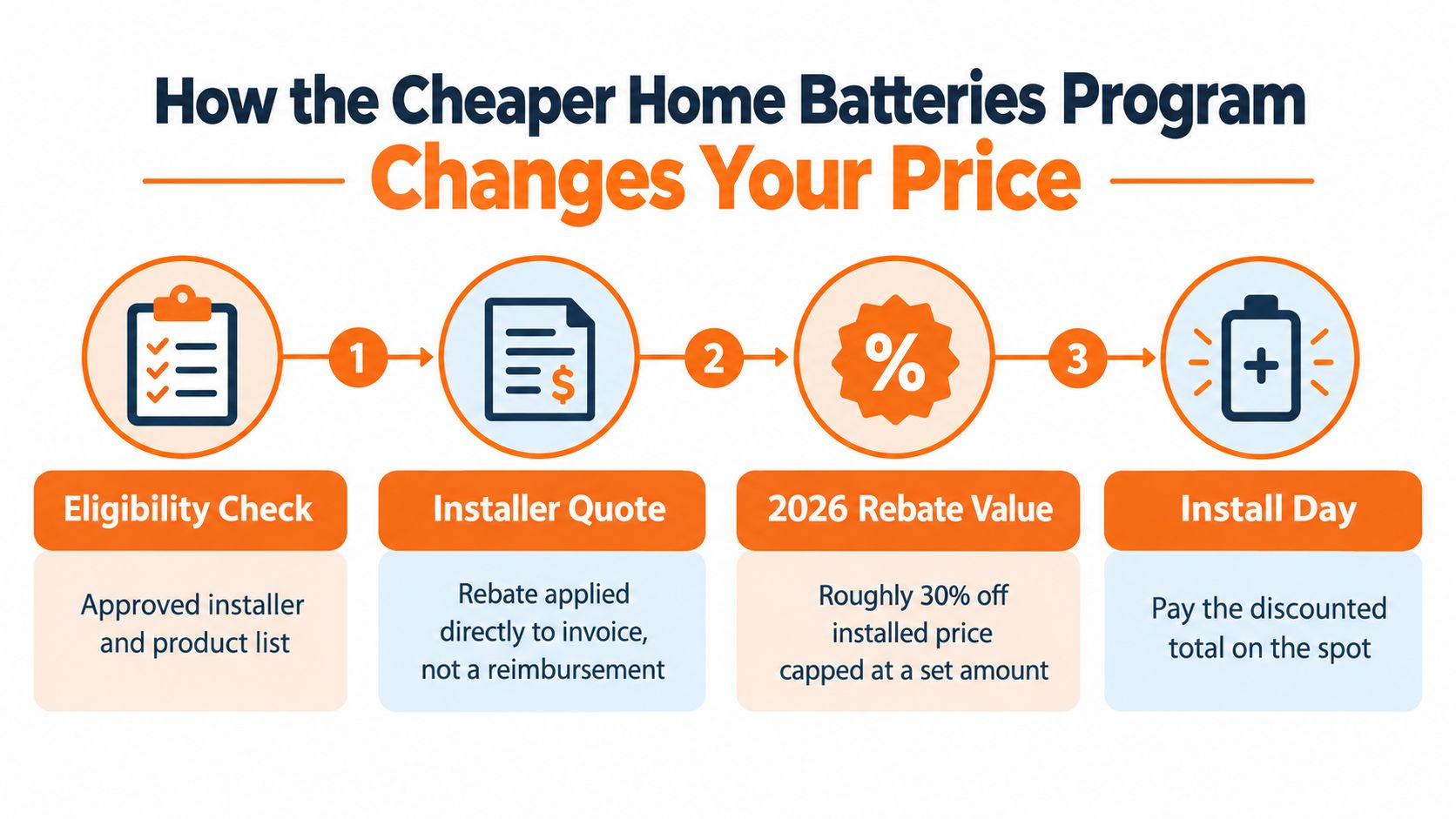
The federal Cheaper Home Batteries Program is designed to reduce the upfront cost of eligible small-scale batteries. The support is applied through the installation process rather than treated as a later household reimbursement. The programme aims to reduce eligible upfront costs by around 30%, and the first 14 kWh receives support of about A$250 per usable kWh. For a typical 10–13 kWh system, that equates to roughly A$2,500–A$3,300 at purchase. (Home battery market and programme summary)
That discount changes the effective price substantially. A system priced within the national installed band can land at roughly A$7,000–A$15,500 after the stated rebate effect, before considering any separate state incentive or additional site work. The exact result depends on the battery's eligible capacity and the installer's treatment of the programme.
Why installation timing matters
From 1 May 2026, the federal support uses a tiered structure. Eligible capacity receives full support up to 14 kWh, 60% support from 14 to 28 kWh, and 15% support from 28 to 50 kWh. The scheme applies to systems from 5 kWh to 100 kWh, with support capped for the first 50 kWh. (Clean Energy Regulator rebate update)
That structure changes the economics of larger batteries. A bigger system may provide more usable storage and a lower equipment cost per kWh, but the rebate contribution falls across the higher capacity tiers. A buyer shouldn't assume that adding capacity creates a proportionate discount.
The practical point for a Queensland or NSW homeowner is simple: the installation date affects the outcome. A quote received before a policy change may not preserve the same rebate if the system is installed later. Confirm the eligibility rules, approved equipment, installation deadline, and invoice treatment in writing before paying a deposit.
The federal scheme also requires the connected inverter to be capable of participating in a VPP. That doesn't force you to join a particular retailer, but it makes compatibility an important part of the purchasing decision. (Clean Energy Regulator solar battery requirements)
Chemistry and Size Choices That Move the Price
Battery chemistry affects more than the initial quote. It influences usable capacity, efficiency, thermal behaviour, warranty structure, installation design, and how confidently the system can operate in the household's location.
LFP, or lithium iron phosphate, is the practical default for many new Australian home installations. Premium LFP systems commonly deliver around 95%–97% round-trip efficiency and include 10-year warranties. Larger battery packs can also reduce the battery-only unit cost, with comparison data placing a 5 kWh pack at about A$1,128 per kWh and a 15 kWh pack at about A$825 per kWh. (Australian home battery comparison)
Other lithium-ion chemistries may still appear in Australian quotes. Don't reject them solely on chemistry, but ask for the usable capacity, warranty conditions, thermal protections, efficiency, and approved installation requirements. A lower price per nominal kWh can be poor value if the usable capacity or warranty support is weaker.
| Option | Chemistry | Usable capacity | Typical installed $ per kWh | Cycle life or warranty | Best fit |
|---|---|---|---|---|---|
| Compact home system | LFP | Smaller household storage | Usually higher unit cost | Premium systems commonly offer a 10-year warranty | Modest evening demand |
| Mid-size home system | LFP | Around 10–13 kWh | About A$1,000–A$1,400 for the installed market band | Premium systems commonly offer a 10-year warranty | Typical solar household |
| Larger modular system | LFP or another lithium-ion chemistry | 15 kWh or more | Battery-only comparison can fall towards about A$825 per kWh | Varies by product | Higher evening demand and suitable cycling |
| Alternative lithium-ion system | Product-dependent | Product-dependent | Quote-specific | Quote-specific | Buyers prioritising a particular inverter ecosystem |
The capacity decision should follow your evening load, not the largest battery the installer can fit. Oversizing reduces the unit cost of storage but can leave capacity idle. Undersizing can force the battery to discharge completely before the household's evening demand is met.
For a more detailed chemistry discussion, review this guide to LFP solar batteries. Then ask your installer to model usable capacity rather than presenting the battery's advertised nominal size.
Payback Math Using NSW and National Benchmarks
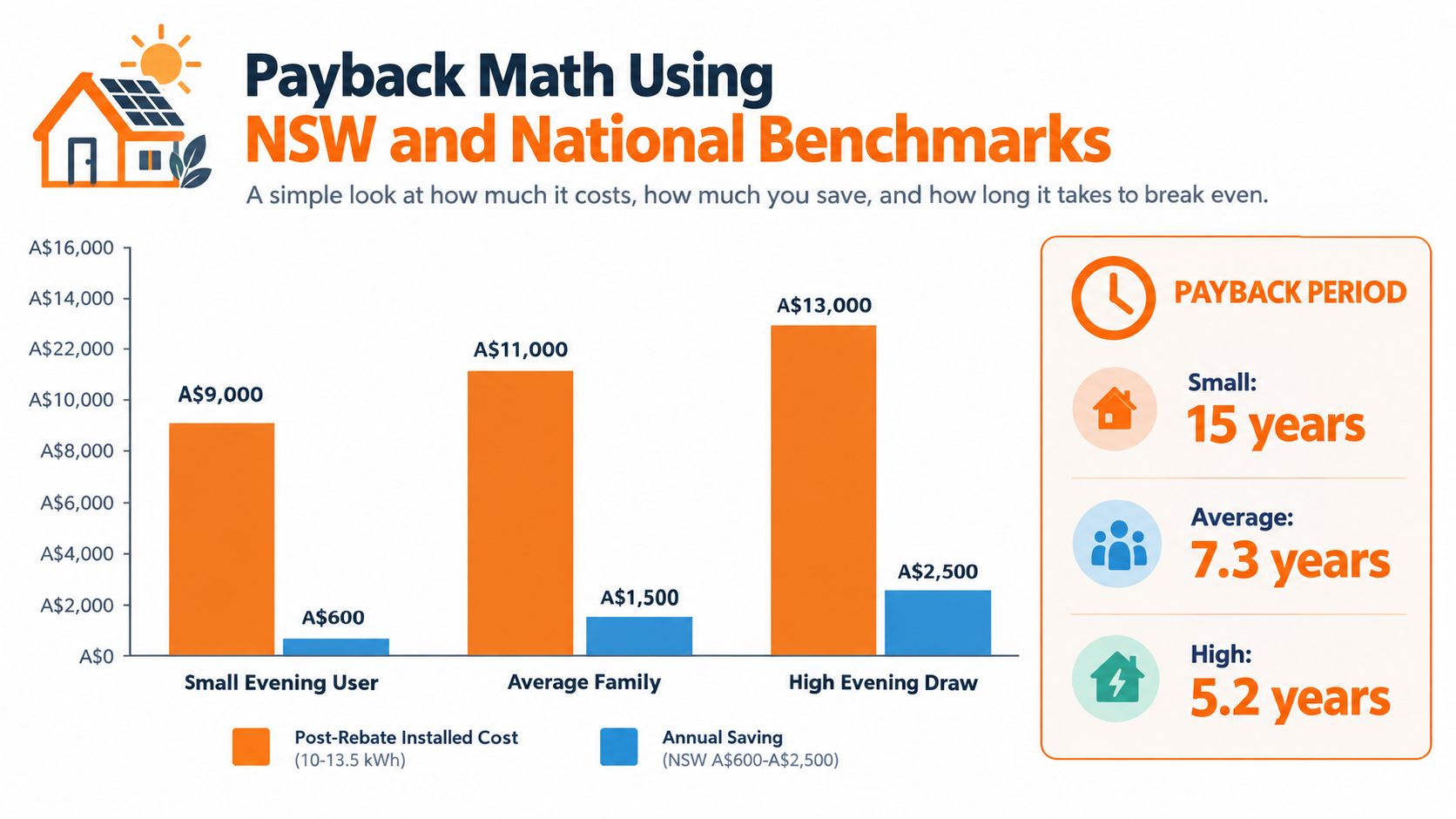
Payback is a calculation, not a promise. The NSW Government states that a home battery can save between A$600 and more than A$2,500 per year through energy savings and incentive earnings, while the same government source places residential battery prices between A$6,000 and A$24,000. (NSW savings and price benchmark)
That range is deliberately broad because household behaviour drives the result. A battery serving a home with high evening consumption can displace more grid electricity than one serving a lightly occupied property. Tariff structure, solar export limits, air-conditioning use, pool equipment, and the retailer's VPP settings all affect the annual outcome.
Three household patterns
A Queensland family with daytime solar and strong evening demand may have worthwhile stored energy available after the solar day, while evening appliances and cooling create regular opportunities for discharge. The battery's value depends on how much of that energy offsets imports rather than being reserved, curtailed, or exported at a lower value.
A NSW couple on a time-of-use tariff may benefit from shifting stored solar into expensive periods. Their result will depend on the difference between import prices and export value, as well as whether the retailer or VPP dispatches the battery during demand events.
A single-person household with modest evening use may not cycle a large battery often enough to justify the extra capacity. A smaller system, a staged installation, or continued solar-only operation may be financially more disciplined.
Use a simple test before signing:
- Annual benefit: estimate avoided imports, tariff shifting, and eligible VPP earnings.
- Net purchase price: subtract the confirmed rebate from the installed quote.
- Simple payback: divide net purchase price by annual benefit.
- Long-term value: test whether the expected benefit remains credible across the warranty period and beyond.
Don't use a national average as a substitute for interval consumption data. Export rates, feed-in settings, and household demand can change the result without any change to the battery hardware.
A sensitivity check is more useful than a single payback number. Model a weaker year, a stronger year, a higher installation quote, and a lower level of battery participation. If the decision only works under the most favourable assumptions, the system is financially fragile.
The battery payback calculator can help organise the inputs, but the quality of the result still depends on accurate household usage, solar export, tariff, and quote data.
Why Purchase Price Is Only Half the Value Story
A battery can be technically installed and financially underused. That happens when it sits in reserve, discharges at the wrong time, or exports energy without a clear strategy for capturing its value.
The key concept is utilisation. Utilisation describes how consistently the battery's usable capacity performs a useful task. Useful tasks include storing surplus rooftop solar, reducing peak imports, shifting energy under a time-of-use tariff, responding to demand events, and supporting a VPP.
A flat feed-in tariff may be appropriate for some households, but it isn't the only possible operating strategy. A coordinated system can assess household demand, wholesale price volatility, network congestion, forecast solar generation, and the need to preserve priority energy for the home.
Retailer value versus passive ownership
A traditional retailer may bill imports and credit exports. A retailer-based VPP can add another operating layer by coordinating compatible batteries and dispatching spare capacity when grid support has value.
That doesn't mean every VPP offer is suitable. Read the control rights, payment or allowance structure, export treatment, warranty conditions, battery reserve settings, and exit terms. The household should retain priority access to stored energy, and the operator should explain how it protects that priority during demand events.
A battery's financial performance depends on what the system does between installation visits, not only on the equipment selected on installation day.
HighFlow Energy operates a Bring Your Own Battery VPP for eligible solar and battery owners in Queensland and New South Wales. Its model uses a compatible existing battery, coordinates spare capacity through a retailer-based VPP, and provides a bill-free electricity allowance structure while prioritising household needs. Customers should still assess eligibility, tariff treatment, control settings, and the terms that apply to their particular system.
Common Questions About Battery Pricing
Is A$10,000 to A$18,000 a reasonable battery price?
For a typical 10–13 kWh installed lithium-ion system in Australia, that is the stated national market band before applying the federal rebate. A quote outside it isn't automatically wrong, but the installer should explain differences in capacity, inverter work, switchboard changes, backup scope, product support, and regional labour.
How much can the federal rebate reduce the price?
For a typical 10–13 kWh system, the federal programme can reduce the purchase price by roughly A$2,500–A$3,300, subject to eligibility and the applicable capacity rules. (Federal rebate estimate)
Does the installation date affect the rebate?
Yes. From 1 May 2026, support is tiered by capacity, with full support up to 14 kWh and lower support levels across the larger capacity bands. The installation timing and eligibility status should be confirmed with the approved installer. (Rebate timing rules)
Is a larger battery always better value?
No. Larger systems can have a lower price per kWh, but they need enough solar surplus and household demand to cycle usefully. Extra capacity that remains idle can lengthen the financial return.
Can an existing solar system use a VPP?
It may be able to, provided the battery and connected inverter meet the relevant technical and programme requirements. The federal scheme requires the connected inverter to be VPP-capable, and the installer or retailer should verify compatibility before enrolment.
Can a VPP control my battery whenever it wants?
Control rights depend on the programme. Ask when the VPP can dispatch the battery, what reserve is protected for your home, how demand events are handled, how compensation is calculated, and whether you can override the operating plan.
Does NSW offer a separate VPP incentive?
NSW calculates its VPP incentive based on battery capacity made available to the grid, up to 28 kWh. NSW also states that batteries eligible for the federal Cheaper Home Batteries Program are VPP-compatible. (NSW VPP incentive information)
A Practical Decision Framework for QLD and NSW Buyers
Use this sequence before accepting a battery quote.
1. Confirm your solar export profile
Look at your electricity data and identify how much rooftop solar is exported during the day. A battery needs surplus generation to charge, and its value depends on how much stored energy your home can use later.
Check for seasonal changes, air-conditioning demand, pool equipment, electric hot water, and export limits. Queensland and NSW households can have very different operating patterns even when their solar systems look similar on paper.
2. Match capacity to evening demand
Shortlist a 10 kWh or 13 kWh LFP system only after checking your actual evening draw. Don't buy capacity only because the installer offers a larger discount per kWh.
Ask for separate figures for nominal capacity, usable capacity, maximum discharge power, backup output, and expected reserve. Those details tell you whether the battery can serve your home in practice.
3. Lock in the rebate treatment
Ask whether the quote assumes the rules before or after the 1 May 2026 tier change. Confirm the installation date, approved product status, rebate amount, and final customer payment in writing.
A quote can become less attractive if the installation is delayed into a different rebate tier. The rebate isn't a reason to rush into unsuitable hardware, but it is a reason to treat timing as part of the financial calculation.
4. Choose standalone operation or VPP participation
A standalone battery gives you direct control over charging and discharging. A VPP can add coordinated grid services, but it introduces operating rules and retailer terms.
Before enrolling, check:
- CEC approval: Confirm that the battery and inverter are approved for the proposed installation.
- STC treatment: Ask how any Small-scale Technology Certificate assignment is reflected in the quote.
- Export pricing: Confirm how exported energy and VPP value are credited.
- Priority use: Check the reserve that remains available to your household.
- Warranty protection: Confirm that VPP participation complies with the manufacturer's warranty.
- Network requirements: Ask whether local export limits or connection rules affect operation.
A battery quote should show both the purchase economics and the operating plan. If the installer can't explain how the system will charge, discharge, export, and respond to demand events, you don't yet have a complete value assessment.
The Australian Energy Regulator and AEMO are useful reference points for understanding retail obligations, the National Electricity Market, demand response, and system conditions. Your retailer and installer remain responsible for explaining the terms and technical requirements that apply to your property.
Most battery owners focus on installation quality. Far fewer focus on ongoing performance and optimisation. HighFlow Energy is an electricity retailer built around unlocking the full value of your existing solar and battery system. If you want to check whether your battery is underperforming financially, review your eligibility and explore the HighFlow Energy Bring Your Own Battery VPP service.