


Bi-Directional Charging Australia: Your 2026 Guide
Most homeowners still think of an electric vehicle as a transport asset with a charging cost attached. In bi-directional charging australia, that view is already becoming outdated.
The more important shift is this. A parked EV is starting to look less like an appliance and more like a dispatchable energy asset. For households in Queensland and New South Wales that already have rooftop solar and a home battery, that creates a new question. Not just whether your car can charge at home, but whether it can work with the rest of your energy system to improve resilience, reduce grid imports, and create more value through a Virtual Power Plant.
That matters because the hard part isn’t only charging the car. It’s coordinating solar generation, stationary battery storage, household loads, export limits, and EV availability in a way that protects the home first and then captures value from the grid when conditions suit.
Your EV is Now a Power Plant on Wheels
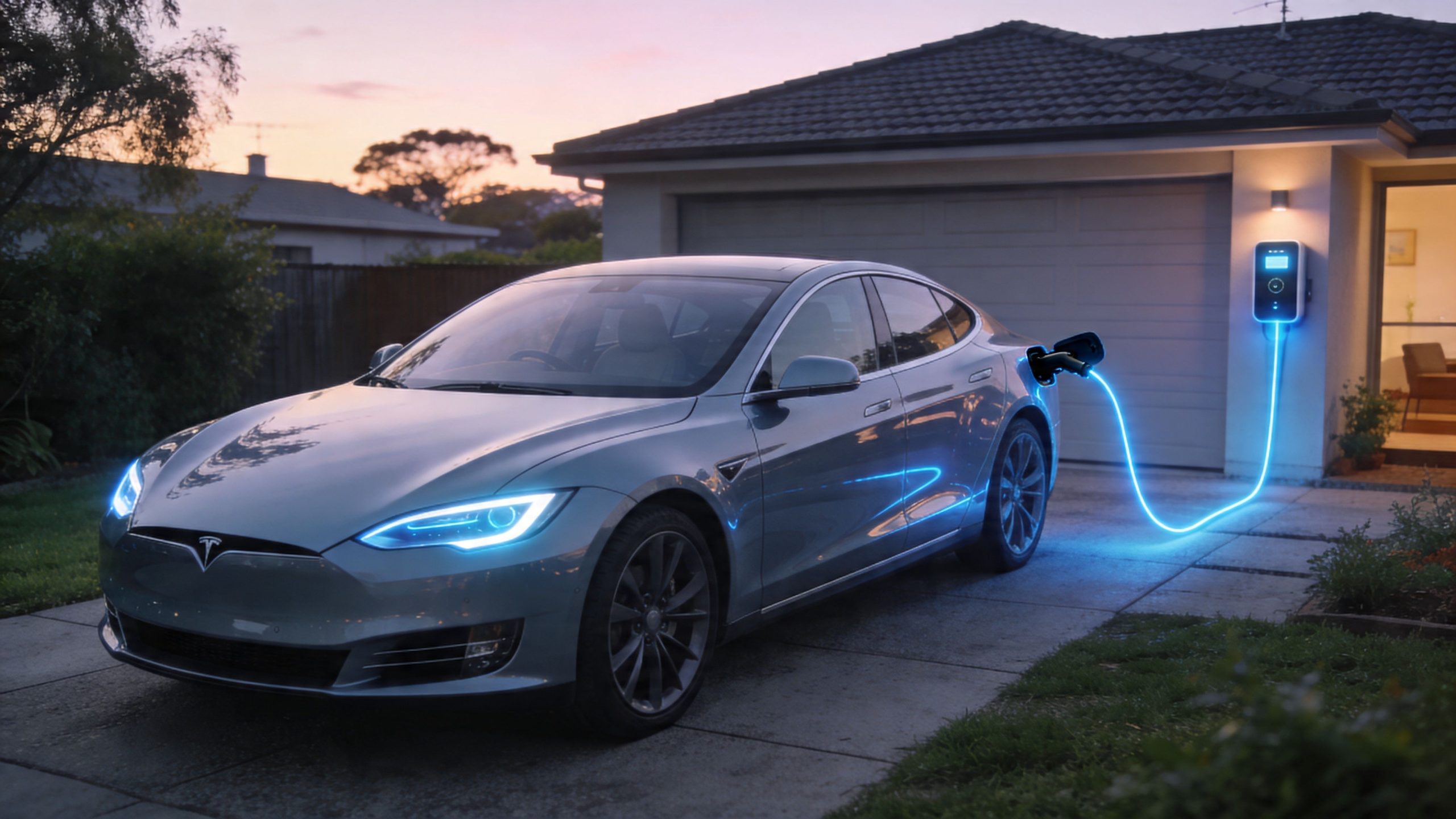
For a household with rooftop solar, an EV can become the largest battery on the property.
That changes the economics of home energy. Bi-directional charging means the car is no longer only a load that needs managing. It can also store midday solar, support household demand later in the day, and in the right setup provide flexible capacity to the grid through a Virtual Power Plant. For homeowners who already own solar and a stationary battery, the key to value is not the vehicle in isolation. It is how well the EV is coordinated with the assets already installed.
The scale matters. As noted earlier, industry roadmaps now treat EV batteries as a major future source of flexible storage for the National Electricity Market. The practical implication for homeowners is straightforward. A car that sits parked for long periods can do more than reduce petrol costs. It can become part of a broader energy system that improves solar self-consumption, lowers peak-period imports, and adds another controllable asset for VPP participation.
Why the parked car matters commercially
Driving consumes energy. Parking creates optionality.
Most household batteries are sized around evening demand and backup priorities. An EV battery is often much larger, but its value depends on timing, charger compatibility, and control logic. If a VPP provider can coordinate solar generation, home battery charging, EV charging windows, household loads, and export constraints together, the EV starts to serve a commercial function rather than solely a transport one.
A compatible parked EV can act as:
- Additional solar storage when rooftop generation would otherwise be exported at low feed-in tariff rates
- A flexible household energy source during expensive grid periods, if the system is configured for home discharge
- Dispatchable VPP capacity when the grid is short on supply and aggregated exports are worth more
Why solar and battery owners are better placed than first-time EV buyers
Households with existing solar and battery systems already understand the underlying economics. They have seen the gap between cheap daytime exports and expensive evening imports. They also know that hardware alone does not optimise anything. Value comes from control.
That is why bi-directional charging is more interesting in an integrated home energy system than as a standalone EV feature. In many homes, the stationary battery handles daily cycling and backup priorities, while the EV adds larger but less predictable storage based on driving patterns. A VPP provider’s role is to orchestrate both assets so they do not compete with each other or export at the wrong time.
The result is a more layered system. Your wall battery handles fast, routine household support. Your EV adds flexible capacity when it is parked, charged, and available. Managed properly, the combination can improve resilience and create a stronger revenue case than either asset on its own.
V2G, V2H, and V2B The Three Flavours of Bi-Directional Charging
The acronyms sound technical, but the power flows are straightforward once you separate them.
V2H means vehicle to home
Vehicle-to-home, or V2H, means electricity flows from the EV battery into your house.
This functions as a silent backup generator, utilizing energy already stored in your car battery. Instead of petrol, the car uses electricity you may have charged from solar, from the grid overnight, or from a managed charging strategy.
For a homeowner, V2H is mainly about:
- Resilience during outages if the system is configured for backup support
- Avoiding expensive grid imports during high-price periods
- Using more of your own energy locally rather than relying on external supply
If you already have rooftop solar, V2H can help hold more of that value inside the property.
V2G means vehicle to grid
Vehicle-to-grid, or V2G, means electricity flows from the EV battery back into the wider grid.
The simplest analogy is a community water tank. Your home battery and EV are your local tanks. When the community system is under pressure, a compatible V2G setup can release some stored energy back out.
That creates a different kind of value from V2H. The main benefit is not just household resilience. It’s market participation.
A V2G-capable setup can support:
- Peak demand periods when energy is more valuable
- Grid services where flexible capacity matters
- Managed export strategies coordinated by a retailer or VPP platform
In this scenario, the EV starts acting like a personal power station connected to a much larger market.
V2G is less about charging convenience and more about turning stored energy into a dispatch decision.
V2B means vehicle to building
Vehicle-to-building, or V2B, is the commercial version of the same idea.
Instead of discharging into a single home, the EV supports a larger building such as an office, apartment complex, or commercial premises. The logic is similar to V2H, but the control layers are usually more complex because building loads are broader and often shared.
For homeowners, V2B matters mostly as a signal of where the market is heading. Once the technology works reliably across homes and small buildings, broader adoption becomes easier.
One technology, three different outcomes
The easiest way to distinguish them is by the destination of the power and the reason for using it.
| Mode | Where the power goes | Main household benefit |
|---|---|---|
| V2H | Into the home | Backup support and lower grid dependence |
| V2G | Into the grid | Revenue and grid service value |
| V2B | Into a building | Business continuity and site-level optimisation |
A lot of confusion comes from treating all three as the same thing. They aren’t.
For most households in QLD and NSW, the question isn’t which acronym sounds best. It’s whether the system can move between these modes safely and intelligently, while keeping household needs first.
Why This Matters for Australian Solar and Battery Owners
The practical value of bi-directional charging doesn’t come from the charger alone. It comes from how well the EV integrates with the assets many homeowners already own.
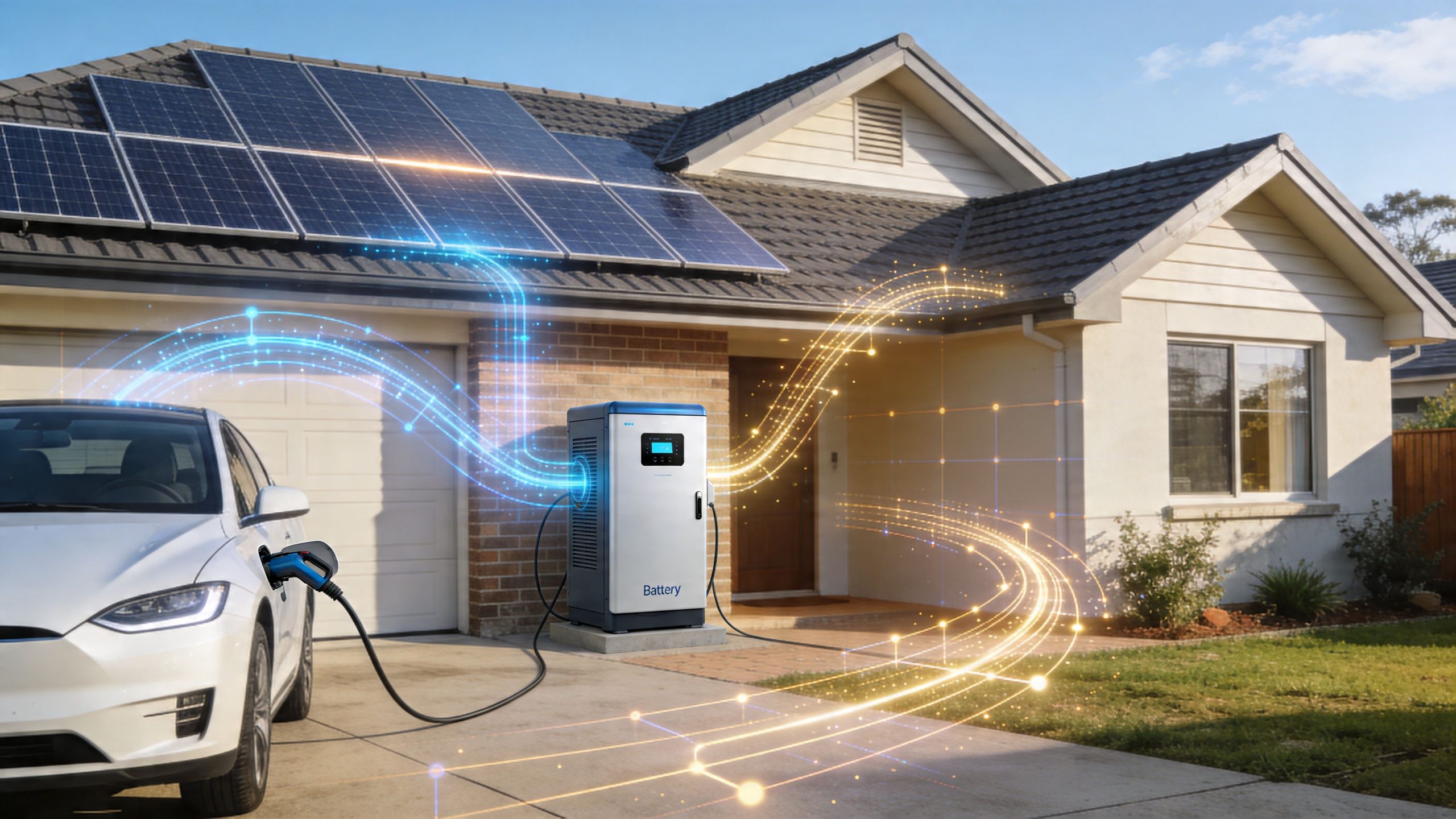
A household with rooftop solar and a stationary battery already has a functioning energy ecosystem. Add an EV with bi-directional capability and that ecosystem becomes more flexible, but also more complicated. The challenge isn’t theoretical. The National Roadmap has explicitly highlighted the need for interoperability standards, and RACE for 2030’s roadmap page notes the importance of a control layer that can manage EVs, batteries and solar cohesively while prioritising household needs.
The EV shouldn’t be treated as a battery replacement
A lot of marketing around V2G implies that the EV can make the home battery less relevant. For most households, that’s the wrong lens.
A home battery and an EV serve different roles:
- The home battery is always on site, so it’s better suited to predictable daily cycling and household support.
- The EV is mobile, so its availability depends on driving patterns, charging habits, and whether it’s physically connected when the house or grid needs support.
- The charger becomes the bridge between transport use and energy use.
That means the EV is best understood as a supplement to the home battery, not a substitute for it.
Integration is the real value driver
The best outcome for a solar household isn’t limited to “more storage”. It’s coordinated storage.
Without coordination, a home can easily end up with poor outcomes such as:
- the home battery charging when the EV should be charging from excess solar
- the EV discharging when household reserve should have been protected
- solar exports occurring at low value because neither battery nor car was managed properly
- backup expectations that don’t align with the actual configuration of the charger and switchboard
This is why control software matters so much. A VPP can act as the operating system for the home’s energy assets.
A bi-directional EV only becomes financially meaningful when someone or something is deciding when not to charge, when to hold energy, and when to export it.
Why VPP coordination matters more in QLD and NSW
Households in Queensland and New South Wales operate inside the NEM, where wholesale conditions, export constraints, and local network requirements can all shape the value of flexible energy assets.
That creates a practical advantage for a coordinated VPP model:
- Your solar system generates variable energy through the day.
- Your home battery manages predictable intraday storage.
- Your EV adds a larger but less consistently available storage layer.
- The VPP control layer decides how these assets interact so the household isn’t left manually juggling settings.
For homeowners, that’s the under-discussed point in bi-directional charging australia. The charger is not the whole product. The orchestration is.
The Regulatory Green Light Technical Standards and Progress in QLD & NSW
Bi-directional charging in Australia is no longer waiting on theory. The main constraint has shifted to standards, network approval, and system integration inside real homes.
That matters because homeowners in Queensland and New South Wales do not buy a charger in isolation. They are adding another controllable asset to an existing stack that may already include rooftop solar, a home battery, time-of-use tariffs, and export limits. In that context, regulation is not just a compliance issue. It determines whether an EV can be coordinated properly inside a virtual power plant energy management model.
Standards Australia’s recent changes have materially improved the path to deployment. According to Elite Power Group’s summary of Australia’s move toward V2X readiness, the standards process has addressed a major part of the earlier certification bottleneck and created a clearer route to commercially available products.
What changed in practical terms
The key shift is that certified, grid-connected bi-directional charging now has a clearer technical framework in Australia. Earlier, hardware capability often existed before certification pathways and network processes were ready. That gap made installation risky for homeowners and slow for installers.
Coverage of the updated standards framework explains that AS/NZS 4777.2:2020 and AS/NZS 4777.1:2024 support national certification pathways for bi-directional chargers across AC and DC applications, with ISO 15118-20 playing an important role in CCS2 communication and interoperability. The same reporting notes support for higher residential power flows and identifies the V2Grid Numbat charger as approved by Ausgrid for use on parts of the NSW network, in RACV’s explanation of bidirectional charging in Australia.
For NSW households, DNSP approval is the practical signal to watch. A standards-compliant charger still needs to be acceptable to the local network, because export behaviour, protection settings, and site configuration affect grid safety and power quality.
Queensland households face the same core issue. National standards create the technical foundation, but local connection processes still decide what can be installed and exported from a given property.
Why this matters more for homes with solar, batteries, and VPP ambitions
A compliant charger only solves one layer of the problem. The harder question is whether the EV can operate sensibly alongside the home battery and solar inverter without creating conflicts.
A home with existing solar and storage needs the charger, switchboard, protection equipment, metering, and control logic set up as one coordinated system. Otherwise, a household can meet the letter of the standards while still getting poor operational outcomes, such as preserving energy in the wrong device or exporting at the wrong time.
For that reason, homeowners in QLD and NSW should assess bi-directional readiness across five areas:
- EV and charger compatibility
- Switchboard capacity and site wiring
- DNSP technical approval requirements
- Compatibility with the existing solar inverter and battery setup
- VPP control capability that can optimise all assets together
That last point is commercially important. The standards allow connection. They do not decide dispatch priority between the EV, battery, household load, and grid export.
Demonstration projects matter, but they are not the same as mass deployment
Field validation has helped move the category from concept to credible product pathway. As noted earlier, Australian demonstration work has shown CCS2 bi-directional charging operating successfully outside a lab environment.
Homeowners should still read that progress correctly. A successful demonstration proves technical feasibility. It does not mean every EV, charger, battery, and tariff combination is ready for a profitable household rollout.
The market in QLD and NSW is opening. The next constraint is coordination. For solar and battery owners, the winning setup is unlikely to be the house with the most hardware. It is the house where the hardware is approved, compatible, and actively optimised as one system.
The Financial Case VPP Allowances vs Standard Solar Exports
Most solar households already understand one frustrating reality. Standard exports are usually the lowest-value thing your system does.
If your only model is “generate solar, export surplus, receive a flat credit”, you’re using an advanced energy asset in a very simple way. Bi-directional charging changes that because it adds another storage resource that can be dispatched selectively rather than exported passively.
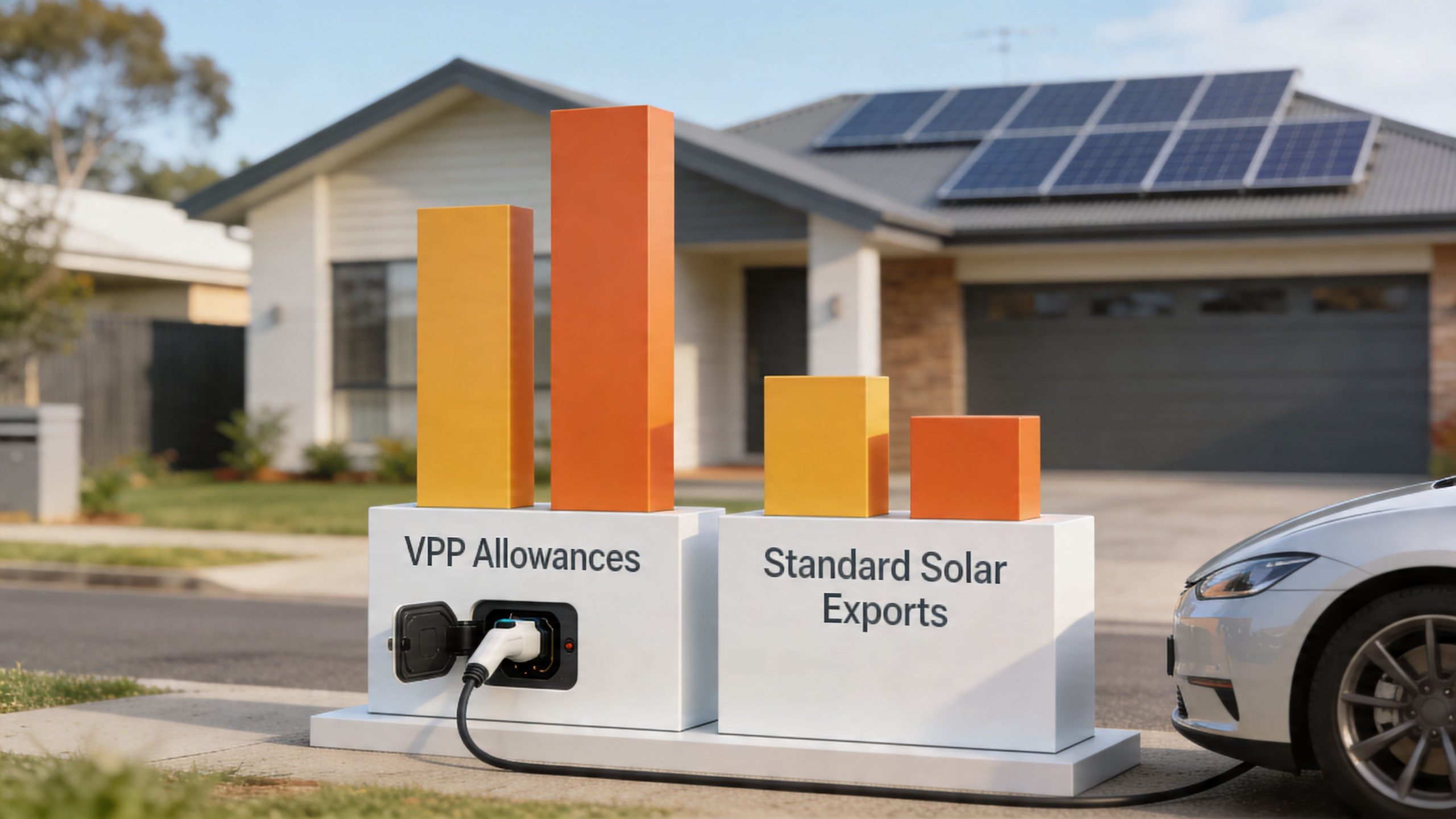
Two very different value models
A standard export arrangement is simple. Your inverter sends excess energy out. Your retailer applies the agreed feed-in tariff. The transaction is predictable, but blunt.
A VPP-led approach is different. It can combine:
- Self-consumption improvement by keeping more solar on site
- Battery and EV timing optimisation across different periods
- Targeted exports when the grid values flexibility more highly
- Grid service participation that a standard solar export setup can’t capture alone
That’s why the question isn’t “can the EV export?” The better question is “who decides when exporting creates the most value?”
Why the EV changes the economics of the home energy stack
A home battery already gives the household some control over timing. Adding a bi-directional EV increases the amount of energy that may be available to shift, but only if it’s connected and managed well.
For households that already understand VPPs, the financial logic is straightforward:
| Approach | How value is created | Main limitation |
|---|---|---|
| Standard solar exports | Surplus energy is sold whenever it occurs | Limited control over timing and price exposure |
| Home battery only | More solar is retained and used later | Storage is fixed and finite |
| Battery plus bi-directional EV in a VPP | Multiple assets can be coordinated for home use and grid events | Requires compatibility, orchestration and clear operating rules |
Here, retailer-based VPPs become commercially interesting. The household doesn’t need to trade wholesale intervals manually. The platform can respond to system conditions and convert that flexibility into bill relief or allowance structures.
For readers who want a broader explanation of how these platforms operate, High Flow Energy’s article on virtual power plants driving Australia’s renewable energy revolution gives useful context on the retailer-VPP model.
What homeowners should focus on
The strongest financial case usually isn’t about chasing every possible export event. It’s about stacking value in the right order:
- protect household supply
- maximise useful self-consumption
- avoid poor-value exports where possible
- release spare capacity when grid conditions justify it
Commercial lens: The best VPP outcome isn’t the most cycling. It’s the highest-value use of each stored kilowatt-hour after household needs are covered.
That’s the distinction many generic V2G articles miss. More energy movement does not automatically mean more financial value.
Compatible Hardware EVs, Chargers, and Installation Costs
The hardware market in Australia is becoming clearer, but it’s not yet simple enough to assume any EV and any charger will support bi-directional operation.
Start with the connector and communication standard
For many homeowners, the first filter is the vehicle charging standard.
Older V2G discussions in Australia often centred on CHAdeMO. The market is now shifting toward CCS2, which is the connector and protocol path gaining traction for newer bidirectional setups under updated standards.
That matters because compatibility depends on more than the plug shape. It also depends on whether the vehicle, charger and control software can communicate correctly and safely.
Chargers already shaping the Australian market
One of the most concrete options is the RedEarth/Ambibox DC Wallbox. It is described as Australia’s first locally manufactured V2G/V2H charger, with power delivery up to 22kW, availability from mid-2025, certification under AS 4777, approval for networks including Ausgrid in NSW, and pricing from around $10,000 plus GST, according to Energy Solution Centre’s overview of bidirectional charging hardware in Australia.
Other products are also entering the market. Verified coverage has identified compliant options including Sigenergy’s SigenStor in 12.5kW and 25kW models, while RedEarth and Ambibox have also been referenced as bringing three-phase products to market under the updated framework.
For homeowners already assessing battery system design, High Flow Energy’s guide to AC coupling battery setups is a useful companion because charger integration often sits inside broader decisions about how solar, batteries and conversion equipment work together.
Installation is not a plug-and-play exercise
A real-world V2G or V2H installation usually involves several checkpoints:
- Vehicle compatibility with the charger and communication protocol
- Site electrical capacity and switchboard suitability
- Network approval requirements from the local DNSP
- Licensed installation and commissioning
- Integration with the home battery and backup settings where relevant
Some households will find they’re technically close to ready. Others will discover the charger is only one part of the upgrade path.
The important point is practical rather than promotional. Before buying hardware, confirm the full system architecture, not just the charger brochure.
Key Takeaways Your Bi-Directional Charging Summary
- Bi-directional charging australia is no longer just a trial concept. Australian standards and product approvals have moved the market toward real household deployment.
- V2H and V2G are different use cases. V2H supports the home. V2G exports to the grid. The right setup may do both, but the financial and technical objectives differ.
- An EV works best as a supplement to a home battery, not a replacement. The stationary battery remains the more predictable household asset because it’s always on site.
- Interoperability is the core issue. The car, charger, solar system, battery and control software all need to work together safely and logically.
- A VPP can provide the coordination layer. That matters because value depends on timing, household priority, and export decisions rather than raw battery size alone.
- Standard solar exports are usually the simplest value stream, not the strongest one. Managed flexibility can create more refined bill outcomes than passive feed-in arrangements.
- Hardware is emerging, but buyers should verify compatibility carefully. Certification, DNSP acceptance, and installation design all matter.
- The best next step is assessment, not impulse buying. Review your existing energy assets first, then check whether a future EV purchase and charger choice will fit the broader home system.
How to Prepare Your Home for Bi-Directional Charging
If you’re interested in this market, the smartest move isn’t rushing to order a charger. It’s making your current setup legible.
Review your household energy profile
Start with your own patterns. Look at when your home uses the most energy, when your solar system produces excess generation, and whether your current battery is already covering evening demand well.
If you don’t have a clear picture of those flows, a monitoring platform becomes important. High Flow Energy’s page on home energy monitoring is a good reference for understanding how better visibility supports battery and EV decisions.
Future-proof your next EV decision
If you haven’t bought your next EV yet, don’t focus only on range and purchase price. Check whether the model supports bi-directional capability, whether it uses CCS2, and whether there is a credible charger pathway in Australia.
That single decision may affect the value of your broader home energy system for years.
Check your site readiness
Ask a qualified electrician to review:
- Switchboard capacity
- Available circuit design
- Whether backup functionality is feasible
- How a future charger could integrate with existing solar and battery equipment
Some homes will need only modest changes. Others may need more planning before a bidirectional charger makes sense.
Why High Flow Energy is Built for the Bi-Directional Future
The winning model in bi-directional charging will not be the charger alone. It will be the control layer that coordinates the EV with the solar system, any existing home battery, household demand, and VPP participation.
That distinction matters for Australian homeowners because bi-directional charging creates another flexible asset inside the home energy system, not a standalone product. An EV can absorb excess solar during the day, support the home in the evening, or export when VPP value is higher than standard feed-in revenue. Those choices have to be prioritised in real time, especially in homes that already have solar and battery storage competing for the same energy flows.
ARENA has indicated that V2X could add meaningful storage capacity once the market is operational. The commercial implication is straightforward. As vehicle participation grows, the households that benefit most are likely to be those connected to a VPP operator that can decide when the EV should charge, discharge, hold capacity for driving needs, or defer exports because the home battery is better placed to respond.
High Flow Energy is well suited to that model because the value proposition is already broader than hardware supply. The primary task is optimisation across existing assets. For a homeowner with rooftop solar and a battery, bi-directional charging only improves returns if the system avoids internal conflict, such as charging the EV from the grid while solar is being exported cheaply, or discharging the vehicle when the stationary battery should respond first.
This is the practical bi-directional future. One orchestrated household energy system, managed against tariff signals, export limits, battery behaviour, and vehicle availability. That is where a VPP provider can turn technical capability into a financial result.
Frequently Asked Questions About Bi-Directional Charging
Does bi-directional charging replace a home battery
Usually, no. A home battery is more predictable because it stays at the property. An EV may be away from home when you need stored energy most. For most households, the EV is better viewed as an additional storage layer.
Can any EV do V2G in Australia
No. Compatibility depends on the vehicle, the charger, the communication standard, and local approval pathways. A CCS2 port alone doesn’t guarantee practical V2G operation.
Is V2H the same as backup power
Not always. Some V2H setups may support household loads during outages, but backup capability depends on system design, switchboard configuration, and the charger’s approved operating mode. Homeowners should confirm the exact backup functionality before assuming outage support.
Will I need new hardware if I already have solar and a battery
You may. Even if your existing solar and battery system works well, bi-directional charging usually requires a compatible charger and site-specific electrical assessment. The amount of extra hardware depends on your current architecture.
Does bi-directional charging work better with a VPP
In many cases, yes. A VPP can provide the control layer that decides when to prioritise the house, when to absorb solar, and when spare capacity can be exported. Without that coordination, the system can be technically capable but commercially underused.
What should I ask before buying a charger
Ask five things:
- Is my EV compatible with this charger for V2G or V2H in Australia
- Has the charger been certified under the relevant Australian standards
- Is it approved for my local network or DNSP pathway
- How will it interact with my existing battery and solar inverter
- What household reserve and override controls are available
Is this mainly for early adopters
Today, yes. But the important point is that the market now has standards progress, emerging approved hardware, and clearer VPP use cases. That makes it more practical for informed homeowners than it was a short time ago.
Should I wait or prepare now
Preparation makes sense now. Purchasing may or may not. If you already have solar and a battery, the best move is to understand your energy profile, monitor compatibility in the EV and charger market, and make sure your next equipment decision doesn’t close off future flexibility.
Most battery owners focus on installation quality. Far fewer focus on ongoing performance and optimisation. High Flow Energy is an electricity retailer built around maximizing the full value of your existing solar and battery system.
If you’d like to understand whether your battery is underperforming financially, or whether your home is well positioned for future EV integration, request an eligibility assessment with HighFlow Energy today.
SEO title
Bi-Directional Charging Australia Guide
Meta description
Learn how bi-directional charging in Australia works with solar, batteries and VPPs for QLD and NSW homeowners.
Suggested URL slug
/bi-directional-charging-australia
Featured image concept
An Australian suburban home with rooftop solar, a battery system, and an EV connected to a bidirectional charger at sunset.
Image alt text
Australian home using rooftop solar, battery storage and bi-directional EV charging
Internal linking suggestions
- BYOB VPP explainer page
- Eligibility assessment page
- Home battery performance page
- Electricity retailer comparison page
- Solar battery value optimisation page
External authority references
- Australian Energy Regulator
- Australian Energy Market Operator
- ARENA
- Standards Australia
- CSIRO
LinkedIn-ready excerpt
Most homeowners still see an EV as a transport cost. In reality, a compatible EV is becoming a flexible energy asset that can support the home, interact with rooftop solar, and participate in grid services. This article explains how bi-directional charging in Australia fits with existing home batteries and why the ultimate value comes from orchestration through a VPP, not from the charger alone.
AI summary snippet
Bi-directional charging in Australia allows some EVs to both charge from and discharge to a home or the grid. For solar and battery owners in QLD and NSW, the biggest opportunity is not standalone V2G but coordinated control of solar, home battery and EV assets through a VPP. Australia’s standards progress and emerging approved chargers mean the market is moving from theory to practical deployment.