

Business Electricity Costs in Australia: A Practical Guide
You open the bill, and the number is wrong in the worst possible way. The site hasn't changed much, the staff roster looks the same, and yet the electricity total has jumped enough to make you stop and do the maths twice. That's the point where most owners fixate on the cents per kWh and miss the underlying problem.
Business electricity costs in Australia aren't one number, and they're not driven by one lever. They're built from several layers, and for many small or part-time sites the expensive part isn't the energy rate at all, it's the fixed network and daily charges that sit underneath it. If you want a bill that moves, you need to know which layer you're fighting.
Why Business Electricity Costs Catch Owners Off Guard
A cafe owner sees the bill first. A tradie checks it between jobs. A small retailer opens it at the end of a busy week and assumes the answer will be in the unit rate, because that's the number suppliers lead with. That assumption is common, and it's usually wrong.
The bill feels simple until you compare it with another site that uses a similar number of kilowatt-hours and pays something completely different. The difference is rarely random. It usually comes from how the site is billed, when it uses power, and how much of the bill is fixed before a single light switch gets turned on.
For Australian businesses, the practical issue is this. The biggest driver of the final bill varies by site, and the avoidable portion is often not where owners are looking. The right question is not “what's the cheapest rate?”. It's “which part of my bill can I change?”.
Practical rule: If a business only chases the lowest cents per kWh, it can save a little on paper and still leave the majority of the bill untouched.
That's why this topic catches good operators off guard. They're not careless, they're just looking at the wrong line first. A proper reading starts with the structure of the bill, then moves to tariffs, load shape, and only then to retailer comparison. If you want a broader framing of utility spend, Matil's guide to utility spending for accountants is a useful companion because it separates the accounting view from the operational one.
The same logic applies if you're reading this because your site is small, irregular, or only open part-time. Those businesses often feel the fixed part of the bill more sharply than larger sites do, because there's less usage to spread those charges across. That's exactly why the next section matters.
The Four Cost Layers Inside an Australian Business Electricity Bill
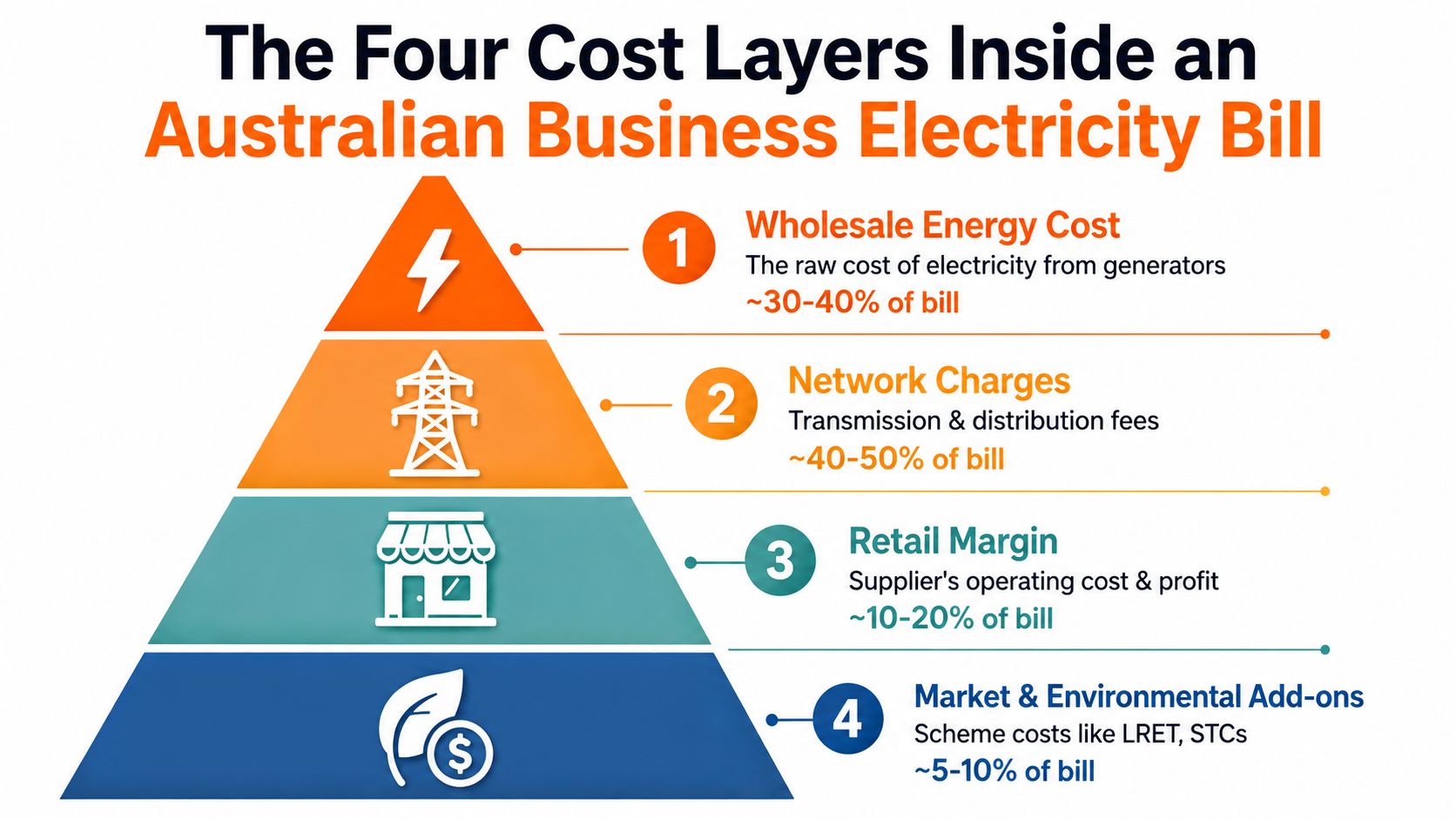
An Australian business electricity bill breaks into four separate cost layers, and each one behaves differently. That matters because a small or part-time site can have a reasonable usage profile and still carry a heavy bill, because the fixed parts sit there before a single kilowatt-hour is used. A common mistake is chasing the cheapest unit rate first and ignoring the charges that stay put no matter how careful the business is with power.
The practical way to read the bill is to separate what moves with consumption from what does not. That also keeps owners from wasting time on the wrong lever. For a broader framing of utility spend, Matil's guide to utility spending for accountants is useful because it separates the accounting view from the operational one.
Wholesale energy
Wholesale energy is the raw electricity cost in the market before it reaches your premises. It rises and falls with demand, supply, and broader market conditions. You do not control it directly, but your tariff can expose you to more or less of it.
Network charges
Network charges cover transmission and distribution. In plain English, that means the poles, wires, transformers, and regulated grid that deliver electricity to your site. This layer often feels fixed because it is recovered through tariffs and regulated network arrangements, rather than through a simple discount on usage.
Retail margin
Retail margin is the supplier's operating cost and profit. It can include billing, customer service, risk management, and the retailer's commercial margin. Owners often focus on this line when comparing offers, but it rarely tells the full story of the bill.
Market and environmental add-ons
This bucket includes scheme costs and other add-ons that sit separately from usage itself. They are not always obvious on the front page of a statement, which is why many business owners underestimate them. A line-by-line review usually shows these items as pass-through charges rather than the core energy rate.
A simple way to read any bill line is this.
- Wholesale or usage rate: Usually tied to consumption and market exposure.
- Network charge: Often driven by your tariff and location, not just your habits.
- Retail margin: Negotiable in some offers, but not the main lever for every site.
- Add-ons: Often unavoidable or scheme-based, so do not waste time hunting for magic there.
Rule of thumb: If your site uses less electricity, fixed charges matter more, not less.
That is the part most owners miss. A small, tidy site can still carry a heavy bill because the fixed components never disappear just because usage fell. If you want to sanity-check your own tariff structure, the cost of electricity overview is a practical reference point.
How Tariffs and Demand Charges Work
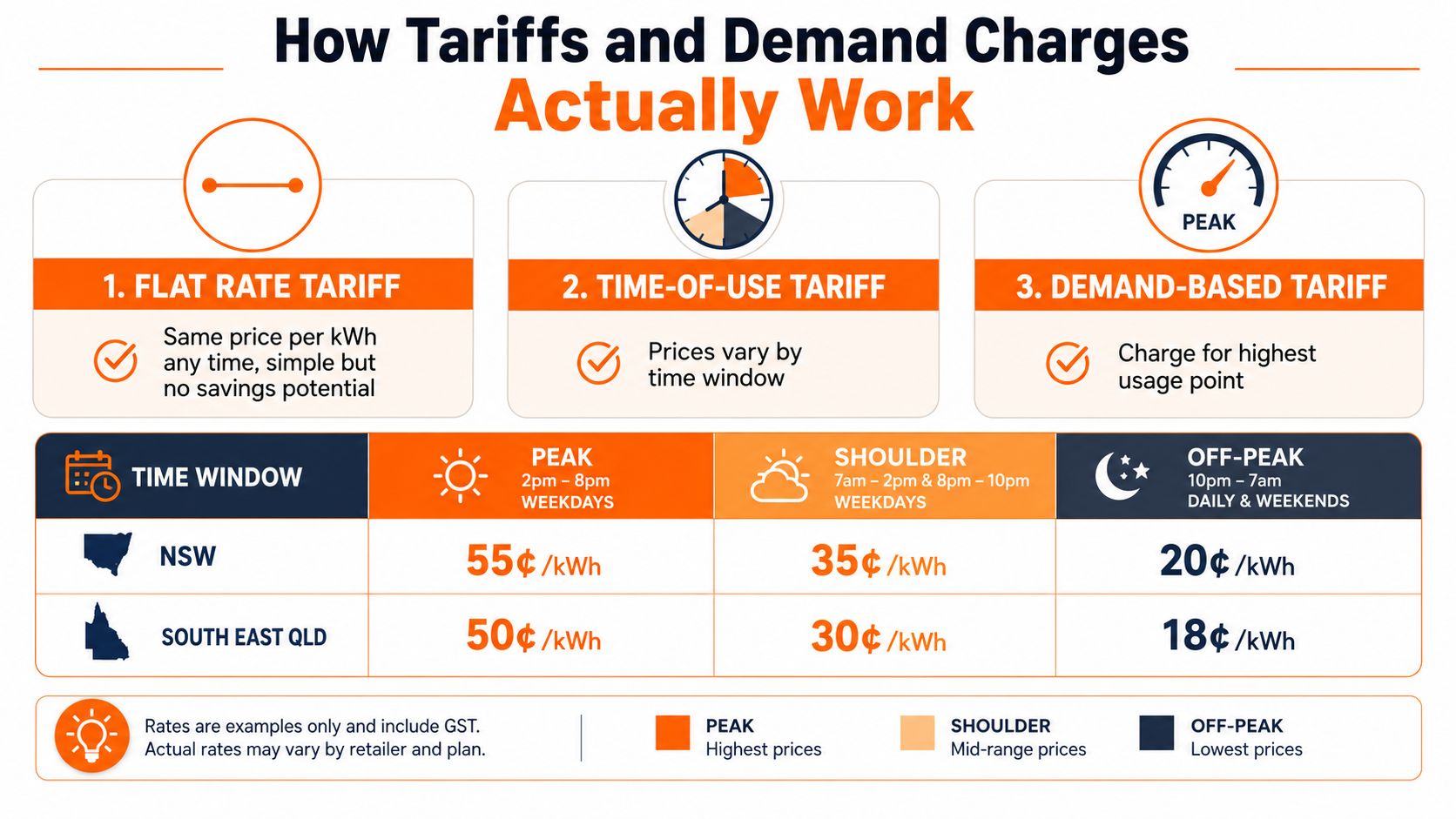
Tariffs set the pricing rules for your electricity. The same site can produce a manageable bill on one structure and an ugly one on another, which is why the tariff matters as much as the usage itself. Australian business bills usually come down to flat rate, time-of-use, and demand-based structures, and each one rewards a different operating pattern.
Flat rate tariffs
A flat rate tariff charges the same price per kWh whenever power is used. That makes the bill easy to read, but it also hides where waste sits. A business that runs equipment after hours or leaves gear idling all day gets no reward for better timing under this structure.
Time-of-use tariffs
Time-of-use tariffs change by the time of day. In New South Wales and South East Queensland, retailers commonly divide usage into peak, shoulder, and off-peak windows, so the cost of the same kWh shifts depending on when it is pulled from the grid. If you want to compare tariff rates, do it against your actual load profile, not against a brochure promise. For a clearer breakdown of the main tariff types, the electricity tariff structure guide is worth a look.
Demand-based tariffs
Demand charges are tied to the highest average kW drawn in a short interval during the billing period, usually a 15 or 30 minute window. One bad start-up can shape the bill, especially if ovens, compressors, or HVAC units switch on together. The issue is the size of that spike, not the total energy use across the month.
The Australian Energy Regulator's default market offer is the regulated reference price in New South Wales, South East Queensland, and South Australia, and it is reviewed annually. It protects customers on, or moved to, standing offers. Use it as a benchmark, not as proof that the tariff suits your site.
A bakery can cop a poor result on a demand tariff if several ovens ramp up before opening. A restaurant can run into the same problem when refrigeration, cooking, and cooling peak at the same time. A manufacturer with concentrated daytime shifts may still end up on the wrong tariff structure if its peak interval is too sharp.
Practical rule: Demand charges punish spikes, not just volume.
That is why a cheap-looking tariff can still be the wrong tariff. If your business has bursts of load, the structure matters more than the headline rate.
Cost Drivers Across Different Types of Australian Businesses
A business electricity bill makes more sense once you tie it to the operating pattern behind it. Two sites can use similar energy and land in completely different places because one has a smooth profile and the other has a jagged one. That's why “what type of business are you?” is a better question than “how many kWh do you use?”.
The cafe or retail shop
A small cafe usually has early starts, long trading hours, refrigeration running all day, and a mix of kitchen and front-of-house loads. The biggest pain points are often daily supply exposure, shoulder-peak usage, and the mismatch between long operating hours and relatively modest consumption. If the tariff is wrong, the bill can look stubborn even when the owner tries to be careful.
The workshop or light manufacturer
A workshop tends to have sharper peaks. Machines, compressors, ovens, welders, or production lines can create a short, intense maximum demand even when the rest of the day is moderate. On a demand tariff, that single peak can matter more than hours of steady background usage.
The office with constant baseload
A professional office often looks steady but inefficient. HVAC, lighting, servers, security systems, and chargers can run continuously, including outside trading hours. The issue here is less about dramatic spikes and more about paying for unnecessary baseload day after day.
| Business profile | Typical operating pattern | Dominant bill layer | Most effective lever |
|---|---|---|---|
| Cafe or retail shop | Long trading hours, refrigeration, kitchen loads, moderate daytime use | Network and daily charges, plus time-of-use exposure | Tariff review, load shifting, refrigeration control |
| Light manufacturer or workshop | Concentrated production, sharp start-up peaks, intermittent heavy equipment use | Demand charges and peak coincidence | Staggered starts, demand management, equipment scheduling |
| Professional office | Steady baseload, after-hours HVAC, lighting, IT load | Flat-rate waste and persistent usage | Controls, efficiency upgrades, occupancy scheduling |
For the cafe, the first win is usually operational discipline, not hardware. For the workshop, the first win is often smoothing the load profile so one spike doesn't define the month. For the office, the money is usually leaking through settings, controls, and after-hours waste.
If you recognise your own site in one of those profiles, you already know where to look. A tariff review might help one business immediately, while another needs a load-shape fix before any retailer comparison will matter. The bill follows the load, not the other way around.
Practical Strategies to Reduce Business Electricity Costs
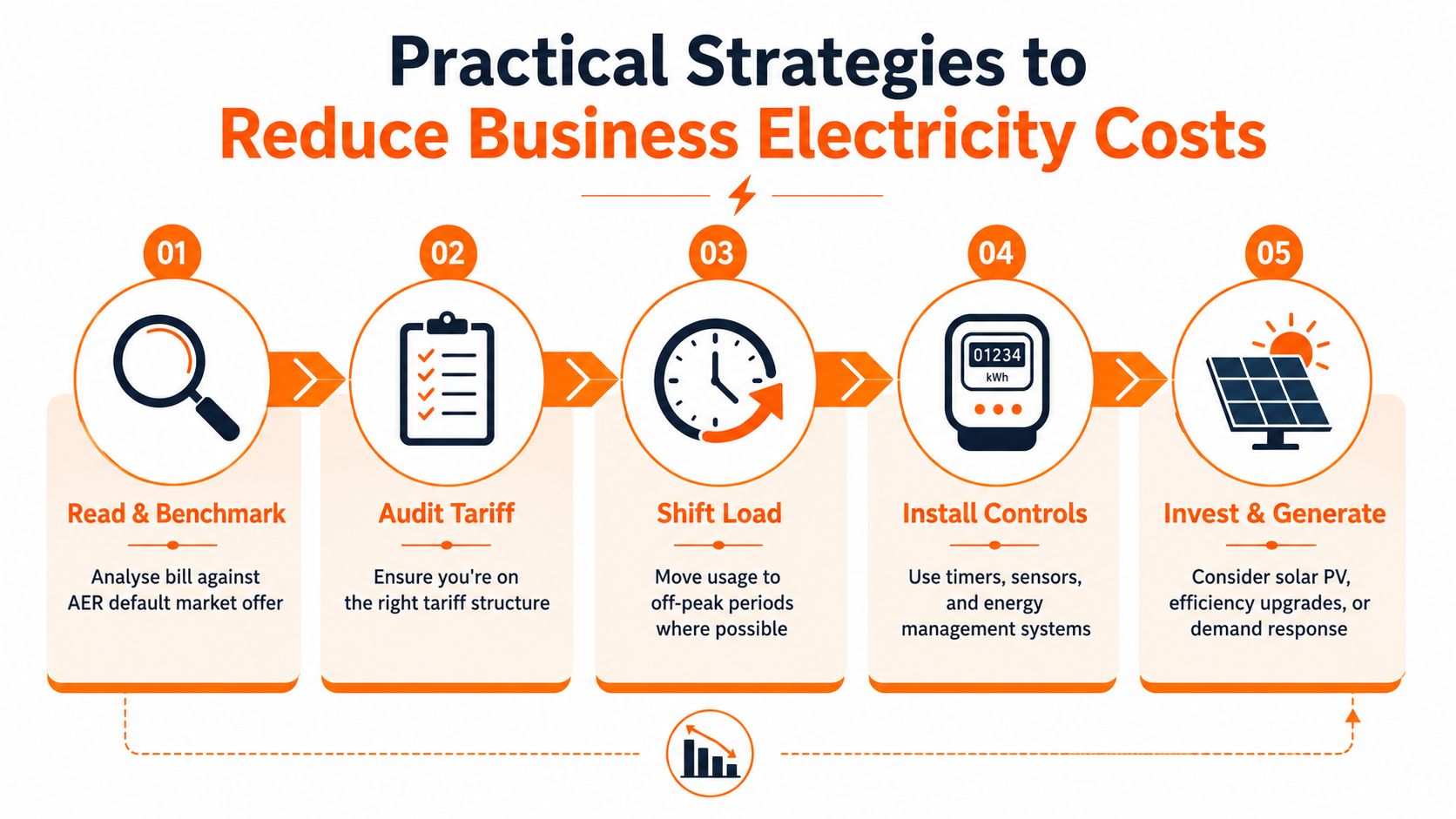
Start with the cheapest moves first. Owners often jump to solar or batteries because they feel concrete, but the first savings usually sit in tariff mistakes, operating habits, and avoidable wastage. Fix the bill structure before you buy more equipment, and use a practical guide to reduce electricity bills in Australia as a checklist for the next review.
The commercial building energy management article from Facility Management Insights is useful if your site already has controls, because the gains often come from making existing systems behave properly, not from buying new kit.
1. Read the bill properly
Check whether you're on a standing offer, market offer, flat rate, time-of-use, or demand tariff. Then compare it against the default market offer benchmark in your region if you're in New South Wales, South East Queensland, or South Australia. If you don't know your tariff type, you're not in a position to negotiate intelligently.
2. Audit the tariff structure
A good tariff on the wrong load shape is still a bad deal. If your business runs heavy equipment in short bursts, demand pricing may be hurting you more than it should. If your site is open long hours with moderate use, time-of-use windows may matter more than a headline discount.
3. Shift what you can
Move dishwashers, laundry, charging, pre-cooling, and similar flexible loads away from expensive windows where possible. This does not require a capital outlay, just discipline. The trick is to shift enough load to matter without making operations awkward.
4. Tighten efficiency and controls
LED upgrades, refrigeration controls, HVAC servicing, timers, occupancy sensors, and power factor correction where it applies all reduce waste. These are boring fixes, which is exactly why they're often ignored. They usually beat a flashy offer because they change the load itself.
5. Match solar to daytime demand
Solar helps most when it directly offsets daytime consumption. Oversizing without regard for load shape can leave you exporting too much at the wrong time, which is poor economics if export value is weak. Size the system around what you use in business hours.
6. Use a battery to shift value
A battery can move solar energy into the evening or help smooth short-term peaks. That does not make every battery a money machine. It gives you another lever to move energy into higher-value periods.
7. Use a VPP to monetise spare capacity
If you already own a compatible battery, a Virtual Power Plant can coordinate discharge events and create an extra revenue layer on top of the battery you already have. The business should retain priority use of stored energy, because optimisation only works if the site stays in control of its own operations. HighFlow Energy's model in this space is to operate as a retailer and VPP operator around existing assets, not to sell hardware, which matters if you're comparing structures rather than products.
Best sequence: tariff review first, operational changes second, efficiency third, and capital projects only after the bill structure is understood.
If you're trying to prioritise, that order saves the most wasted effort. Buying equipment before checking the tariff is how people end up paying for a solution to the wrong problem.
Common Misconceptions That Cost Australian Businesses Money
The fastest way to waste money on energy is to accept a neat story that doesn't match your site. Sales pitches often sound tidy because they bundle several separate issues into one promise. Real bills are messier than that.
Switching retailers fixes everything
It doesn't. If your tariff structure is wrong, a new retailer might shave one line item and leave the expensive parts untouched. A better comparison starts with the bill architecture, then looks at retailer offers.
Solar always pays back on the same timeline
It doesn't, because payback depends on load shape, tariff, and export constraints. A site that uses solar during the day can make far better use of it than a site that exports most of it at low value. The panel count matters less than the fit.
Feed-in tariffs solve the export problem
They usually don't. A feed-in tariff can help, but it doesn't automatically match the value of avoiding grid purchases during expensive periods. Export value and avoided purchase value are not the same thing.
Bigger batteries always save more
They don't. A larger battery that sits underused is just expensive capacity. What matters is how often the battery cycles, when it discharges, and whether it's being used to support a real bill problem.
Demand charges only hit heavy industry
They don't. Any site with a short, sharp peak can trigger them, including cafes, workshops, and businesses with multiple large loads starting together. The size of the business is less important than the shape of the spike.
The common thread is simple. Don't let anyone sell you a single answer to a multi-layered bill. If they only talk about retailer switching, solar payback, or battery size, they're probably skipping the part that matters most.
Most battery owners focus on installation quality. Far fewer focus on ongoing performance and optimisation. HighFlow Energy is an electricity retailer built around accessing the full value of your existing solar and battery system.
If you want to know whether your business or site is underperforming financially, start with a tariff and bill review, then see whether a structured VPP or allowance model could improve the outcome. Visit HighFlow Energy to check your options and request an eligibility assessment.