

Demand Charges Electricity Explained
You've got rooftop solar, a home battery and sensible energy habits, yet the bill still looks higher than expected. In Queensland and New South Wales, the missing piece may be demand charges electricity, a billing structure that responds to your highest power draw during a defined period, not just the total energy your home uses.
That distinction matters. A battery can store plenty of energy and still fail to prevent one evening grid-draw spike. A properly managed battery, by contrast, can reduce that peak while preserving household comfort and priority access to stored energy.
Why Demand Charges Are Showing Up on More Australian Bills
A demand charge is based on how intensely your home draws electricity from the grid at a particular time. Energy charges measure accumulated use in kilowatt-hours, or kWh. Demand charges measure power drawn in kilowatts, or kW, during specified periods.
The Australian Energy Regulator explains that demand tariffs can use the highest demand in a billing period, an average of peak demand, or different seasonal rates. In the Australian Energy Market Commission's National Electricity Market, or NEM, demand charges represented 13% of a customer's total annual calculated price on average in the ACCC's December 2024 reporting. (ACCC National Electricity Market report)
That makes demand charges electricity a practical concern for households that already own solar and batteries. A system may reduce daytime imports and export surplus solar, but it won't automatically protect the household during the specific interval used to calculate demand.
Why the timing matters
A home can consume modest total energy and still create a costly peak. An air conditioner, electric oven, pool pump and battery charger operating together can produce a short period of high grid draw. If the battery isn't covering that load, the event may influence the demand component for the billing period.
Networks plan infrastructure around the capacity needed during high-demand periods. Demand-based pricing is designed to reflect that capacity requirement more directly than a simple kWh charge.
Australia's demand profile is also changing. AEMO reported that underlying NEM-wide demand averaged 25,496 MW in Q1 2026, a new quarterly record and 302 MW higher than Q1 2025, an increase of 1.2%. In Q2 2026, underlying demand reached 24,220 MW, another quarterly high and 46 MW above Q2 2025, an increase of 0.2%. (AEMO Quarterly Energy Dynamics Q1 2026)
Practical rule: Solar reduces energy purchased. Battery control must reduce the right grid-draw peak.
The result is a bill that can feel disconnected from your total consumption. The household may have generated useful solar and discharged a battery, but one unmanaged demand event can still weaken the financial result.
How Demand Charges Are Measured and Billed in the NEM
The easiest way to understand a demand tariff is to separate energy from power.
- Energy, measured in kWh: The total amount of electricity used over time.
- Power, measured in kW: The rate at which electricity is being drawn at a particular moment.
- Demand charge: A charge linked to the maximum or otherwise defined kW demand during a billing period.
Australian Government guidance explains that demand tariffs can use a 30-minute maximum and may apply as “anytime demand” across the whole billing period or as “peak-period” demand during a defined window. Smart meters are required because the retailer or distributor needs interval data to identify the relevant peak. (Australian Government energy pricing guidance)
The single-peak problem
Under a maximum-demand structure, a short evening spike can establish the demand figure used for the billing period. The precise tariff rules vary, so the bill and distributor tariff sheet matter more than a generic solar rule.
Consider a home where solar generation has fallen and several appliances start together. The battery might have energy remaining, but if it is reserved for later, limited by its operating settings or unavailable because of another control instruction, the grid supplies the combined load. The household's total kWh might look reasonable while the maximum kW remains high.
The distinction between anytime and peak-period demand changes the operating strategy:
| Tariff structure | What matters | Battery implication |
|---|---|---|
| Anytime demand | The relevant peak can occur throughout the billing period | Monitoring must cover the full day |
| Peak-period demand | The relevant peak occurs inside a specified window | Battery discharge must be available during that window |
| Seasonal demand | The calculation changes with the season | Settings need periodic review |
For a broader explanation of how solar can affect household billing, this guide to renewable energy and utility bills provides useful general context. For Australian households, the next step is checking the actual tariff attached to the meter and distributor.
Your retailer's tariff details should identify whether a demand component applies, the measurement interval, the demand window and the rate. High Flow Energy's explanation of electricity tariff structure can help readers understand how demand, time-of-use and supply components fit together.
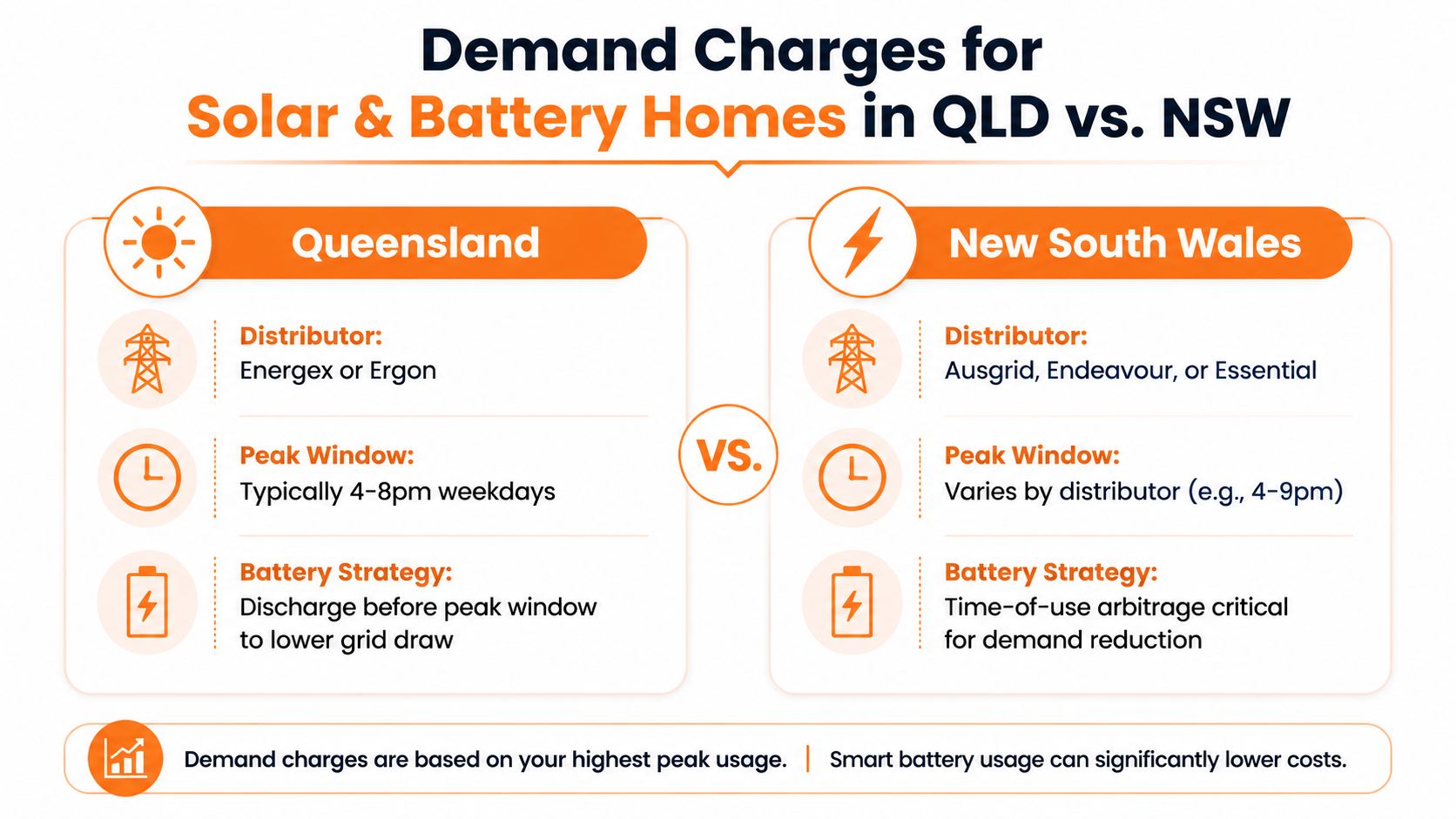
What Demand Charges Mean for Solar and Battery Homes in QLD and NSW
The value of a battery depends partly on where its stored energy is used. In a demand tariff, the critical question isn't only whether the battery discharges. It's whether discharge reduces grid import during the distributor's demand window and during the interval that produces the household peak.
Distributor rules create important differences between Queensland and New South Wales. Energex's residential demand tariff uses a 4pm to 9pm demand window, while Endeavour Energy's window is 4pm to 8pm on weekdays. Industry guidance describes these tariffs as based on maximum demand in 30-minute blocks, often combined with a daily supply charge and time-of-use energy rates. (EnergyAustralia demand tariff guidance)
Solar-only homes
Solar generation often falls as evening household demand rises. That creates a natural mismatch between rooftop production and the period in which many homes use air conditioning, cooking equipment and other high-load appliances.
Solar can still reduce daytime imports and may charge a battery for later use. It can't directly cover an evening peak once generation has declined, unless stored energy is available through a battery or another controlled supply source.
Solar and battery homes
A battery gives the household a tool for shaping demand, but its presence alone doesn't guarantee a lower demand charge. The system needs enough available energy and sufficient discharge power to cover the household load during the relevant interval.
Settings can also work against the intended outcome. A high reserve level, an export-priority mode or a schedule designed only around wholesale prices may leave the battery unavailable when the demand peak occurs.
VPP participants
A retailer-based Virtual Power Plant coordinates many customer batteries through software. That can support automated charge and discharge decisions, respond to grid conditions and create additional value through grid support participation. The trade-off is that the operating plan must protect household needs, battery limits and tariff exposure at the same time.
A sound BYOB VPP arrangement should make priority access clear. Customers retain ownership of their battery, and the control model should explain when the battery may participate, how household reserve requirements work and how the customer can override or review the plan.
The commercial case also needs transparency. Traditional feed-in tariffs reward exported energy through a retail credit. A VPP may create value through several revenue streams, including coordinated grid services, but those streams involve control, availability and battery cycling considerations. A multiple revenue streams approach is relevant only when the customer can understand how each stream affects their household and account.
The following video provides a visual introduction to household energy management:
Practical Ways to Reduce Your Demand Exposure
Demand reduction works best when you treat the home as a coordinated system. The aim isn't to use less electricity. It's to stop several large loads from pulling from the grid at the same time, particularly during the relevant demand window.
Start with the tariff window
Find the exact period that determines demand. For an Energex residential demand tariff, the published charge is $7.00 per kW per month, calculated from the highest half-hourly demand between 4pm and 9pm on weekdays and weekends. (Energex residential tariffs)
Ergon Energy's residential demand tariff combines time-of-use energy rates with a maximum evening demand charge. Its published peak period runs from 4pm to 9pm daily, with a listed peak demand rate of $8.53490 per kW per month from 1 July 2025. (Ergon Energy demand tariffs)
Those examples show why a battery schedule copied from another household may be unsuitable. Distributor, tariff and meter configuration determine the relevant operating window.
Apply the control levers in order
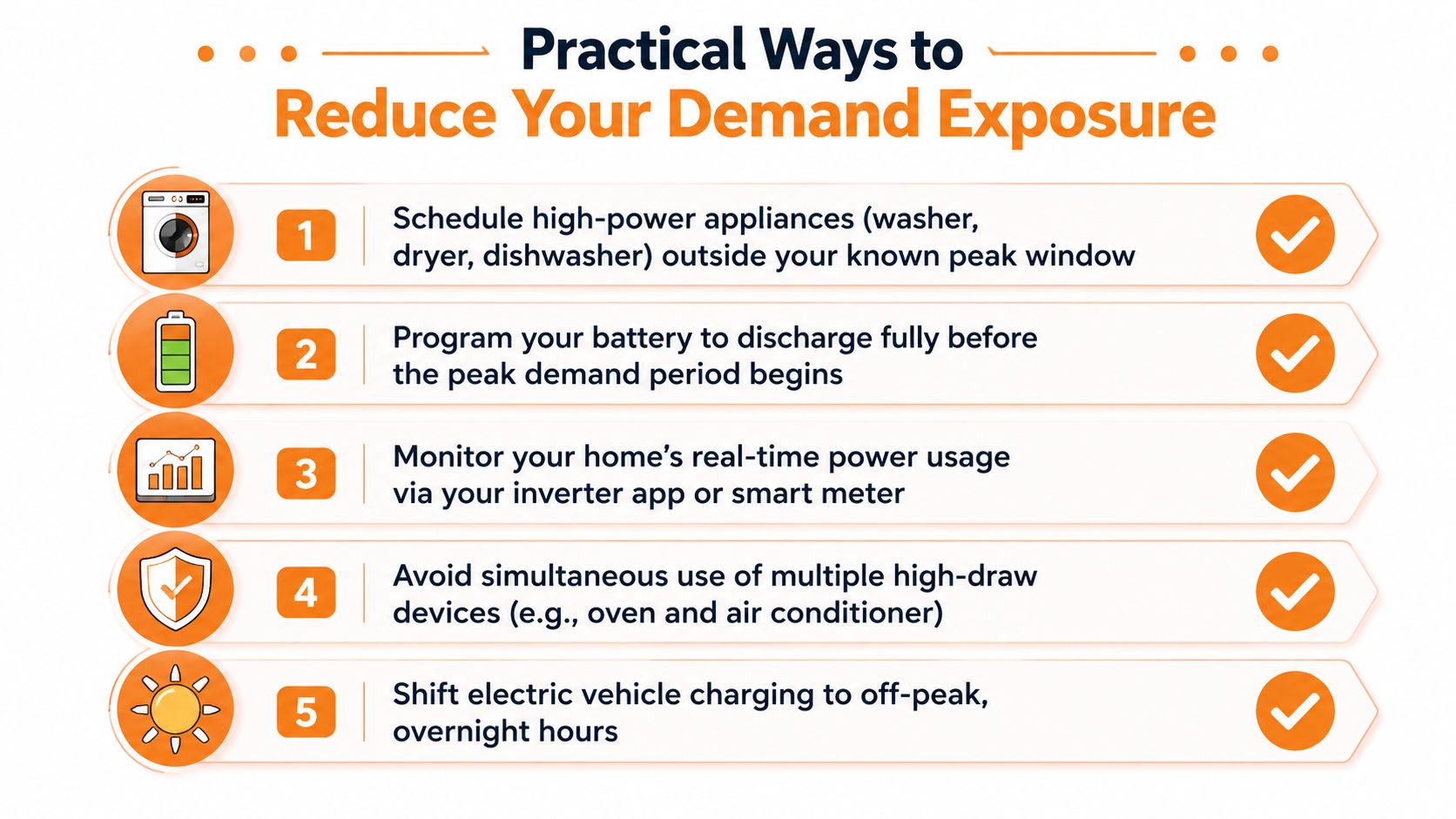
Stagger major appliances. Run the dishwasher, clothes dryer, pool equipment and electric cooking loads at different times where practical. This reduces the chance that several devices combine into one high grid-draw interval.
Make the battery available before the peak. A battery that starts discharging only after a demand event has already occurred may miss the opportunity. The schedule should account for the start of the demand window, household routines and the battery's reserve setting.
Monitor real-time power. Inverter apps and energy monitors can reveal whether the home is drawing from the grid, exporting or using stored energy. Look for recurring spikes rather than relying on monthly kWh totals.
Respect export limits. Distribution networks can restrict how much power a home exports. Export constraints don't directly set the demand charge, but they affect when solar can charge the battery or send energy to the grid, which changes the available energy later.
Assess VPP participation carefully. A VPP can automate responses to wholesale price volatility and grid-support events, but its value depends on the operating rules. Check household priority, reserve protection, override controls, warranty considerations and the treatment of extra electricity use.
Automation can reduce human error, especially when weather, solar output and household demand change. It can't fix an unsuitable tariff, an undersized battery or unclear control permissions.
How to Check Your Bill and Measure Your Home's Demand
Start with the bill, not the battery app. Look for line items labelled demand, peak demand, maximum demand or a similar term. The wording differs between retailers, so compare the bill with the tariff sheet or ask the retailer to confirm whether the account uses a demand tariff.
A practical audit
- Check the pricing components. Identify daily supply, energy usage, feed-in credits, demand charges and any separate adjustments.
- Find the demand window. Confirm whether demand applies anytime, during a peak period or under seasonal rules.
- Locate the kW figure. The bill may show the measured peak, the billed demand or both. Ask which interval produced it if the presentation isn't clear.
- Compare billing periods. A falling kWh total doesn't necessarily mean the demand component has fallen. Track both measures separately.
- Review battery behaviour. Match the battery's discharge times with the demand window and the household's highest-load events.
Use the available data
Your inverter application may show battery state of charge, solar generation, household consumption and grid import. An in-home display or retailer portal may provide interval information. The useful question is whether grid import rises sharply when several appliances run together.
A power draw meter can help make those patterns easier to interpret, provided the device is compatible with the home's metering and electrical setup. Don't assume an app's “home consumption” figure is identical to the distributor's billed demand calculation. The tariff definition remains authoritative.
Check the interval, not just the monthly total. Demand charges are a peak-management problem, so your audit must identify when the peak occurred and what caused it.
Keep a simple record of unusual events. Note hot evenings, electric vehicle charging, pool equipment, cooking and battery reserve behaviour. One-off events may explain a peak, while repeated patterns point to a setting or scheduling problem.
Common Misconceptions About Demand Tariffs and Home Batteries
A battery automatically eliminates demand charges. It doesn't. The battery must discharge with enough power during the relevant measurement interval. If it reaches its reserve, follows a competing schedule or lacks sufficient output, the grid may still supply the peak.
Solar alone neutralises evening demand. Rooftop solar is most useful while the sun is producing. Evening demand often occurs after generation has declined, so solar-only households need to examine whether their tariff exposes them to a peak they can't directly cover.
The lowest kWh bill means the tariff is optimised. A household can reduce total energy use while leaving its maximum kW unchanged. Demand and energy are separate billing questions.
VPP control always conflicts with comfort. That depends on the program's rules. A properly documented VPP should prioritise household needs, maintain agreed battery reserves and provide a clear override mechanism. Customers should understand whether participation affects battery availability during price events or grid-support periods.
Demand tariffs always reward battery owners. They can reward well-managed flexibility, but they can also shift exposure towards households that own flexible assets without having reliable automation. ACCC reporting in August 2025 found households with rooftop solar and a home battery paid electricity bills about 40% lower on average than grid-only customers, but that result doesn't prove batteries eliminate demand exposure. (ACCC battery and solar media release)
A battery can already deliver bill value while still requiring careful demand management. The right assessment considers tariff design, household load, battery control, export limits, cycling and VPP terms together.
Key Takeaways and Next Steps for Battery Owners
Demand charges electricity isn't a niche issue for large commercial sites. It can affect Australian households on specific residential tariffs, particularly where a distributor calculates demand from a defined peak window.
The core mechanics are straightforward:
- Demand is measured in kW, not kWh. It records the rate of grid draw.
- A short interval can matter. The applicable tariff may use a maximum 30-minute period.
- Solar and batteries solve different problems. Solar reduces daytime imports and charges storage. Battery control shapes later demand.
- Distributor windows are decisive. Energex, Ergon and NSW distributors don't necessarily use identical periods or methods.
- A battery needs an operating plan. Reserve levels, discharge timing, appliance schedules and export constraints all influence results.
- VPP participation involves trade-offs. Review household priority, control rights, battery cycling and the way allowances or grid-service value are calculated.
High Flow Energy is a technology-enabled electricity retailer for existing solar and compatible battery owners. Its Bring Your Own Battery Virtual Power Plant coordinates customer batteries for grid support, while providing an app for live prices, forecasts and savings information, with household use prioritised and the ability to override automated plans.
The right next step is a performance review. Check whether your battery is discharging during the demand window, whether a recurring appliance combination creates the peak and whether your current retailer structure recognises the value of flexible storage. Don't judge the system only by how much solar it produces or how many kWh it exports.
High Flow Energy connects existing solar and compatible batteries to a Bring Your Own Battery Virtual Power Plant, with household priority and transparent control settings. Visit HighFlow Energy to check eligibility and assess whether your battery is underperforming financially under its current demand tariff.