


Gas Smart Metering in Australia: Homeowner Guide
Have you noticed how many homeowners talk about smart electricity, batteries, and bill reduction, but almost nobody can explain what gas smart metering would change in a real Australian house? That gap matters, especially if you already own solar or a battery and you're deciding whether gas deserves attention at all in an electrifying home.
Gas smart metering is the digital upgrade to a traditional gas meter. Instead of relying on manual reads and estimates, it can send usage data automatically, which gives retailers, networks, and households a clearer picture of consumption and billing. In Australia, the topic sits at the intersection of metering rules, utility digitisation, and the longer-term shift away from gas in many homes.
What Gas Smart Metering Is
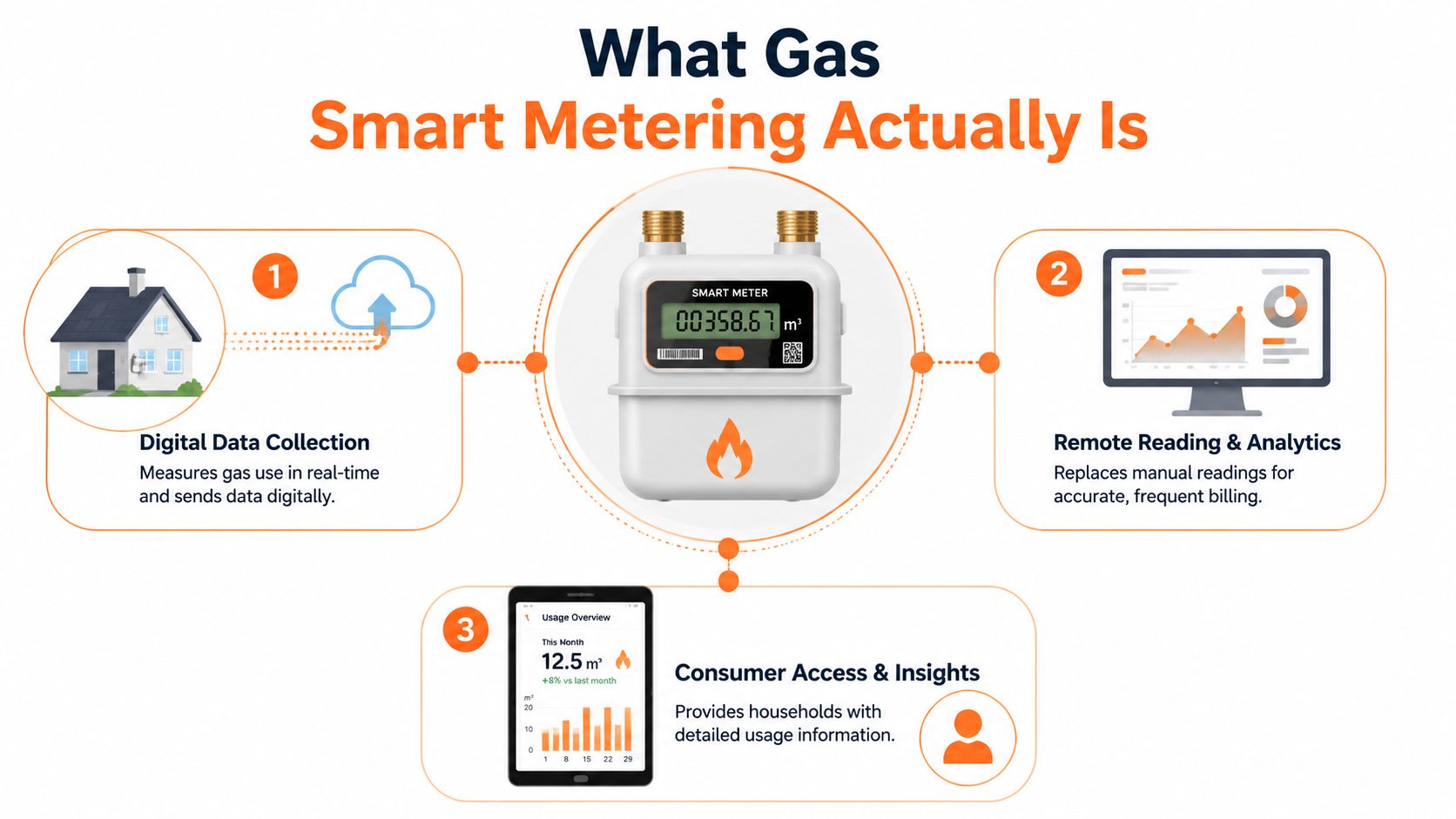
A traditional gas meter is a measuring device you read by hand. A gas smart meter does the same basic job, but it also records and sends usage data automatically, so the household and retailer do not have to rely on a manual visit every time billing is due. In plain English, it turns gas metering from a snapshot into a connected data feed.
The meter still measures gas flow, but the communication layer turns that measurement into something the retailer can use for more frequent billing, validation, and operational checks. That is easier to picture in a home where electricity, solar, and battery systems already get attention, because gas metering sits in the background until the bill or a fault forces the issue.
The basic components
A smart gas setup usually has three parts. The first is the meter itself, which measures flow. The second is a communication module, which sends data onward. The third is the data pathway into retailer and market systems, where the information can be checked, timestamped, and used for billing or other operations.
Practical rule: the value of smart metering does not come from the device alone. It comes from the data moving reliably into the systems that need it.
That matters in Australia because gas metering is not just a local display on the wall. The verified technical reference notes that gas metering data exchanged through market systems needs to support utility-grade validation, timestamping, and secure transfer, not just convenient readout at the property AEMO-linked metering architecture context. In other words, the meter has to fit the operational rules of the broader energy market.
The engineering envelope also matters. Domestic gas smart meter equipment is designed for low power draw, automatic recovery after power loss, wide ambient tolerance, and enough flow headroom to handle household appliances, which is why the technical discussion is more complex than adding a wireless module technical specification reference. That is the difference between a consumer gadget and utility infrastructure.
A separate issue for households is control, especially if there are outstanding account problems. In some cases, discussions about metering and account management can sit alongside gas red tag rights for unpaid accounts, so the meter is part of a wider service and billing relationship, not just a device on the wall.
Benefits and Drawbacks for Australian Households
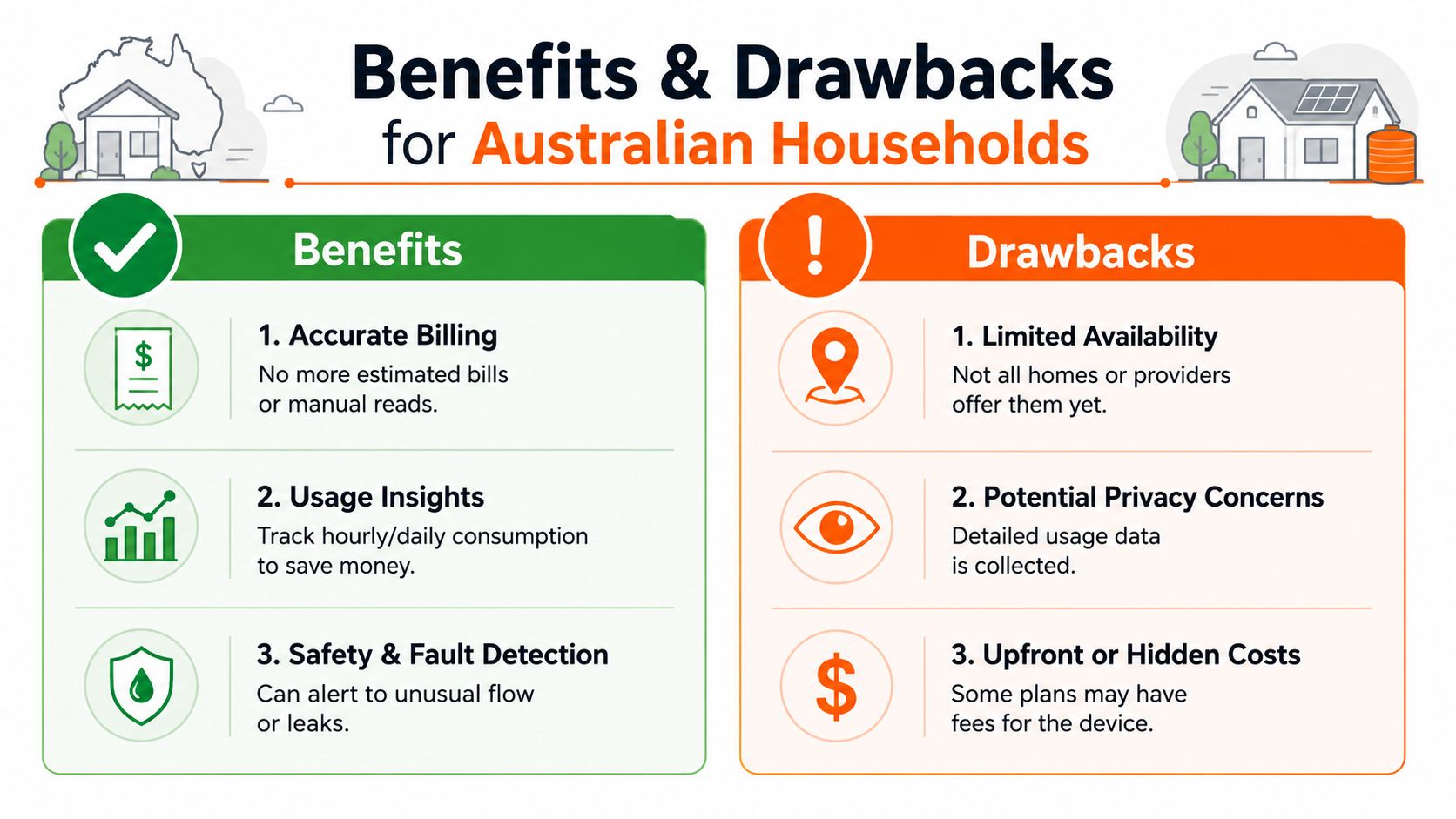
The biggest benefit of gas smart metering is simple, better information. If your retailer can receive actual usage data instead of waiting for a manual read, billing can be more accurate and less dependent on estimates. That can reduce frustration for households that have dealt with awkward catch-up bills or disputes over what was used.
There's also a behavioural benefit. When households can see how gas is being used, they can spot patterns they'd never notice from a quarterly bill. The strongest international evidence we have is from Great Britain, where government reviews found average gas savings of 2.2% anticipated in policy analysis, while the meta-analysis cited in that review estimated first-year gas savings of 2.97% on average and 2.9% to 3.1% in a narrower range of models UK supplier-evidence review.
Where the value is real, and where it gets patchy
Longer-run monitoring still found gas savings, but they weakened over time. The UK Department for Energy Security and Net Zero reported statistically significant first-year gas savings across all gas installation cohorts, with savings ranging from 1.0% to 2.8%, and a median of 2.0%. By the third year, savings were still present, but lower, at 0.9% to 2.2% NEED monitoring. That's useful because it shows smart metering can help, but it isn't magic.
The drawback is that the gas benefit case is often more fragmented than electricity. International literature has already flagged obstacles such as physical separation between gas and electricity meters, power-supply constraints, and split incentives between landlords, tenants, and different retailers structural barriers discussion. Those issues help explain why gas smart metering can feel less immediately useful to a household than electricity smart metering.
A simple way to judge value is to ask who benefits most.
- Households that watch usage closely: more likely to use the data and gain from better feedback.
- Households on flat or infrequent billing: more likely to notice the difference in billing accuracy first.
- Households planning electrification: may see less long-term value if gas use is shrinking.
For readers concerned about debt-related service risks, a practical external explainer on gas red tag rights for unpaid accounts can help frame what happens when gas supply issues intersect with billing and account management.
How Gas Smart Metering Differs from Electric Smart Metering
Why do gas and electricity smart meters get grouped together so often, even though they solve different problems? The short answer is that both send usage data digitally, but the way they fit into a home is quite different. Electricity smart metering has moved ahead faster because it sits inside a more developed metering and communications system, while gas still has to deal with location, connectivity, and weaker day-to-day motivation for some households.
For Australian homeowners who already have solar, or are thinking about a battery, that difference matters. Electricity metering sits closer to the decisions that shape a home energy setup, while gas metering is mainly about measurement and billing in a fuel that many households are slowly using less of.
Side by side comparison
| Feature | Gas Smart Meter | Electric Smart Meter |
|---|---|---|
| Primary job | Measures gas usage and sends data digitally | Measures electricity usage and sends data digitally |
| Power source | Often needs extremely low auxiliary power and fail-safe design | Can generally draw from the electricity supply it measures |
| Household value | Stronger for billing accuracy and usage visibility in dual-fuel homes | Often stronger for bill management, tariff alignment, and broader energy optimisation |
| Rollout friction | More affected by physical separation and communications issues | Typically easier to integrate into existing electricity networks |
| Adoption path | Earlier-stage in Australia | More established in the National Electricity Market |
The power difference is one of the clearest technical gaps. Domestic gas meters have to work with very low parasitic load and recover properly after power loss, so the design needs to be careful about resilience and operating range. Electricity meters avoid that same constraint because they can usually use the supply they are measuring.
There is also a difference in how each meter supports household decisions. Electricity smart meters connect more naturally to time-of-use tariffs, battery optimisation, and broader home energy management, which is why they matter so much for solar households. Gas smart meters are more about accurate reads, visibility, and operational data, which can still help, but in a narrower way. For a homeowner trying to decide where attention is best spent, the comparison often lines up with the point made in this guide to what a smart meter for electricity does.
Gas smart metering is useful infrastructure. Electricity smart metering is usually the more strategic optimisation layer for a battery-owning home.
Rollout Status and Regulatory Context in Queensland and New South Wales
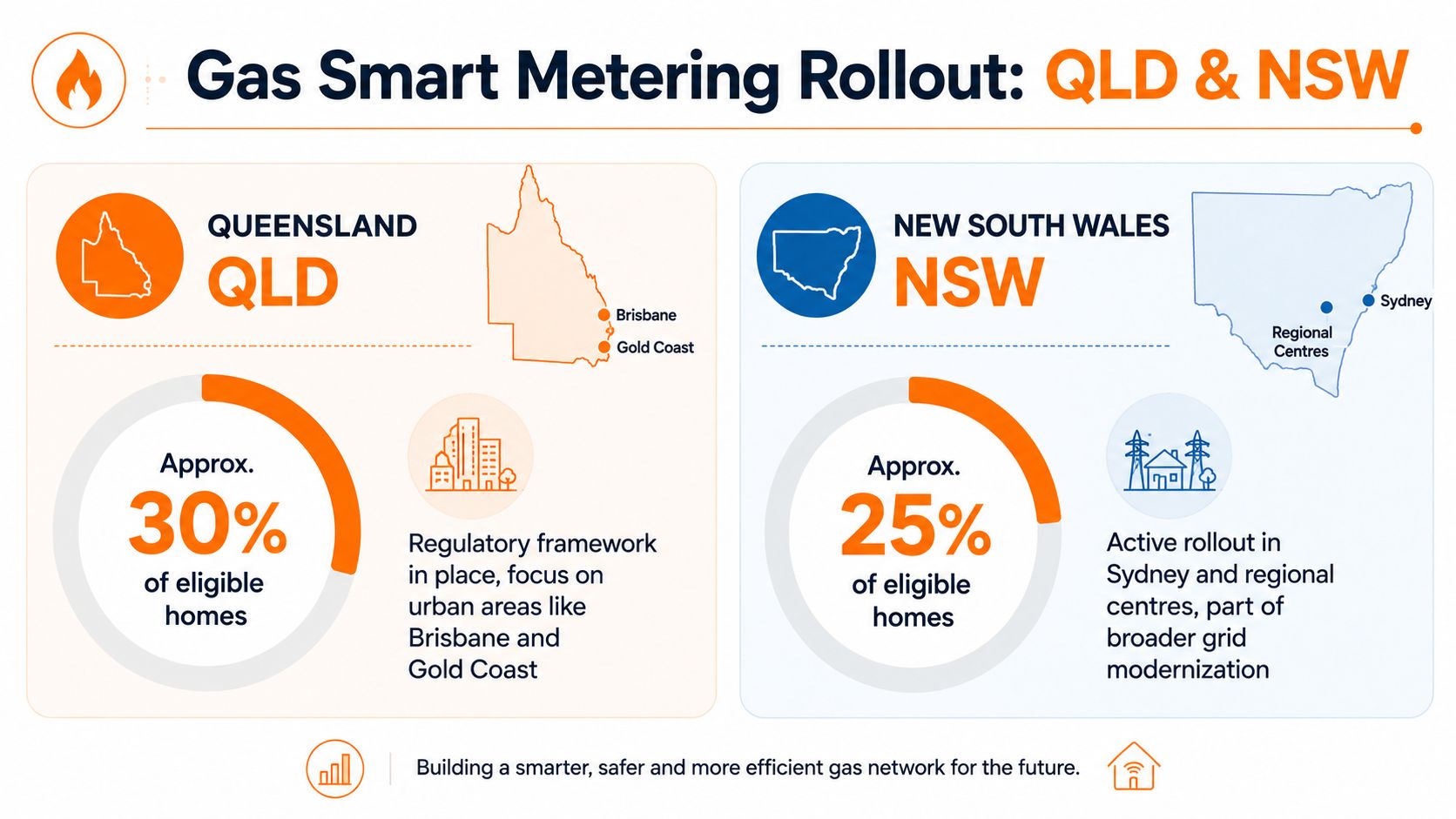
Gas smart metering in Australia is still early compared with the most mature international programs, but the regional market is moving in the same direction. The clearest statistical context comes from the broader Asia-Pacific smart gas meter market, which was estimated to hold over 38% of global revenue in 2023 and is forecast to remain the fastest-growing geography through 2030. Some research projects Asia-Pacific's smart gas meter market share at 41.65% in 2025 and a 15.2% CAGR to 2031, while global market estimates place the category at USD 2.49 billion in 2024 rising to USD 4.04 billion by 2030 at 8.5% CAGR market research.
For Queensland and New South Wales households, the important point is that smart gas deployment doesn't sit outside the market framework. Australian gas metering data that flows through market systems has to line up with metering data procedures and service-level obligations, so the issue is not only hardware installation. It's the full path from meter to retailer systems to billing and validation.
Why the UK rollout matters as a benchmark
Great Britain gives the most established rollout reference point. By the end of March 2023, 32.4 million smart meters were installed across homes and small businesses out of 57.1 million total meters, equal to 57% of all meters, and more than 13.5 million were gas meters NAO rollout report. By 31 March 2026, the share had risen to 72%, with over 38 million operating in smart mode or classified as advanced meters, including 24.3 million gas meters and 29.6 million electricity meters NAO update summary.
That timeline shows what happens when policy, supplier investment, and communications networks line up. It also shows that gas and electricity often scale together, not separately. For Australian homeowners, especially in NSW and Queensland, the practical read is straightforward: rollout can accelerate when the market wants it to, but adoption still depends on infrastructure readiness and clear service arrangements.
If you're unsure whether your household is already in scope for a meter upgrade, this explainer on do I have to have a smart meter is the right place to start.
Installation Process and What to Expect
For a gas smart meter, the installation is usually a scheduled utility job, not a product you choose off the shelf. The retailer, distributor, or program organiser coordinates it, and the household mainly deals with access, timing, and making sure the new meter is working as it should afterward.
What usually happens on the day
The process normally starts with notice, then a booking, then a technician visit. The technician removes the old meter, fits the new unit, checks the connections, and confirms that the device is communicating correctly before leaving the site. The meter also needs to recover properly after any power loss and keep working under normal household conditions, which is why the equipment setup matters so much.
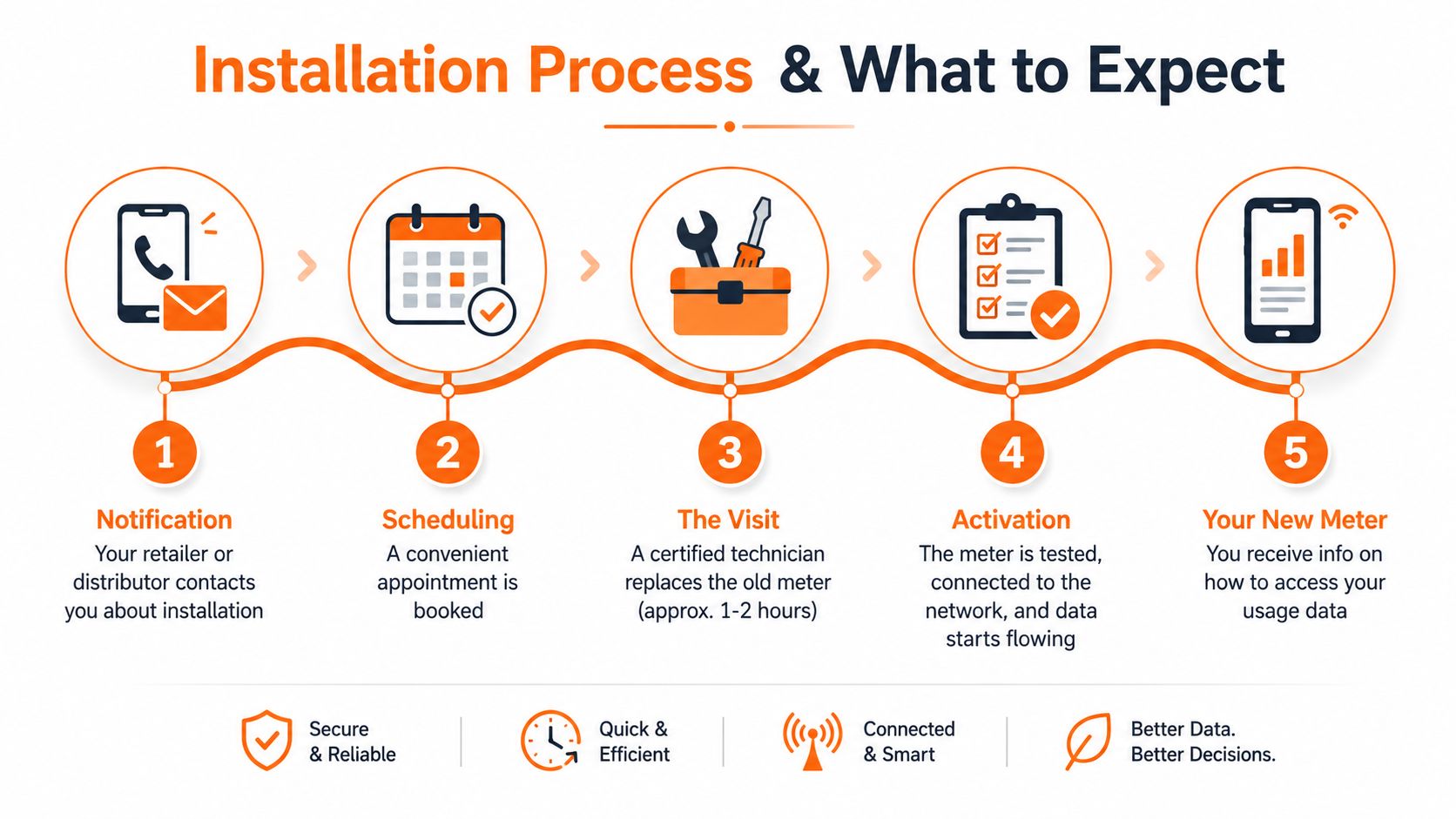
Most households want to know about interruption and access. The gas supply may be paused briefly during the swap, and the visit is usually short rather than disruptive. If a home has difficult access, a separate meter box, or a shared site arrangement, the logistics can take more coordination than a standard electricity meter change. For homeowners already using solar and a battery, the practical question is whether this upgrade adds much value compared with the work of monitoring electricity use and storage. A clear overview of how smart meters and solar work together helps put that choice in context.
Practical rule: before agreeing to installation, ask who owns the device, how the communication link works, and where your usage data will be stored.
Data security and privacy questions to ask
Homeowners should slow down here. Smart gas systems depend on connected communications and cloud-linked data handling, and the public discussion often underplays that reality. Research on smart metering consumer experience has found people often still have unanswered questions after installation, especially around how the meter works and how to use the data, while gas metering literature also highlights concerns about wireless reliability in weak-coverage areas consumer experience and connectivity issues.
Ask for plain answers to these points.
- Data access: who can see the usage data, and how can you access it yourself?
- Communication method: what network does the meter rely on, and what happens if coverage is weak?
- Fault handling: how are failed reads, outage events, or device faults managed?
- Billing impact: will estimated reads stop once the meter is live?
If those answers are vague, the upgrade is not fully explained yet. A good installation conversation should leave you confident about both the physical swap and the digital pathway after it. If you want a practical comparison point while weighing household energy upgrades, you can also compare Jackery 1500 models as part of a broader look at backup and storage choices.
What Gas Smart Metering Means for Solar and Battery Owners
For a household with solar and a battery, the question is not whether gas smart metering is clever. It's whether it's worth your attention compared with the higher-value task of optimising electricity and battery performance. For many Australian homes, the answer is that gas smart metering is a supporting issue, while battery optimisation is the bigger financial lever.
If you still use gas for cooking, hot water, or heating, a smart gas meter can help you track the shrinking role of gas as your home electrifies. That's useful during a transition period because it gives you better visibility over what's left to replace and what's still costing you money. If you expect to phase gas out entirely, the long-term value of a gas meter is naturally lower.
The strategic trade-off for electrifying homes
Homeowners can get stuck here. They spend time asking whether gas smart metering is coming, while the bigger opportunity sits in getting better value from the assets they already own. If you have a compatible battery, the more important question is how well it's being dispatched, how it interacts with tariffs, and whether a retailer-backed VPP structure can improve the economics of stored energy.
A gas meter helps you measure a shrinking part of the home energy picture. A battery strategy can reshape the part that matters most over time.
For a broader view of that relationship between metering, solar, and home energy management, this guide on smart meter and solar is a useful companion. It also helps to compare the technology with portable backup options, and a resource such as compare Jackery 1500 models can be useful when homeowners are weighing short-term resilience tools against full-home energy planning.
The honest takeaway is simple. If your household is still materially dependent on gas, smart metering can improve visibility and billing accuracy. If your household is already moving hard toward electrification, it's usually lower priority than electricity-side optimisation, tariff alignment, and battery participation in a well-structured VPP.
Frequently Asked Questions and Practical Next Steps
Can I refuse a gas smart meter?
That depends on the supply arrangement, the retailer, and the rules that apply to your property. The practical question is usually not whether the meter can be installed, but whether you have been clearly told what changes, what data is collected, and how billing will work.
What happens if the communication network fails?
The meter should still measure gas. The problem is usually data transmission, not the physical act of metering, so the household may temporarily lose the convenience of remote reads until communications are restored.
Can I see my own usage data?
You should expect a clear explanation of how to access it. If the retailer or installer cannot show you where the data appears, ask before the installation is completed.
Do smart gas meters work during power outages?
The meter design has to support fail-safe operation and automatic recovery, but the communications path may still be affected depending on the network and site setup. The technical specification sets out that kind of equipment behaviour in detail.
How do I know if it makes financial sense for my household?
Start with your current gas use, how long you expect to keep gas appliances, and whether the main pain point is billing accuracy or actual consumption. If you are moving toward electrification, the value case for gas smart metering gets weaker.
What should solar and battery owners do first?
Check whether your bigger opportunity is electricity-side performance, not gas-side visibility. If your battery is underused, a structured optimisation approach is likely to be more valuable than focusing on the gas meter.
Industry analysts and consumer advocates often point out that metering gets attention when a bill looks wrong or a utility sends a notice. A better approach is to ask which meter changes your household economics. For many solar-plus-battery homes, that means looking closely at electricity optimisation first.
If you are comparing how your home uses energy today and where value sits, HighFlow Energy can help you assess whether your battery is underperforming financially and whether a better-structured VPP approach makes sense. If you want to understand your options for optimising existing solar and battery assets, visit HighFlow Energy and request an eligibility assessment.