

How to Store Solar Energy in Battery: A Practical Guide
Your rooftop solar is exporting electricity while you're at work, but the house is buying power again when dinner, air conditioning and laundry start. Even with a battery, that pattern can continue if the usable capacity, charging schedule or reserve settings don't match your household.
Understanding how to store solar energy in battery systems starts with a simple distinction: the capacity on the label isn't necessarily the energy available tonight. A well-configured system stores surplus generation, protects household demand and makes only spare capacity available for other uses.
How Much Usable Storage Your Home Needs
A battery labelled 10 kWh may not deliver 10 kWh to your home. Kilowatt-hours (kWh) measure stored energy, while the separate power rating, in kilowatts, limits how quickly the battery can deliver it. For sizing, use the energy the system can make available after reserve settings and losses.
The Australian Government's battery guide describes typical household batteries as 4–14 kWh and lithium-ion charging and discharging losses as typically around 10%. On that assumption, a nominal 10 kWh battery returns approximately 9 kWh before additional system losses.
Nominal capacity against energy returned at 90% efficiency
| Nominal capacity | Energy returned |
|---|---|
| 5 kWh | 4.5 kWh |
| 10 kWh | 9 kWh |
| 14 kWh | 12.6 kWh |
These are calculated examples, not guaranteed outputs. Check whether the manufacturer quotes nominal or usable capacity, and what its efficiency figure includes. Otherwise, you could count the same losses twice.
Turn capacity into a household working figure
A reserve reduces the energy available for routine use. With a hypothetical 20% reserve, the 10 kWh example leaves approximately 7.2 kWh for routine use after applying the 90% efficiency assumption. That reserve is an illustration, not a recommended setting for every household.
Build your working figure from actual usage:
- Download smart-meter interval data and total consumption between 6 pm and 7 am as a practical starting window.
- Compare that overnight load with the energy available after reserve and losses.
- Check whether daytime solar surplus can replenish the energy used overnight.
The usable figure, rather than the headline capacity, is the number to carry into schedules and reserve settings. An oversized battery can remain partly empty while adding upfront cost. Use this guide to typical battery sizes in Australia to frame the comparison.
The distinction between capacity and runtime also applies to portable devices. OLED runtime explained by NeoTeo discusses how energy capacity and operating time differ.
Practical rule: Write down your estimated usable evening energy. Use that working figure, rather than headline capacity, when choosing schedules and reserves.
How to Set Up Solar Storage Step by Step
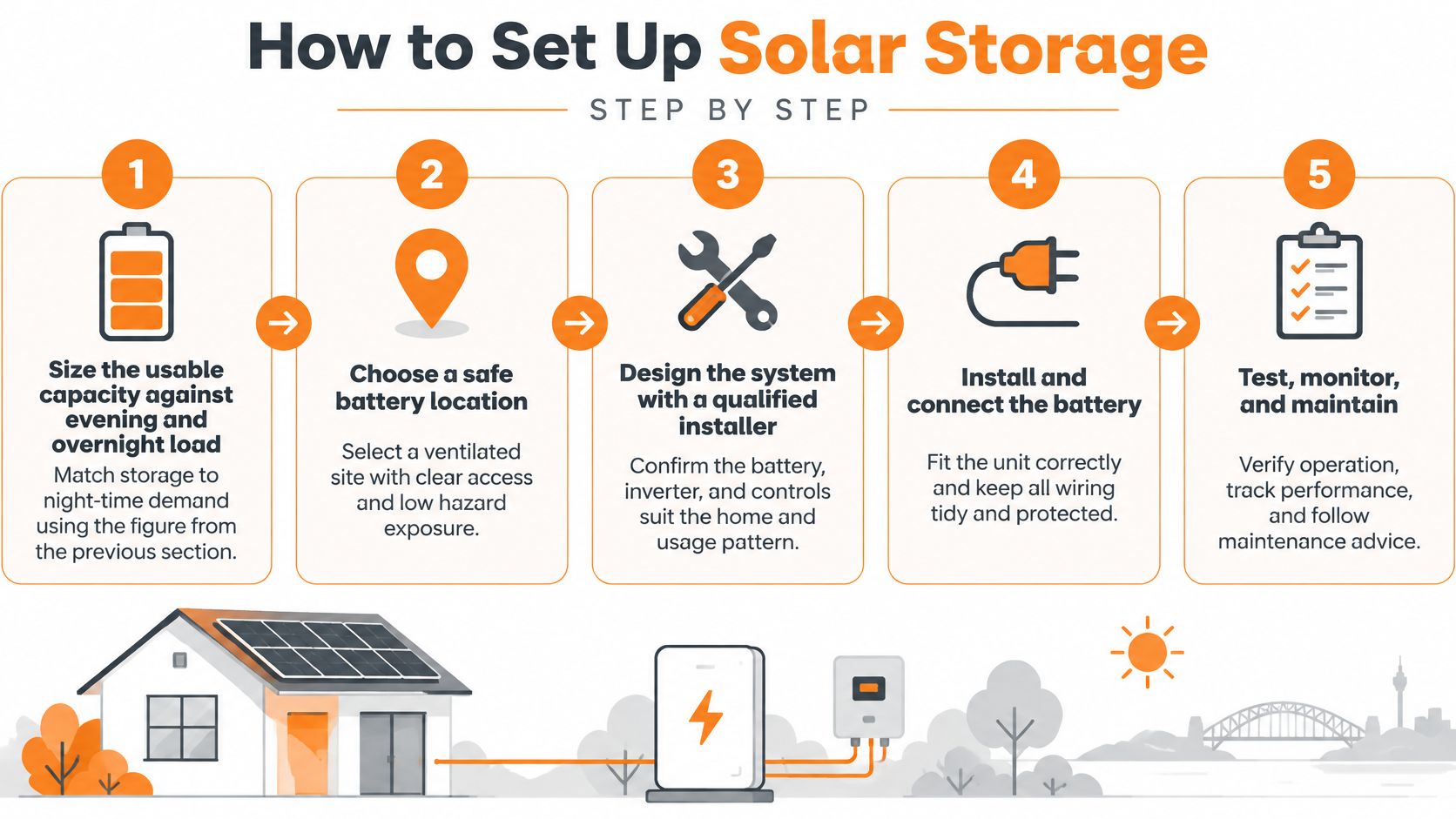
A battery can be correctly sized yet deliver less value if its inverter, network settings and controls are not configured to work together. Set the household's usable energy and reserve first, then use those figures to guide system design and operating settings.
Design and approval
Match usable energy to demand. Give the designer your interval consumption and solar-export records, not just the quarterly bill total. Size the system around the energy the battery can supply after its reserve and conversion losses, accounting for daytime appliances already powered directly by solar.
Confirm inverter compatibility. Check the exact battery model against the inverter manufacturer's compatibility documentation, including firmware and communications requirements. Confirm charge and discharge power, plus export-control capability. Matching brand names alone does not establish compatibility.
Get distributor approval before connection. Your installer should submit the connection application to the electricity distributor and confirm the approved export arrangement. Existing solar approval may not cover a changed inverter or an added battery.
Installation and commissioning
Use a licensed electrician. Installation and commissioning should follow AS/NZS 3000, AS/NZS 5139 and the manufacturer's instructions. Keep the connection approval documented. The solar battery installation guide can help you prepare questions for the installer; electrical work belongs with a qualified professional.
Set household priorities before enabling remote dispatch. Agree on the reserve and household operating schedule, then confirm how much capacity can be used for tariff optimisation or grid support. Check the operating mode and its settings rather than accepting a factory preset without understanding its effect on the available energy.
Test the energy flows. Ask the installer to demonstrate shutdown controls and check charging, discharging, household consumption and grid readings in the monitoring app. Follow an evening-to-morning cycle and compare meter readings with battery behaviour. A dashboard animation alone does not confirm that the system is operating as intended.
On a sunny day, surplus generation may charge the battery around midday, with stored energy supplying the home as solar production falls. Cloud cover, household demand and tariff scheduling can change that pattern. Commission the system against its intended design, not an expectation that the battery will fill every day.
Where to Install the Battery Safely
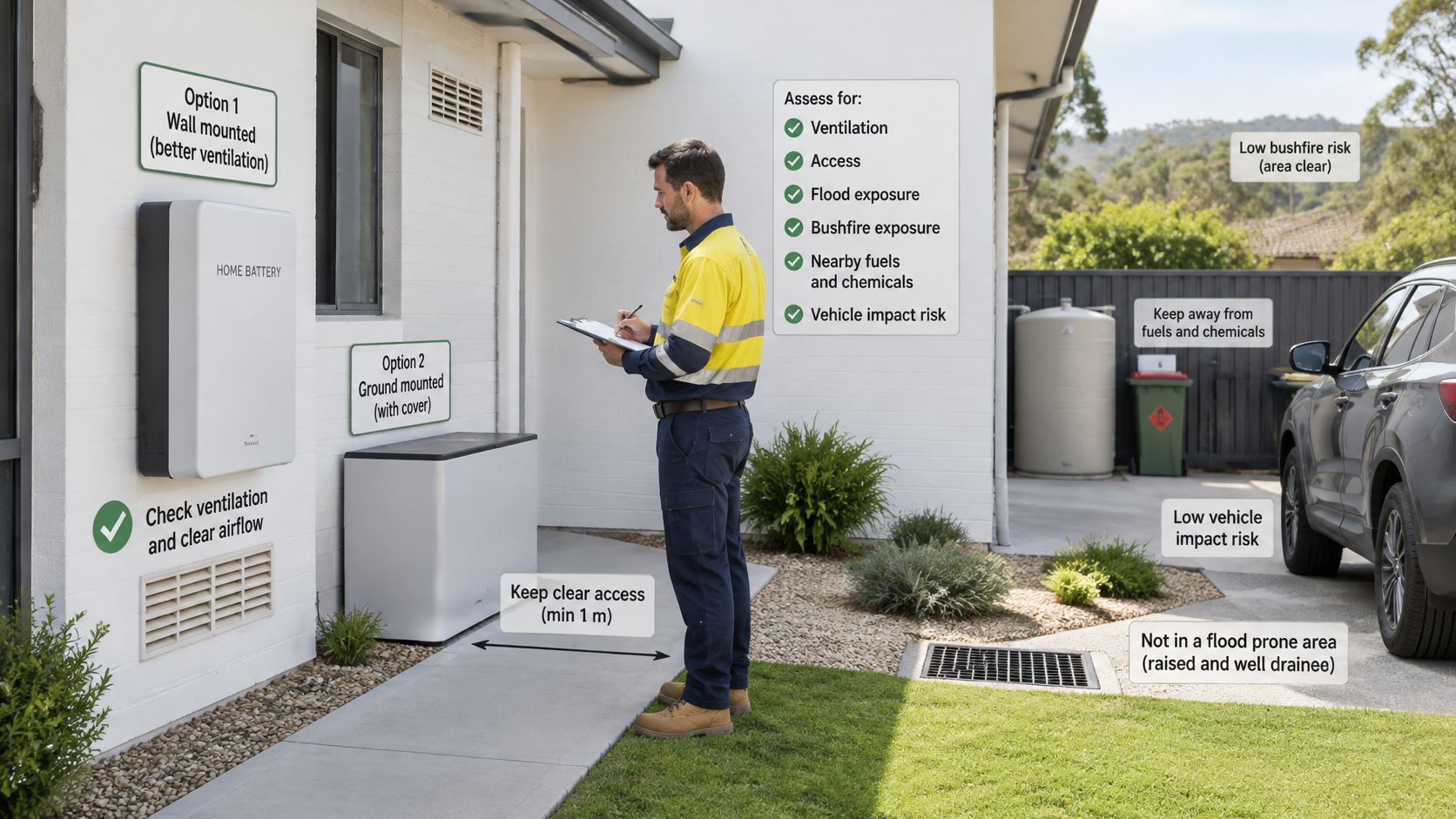
Clearance and ventilation aren't optional. A convenient wall or spare shed isn't automatically a safe battery location, even if the enclosure physically fits.
A qualified battery-system designer should assess airflow, service access, flood and bushfire exposure, nearby fuels or chemicals, and vehicle-impact risk. They also need to assess the relationship to doors, windows, pools, pipes and habitable rooms before settling on a location.
A site assessment should establish these constraints before equipment arrives.
Choose the location for operating conditions
The Queensland Government's battery safety guidance warns against direct sunlight and uninsulated, unshaded metal sheds. Select a shaded, appropriately insulated and ventilated location that restricts children's access and resists vermin.
Batteries generate heat, and some chemistries can release flammable hydrogen during charging. Don't apply a generic ventilation solution without checking the battery chemistry, enclosure requirements and manufacturer's specified clearances.
Check the handover and keep access clear
At commissioning, confirm:
- Shutdown access: You can reach the designated controls without moving stored goods.
- Identification: Required warning signs and battery-chemistry information are displayed.
- Emergency procedures: The installer explains shutdown and emergency actions, including the smoke-detector recommendation for NSW installations.
- Maintenance access: Vents, inspection points and service clearances remain unobstructed.
During routine visual checks, look for physical damage, unusual sounds, unexpected odours or gases, blocked ventilation and accumulated leaves. Follow the manufacturer's maintenance schedule, and arrange professional assessment rather than opening the enclosure yourself.
Don't turn the battery area into storage for paint, fuel or garden equipment after installation. A compliant handover doesn't make later obstruction or added ignition hazards acceptable.
Automated optimisation must never override thermal protection, electrical limits, emergency shutdowns or configured operating safeguards.
Operating Modes and VPP Dispatch Priority
Battery operating modes and their trade-offs
| Operating mode | When the battery charges | When it discharges | Main trade-off |
|---|---|---|---|
| Self-consumption | Midday, from surplus solar | Evening and overnight household load | Lower grid import, little grid-service value |
| Time-of-use | Cheaper tariff windows and surplus solar | Peak-price windows | Gain depends on the actual tariff and cycle wear |
| Backup priority | Keeps the set reserve charged | During an outage, or normally above the reserve | Less capacity available for bill reduction |
| VPP participation | Into spare capacity when the VPP requests it | Dispatch signals, subject to configured household safeguards | Payment is uncertain and not guaranteed |
These modes can overlap. A household might use self-consumption routinely, preserve emergency energy and permit selected VPP events, provided the controls support that combination.
Self-consumption is straightforward when export compensation is low relative to imported electricity. Time-of-use scheduling requires more care: cheaper charging only helps if the later avoided purchase outweighs charging cost, losses and additional battery wear.
Set household priority before sharing control
The intended allocation should be clear:
- Protect forecast evening household demand.
- Hold the user-selected emergency minimum.
- Offer only spare capacity for grid services.
That is an operating objective to verify, not a universal guarantee attached to VPP membership. Backup also requires suitable hardware, protected circuits and an outage-capable installation.
A Virtual Power Plant is a centrally coordinated network of customer batteries managed through software and communications. In ARENA's AGL VPP demonstration, batteries across 1,000 residential and business premises formed a system designed to operate like a 5 MW solar power plant.
The AEMO VPP demonstration program also tested Frequency Control Ancillary Services, where coordinated equipment responds to electricity-system frequency changes. That's different from emptying a battery into the grid when a household finishes dinner.
Understand the commercial and control trade-offs
Queensland and NSW participate in the National Electricity Market (NEM), where wholesale conditions can change independently of your retail tariff. A demand event or wholesale price spike doesn't automatically mean your household receives the wholesale value of its discharge.
Check whether your retail contract passes through wholesale prices, pays an event incentive or provides an allowance. Network congestion and distributor export limits still constrain operation, regardless of a favourable market signal.
The AEMO consumer-panel submission describes the VPP market as early in development with limited market information. Treat future dispatch revenue as uncertain, not a dependable household income stream.
Look for controls that show:
- Prices and forecasts: Whether displayed prices are wholesale signals or your actual retail charges.
- Planned activity: Scheduled charging and discharge alongside expected household consumption.
- Override access: How to suspend or change an automated plan.
- Event records: State of charge, exported energy and reserve behaviour during dispatch.
Remote dispatch can reduce stored energy available at a particular time. Review event logs to establish whether the configured reserve and household priority held, rather than assuming the selected mode proves they did.
Stored Solar Against Feed-in Tariffs
Compare the value of storing surplus solar with the payment you forgo by not exporting it. The useful calculation is avoided import cost minus forgone feed-in revenue, with storage losses included.
Find the feed-in rate on your current bill or retailer schedule, then identify the import rate applying when you expect to use the battery. For time-of-use plans, match consumption to the actual peak, shoulder or off-peak window rather than using a blended bill average.
A worked example using hypothetical tariffs
Assume a household can store 4 kWh of surplus solar, with 90% round-trip efficiency, returning 3.6 kWh. Assume an evening import price of 35 cents/kWh and a feed-in tariff of 5 cents/kWh; these are illustrative inputs, not current market offers.
| Calculation | Illustrative daily value |
|---|---|
| Avoided import, 3.6 kWh × $0.35 | $1.26 |
| Forgone export, 4 kWh × $0.05 | $0.20 |
| Difference before other effects | $1.06 |
That difference is the self-consumption case before reserve restrictions, additional system losses, cycle wear and capital costs. It doesn't remove daily supply charges or establish a battery's full investment return.
Our guide to net metering and solar explains the import-and-export accounting behind that comparison.
Use your own tariff and available energy. A favourable example isn't a forecast for your property.
VPP value is a separate commercial layer. When comparing retailers, include import charges, feed-in treatment, daily charges, allowance conditions and dispatch compensation together, rather than selecting the largest advertised incentive.
A conventional feed-in arrangement pays for exports without necessarily coordinating battery operation. A retailer-based VPP can coordinate the battery and electricity account, but its overall value still needs to beat the household's credible self-consumption baseline.
Common Mistakes That Cut Battery Output
The most damaging financial mistake is budgeting around grid-service income before establishing what the battery saves through ordinary household use. A busy battery isn't necessarily a profitable battery, and extra cycling can deliver little value if the tariff difference is small.
Five mistakes worth correcting
- Budgeting on uncertain payments: Build bill estimates around the self-consumption case and treat dispatch-related value as upside, rather than money required to meet household expenses.
- Judging a summer snapshot: Compare a full year of bills and interval records instead, because seasonal changes in solar production and evening demand can materially change utilisation.
- Accepting enrolment defaults: Confirm reserve and export settings before remote operation begins, then review app event logs monthly for behaviour that differs from the agreed configuration.
- Ignoring warranty conditions: Read the operating limits for cycling, temperature and depth of discharge, and keep commissioning and service records rather than assuming every control setting is permitted.
- Leaving schedules unchanged: Review automation after firmware updates and tariff changes, since an old schedule can remain active after the economics or control behaviour changes.
Key Takeaways
Usable energy is the working number. Capacity alone doesn't establish how long the home can run or how much discretionary export is available.
Measure useful output, not activity. Repeated charging and discharging should have a clear household or commercial purpose.
Keep protection settings intact. If a proposed setting would drain the intended reserve or move the battery outside its approved operating range, don't enable it. Resolve the conflict with the installer or operator before allowing automated dispatch.
Check Whether Your Battery Is Underperforming
If your home imports electricity while the battery still holds charge, check its settings before assuming you need more storage. Compare electricity bills and battery records across the year, then check whether usable capacity is being reserved, exported or left unused when the home needs it.
Review the reserve, operating mode, export limit and remote-control status. Confirm that your solar system and battery are compatible with the VPP, and that the battery has an internet connection.
Why HighFlow Energy
HighFlow Energy is an Australian energy service for eligible solar-and-battery homeowners in Queensland and New South Wales. You bring your existing solar and battery, the battery joins HighFlow's Virtual Power Plant (VPP), and HighFlow uses spare capacity to support the grid when your battery is available. The value generated funds a monthly bill-free electricity allowance.
Your household's energy use comes first, and you keep ownership and control of your battery. The allowance may cover daily supply charges and electricity use up to its limit; use beyond the allowance is charged at standard rates.
Participation requires a compatible solar system, a compatible home battery you already own, and an internet connection for the battery. Check the offer terms and confirm compatibility before joining.
Frequently Asked Questions
Can an existing solar system charge a battery?
Yes, if the system is compatible. An installer can confirm whether the existing inverter supports the battery or a separate battery inverter is needed.
Will a battery power the home during an outage?
Only if the installation supports backup operation. VPP participation does not guarantee that charge will be retained or backup power will be available.
Is a larger battery automatically better?
No. Extra capacity adds little value if the home lacks enough solar energy to charge it or demand to use the stored energy.
Does joining HighFlow transfer battery ownership?
No. You keep ownership and control of your battery.
What should an eligibility assessment establish?
It should confirm equipment compatibility, usable capacity and whether the arrangement suits your existing system.
HighFlow Energy coordinates compatible home batteries to support the grid using spare capacity, with household energy use prioritised. Visit HighFlow Energy to request an eligibility assessment and check whether your system is compatible.