

Solar Battery Storage Box: An Australian Owner’s Guide
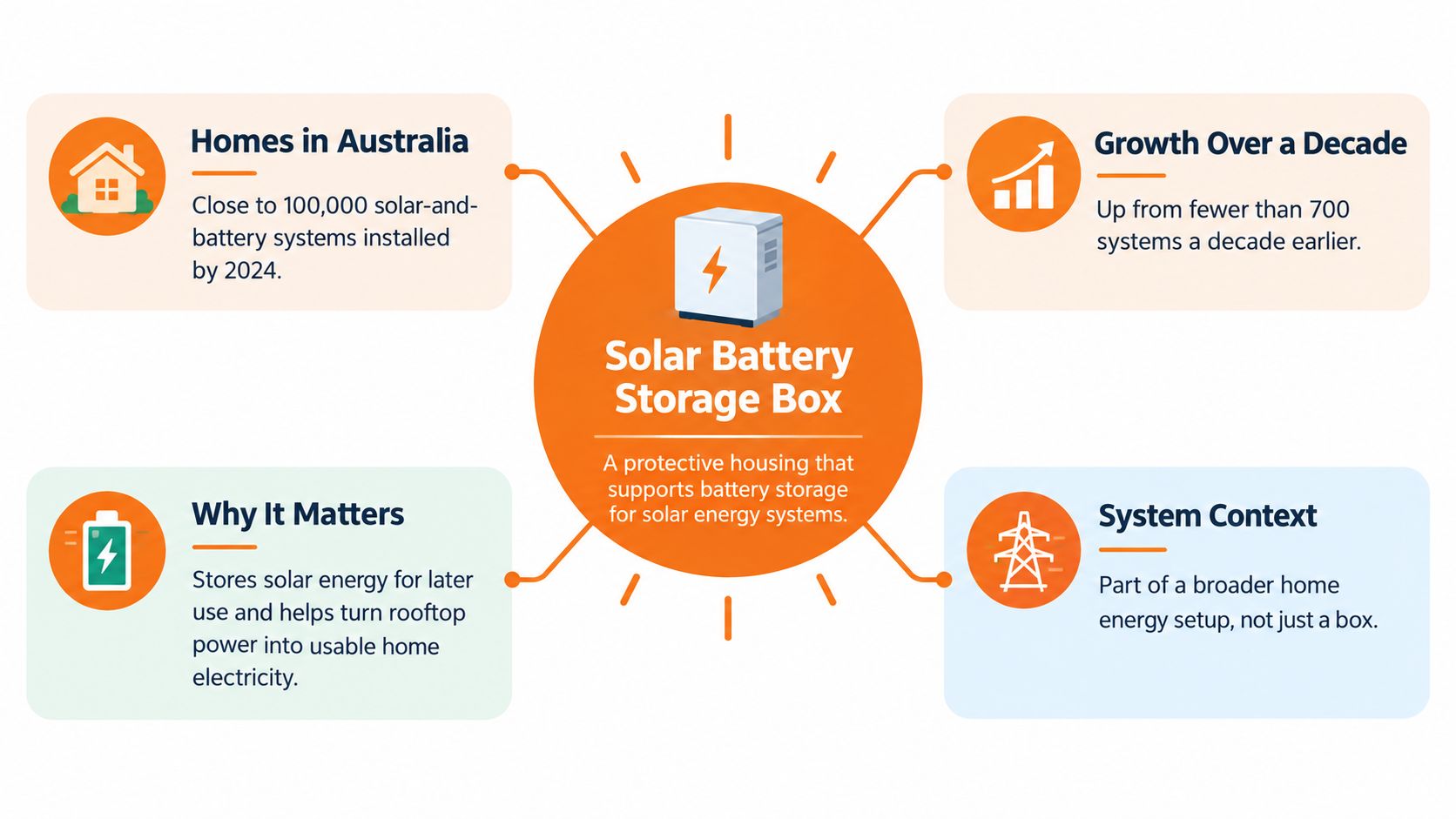
A solar battery storage box is a weather-rated enclosure that packages battery modules, a battery management system and often an inverter into a single certified unit, not merely a protective metal case. That distinction matters because you're not buying an empty container for someone to fill later. You're buying, or already own, a complete electrical system that stores surplus rooftop solar, protects its own cells, converts power for your home, and may also communicate with a retailer or Virtual Power Plant.
What Is a Solar Battery Storage Box
In Australian quotes and product listings, solar battery storage box usually describes that complete packaged unit. The enclosure is the visible part, so people name the whole system after it. It's closer to buying a fridge than buying a box. The cabinet keeps weather, dust and accidental contact out, but the value sits inside in the cells, electronics and controls.
That naming habit causes real confusion at quote stage. One installer might price an integrated all-in-one unit where the battery, management system and hybrid inverter are factory matched in one cabinet. Another might describe an enclosure housing separately specified battery modules, paired with an external inverter elsewhere on the wall. Both can work well, but they differ in wiring, commissioning, upgrade paths and who is responsible when components don't communicate properly.
Why the term now describes infrastructure, not an appliance
Australia's scale explains why this distinction has become more than semantics. The National Consumer Energy Resources Roadmap reporting close to 100,000 small-scale solar photovoltaic systems with batteries installed by 2024, up from fewer than 700 combined systems at the end of 2014, with about 1 gigawatt of small-scale battery capacity across the National Electricity Market shows growth of more than 140 times in roughly a decade. The same roadmap context includes roughly one-third of Australian households having rooftop solar and national rooftop capacity reaching 22.6 gigawatts in May 2024. Under the Australian Energy Market Operator's 2024 Integrated System Plan Step Change scenario cited there, small-scale battery capacity needs to rise to 6.6 gigawatts by 2029 to 2030, an increase of about 560 percent.
Adoption has kept accelerating since then. An Australian Government implementation update recording more than 72,000 home batteries installed in the year ending December 2024, a 27 percent year-on-year increase to more than 320,000 batteries nationally, with about one in 30 households owning one%20Roadmap%20Implementation%20Plan%20Update%20August%202025.docx) also noted Australia's four-millionth rooftop solar system under the Small-scale Renewable Energy Scheme in December 2024. Average system size in that update rose from 9.3 kilowatts in early 2024 to 9.9 kilowatts in early 2025. Larger arrays produce more midday surplus, and the box is what lets a household keep some of that energy for the evening instead of exporting it all.
For homes in Queensland and New South Wales, both inside the National Electricity Market, that means your unit has two identities. At household level it's a store for your own solar. At system level, thousands of similar units form flexible capacity the grid can draw on when coordinated properly.
A storage box isn't defined by its cabinet. It's defined by what the packaged system can safely store, deliver and communicate.
When you read a quote, translate the label into components. Ask what's inside the enclosure, what's external, and what's not included at all. That single question prevents most misunderstandings about price, backup capability and later battery optimisation.
Key Components Inside a Solar Battery Storage Box
Follow the energy and you'll understand the hardware. Sunlight becomes direct current electricity in your panels, some of it flows into the battery, and the system later converts stored energy back into alternating current your appliances can use. Information flows alongside it the whole time, because every charge and discharge decision depends on measured limits.
The parts that store and protect energy
Battery modules contain the cells where energy is stored. Their chemistry influences how far they can be discharged, how they handle heat, and how they age with cycling. Modules may be fixed as one block or stacked so capacity can expand later, but expansion always depends on manufacturer compatibility and inverter limits.
The battery management system, or BMS, is the traffic controller. It monitors cell voltage, current, temperature and state of charge, balances cells, and stops operation outside safe boundaries. If software asks for a discharge the cells can't safely deliver, the BMS is the component that should say no. That's why firmware and BMS communication matter as much as raw capacity.
The inverter converts between DC and AC. A hybrid inverter manages both solar and battery flows, while a separate battery inverter can be added to an existing solar setup. Its continuous and peak power ratings decide how many appliances can run at once from stored energy, which is a different question from how long the battery can run them.
Thermal management keeps cells within their operating window through enclosure design, airflow, heat dissipation or active components depending on the product. In a hot Queensland garage, heat isn't a minor comfort issue for the equipment. It affects available power, efficiency and long-term degradation, so it's worth understanding how a thermal management system protects battery performance before you accept a proposed mounting spot.
Around those core parts sit the enclosure with its IP weather rating, isolators and protective devices, plus metering and communications hardware. The metering tells the system whether the house is importing or exporting. The communications path carries monitoring data and, where enabled, remote control signals for automated optimisation.
Reading the specification sheet properly
Australia's YourHome guidance gives useful context in the YourHome battery guidance listing lithium-ion round-trip efficiency at about 89 to 96 percent, depth of discharge at 90 to 100 percent, discharge operating range of roughly minus 20 degrees Celsius to 50 degrees, charging range of 0 to 50 degrees, and cycle life of 1,000 to 10,000 cycles.
| Specification | Typical Range | What It Means for Your System |
|---|---|---|
| Round-trip efficiency | 89 to 96 percent | Share of stored energy you get back after losses |
| Depth of discharge | 90 to 100 percent | Share of nameplate capacity that's actually usable |
| Operating temperature | Minus 20 to 50 degrees discharging, 0 to 50 charging | Heat and cold limits that can restrict operation |
| Cycle life | 1,000 to 10,000 cycles | How repeated use relates to long-term wear |
Here's the worked example that makes those figures concrete. A nominal 10 kWh lithium battery delivering 90 percent usable capacity with 92 percent round-trip efficiency returns about 8.28 kWh after a full charge and discharge cycle, as calculated in that same guidance context, before inverter and standby losses. So headline capacity isn't dishonest, it's just incomplete. Usable energy, power output and temperature limits decide what you experience each evening.
Safety and Installation Requirements in Australia
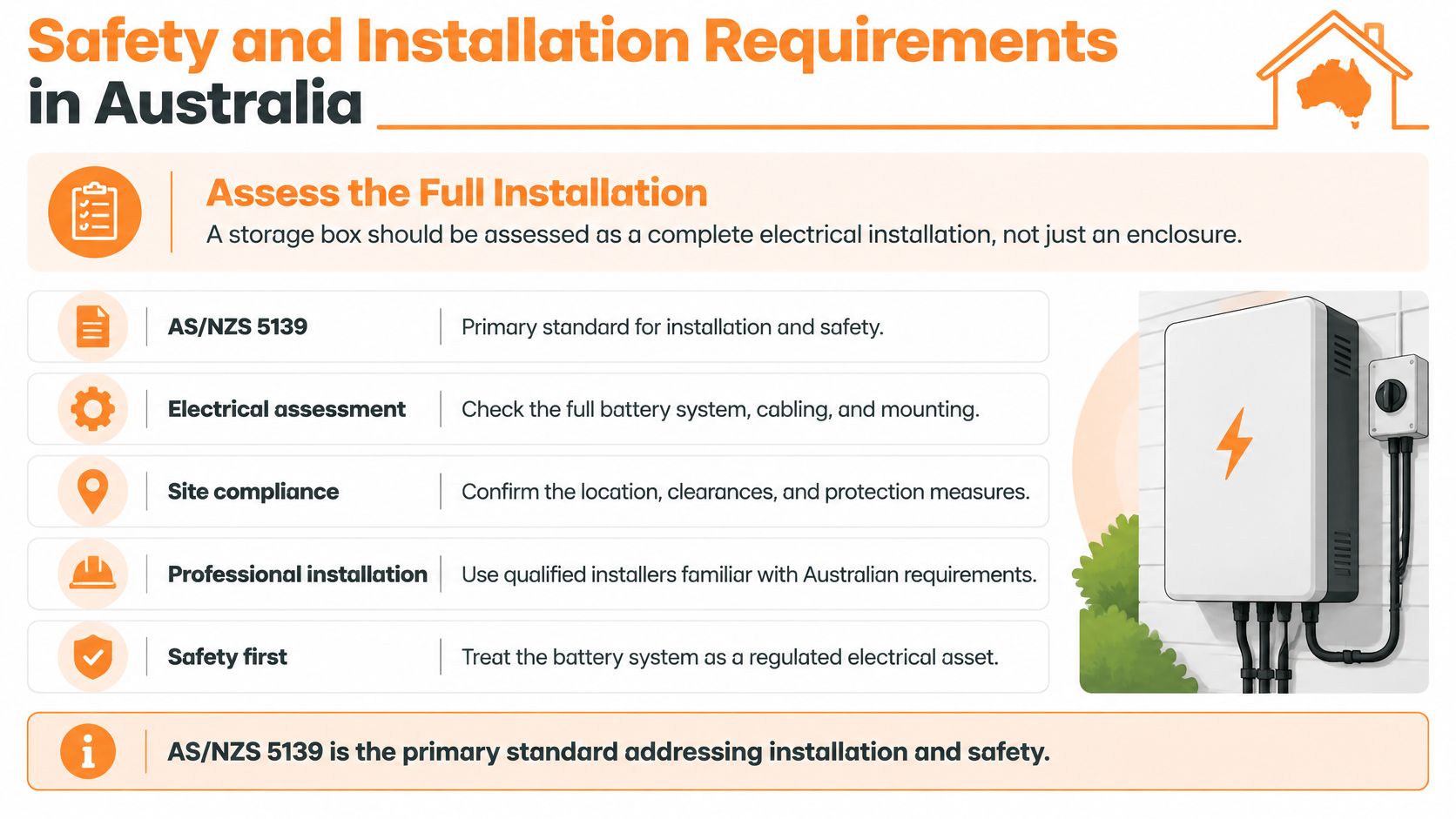
Treat the box as a complete electrical installation, not furniture that happens to contain a battery. The cabinet, cabling, inverter, protection devices, mounting surface and surrounding clearances all interact. A capable battery installed badly can be restricted, unreliable or unsafe, and software control can't fix a physical installation problem.
AS/NZS 5139 is the primary Australian standard addressing installation and safety for battery systems used with power conversion equipment. Government guidance around it covers separation, clearances, ventilation, labelling and fire safety. Those aren't paperwork details. Clearances allow heat to dissipate and technicians to work safely. Labelling tells emergency services and future electricians what's connected and how to isolate it.
There's a second complication homeowners rarely hear about. The Australian Renewable Energy Agency overview of battery performance standards noting that AS/NZS 5139 primarily addresses installation and safety while Australia has historically lacked a universally consistent performance standard explains that manufacturer claims for capacity, power and cycle life may use different measurement methods. Two datasheets can therefore look comparable while measuring performance differently. Safety compliance is standardised far more tightly than performance claims.
What Queensland and New South Wales conditions change
Summer heat raises enclosure and cell temperatures, particularly on sun-exposed walls or in enclosed garages with poor airflow. That can trigger temperature derating, where the system reduces charge or discharge power to protect itself. Location restrictions under the standard may also rule out spots that look convenient, such as near habitable room openings or where required separation can't be achieved.
Documented compliance protects more than safety. It supports warranty claims, insurance discussions and any later connection to automated control. If you're assessing an existing installation, it's sensible to check your home's electrical safety as part of confirming the broader switchboard and circuits are sound, not just the battery itself. Our own plain-English overview of whether solar batteries are safe in Australian homes covers the household side of these questions.
Your verification checklist before sign-off
- Compliance documentation: Obtain the installer's certificates and confirm the installation matches them.
- Inverter configuration: Verify the inverter and protection setup are compatible with the battery and intended operating modes.
- Backup circuit limits: Record which circuits are backed up and what load they can carry.
- Operating boundaries: Note the manufacturer's permitted state-of-charge and temperature limits.
Practical rule: Never let a control platform command operation outside the certified limits recorded at installation.
Those records turn a vague assurance into evidence. Keep them with your warranty documents, because you'll need them again if you change retailer, add capacity or enrol in a VPP.
How to Choose the Right Solar Battery Storage Box
Don't start with brands. Start with the job you want the system to do, then test each option against measurable specifications. A household chasing evening self-consumption, a household wanting blackout protection for medical equipment, and a household planning VPP participation can all look at the same cabinet and reasonably reach different conclusions.
Nameplate kilowatt-hours are the weakest comparison tool on their own. As the worked example earlier showed, usable capacity and efficiency determine what returns to your home. Ask every supplier for the same set of figures so quotes become comparable.
- Usable capacity: Independently defined usable kilowatt-hours, not just nominal capacity.
- Continuous and peak power: What the system can deliver steadily and briefly, in kilowatts.
- Efficiency test conditions: How the round-trip figure was measured.
- Temperature derating: How output changes as the enclosure heats up.
- Warranty throughput: The total energy the warranty allows over its life.
- Minimum state of charge: The reserve floor the system won't discharge below.
The trade-offs nobody can decide for you
Capacity versus cost is the obvious one. More usable storage captures more midday surplus, but only if your array generates surplus and your evening usage can absorb it. Oversizing storage for a small array leaves expensive capacity sitting partly empty for much of the year.
Power versus energy confuses many buyers because the units sound similar. Kilowatts describe how fast energy flows, like the width of a tap. Kilowatt-hours describe how much is stored, like the size of the tank. A large tank with a narrow tap can't run several heavy appliances at once, while a powerful system with modest capacity runs them briefly.
Backup capability versus simplicity is the third decision. Backup requires suitable inverter function, protected circuits and load limits, which adds cost and complexity. It works on the same basic principle as smaller household backup devices, and if you're curious about the concept at a simpler scale, reading about how sump pump battery backups work shows how stored energy keeps one critical load running when mains power fails. A home battery does that job at a larger, regulated scale, but only if it's specified for it.
Fixed versus expandable designs affect your future options. Modular systems let you add capacity if an electric vehicle or larger array arrives later, but expansion windows and module compatibility aren't open-ended. Confirm how long matching modules will remain available.
Match the final choice to your interval data, not your impressions. Look at evening consumption after solar generation fades, seasonal variation, and the size of your existing array. Then check inverter compatibility carefully, because that pairing decides whether the battery can later join automated optimisation or a Virtual Power Plant Australia program without hardware changes.
What VPP Compatibility Really Means for Your Battery
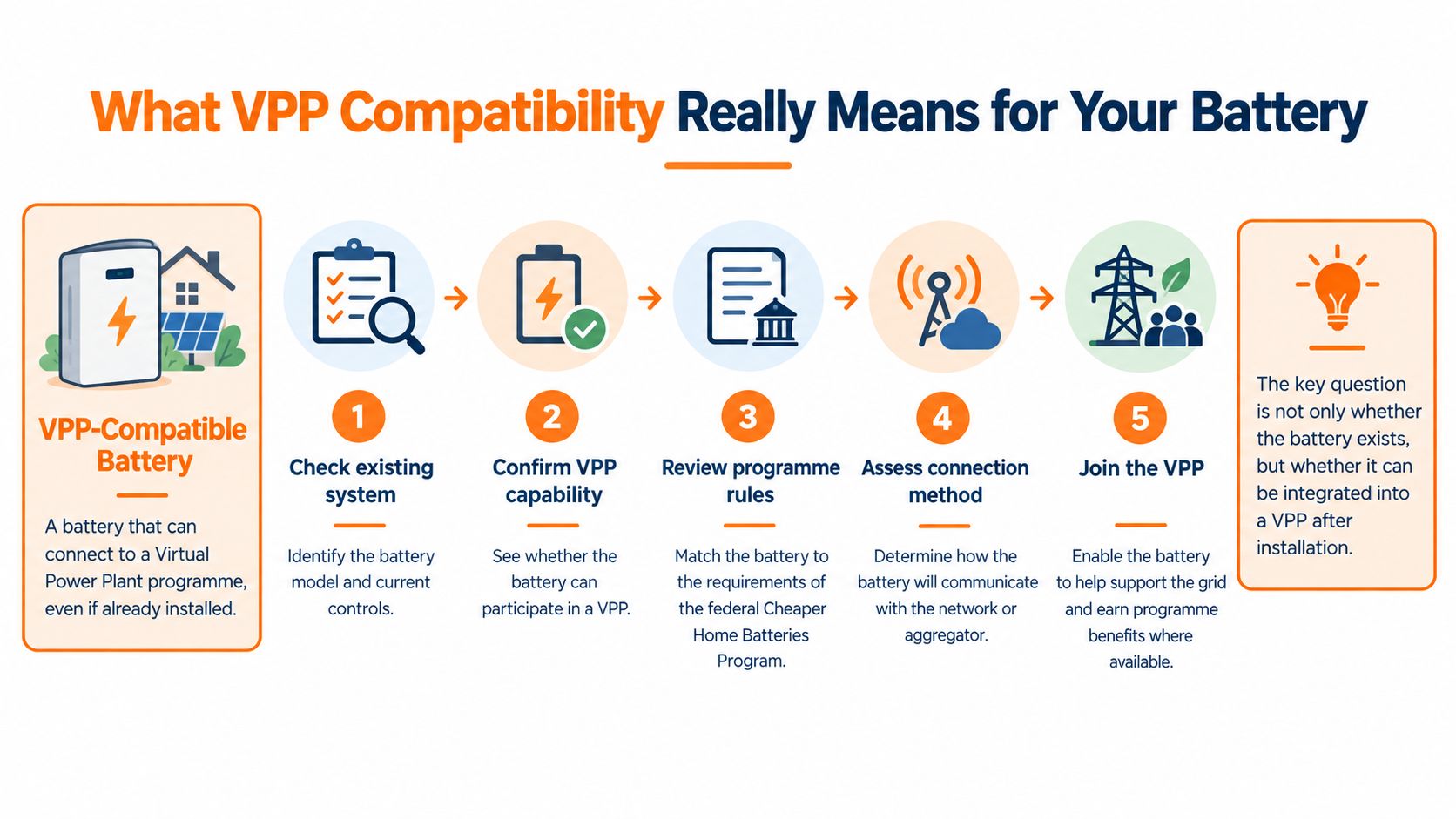
Here's the assumption worth challenging. A battery labelled VPP-ready isn't automatically a battery that will earn well, or at all, in a Virtual Power Plant. Technical capability is the entry ticket. Export limits, reserve settings, firmware, warranty conditions and network constraints decide whether meaningful dispatch can happen.
The regulatory baseline has tightened. The Australian Government battery guidance confirming the Cheaper Home Batteries Program began on 1 July 2025 and requires eligible on-grid systems, including the inverter, to have technical VPP capability and meet Clean Energy Council approval requirements sets that entry ticket for new subsidised systems. NSW Government guidance referenced in that context confirms provider conditions vary, including the price paid for exported energy and when the battery can discharge. So two VPP offers on identical hardware can produce very different outcomes.
Market rules are moving the same way. The Australian Energy Market Commission rule made on 19 December 2024 establishing dispatch mode for aggregated price-responsive resources including Virtual Power Plants and energy storage systems created a recognised pathway for aggregated household batteries to participate in National Electricity Market dispatch. Your box can therefore be represented as part of a coordinated resource rather than operating only as an isolated device behind your meter.
A plain-English compatibility audit
Work through these questions with any provider before enrolling, and check them against the system integration requirements for connecting a battery to coordinated control.
- Battery and inverter models: Are both supported, on current firmware?
- Communications pathway: Does control run through the inverter, a separate device or a cloud platform, and what happens if your internet drops?
- Export limits: Does your network connection allow enough export for dispatch to matter?
- Minimum reserve: What state of charge is protected for your own use or backup?
- Outage behaviour: Does participation change what happens in a blackout?
- Exit process: How do you leave, and what settings remain afterwards?
For our Bring Your Own Battery program, eligible batteries must meet minimum usable capacity, inverter requirements and VPP compatibility standards. You'd need a compatible solar system, a compatible home battery and an internet connection for the battery. The VPP only uses spare battery capacity and operates automatically in the background, with your home's energy use always coming first.
VPP-capable describes what the hardware can do. VPP-suitable describes whether participation makes sense for your household.
That distinction is where honest assessment beats a compatibility logo. If your reserve settings, export limit or warranty throughput leave almost nothing available to dispatch, the right answer may be to optimise self-consumption first and revisit enrolment later.
Real-World Examples of Home Battery Storage in Action
A single household battery looks modest on a garage wall. Its significance appears when you watch what it does across a day, and then multiply that behaviour across a suburb. Three distinct jobs explain nearly everything a storage box does in practice.
Shifting your own solar into the evening
The everyday job is time shifting. The Australian Renewable Energy Agency explanation of battery storage storing energy during low demand and releasing it during peak demand describes exactly what happens when your system charges from midday surplus and discharges while you cook dinner. The battery doesn't create energy. It changes when your solar energy is available, which is why larger arrays and evening-heavy households tend to use storage most fully.
That same source documents a South Australian VPP phase where each property received a 5 kilowatt rooftop solar system and a 13.5 kilowatt-hour Powerwall battery, combining into approximately 20 megawatts and 54 megawatt-hours of centrally controlled residential storage. Hold those two scales together for a moment. One home had a battery sized for its own evenings. Together, the fleet operated at a scale comparable to a small power station, without a single new centralised building.
Backup when the grid fails
The second job is backup power, where the system supports it. During an outage, a suitably configured battery and inverter can supply protected circuits such as lighting, refrigeration and communications. This isn't automatic with every storage box, and it isn't whole-home supply unless the system was specifically designed and wired that way. The capability lives in the inverter function and switchboard configuration recorded in your compliance documents, not in the cabinet size.
Many small batteries acting as one resource
The third job is coordinated grid participation. In the Australian Renewable Energy Agency demonstration connecting 1,000 residential and business premises through cloud-based control to operate collectively as a 5 megawatt solar power plant, batteries stayed behind each customer's meter while central software coordinated their operation. Nothing physical moved. Software aggregated charging, discharging and availability into a resource the energy system could use.
That's the thread connecting all three jobs. In the evening your box serves your household. During an outage it may protect essential loads. When coordinated with thousands of others across Queensland and New South Wales, the same hardware supports the wider grid during demand events and wholesale price volatility. The box doesn't change. The control layer decides which job it's doing at any given moment, and whether that work benefits only your home or your home and the network at once.
Key Takeaways and Next Steps for Battery Owners
Five points capture what matters most from everything above.
- It's a system, not a case: A solar battery storage box packages cells, controls and often an inverter into one certified electrical unit.
- Usable figures beat nameplate figures: Usable capacity, continuous power, efficiency and temperature derating decide daily performance.
- Installation quality is performance: Compliance with AS/NZS 5139 on location, clearances and ventilation determines safety and reliable operation.
- Compatibility is a spectrum: VPP capability on a datasheet doesn't guarantee a battery can dispatch meaningfully under your export limit, reserve and warranty settings.
- Control creates value: The same hardware can serve self-consumption, backup or coordinated grid support depending on how it's operated.
Most battery owners focus on installation quality. Far fewer focus on ongoing performance and optimisation, yet that's where the financial outcome is decided over the system's life. A well-installed battery on a basic tariff with no coordination is often an underutilised asset, exporting cheaply at midday and buying back expensively in the evening.
Our process is built around the system you already own. You bring your existing solar and battery, your battery joins the HighFlow Virtual Power Plant, we support the grid using spare capacity only when your battery is available, and you receive a monthly bill-free electricity allowance. Current tiers range from 300 kWh to 1,000 kWh per billing month depending on system size, for homeowners in Queensland or New South Wales who have solar and a compatible battery, still receive electricity bills, and want better value from what they've already installed.
If you'd like to understand whether your battery is underperforming financially, request an eligibility assessment and we'll work through the compatibility audit with you.
Frequently Asked Questions
Is a solar battery storage box the same as a home battery
Mostly, yes. The terms overlap in everyday Australian usage, but storage box specifically implies a packaged, enclosed unit containing the battery modules and controls, often with an integrated inverter. A home battery could also describe the same thing, so check what's inside any quoted product rather than relying on the label.
Can I add a storage box to my existing solar system
Usually, yes, subject to inverter compatibility. If your existing inverter is hybrid or battery-ready, integration is simpler. If it isn't, a separate battery inverter or an inverter replacement may be required. Your installer should confirm the pairing, firmware support and switchboard suitability before quoting, because that combination also decides your later VPP options.
Will my battery keep working during a blackout
Only if it was specified and wired for backup. Some systems support whole-home backup within their power limits, many support selected protected circuits such as lights and fridges, and some grid-tied systems shut down during outages with no backup mode at all. Check your compliance documentation for the backup circuit limits recorded at installation rather than assuming the battery alone provides it.
Does joining a VPP affect my warranty or control
Participation terms vary by provider, including discharge timing and payment for exports, so read the conditions before enrolling. Under our Bring Your Own Battery VPP, joining does not affect your battery warranty, and you keep full ownership of your system. Ask any provider how cycling under their program interacts with your warranty throughput limits, since that's the detail that matters most over time.
Do I need to change how I use energy at home
No. Coordinated operation runs automatically in the background using spare capacity after your household needs are met. Running heavy appliances during daylight hours still helps you use more of your own solar directly, but that's an optimisation choice, not a condition of participation.
If your storage box is installed, compliant and still leaving value on the table, HighFlow Energy can assess whether your existing solar and battery system qualifies for our Bring Your Own Battery Virtual Power Plant and monthly bill-free electricity allowance. Request an eligibility assessment today and find out what your battery could earn beyond self-consumption, with your household's energy use always prioritised first.