

Virtual Power Plant Battery: How It Works for Your Home
A sunny Queensland afternoon can make a home battery look busier than it really is. Rooftop solar may be producing more electricity than the house needs, the battery may already be close to full, and the surplus may flow to the grid for a modest feed-in tariff. By evening, the same household may buy electricity again when demand and wholesale prices are higher.
That gap is where a virtual power plant battery can matter. A VPP doesn't replace your solar or battery. It coordinates spare capacity across many homes so the battery can support the grid at useful times, while the household keeps priority access to stored energy. The financial question isn't merely whether your battery can export electricity. It's whether coordinated dispatch creates more value than leaving the system to follow its default settings.
The Battery on Your Wall Is Doing Less Than You Think
Consider a Queensland household with rooftop solar and a 10 kWh battery. On a clear afternoon, the solar system is producing strongly, household demand is moderate, and the battery has already reached a high state of charge. The air-conditioner cycles on and off, but the inverter still has limited room to absorb more solar. Excess generation heads to the grid, where the household receives its feed-in tariff.
The owner may reasonably believe the battery is doing its job. It charged from solar, it will discharge after sunset, and it should reduce evening imports. But the inverter data often tells a more precise story. The battery may spend much of the day waiting, then discharge only during the household's evening consumption window. Any capacity left unused during the afternoon has no additional value unless the system can respond to a better charging, discharging or grid-support opportunity.
That doesn't mean self-consumption is the wrong strategy. For many households, storing midday solar for later use remains the battery's most important function. The issue is that a home battery has several possible jobs, and a fixed schedule may not select the highest-value one on every day.
The difference between energy and timing
Electricity has value at the time it is generated, consumed or dispatched. Surplus solar exported when the network has abundant daytime generation may earn less than energy used inside the home or dispatched during a demand event. The exact result depends on the retail plan, network conditions, export settings and VPP rules.
Australian VPP activity has moved beyond small demonstrations. AEMO's demonstrations across the mainland NEM states reached 31 MW of registered capacity, involved about 7,150 consumers, and included almost 25% of residential customers with registered batteries participating. South Australia represented 27 MW of that total, while later independent analysis estimated the household VPP fleet in the NEM at roughly 300 MW. These figures are reported in the IEEFA analysis of virtual power plants in Australia.
Practical rule: Judge your battery by its dispatch pattern, not by its nameplate capacity. A system can be technically large and financially underused.
Homeowners comparing Brisbane battery storage options should therefore look beyond battery size and chemistry. The more useful questions are how much energy the household consumes after sunset, how much solar is routinely exported, whether the inverter can receive external dispatch instructions, and whether the retailer or aggregator explains the reserve and control rules clearly.
What a Virtual Power Plant Battery Actually Is
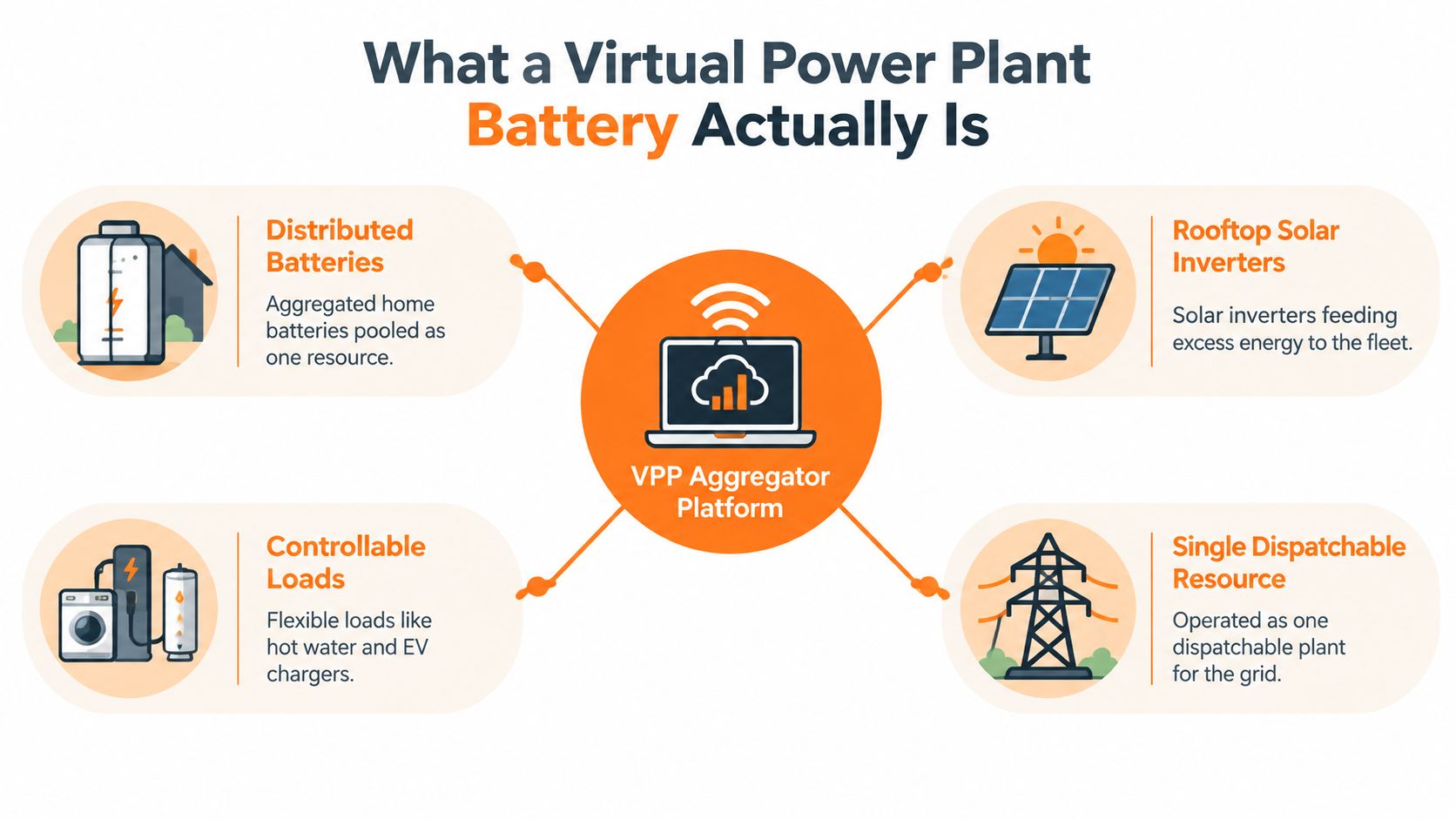
A Virtual Power Plant is a coordinated fleet of distributed energy assets. Those assets can include home batteries, rooftop solar inverters and controllable loads. Software groups them together so an operator can treat the combined fleet as a dispatchable resource in the National Electricity Market.
The battery isn't the VPP by itself. It becomes VPP-compatible when its inverter and communications system can receive authorised remote instructions, report relevant operating information and follow those instructions within safety and equipment limits. The operator may use a cloud connection or an application programming interface, but the homeowner should focus less on the technical label and more on what the connection permits.
Four capabilities to check
A VPP-ready system should support the following functions:
Remote charge and discharge. The operator needs to request a change in battery output without sending a technician to the property. The request should remain subject to equipment limits and a household safety override.
State-of-charge and power-flow reporting. The system needs to communicate its available energy and terminal power flow. Without that information, the operator can't reliably coordinate a distributed fleet or verify what each battery contributed.
Network security settings. Australian frameworks expect VPP-capable batteries to support features such as advanced ride-through settings. These features help the battery respond appropriately to disturbances rather than disconnecting unnecessarily from the network. The Solar Victoria virtual power plant pilot requirements outline the technical capability expected from participating systems.
A defined household reserve. The agreement should state how much energy remains available for the home, when that reserve applies and whether the homeowner can change it. Backup behaviour and VPP dispatch aren't the same thing, so the contract and app should make both clear.
A coordinated battery fleet can absorb surplus solar during the day, export during evening peaks and support system-security services. AEMO's Australian demonstrations focused on battery and photovoltaic resources because they had enough participation to test market and network services. Ausgrid's trial began with 237 customers, while Western Australia's Project Symphony was designed around roughly 900 distributed energy resources across 500 homes and businesses, according to the Ausgrid battery VPP progress report.
A homeowner may encounter a fully managed VPP, a BYOB VPP, or a retailer-controlled programme. In a Bring Your Own Battery arrangement, you retain ownership of the equipment and authorise an operator to coordinate it under agreed conditions. The High Flow Energy VPP information page is one example of how a retailer-based model can be presented to existing solar and battery owners.
How Your Battery Earns a Bill-Free Allowance
A bill allowance changes the way the battery's value appears on your account. Instead of treating every discharge as a small cash payment for exported energy, the VPP operator can combine availability, dispatch and grid-service value into a credit applied to electricity charges.
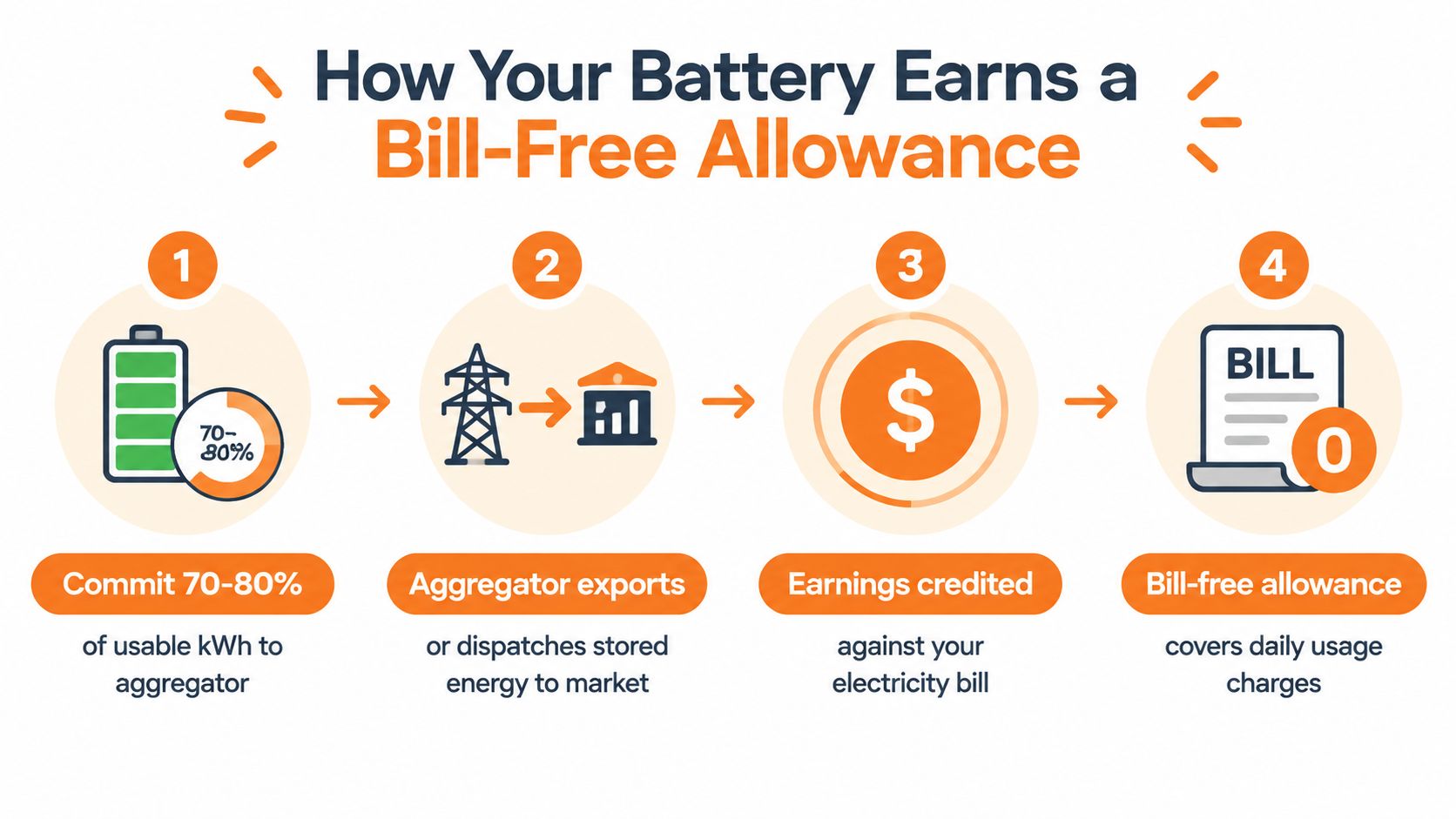
The practical sequence looks like this:
You make an agreed share of usable capacity available. The commitment might be expressed as a capacity amount or a proportion of the battery. The precise figure must come from the provider's contract, not a generic VPP explanation.
The operator schedules the fleet. Software considers household demand, solar forecasts, network conditions and market opportunities. It may charge from available solar or discharge stored energy when coordinated output has greater system value.
The operator settles the value. Revenue or an allowance is then reflected on the electricity bill. In a retailer-based structure, that may cover supply charges and eligible usage up to the agreed allowance rather than arriving as a separate cash transfer.
The household retains priority use. A workable programme must define a reserve and prevent grid dispatch from taking energy needed for ordinary household operation or backup requirements.
This isn't a promise that the battery will discharge continuously. A market optimiser should call on the fleet selectively, because unnecessary cycling can reduce the value of each dispatch and increase equipment wear. The battery may support peak shaving, demand response or FCAS-type services, depending on the operator's permissions, market access and technical setup.
The Australian market is still developing. ACCC-linked reporting placed VPP-connected customers at about 38,200 in the mainland NEM states. VPP-controlled electricity rose by more than 75% over the two years to 2023-24, but still totalled only 138 MW in that year. Average dispatched energy remained around 16 kWh per VPP customer per year, as reported by the Energy Council's summary of the ACCC report. Those figures suggest that participation and coordination can expand substantially, but they don't support the idea that every enrolled battery is being heavily cycled.
A bill credit also needs careful reading. Check whether the allowance covers usage only, daily supply charges, network charges, or a combination. Confirm what happens when your household uses more than the allowance, whether unused value rolls over, and how the operator calculates settlement.
The High Flow Energy utilities bill example provides a useful format for examining how an allowance can appear on an account. The important comparison is always your current bill against the proposed bill under the VPP, not a headline claim about what a battery could earn in a different tariff or market.
Feed-In Tariff Versus VPP Allowance in Real Numbers
A feed-in tariff pays for exported energy. A VPP allowance can pay for access to the battery's flexibility and for the operator's ability to coordinate it. These are different revenue paths, so comparing them requires more than multiplying battery capacity by a tariff.
A household that exports surplus solar may receive a modest per-kilowatt-hour payment. By contrast, a VPP may apply a recurring bill credit based on the battery's availability, dispatch and the terms of the retail plan. The household must then consider what it gives up, including some direct control over dispatch and possibly some opportunities to maximise behind-the-meter self-consumption.
The ACCC's June 2026 report found median annual bill savings of about $329 to $909 for solar-plus-battery households and $762 to $1,093 for battery-plus-VPP customers. The same report highlighted consumer risks, billing complexity and the need for stronger protections in the ACCC National Electricity Market report.
| Metric | Standard FiT Path | VPP Allowance Path |
|---|---|---|
| Primary value source | Export payment for surplus solar | Bill credit for coordinated battery availability and dispatch |
| Household control | Battery follows the owner's settings | Operator dispatches within agreed rules |
| Evening energy | Usually reserved for household use | Household reserve remains subject to the programme |
| Main trade-off | Lower value for surplus exports may remain | Less direct control and more complex billing |
| Key comparison | Export revenue plus avoided imports | Bill credit plus avoided imports, less any foregone self-consumption value |
A worked example should use your own interval data. For a 10 kWh battery, the relevant questions are how often it reaches full charge, how much energy it exports, how much energy remains at the evening peak, and how often the VPP can dispatch without forcing the household to import later. The available evidence doesn't provide enough information to calculate a universal annual kWh trade-off or a standard allowance for every 10 kWh system.
Battery degradation complicates the comparison. A VPP may create value through selective dispatch, but a homeowner shouldn't assume that every extra cycle is profitable. The provider should explain dispatch limits, warranty treatment and how it protects the battery from operating outside its approved conditions. For a practical comparison of retail structures, review energy tariff comparisons alongside your own bill and battery data.
Control, Wear and the Questions Homeowners Actually Ask
The central consumer question is simple: who decides when the battery moves energy? In a VPP, the aggregator or retailer normally sends the dispatch instruction within the authority granted by your agreement. You don't manually approve each event, although a well-designed service should provide reserve settings, override functions or clearly defined limits.
That trade-off is the price of coordination. You exchange some moment-to-moment autonomy for the possibility of a more predictable bill credit or a share of grid-service value. The choice is reasonable only when the provider states the limits in plain language.
Battery wear is a contract issue
Additional cycling can affect battery ageing, but the impact depends on depth of discharge, temperature, charging limits, chemistry and the equipment warranty. A provider shouldn't describe all cycling as harmless, and a homeowner shouldn't assume that one extra dispatch has the same effect as a full daily cycle.
Ask for the operating envelope in writing:
- Dispatch depth: How far may the system discharge during an event?
- Frequency: What limits apply to event calls and total throughput?
- Warranty alignment: Does the programme remain within the battery manufacturer's permitted operating conditions?
- Performance treatment: Are there penalties if the battery doesn't respond because of an outage, connectivity issue or household override?
Australian VPP frameworks expect systems to report state of charge and terminal power flow, while supporting network security functions. Those technical requirements matter because they make dispatch measurable and help the operator distinguish a deliberate household reserve from unavailable equipment.
Backup power needs separate rules
A VPP agreement doesn't automatically tell you what happens during a blackout. Some systems isolate from the grid and prioritise backup circuits. Others may suspend VPP participation during an outage, while the exact behaviour depends on the inverter, gateway, islanding configuration and network approval.
Before joining, confirm whether the battery will:
- stop external dispatch when the grid fails;
- preserve a stated reserve for backup;
- power the whole house or only selected circuits;
- resume VPP operation automatically after grid restoration; and
- allow you to change the reserve before a forecast demand event.
The consumer trade-off is therefore not “control or no control”. It's a set of control rights, reserve rules, opt-out terms and outage procedures. A provider that can't explain those items clearly hasn't given you enough information to assess the offer.
Eligibility and Onboarding for Queensland and NSW Owners
Onboarding starts with the hardware, but it shouldn't end there. A Queensland or New South Wales homeowner needs to confirm that the battery, inverter, communications link and network connection can work together under the proposed programme.
Start with the inverter and connection
Ask the operator to confirm compatibility for the installed equipment. Common brands seen on Australian compatibility lists can include Tesla Powerwall 2 and 3, Enphase IQ, Fronius, GoodWe, Sungrow and Selectronics, but an individual model, firmware version or installation configuration may still be excluded.
The operator or installer should then verify:
- the inverter firmware is current;
- the battery has a stable internet connection;
- the smart meter is operating correctly;
- the rooftop solar connection remains registered with the original distribution network service provider; and
- the system's export and protection settings meet the applicable requirements.
For Queensland, that may involve Energex or Ergon. In New South Wales, the relevant DNSP may be Ausgrid, Endeavour or Essential. Network export constraints can affect how much energy the VPP can dispatch, even when the battery has stored capacity.
Treat incentives as separate eligibility questions
State incentives don't automatically combine with VPP participation. In New South Wales, the VPP incentive applies to eligible batteries with more than 2 kWh and up to 50 kWh of storage, but the upfront calculation only uses capacity made available to the grid up to 28 kWh, according to the NSW Government VPP incentive rules.
The Clean Energy Regulator also limits small-scale technology certificates for solar batteries to the first 50 kWh of usable capacity. Its certificate factor is 100% for 0 to 14 kWh and 60% above 14 kWh up to 28 kWh, and the connected inverter must be VPP-capable, as set out in the CER solar battery requirements.
Queensland owners should check the current terms of any Battery Booster or related state programme. Don't assume an interest-free loan, rebate or certificate can be stacked with a VPP allowance without confirming the scheme rules.
The final stage should include gateway pairing, account enrolment, allowance confirmation and a first settlement review. Compare the operator's dispatch records with your inverter data and electricity bill. Early discrepancies are easier to resolve before they become a recurring billing problem.
Key Takeaways for Battery Owners Considering a VPP
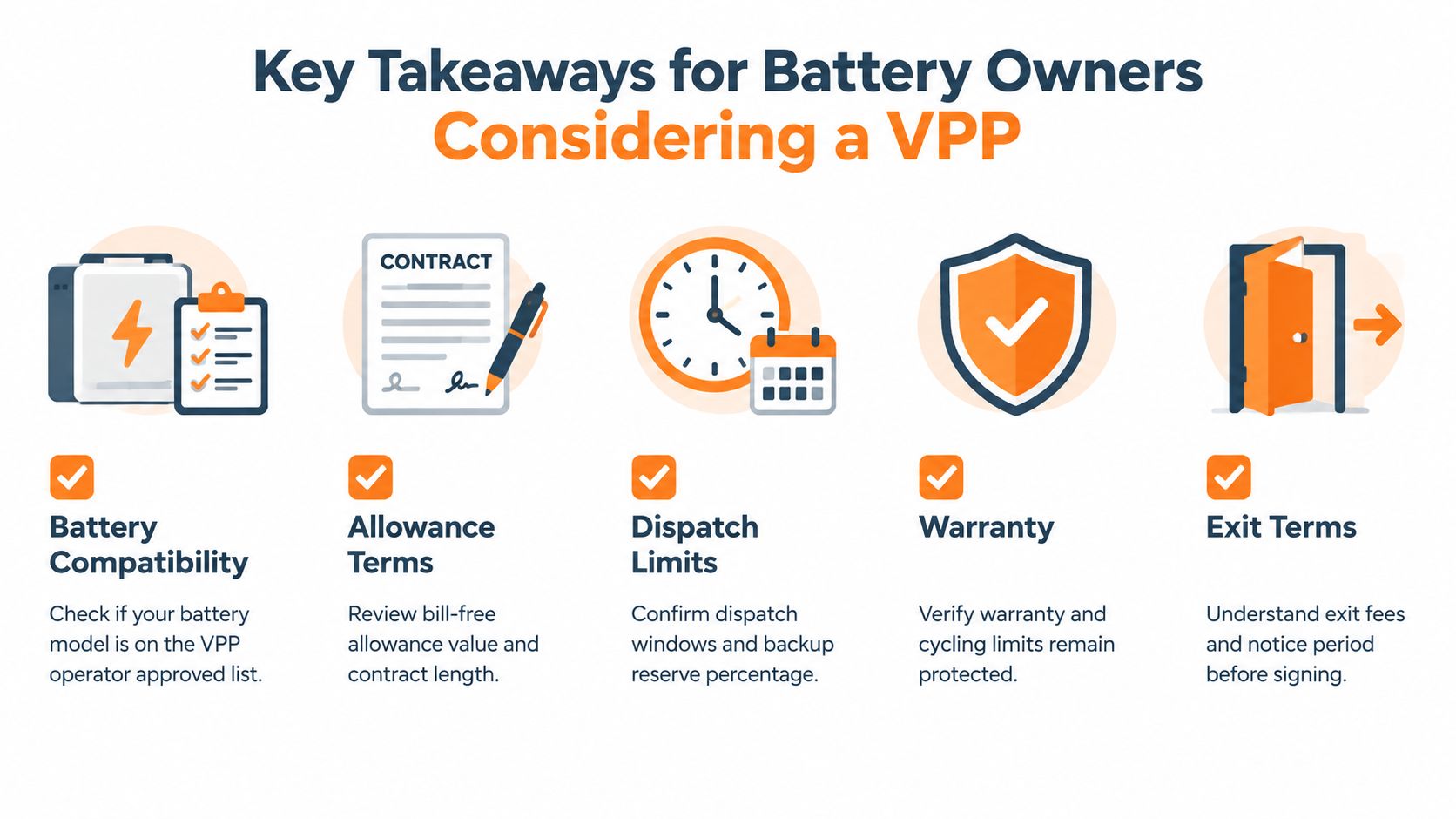
A VPP decision should begin with questions, not a payout figure. Put these five questions to the provider before you authorise remote control.
Is my exact battery and inverter model compatible? A brand name isn't enough. Ask whether the model, firmware and network configuration support remote dispatch, state-of-charge reporting and required protection settings.
How does the allowance compare with my current battery value? Use your own bill, feed-in tariff and export history. Australian evidence shows higher median annual bill savings for battery-plus-VPP customers than for solar-plus-battery households, but the outcome depends on load profile, tariff and dispatch conditions, as reported in the earlier ACCC evidence.
What reserve remains for my household? Ask for the reserve in kilowatt-hours, not only a percentage. Confirm whether you can change it before an expected outage or demand event.
What are the exit terms? Check whether the agreement is month-to-month, whether an exit fee applies, what notice is required and whether a performance penalty can apply after an equipment or communications fault.
What happens when the grid goes down? Find out whether the battery disconnects from VPP dispatch, which circuits receive backup power and when normal optimisation resumes.
Queensland and New South Wales owners also need to separate the allowance from state incentives. The NSW capacity cap and certificate rules affect the value of eligible systems, while Queensland scheme terms may differ. Your net outcome depends on the combination of retail charges, battery behaviour, state support and contract conditions.
The practical choice is between predictable bill credit and maximum behind-the-meter autonomy. Neither approach is automatically superior. A VPP makes more sense when its allowance, reserve rules and dispatch limits match the way your household already uses energy.
Frequently Asked Questions About VPP Batteries
Who controls my battery during a VPP event?
The VPP operator sends dispatch instructions within the permissions and limits in your agreement. You should retain access to household reserve and any stated override controls. Ask how the provider handles manual overrides, connectivity failures and competing household needs.
How often can the operator call on stored energy?
There isn't one universal event schedule. Dispatch depends on market conditions, network requirements, battery availability and the programme's operating limits. The Australian evidence cited earlier shows average dispatched energy per VPP customer remained modest, but individual results vary.
What savings can a VPP battery provide?
Public Australian reporting gives median annual bill savings of $762 to $1,093 for battery-plus-VPP customers, compared with $329 to $909 for solar-plus-battery households, according to the ACCC report linked above. These are bill-savings figures, not a guaranteed cash payment or universal allowance.
Will I be locked into a Queensland or NSW VPP contract?
Contract terms vary. Review lock-in periods, exit fees, notice requirements, opt-out rights and performance conditions before signing. Don't rely on a general claim that all VPP programmes are flexible.
What happens during a blackout?
Many VPP systems stop grid dispatch when the network fails, but backup behaviour depends on the inverter, gateway, islanding configuration and reserve setting. Confirm whether backup serves the whole home or selected circuits and whether the reserve can be adjusted.
High Flow Energy helps eligible Queensland and New South Wales homeowners connect an existing solar and compatible battery system to a Bring Your Own Battery Virtual Power Plant, with coordinated dispatch, household-priority settings and bill allowance tracking. Visit HighFlow Energy to check eligibility and assess whether your battery is being underused financially.