

Peak Demand Reduction Scheme for Battery Owners
The NSW Peak Demand Reduction Scheme is not a niche rebate. It is a long-running market mechanism that the NSW Government says could help households and businesses save around A$1.2 billion on electricity bills between 2022 and 2040, while its statutory target rises from 0.5% peak demand reduction in 2022/23 to 10% in 2029/30 (NSW Energy Security Safeguard). For battery owners, that matters because the scheme turns short bursts of coordinated discharge into certified value, and it does so during the summer hours when the grid is most exposed.
That makes this policy far more relevant than a standard feed-in tariff discussion. If you already own a compatible battery, the key question is whether it's sitting idle during the exact window NSW is paying to reduce demand, or whether it's being coordinated through a VPP so it can earn value when the system is under stress.
Why Peak Demand Reduction Matters for Australian Battery Owners
The scheme's design shows its purpose clearly. It began in the summer of 2022–23 and is scheduled to run until 2050, which makes it a structural policy rather than a short trial. NSW also says it aims to save around A$1.2 billion on electricity bills over the period from 2022 to 2040 (NSW Energy Security Safeguard). For battery owners, the practical point is that short, controlled discharge events can be turned into certificate-backed value when they line up with system stress.
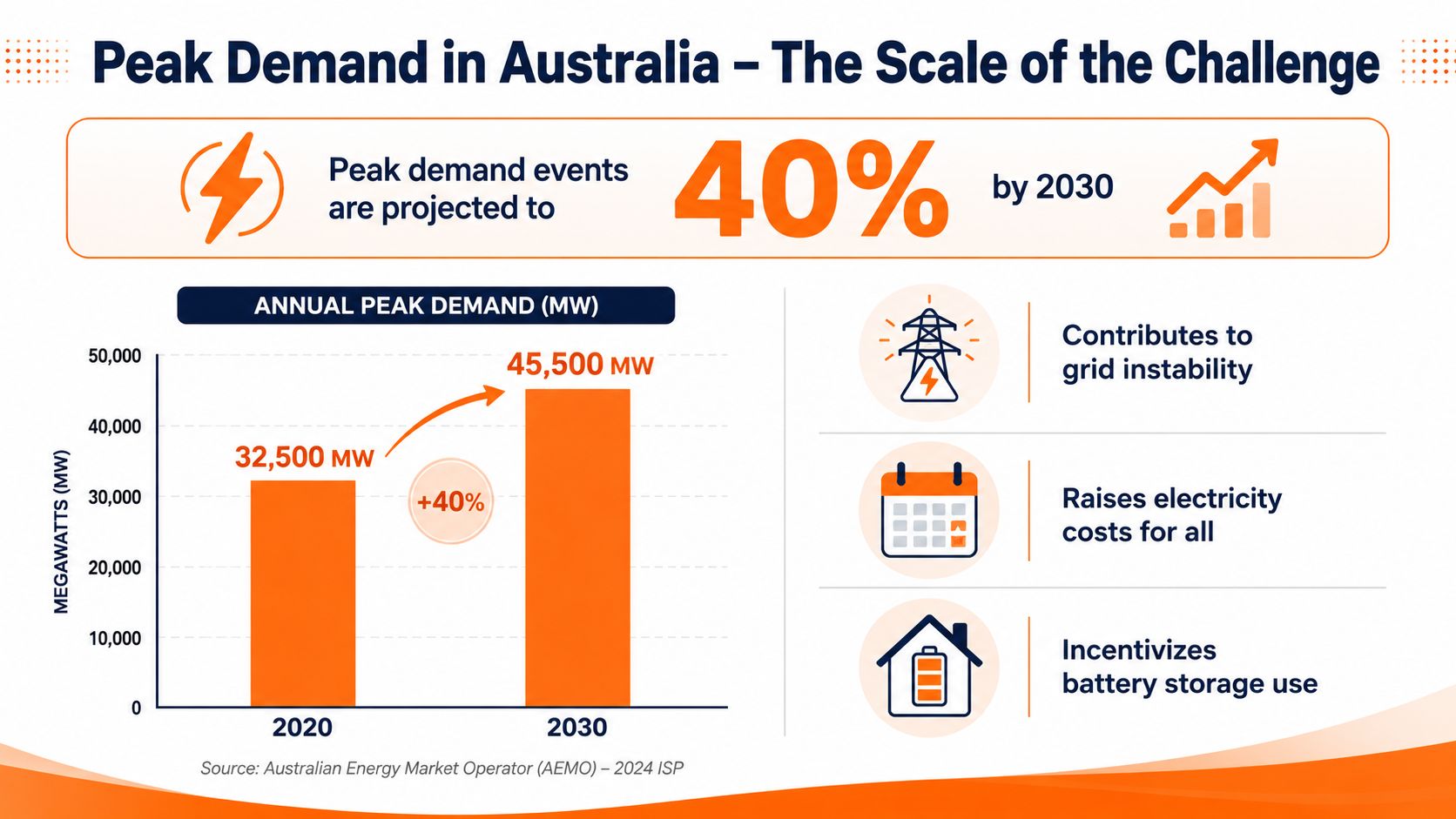
The timing matters just as much as the policy design. The scheme focuses on 2:30 pm to 8:30 pm AEST from 1 November to 31 March, which lines up with the summer peak period in NSW. That is the part of the day when air conditioning, cooking, and evening household use overlap. A battery that can discharge in that window is doing the exact job the scheme is designed to reward.
There is also a network cost angle that many homeowners miss. Peak demand drives congestion, and congestion feeds through into the charges that sit inside retail bills. A clearer explanation of those charges is available in this overview of electricity network charges, and that is why a battery coordinated through a VPP can matter even when the household itself is already using solar well.
The future of the grid becomes more decentralised as more homes add storage, rooftop solar, and flexible load. For a useful industry perspective on that shift, Blocsys Technologies has a discussion of why future of energy is decentralized, which helps explain why coordinated home assets are becoming more commercially relevant. A battery serving only one home can still lower that home's imports. A battery being coordinated during peak demand can also create scheme value for the retailer or aggregator through verified demand reduction.
Practical rule: if your battery is never being considered for peak event dispatch, you are probably leaving scheme value on the table.
For homeowners, the scheme should be judged on three things, the window it targets, the certificate it creates, and the fact that it rewards actual load reduction rather than abstract participation. Understanding how the scheme operates reveals why timing and measurement matter more than ownership alone.
How the Peak Demand Reduction Scheme Operates
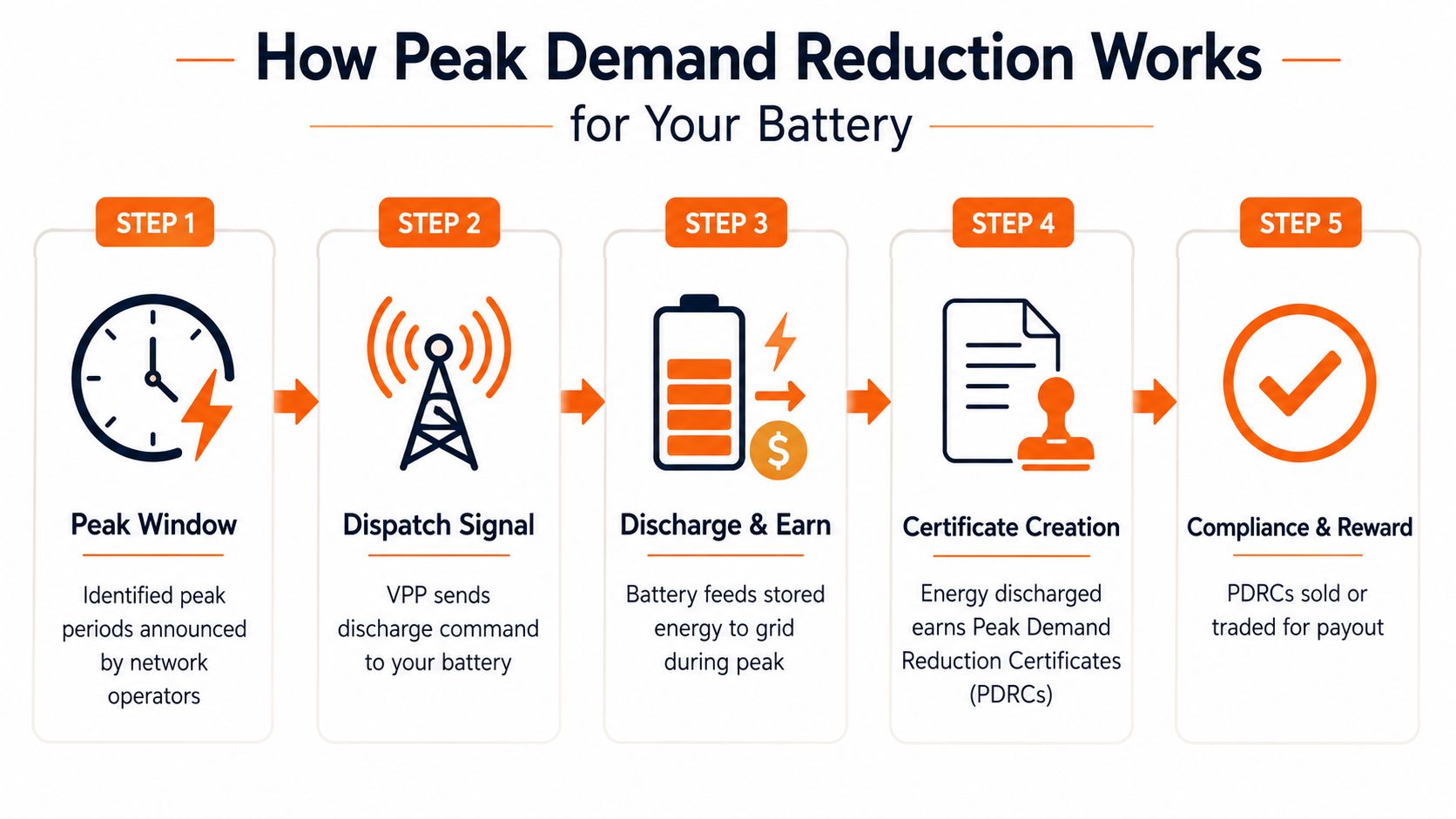
NSW's peak demand rules turn a technical dispatch event into certificate value. The peak demand period runs from 2:30 pm to 8:30 pm AEST from 1 November to 31 March, and PRCs are created when demand is reduced inside that window (NSW final statutory review report). For a battery owner, that means the scheme only has financial value when the battery is reducing load during the defined peak period.
The event window comes first
Timing is the first filter. A battery can still improve a home's self-consumption profile outside the peak window, but that output does not necessarily create PDRS value. The scheme is built around verified reduction during a specific afternoon and evening period, so dispatch control and event timing carry more financial weight than broad household load shifting.
The reduction has to be measurable
The NSW rule framework ties certificate creation to measured demand-response performance. It uses a peak-demand savings capacity formula that draws on baseline input power, peak adjustment factors, and a firmness factor, then calculates certificate volume using peak-demand reduction capacity, network loss factor, and a 10x conversion factor (PDRS Draft Rules). That structure matters because the scheme rewards audited performance, not a general statement that a battery was available. The baseline and forecast step also matters, because measured performance depends on how the starting load is defined. A useful explanation of that baseline logic is available in this overview of demand forecasting.
Certificates follow verified output
The result is a certificate market, not a direct grant. A verified reduction in peak demand is converted into tradable certificate value, so the homeowner's financial outcome depends on how precisely the battery can be controlled and how reliably the reduction can be measured in the relevant window.
A practical way to read the scheme is as a chain, baseline, dispatch, measured reduction, certificates, and settlement. Each link affects the next one. If the baseline is weak, the event is short, or the control is sloppy, value leakage follows.
The first year of the scheme shows that this is already operating at scale rather than theory. In the 2022–23 compliance period, accredited certificate participants created 3.49 million PRCs out of 3.91 million PRCs reported for the period, and 3.8 million PRCs were surrendered against a 3.9 million PRC target (NSW Energy Security Safeguard annual report). That near-full surrender outcome points to a functioning compliance market behind the policy.
What Certificate Creation Means for Your Battery Economics
Certificate creation turns the policy into a cash flow question. Homeowners typically evaluate batteries by capacity and cost, but certificate value depends on baseline accuracy and dispatch precision. A verified 0.2 kW reduction sustained across the 6-hour peak period can generate 12 certificates under the scheme's 0.1 kWh-per-PRC convention. The lesson is straightforward, small reductions become financially relevant when they are sustained, verified, and counted inside the right window.
Precision is worth money
Battery economics under PDRS are shaped by more than storage size. They depend on how accurately the system can hold a discharge profile, how long it stays in the event, and whether the underlying baseline is auditable. A battery that drifts, drops out early, or misses the window can lose certificate creation potential even if it still helps the home.
Event persistence changes the outcome
A generic time-of-use strategy, such as shifting consumption from late afternoon to evening, can improve a bill. PDRS rewards demand reduction during a narrow period, so the battery earns more value when it is set up for persistence through that window rather than for broad household smoothing.
Baselines are the hidden variable
The baseline is the reference point that turns battery behaviour into measurable value. If the load profile before the event is unclear, the measured reduction can be harder to prove. If the reduction is easy to audit, the financial case strengthens.
Analyst's rule: certificate value follows measured performance, not battery ownership alone.
That is why structured VPP participation matters. A battery connected to a coordinated program can be dispatched according to event signals, monitored through the app, and evaluated against the same performance logic the scheme uses. The owner sees a clearer line between system behaviour and financial outcome.
One useful way to frame this is as layered value. There is the direct household benefit from charging and discharging at the right time, and there is the scheme value that comes from verified peak reduction. A well-run program can capture both, but only if the battery is controlled to suit the event.
For a closer look at how a battery can participate in multiple revenue streams, the key point is simple. A scheme like this creates extra value when the battery is used as a measurable grid resource rather than a static backup asset.
Traditional Feed-In Tariffs Versus VPP-Enabled Demand Reduction
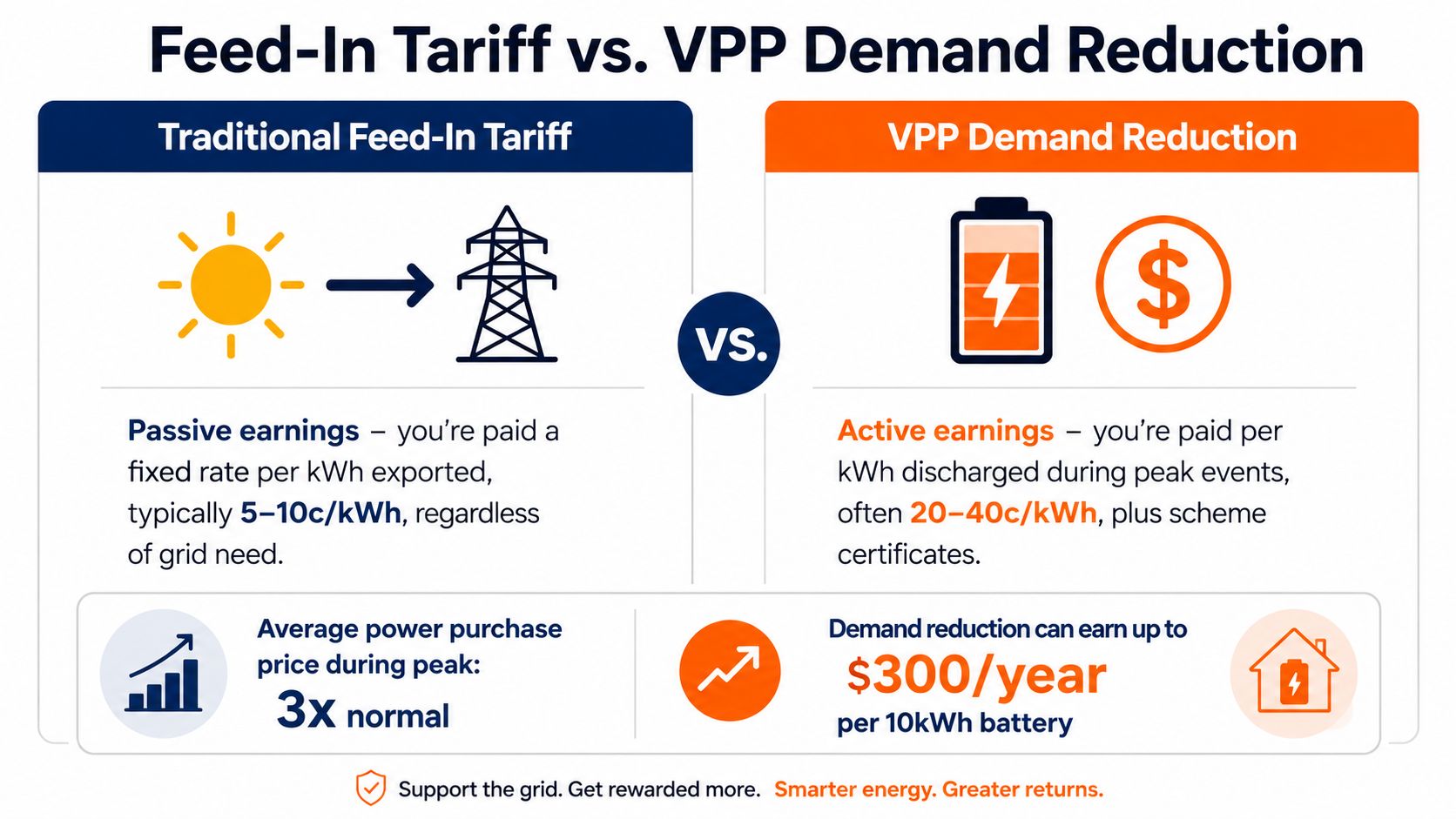
Feed-in tariffs and PDRS participation solve different problems. A feed-in tariff credits exported energy, which can still be useful when your battery is already full or when export timing lines up with household economics. PDRS, by contrast, values the battery for reducing demand during a defined peak window, which means the asset is being paid for when the grid most needs help.
What passive export does well
Traditional feed-in arrangements are simple. The battery exports energy, the retailer credits the export, and the household receives a bill offset. That works best when the household wants predictable, low-friction value from solar surplus.
What VPP demand reduction does differently
A VPP-enabled battery can be coordinated to discharge during peak periods, which creates value from the act of reducing demand at the right time. In NSW, that timing lines up with the PDRS peak window, so the economics are tied to grid need rather than only to export volume.
The contrast matters because retailers do not all optimise battery value in the same way. Some arrangements leave the battery behaving like a passive export device. Others use the asset as a flexible grid resource, which is where PDRS-aligned value can emerge.
A simple comparison
| Feature | Traditional feed-in tariff | VPP-enabled demand reduction |
|---|---|---|
| Primary value source | Exported energy | Verified peak demand reduction |
| Timing sensitivity | Moderate | High |
| Grid benefit | Indirect | Direct |
| Battery control | Usually passive | Actively coordinated |
| Scheme alignment | Limited | Strong |
That table is the divide. Feed-in tariffs are about energy leaving the home. Demand reduction is about preventing load from hitting the grid when it is already stressed.
The two aren't mutually exclusive. A battery can still support household self-consumption and export value while also participating in a coordinated dispatch program. But if the goal is to access the PDRS value stream, passive export alone won't get you there.
For homeowners comparing options, the question is not whether feed-in tariffs still matter. They do. The question is whether the battery is being used in a way that captures the additional value of its flexibility during the state's peak window. That is where VPP participation becomes financially relevant.
Practical Steps to Participate in Peak Demand Reduction
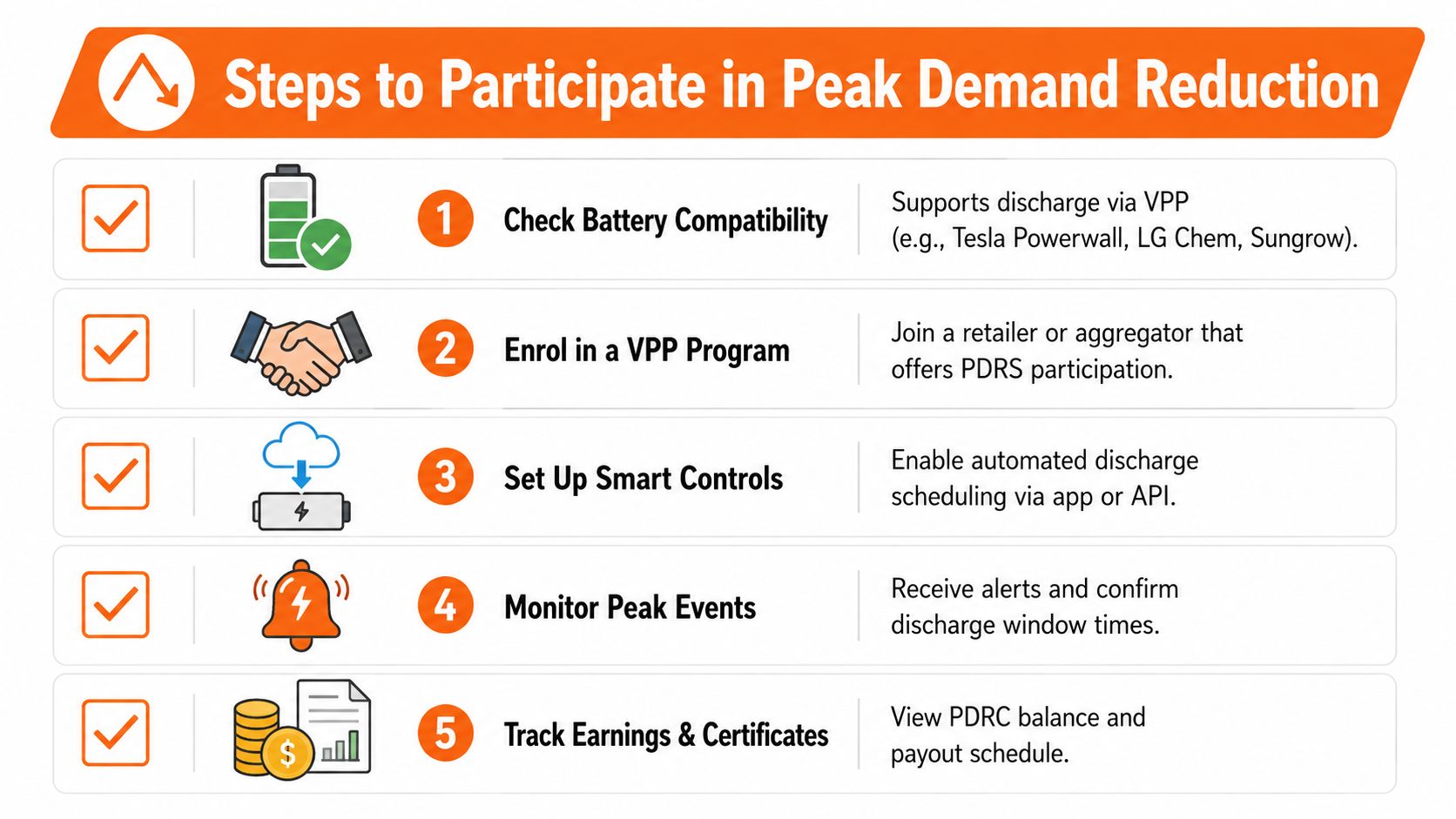
Participation starts with compatibility, not marketing. The battery has to be able to respond to dispatch signals, the retailer or aggregator has to be authorised to coordinate it, and the household has to be comfortable with how the control settings work. If those pieces aren't aligned, the scheme value can't be captured cleanly.
Start with battery and retailer fit
The first step is checking whether the battery can participate through a VPP program that is designed around PDRS-style dispatch. That means looking for an authorised retailer or aggregator with transparent control settings and clear event logic.
Practical check: if you can't see when the battery may be dispatched, you can't judge whether the value exchange is fair.
Understand how the controls work
Once enrolled, the battery is typically managed through smart controls that respond to event conditions. That can involve automated discharge scheduling through an app or API, with household needs still taking priority. The point isn't to hand over your battery blindly, it's to let the system coordinate spare capacity when it's useful.
Track the operational details
Good programs make the dispatch history visible. That means you can see peak events, battery response, and the earnings or certificate outcomes linked to those actions. Visibility matters because it lets you compare expected behaviour with actual performance.
A few practical considerations are worth keeping in view:
- Warranty terms matter: battery operation should stay inside manufacturer expectations, because the economic upside is meaningless if the battery is being stressed outside acceptable use.
- Lock-in risk should be clear: households should understand whether they can exit, and what happens to the control arrangement if they do.
- Priority access should stay with you: the home's needs should come first, then the VPP dispatch logic uses spare capacity.
For NSW and Queensland battery owners comparing program structures, one option is a retailer-led VPP that coordinates the battery while leaving ownership in the home. High Flow Energy is one example of that model, since it coordinates compatible batteries through a VPP and uses spare capacity for grid support, while the household retains priority use of the battery.
The best programs make the value proposition legible. If the app shows the dispatch events, the allowance, and the settlement logic clearly, you're in a much better position to judge whether the battery is working hard enough for its owner.
Real-World Savings and Grid Impact Examples
A useful way to assess the scheme is through the summer peak, when electricity demand is most likely to stress the network. A household battery in NSW or Queensland may discharge through the evening peak to lower grid pressure, and if that discharge is verified through a program, the same action can create scheme value for the battery owner. The household sees lower peak imports, while the network sees less load at the exact time it matters most.
In a practical NSW scenario, the battery charges during the day and the VPP coordinates discharge across the peak window when demand is highest. The household still uses stored energy at the right time, but the grid also benefits from a controlled reduction in demand. That is where the economics become more interesting. The same physical discharge can reduce the household bill and support a revenue stream tied to measured demand reduction.
The wider grid effect is clearer when you look at the timing of peak events. The NSW statutory review reports that across electricity-demand data from 1 July 2022 to 30 June 2024, 6 of the top 10 and 10 of the top 20 daily peak electricity-demand intervals occurred in summer (NSW final statutory review report). That pattern matters because it shows where batteries have the most commercial value. Dispatch that lines up with summer peaks is more likely to coincide with the intervals the grid is actively trying to flatten.
For battery owners, the financial implication is direct. A VPP that can target those peak periods is not just moving energy around. It is converting controlled discharge into measurable system value, and that value can be shared with the household through bill savings, credits, or other settlement arrangements depending on the program design. The better the event timing, the more likely the battery is to earn its keep without changing how the home is powered the rest of the day.
The homeowner takeaway is straightforward. If your battery can shave load during the summer peak, it can support both the household bill and the broader network. If it is not coordinated, you may still get self-consumption benefits, but you miss the scheme-driven layer of value that comes from verified peak reduction.
Common Misconceptions About Demand Response and Battery Participation
The first misconception is that demand response is only for large commercial sites. The NSW scheme's certificate structure shows the opposite. It is built around activities that reduce peak demand, and residential batteries can participate through verified, distributed behaviour during the relevant window.
The second misconception is that joining a VPP means losing control of your battery. In practice, serious programs prioritise household needs first and only coordinate spare capacity. That distinction matters because a battery can still protect the home while contributing to grid support.
Battery wear is the wrong fear if the program is controlled properly
Cycling does matter, but so does the quality of the dispatch strategy. If a battery is being used within manufacturer expectations and only when the event creates genuine value, the trade-off is not the same as uncontrolled cycling. The point is to match dispatch frequency and depth to the economics of the scheme.
Not all VPPs are structurally equivalent
Some programs focus on exports, some on bill credits, and some on direct grid support. The difference is not cosmetic. It changes who controls the battery, how the revenue is created, and whether the scheme value is captured by the household.
The last misconception is that the financial outcome is automatic. It isn't. A battery only creates scheme value when the control, timing, baseline, and participation model line up. That's why transparent retailers and aggregators matter more than simple headline promises.
The cleanest way to judge a program is to ask three questions, when does it dispatch, how is value shared, and can the household still use the battery normally when needed. If those answers are vague, the program probably isn't optimising the asset properly.
Key Takeaways and Next Steps for Battery Owners
The main takeaway for NSW battery owners is practical, not abstract. The Peak Demand Reduction Scheme creates value when a battery can be controlled in a way that supports the grid during peak periods and still protects household needs. For owners, the financial question is whether that control path is available in their setup.
What matters most is the certificate mechanism behind the scheme. A battery only contributes to scheme value if it can be dispatched, measured, and credited through a participation model that lines up with the rules. That means the installer, retailer, or aggregator arrangement is not a side issue, it is the part that determines whether the battery earns ongoing value or just sits as backup storage.
The next step is to test three points in the current setup, compatibility, dispatch visibility, and value-sharing structure. Compatibility determines whether the battery can participate at all. Dispatch visibility shows whether the household can see when and why the battery is being used. Value-sharing structure shows who captures the certificate value and how much flows back to the owner.
Battery owners should also assess whether their current setup can capture certificate value during the upcoming summer peak window. That is the period when coordinated storage has the clearest chance to matter financially, because peak events are most likely to align with higher system stress and stronger incentive value. If the battery cannot participate during those events, the scheme's economics are weaker even if the system itself is well installed.
The cleanest commercial comparison is between a battery that stores energy and a battery that is actively coordinated through a VPP or similar arrangement. The first can still help with backup and self-consumption. The second can turn flexibility into measurable scheme value, provided the control settings, baseline assumptions, and revenue split are transparent.
Most battery owners focus on installation quality. Far fewer look closely at how the asset performs after commissioning. High Flow Energy is an electricity retailer built around realising the value of your existing solar and battery system through coordinated VPP participation, with transparent operation and household priority use.
If you want to know whether your battery is underperforming financially, visit HighFlow Energy and request an eligibility assessment for your setup.