

Electricity Price Forecasting Explained for Home Batteries
A battery can be full at midday, nearly empty after dinner, and still fail to reduce the most expensive part of a household's electricity use. A quiet Tuesday may offer little value for export, then a sharp market event can arrive around the evening peak while the battery remains reserved for a setting that never responds to the signal.
That gap is where electricity price forecasting matters. Forecasting connects long-term changes in the National Electricity Market, short-term wholesale price movements and automatic battery dispatch. For a household in New South Wales or Queensland, it turns a battery from a passive storage device into an asset that can respond to changing conditions, while still protecting the home's own energy needs.
Why Electricity Price Forecasting Matters to Your Battery
At 4pm, a household may see solar production falling and household demand beginning to rise. Dinner preparation, heating or cooling, hot-water systems and electric appliances can all increase consumption at roughly the same time. If the battery is configured only to maximise self-consumption, it may start discharging immediately, leaving less stored energy for a later price event.
Suppose the market signal indicates that prices are likely to rise around 7pm. A battery without a forecasting layer may not know whether to preserve energy, charge from the grid, or discharge into the home. The owner sees only the eventual bill. The control system needs to make the decision before the price movement occurs.
Practical rule: A battery creates more value when its charge and discharge decisions reflect both household demand and expected market conditions.
This doesn't mean a homeowner should chase every movement in the spot market. Household comfort, backup reserves, battery operating limits, network export constraints and retail tariff rules all matter. The useful question is simpler: is the battery being dispatched at the times that matter financially?
A retailer-led Virtual Power Plant can combine household forecasts with market signals. It may preserve energy for the home first, then make spare capacity available for grid support when the expected value justifies participation. Homeowners can also use market information and notices from High Flow Energy's AEMO market notices resource to understand the events that can affect dispatch decisions.
The missing link for many owners is not hardware. It's coordination. Long-range outlooks explain how the market may change, short-term forecasts identify likely price conditions, and battery control converts those signals into action. That connection is the practical meaning of electricity price forecasting for a home battery.
What Electricity Price Forecasting Actually Means
Your battery is full on a sunny afternoon, but the evening price may change quickly. Should it keep that energy for household use, charge from the grid, or discharge earlier? The answer depends on the time horizon of the forecast and how the control system uses it.
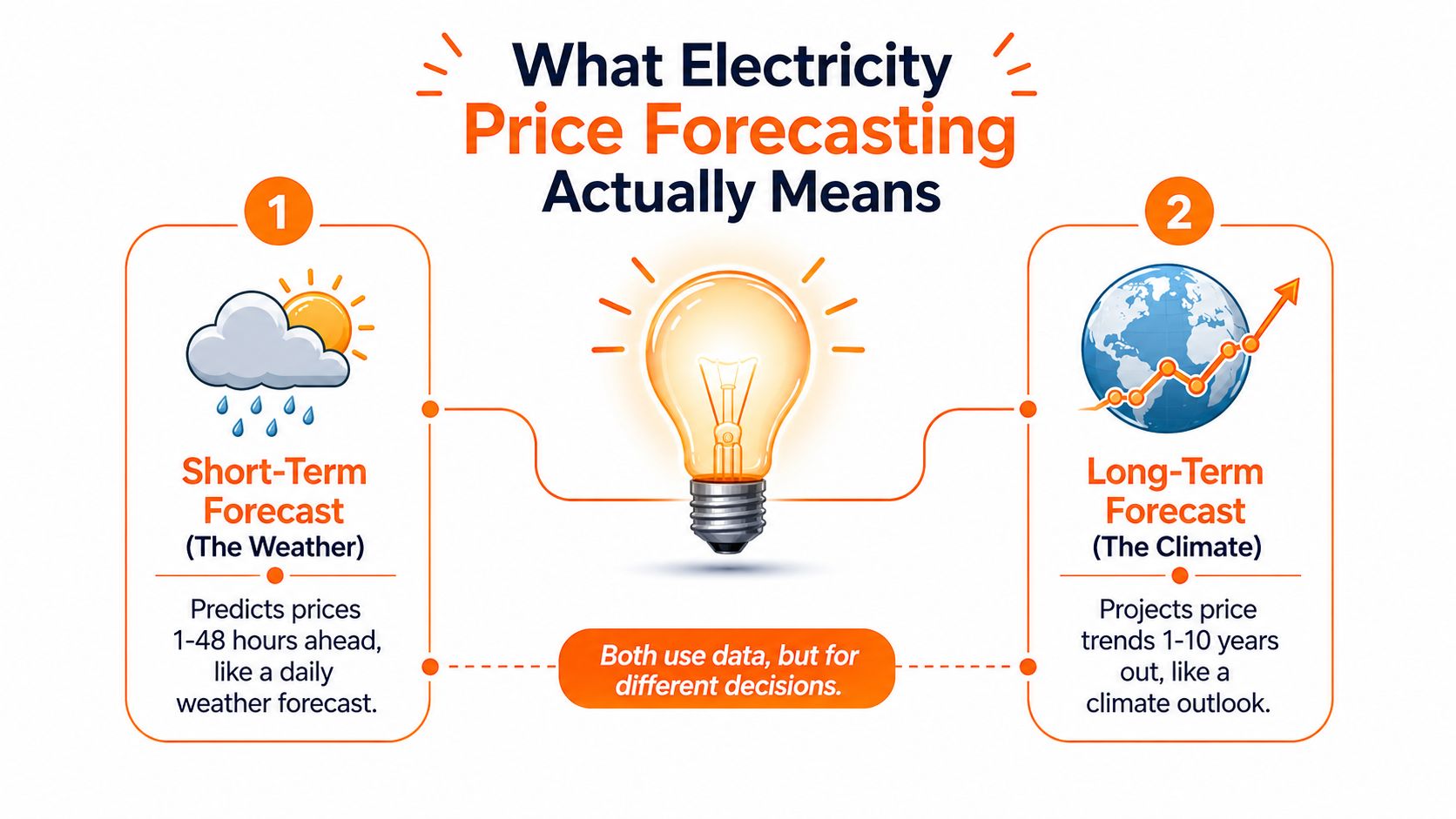
Electricity price forecasting estimates how market prices may behave over a defined period. A forecast covering the next few hours supports battery dispatch. A longer-range outlook supports decisions about retail prices, generation and investment.
Two comparisons clarify the difference:
- A short-term forecast works like a weather forecast. It helps decide what to do today, such as carrying an umbrella or leaving earlier.
- A long-term outlook works like a climate projection. It describes conditions that may develop over a longer period, without promising what will happen on a particular day.
The same distinction applies in the NEM. A short-term spot forecast can indicate whether a battery should preserve stored energy for an evening price event. A long-term outlook can help a homeowner consider future retail prices, coal retirement, renewable generation and the role of flexible assets.
Three forecasting layers
Long-term outlooks describe scenarios rather than guaranteed prices. The Australian Energy Market Commission's 2025 Residential Electricity Price Trends report provides a 10-year outlook using AEMO's Step Change scenario and publicly available data as at 30 September 2025. The AEMC says the report is not a price forecast, because risks, uncertainties and modelling limitations may change the result. The AEMC's 2025 residential electricity price trends report provides the full context.
Short-term forecasts support operations. AEMO-linked services publish 24-hour-ahead price forecasts every 5 minutes for the five NEM regions, NSW1, VIC1, SA1, QLD1 and TAS1, as described in AEMO's NEM data dashboard.
VPP forecasts connect market information with household control. An aggregator combines expected prices with solar production, household load, battery state of charge, operating limits and customer preferences. The result is an action, such as charge, hold, discharge or reserve, rather than just a price estimate.
A live traffic map offers a useful comparison. Current traffic conditions show what is happening now, while a planned road closure can influence the route chosen before congestion begins. Battery dispatch needs both views: real-time signals for immediate conditions and forward-looking forecasts for the next decision.
Key Drivers and Forecast Horizons in the NEM
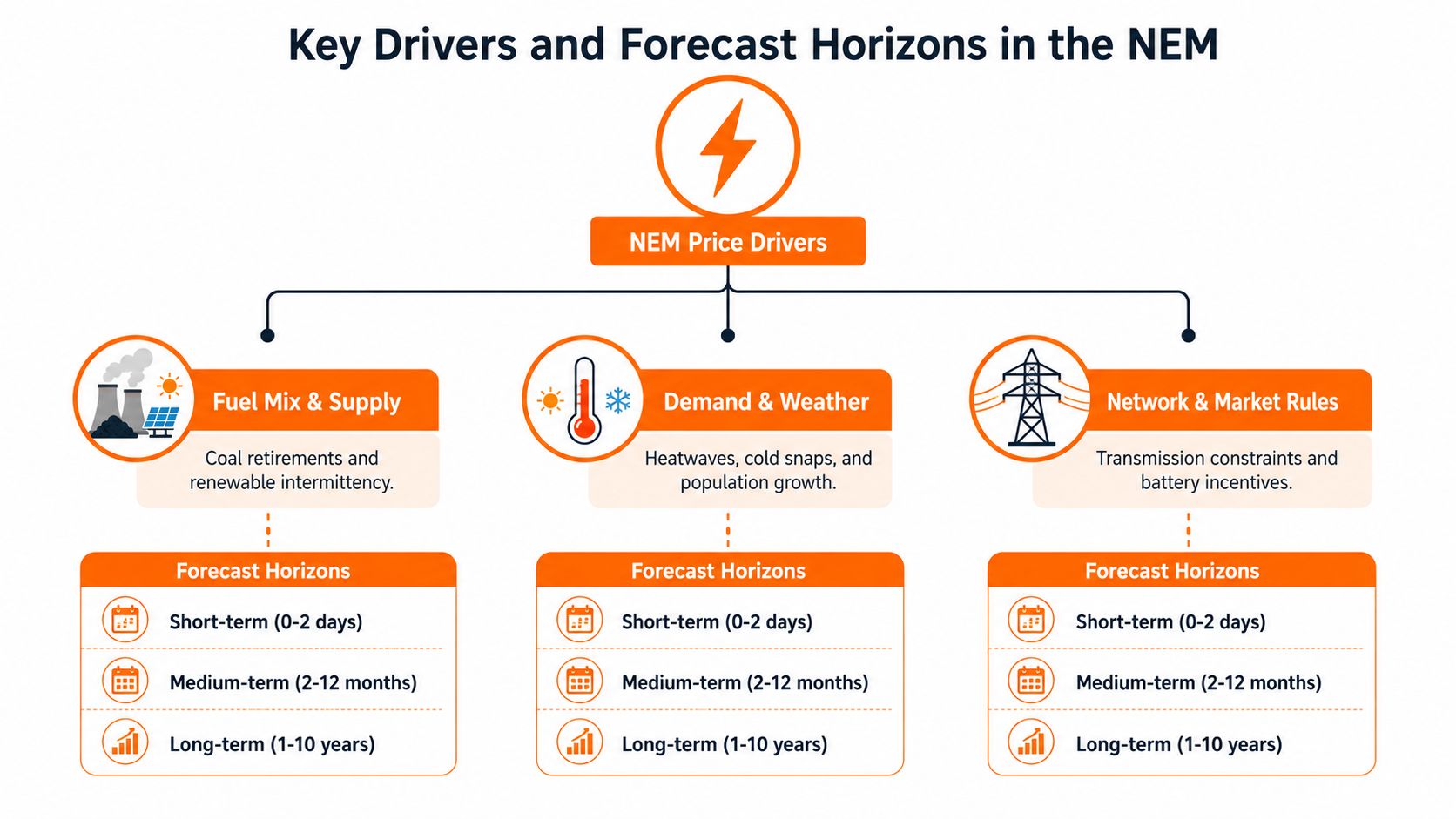
A battery owner in Queensland might see a low midday price, then face a sharp evening increase after clouds reduce solar output. The same battery may also be limited by a network constraint or a household export setting. NEM price forecasting connects these conditions with the next charge, hold or discharge decision.
Supply and fuel mix
Coal retirements, renewable generation and battery availability shape both the amount of energy available and the system's flexibility. Rooftop solar can reduce grid demand around midday. Cloud cover, declining solar production and generator outages can change that balance later. AEMO's electricity and gas forecasts, reports and data bring together information used to examine these conditions.
A battery therefore needs more than a price history. It needs an estimate of whether supply will remain comfortable or become tight during the periods when discharge could earn more value.
Demand and weather
Heatwaves can increase cooling demand, while cold conditions can increase heating demand. Household consumption, commercial activity and industrial use may shift at the same time. Weather forecasts feed both short-term price estimates and longer-range planning.
This also explains why electricity demand forecasting matters to a household battery. Expected demand helps indicate whether a low-price period may last, or whether the market is preparing for a later evening peak.
Networks and market rules
Electricity cannot move freely between every NEM region. Transmission constraints can restrict interconnector flows and produce different price conditions across NSW, Queensland, South Australia, Victoria and Tasmania. Local export limits may also prevent a battery from sending energy to the grid, even when wholesale prices look attractive.
Distributed batteries and VPPs add a further feedback effect. They can absorb energy during lower-price periods and provide flexibility when the system needs support. Forecasts must therefore estimate likely demand and generation, along with how many smaller assets may respond to the same signal.
Forecast horizons serve different decisions
| Horizon | Main question | Battery relevance |
|---|---|---|
| Short term | What may happen during the next market interval or day? | Whether to charge, hold or discharge |
| Medium term | Are seasonal or operational conditions changing? | How conservative the reserve strategy should be |
| Long term | How could market structure and consumer costs evolve? | Whether flexibility and VPP participation may become more valuable |
The AEMC's 2024 modelling estimated that national residential electricity prices could fall by about 13% over the next 10 years, or roughly 5 c/kWh. That example shows how a long-run model can translate market assumptions into an estimated consumer impact. It remains a modelled outlook, not a promise about an individual household bill.
Short-term regional data serves a different purpose, with frequent updates for operational decisions. A 10-year scenario helps shape strategy, while a same-day signal helps set dispatch. Household load, battery state of charge and export limits connect the two, turning market information into a practical control choice.
How Forecasting Models Actually Work
A forecasting system works like a team of weather instruments: each model observes a different pattern, then the control process combines those signals before a battery decision is made. Forecasting teams therefore use several model families rather than relying on one algorithm.
Classical statistical and econometric models measure historical relationships between demand, weather and price. Analysts can inspect their assumptions and compare results with familiar baselines. A model that cannot outperform a simple benchmark under realistic conditions is not ready to control a battery fleet.
Deep-learning models, including LSTM and Transformer architectures, examine long sequences and detect interactions that are difficult to express in a conventional equation. Their performance can deteriorate when the market enters conditions unlike those in the training data. A model may recognise yesterday's pattern well and still misread a rare price spike.
Hybrid models combine structured market logic with machine learning. One NSW study using AEMO data reported that a KAN plus XGBoost approach reduced mean absolute error from 29.49 to 26.17, an improvement of about 12% over XGBoost and more than 50% against a naive baseline, using data from April 2024 to March 2025. The market data environment referenced in this work is available through AEMO's NEM data dashboard, as noted earlier.
A separate NSW dataset contains more than 175,000 half-hourly spot-price observations from 2015 to 2024, alongside daily temperature and curated market-news summaries. An LLM-enhanced pipeline using news-derived features improved accuracy by about 0.39 percentage points in NRMSE and performed better during volatile periods. Quantile regression and conformal calibration also produced uncertainty intervals. These findings are documented in the NSW electricity-price prediction dataset and study.
Forecasting approaches compared
| Approach | Typical horizon | Strength | Known limit |
|---|---|---|---|
| Statistical and econometric | Short to medium term | Transparent relationships and strong benchmarks | Can miss complex non-linear behaviour |
| Deep learning | Short to medium term | Learns patterns across large time-series datasets | May struggle during unfamiliar price regimes |
| Hybrid models | Multiple horizons | Combines market structure with data-driven correction | More difficult to design and validate |
| LLM-enhanced features | Short term, especially during events | Can incorporate structured news signals | Depends on feature quality and careful calibration |
A newer architecture is not automatically a better dispatch tool. A 2026 multi-region study across all five NEM regions found that recent deep time-series models often failed to beat standard deep-learning baselines under real-world volatility. Testing should cover calm periods, price spikes, scarcity events and interregional constraints. The multi-region NEM forecasting study provides that caution.
For a battery owner, this matters because the forecast is only one layer of the decision. Long-range models shape expectations about value, short-term models estimate likely conditions, and real-time signals determine what the battery can do now. Good systems connect those layers while showing uncertainty instead of presenting one precise price as certainty.
Turning Forecasts Into Battery Charge and Discharge Decisions
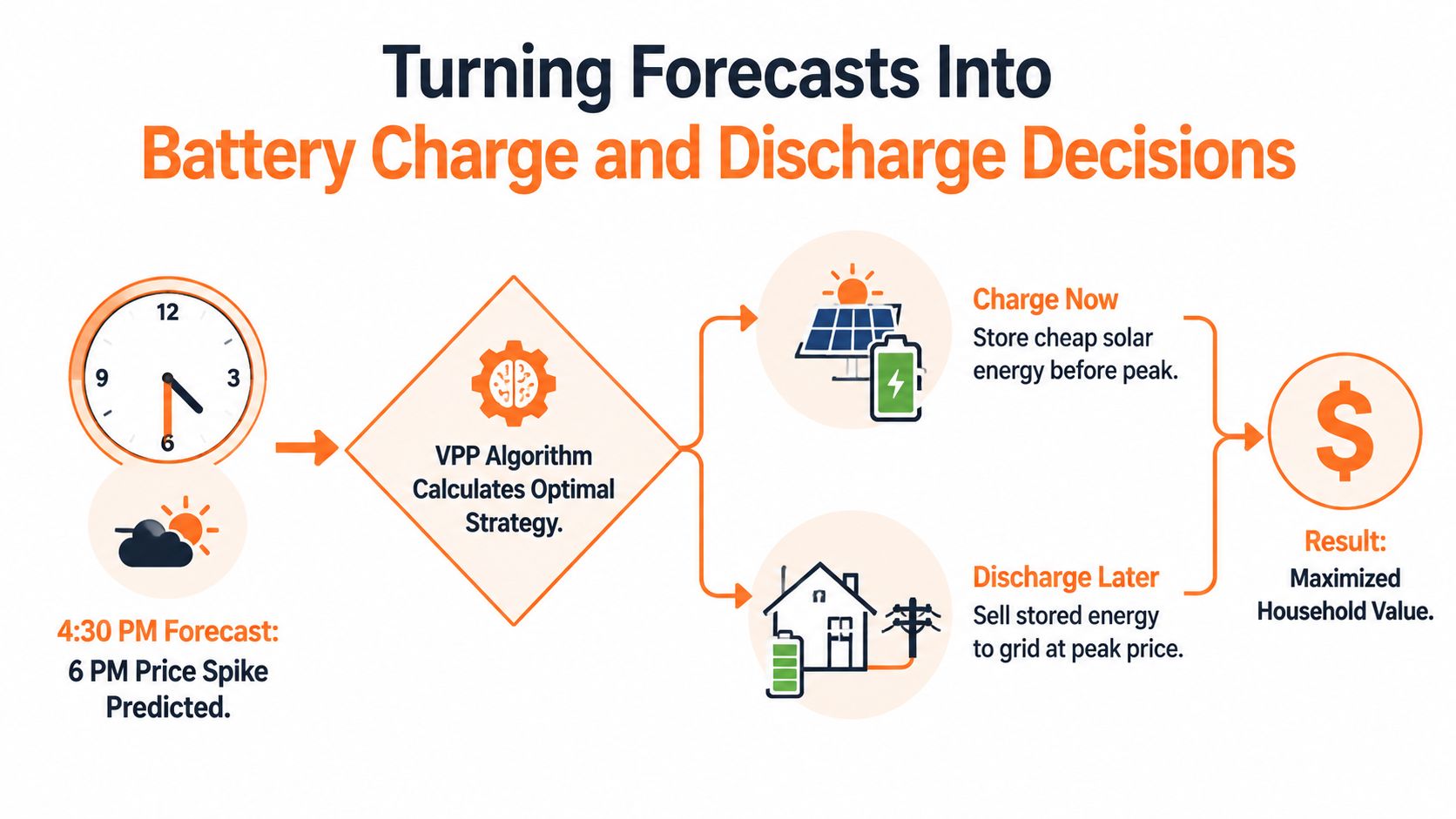
A forecast becomes useful only when it changes a decision. At 4.30pm, a VPP control system might receive an updated signal suggesting that a 6pm price event is likely. The algorithm then checks the battery's state of charge, expected household demand, solar production, export limits and the customer's reserve settings.
The system may choose to hold stored energy rather than discharge immediately. It may also charge from available solar before the expected event. If the home needs energy for cooking, heating or air conditioning, those needs remain the priority.
The dispatch sequence
Read the signal. The system compares live market information with the latest forecast and identifies a potential high-value interval.
Protect the household. It reserves enough energy for expected home consumption and any customer-defined backup preference.
Assess available flexibility. Remaining capacity is checked against battery power limits, cycling preferences and network export conditions.
Choose the action. The battery can charge, hold energy, discharge to the home or, where permitted and suitable, provide energy to the grid through the VPP.
Review the outcome. The operator compares the forecast with the realised market conditions and adjusts future decisions.
The homeowner should be able to see the proposed plan in a companion app. Useful information includes live prices, forecast events, battery state of charge and the reason for a planned dispatch. A manual override matters because household circumstances can change. A family may need to preserve energy for an unexpected evening load, or a customer may decide that backup protection is more important than market participation.
The economic value comes from coordination, not from discharging at every high price. A retailer-led VPP can combine wholesale participation with retail bill outcomes. The customer retains ownership and priority access to the battery, while spare flexibility can support grid stabilisation when the operating rules allow it.
A visual explanation of this control logic is also available in the following demonstration:
A sound dispatch plan should also account for battery cycling and efficiency. A forecast may identify an attractive price difference, but the operator still needs to consider conversion losses, the customer's retail tariff, network conditions and the opportunity cost of using stored energy later.
Why Lower Forecast Prices Can Still Increase Battery Value
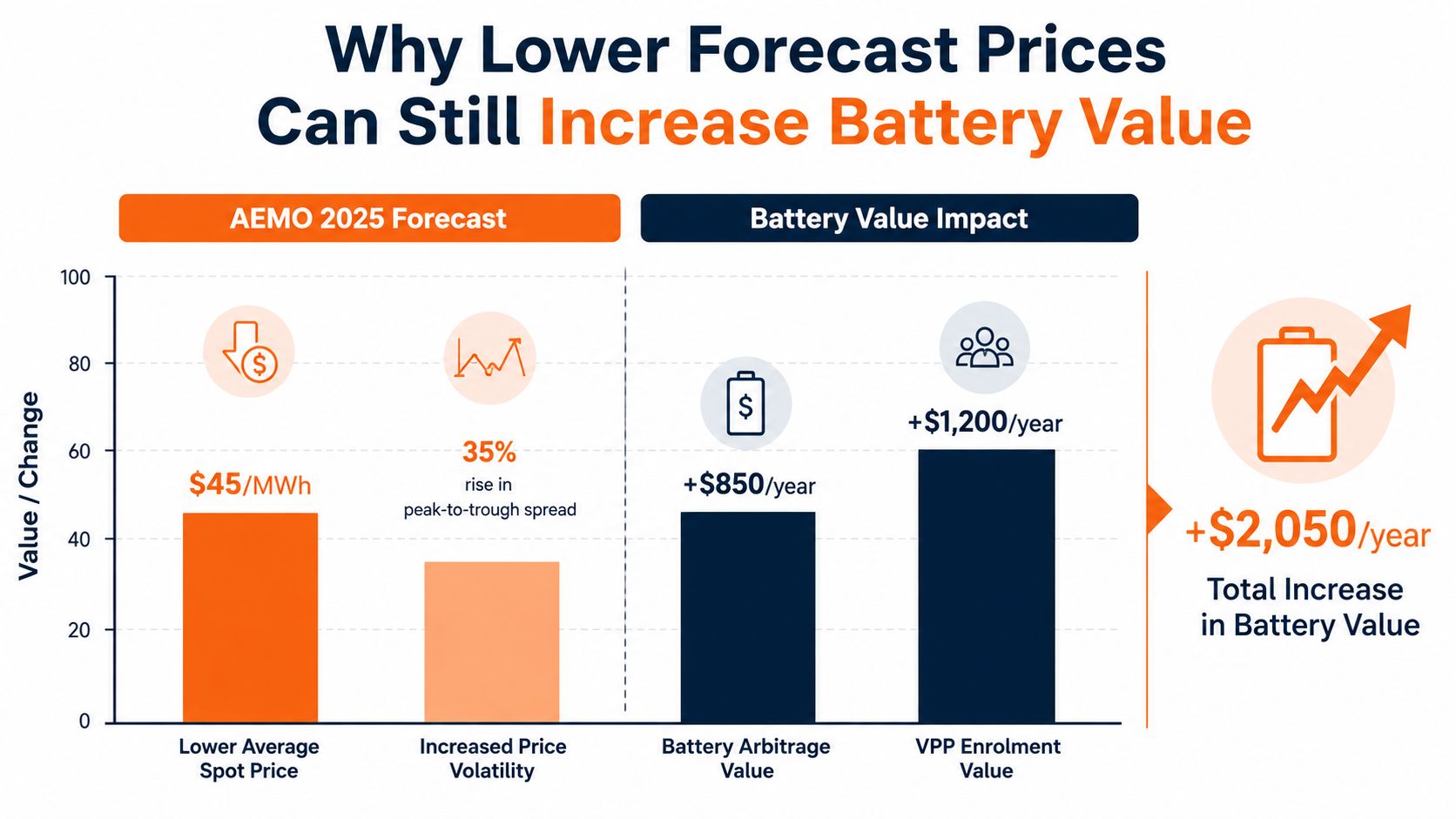
Lower average prices don't automatically make a battery less useful. The financial question depends on the difference between low-price and high-price periods, the battery's available flexibility and the way a retailer or VPP shares value with the customer.
The AEMO 2025 Distributed PV and Batteries/VPP Forecast Report uses retail electricity price forecasts from the 2025 IASR. That outlook indicates that prices may fall by about 5% over the next five years before rising again as coal retires and some new variable renewable energy and battery projects are delayed. It also points to stronger volatility later in the outlook period. The AEMO Distributed PV and Batteries/VPP Forecast Report sets out the relevant assumptions.
That combination matters. A market can have lower average prices while still producing sharp intervals where flexible storage has greater operational value. A battery can charge when energy is plentiful, preserve capacity during low-value periods and respond when the system experiences a demand event or supply constraint.
Average price versus usable flexibility
For a battery owner in NSW or Queensland, the practical comparison looks like this:
| Market condition | Passive battery behaviour | Forecast-led VPP behaviour |
|---|---|---|
| Strong solar output and weak demand | Battery may fill and export according to fixed settings | System can preserve room for later solar or market opportunities |
| Expected evening demand event | Battery may discharge too early | Control system can reserve energy for the higher-value interval |
| Network congestion | Export may be limited or less attractive | Dispatch can account for regional and local operating conditions |
| Uncertain forecast | Fixed automation may act too aggressively | Risk controls can preserve household reserves |
This is why a lower long-run price outlook doesn't settle the battery-value question. Flexibility earns value from timing and response, not only from the average price level.
A VPP can participate in both directions. It may use low-price or surplus periods to charge, then offer available energy or grid support during higher-value events. The customer should still examine the allowance structure, retail rates, operating limits, warranty considerations and the treatment of any energy exported through the programme. For background on the relationship between market prices and household costs, see High Flow Energy's electricity cost guide.
Forecast Accuracy, Limits and What Owners Should Expect
Forecasts are decision tools, not crystal balls. AEMO's wholesale market modelling uses a two-step process because a fundamentals-based equilibrium model doesn't produce the very high price peaks that can occur in the market. The model is re-run with statistical methods to capture extreme events above $1,000/MWh or below -$100/MWh, as described in the Productivity Commission material on NEM wholesale market modelling.
A forecast can identify risk without predicting the exact outcome. The 2026 multi-region research noted earlier shows why performance needs testing during volatility, not only during normal intervals. Models can also use quantile regression and conformal calibration to produce uncertainty ranges instead of presenting one apparently precise number, as shown in the NSW research dataset.
What a homeowner should ask
- How is performance measured? Statistical accuracy matters, but dispatch value and household bill outcomes matter too.
- Does the system show uncertainty? A range can support more cautious decisions than a single point estimate.
- What happens during a spike? The operator should explain reserve settings, event controls and customer protection.
- Can the customer override dispatch? Manual control is important when household priorities change.
- Are outcomes guaranteed? They shouldn't be. Forecasting cannot eliminate price risk or promise a specific bill result.
Data quality also limits performance. Missing readings, changing household usage, unexpected generator outages, weather errors and network constraints can all affect the result. A mature VPP continuously compares predicted and realised conditions, then uses that feedback to refine its controls.
Key Takeaways for Battery Owners in NSW and Queensland
A battery owner in NSW or Queensland may face a simple decision before dinner: preserve energy for the evening, charge from the grid, or discharge while the market price is high. The best choice depends on more than the current price. It connects the long-range NEM outlook, near-term price signals, household needs and the battery's operating rules.
Use these checks to assess whether a battery or VPP is making that connection:
- Review dispatch behaviour: Check whether the battery responds to expected price events, rather than following a fixed timetable. A forecast should influence the plan, while live market conditions can change it.
- Look for visibility: Choose an app that displays current prices, forecasts and the proposed charge or discharge plan. Clear information makes automatic control easier to assess.
- Protect household access: Confirm that home consumption and backup preferences come first. An override should be available when household plans change.
- Assess the retailer model: Compare how the programme handles bill reduction, allowances, wholesale participation and export limits. These rules determine how market opportunities affect the customer.
- Treat long-term outlooks as context: A projection can guide battery strategy and planning. It does not promise a future price or a particular bill.
Forecasting works like a weather report for battery control. A long-range outlook helps set expectations about market conditions. A short-term signal helps decide what to do over the next operating interval. Household demand, battery reserves and retailer rules determine whether that action is suitable.
Installation quality matters, but ongoing operation matters too. High Flow Energy is an Australian electricity retailer that coordinates existing solar and battery assets through a BYOB VPP. Its platform retains household priorities and provides forecast-led dispatch for eligible participants.
Before changing retailers or joining a VPP, review your current battery settings, electricity performance and eligibility requirements. Regulatory information and market forecasting material can help explain the conditions behind the programme. Compare those conditions with the actual operating rules offered to you.
Frequently asked questions
What is electricity price forecasting?
Electricity price forecasting estimates likely market prices for a defined period. Short-term forecasts can support battery dispatch, while long-term outlooks support planning and scenario analysis.
Does a forecast predict my household bill?
No. A market forecast does not include every household variable, such as usage, retail tariff, solar production, battery settings, network charges and customer behaviour. It can inform a decision, but it cannot guarantee a bill outcome.
Why do NEM prices change so quickly?
Prices respond to demand, generation availability, weather, network constraints, interregional flows and broader market conditions. These factors can change rapidly during demand events or supply shortages, so a forecast is a guide rather than a fixed instruction.
Can a VPP use forecasts without taking control away from the homeowner?
A properly designed VPP can operate within customer settings and preserve priority access for household needs. Before enrolling, check reserve rules, override controls, participation terms and the situations in which the operator may dispatch the battery.
Are lower average electricity prices bad for batteries?
Not necessarily. Lower average prices can still sit alongside larger differences between low-value and high-value intervals. A flexible battery may create value by responding to those differences, even when the overall price level is lower.
Should a battery always discharge when the forecast price rises?
No. The system should consider household demand, backup reserves, battery efficiency, cycling preferences, retail arrangements and network restrictions. A higher forecast price is only one input, and discharging may reduce later flexibility.
What should NSW and Queensland owners compare before joining a VPP?
Compare the retailer's authorisation, pricing structure, allowance or payment model, customer priority settings, export treatment, warranty considerations, data access, override controls and exit terms. Read the operating rules closely. A general savings claim cannot show how the battery will behave in your home.
LinkedIn excerpt
Electricity price forecasting links battery ownership with practical dispatch decisions. Long-range NEM outlooks provide planning context, near-term market signals support charge and discharge choices, and a retailer-led VPP can automate those choices while protecting household energy needs. Battery owners in NSW and Queensland should assess whether their system is being actively optimised, not merely installed.
AI summary
Electricity price forecasting connects long-term NEM projections with real-time battery decisions. Long-range outlooks describe possible market conditions and should not be treated as guaranteed prices. Short-term forecasts help VPP operators respond to expected demand events and market volatility, but performance can vary during price spikes. Household reserves, uncertainty information and manual override controls therefore matter. A retailer-led BYOB VPP can use these signals to reduce bills and create value from available battery capacity, subject to its retail and participation terms.
High Flow Energy provides a retailer-based BYOB VPP for eligible solar and battery owners in NSW and Queensland. Its platform connects forecasting and market signals with battery optimisation while keeping household energy priorities central. Owners of compatible systems can review whether their battery is underused and request an eligibility assessment through High Flow Energy.