

Solar Battery Discharge Limit Explained for Homes
On a warm evening in Queensland or New South Wales, the air conditioner is running, dinner is being prepared and the lights are on. Your solar battery app still shows energy remaining, yet the battery stops discharging at what looks like 10% or 20% state of charge. The household starts drawing electricity from the grid, and the obvious question follows: why can't the battery use what is left?
The answer is usually the solar battery discharge limit. It defines how far the system is allowed to discharge, rather than how large the battery looks on its specification sheet. That setting affects usable energy, evening bill reduction, backup security, battery wear and, where applicable, participation in a Virtual Power Plant.
This guide explains the difference between state of charge, depth of discharge and usable capacity, then shows how chemistry, inverter controls and battery management systems enforce the limit. It also examines the four-way trade-off between daily energy use, battery life, household reserve and VPP earnings. The focus is Australian homes, including the different practical considerations for households connected in Queensland and New South Wales.
Introduction Why Your Battery Stops Before Empty
A battery stopping before the display reaches zero doesn't necessarily indicate a fault. In many systems, the remaining charge is deliberately protected as a reserve. The battery may report that energy remains, but the inverter or battery management system won't allow the household to access all of it.
That reserve can support several purposes. It can reduce stress on the cells, protect the battery from an unsafe voltage, preserve backup energy during an outage or satisfy a VPP operating rule. The percentage shown in an app is therefore only one part of the story.
The first source of confusion is that manufacturers describe storage in more than one way. A battery may have a nominal capacity, which is the total nameplate storage, and a smaller usable capacity, which is the amount the system permits you to discharge. The Clean Energy Council explains that most battery systems can't have 100% of their stored energy drawn out, while lithium-ion systems typically have a depth of discharge of 80% or above in its consumer guidance, available through the NSW Home Solar Battery Guide.
For a household owner, this distinction is practical rather than academic. Usable capacity helps determine whether the battery can cover cooking and cooling after sunset, maintain a reserve for a blackout or respond to a time-of-use price period. It also affects how much spare energy a retailer-based VPP can coordinate without taking priority away from the home.
High Flow Energy operates in the Bring Your Own Battery market, connecting eligible existing solar and battery systems to a VPP rather than selling or installing hardware. That makes discharge control particularly important. A VPP must coordinate grid support with household comfort, warranty requirements and the customer's chosen reserve.
By the end of this guide, you should be able to read the relevant settings in your battery app, understand why the system stops where it does and identify which questions to ask your installer, retailer or VPP operator.
What Solar Battery Discharge Limit Really Means
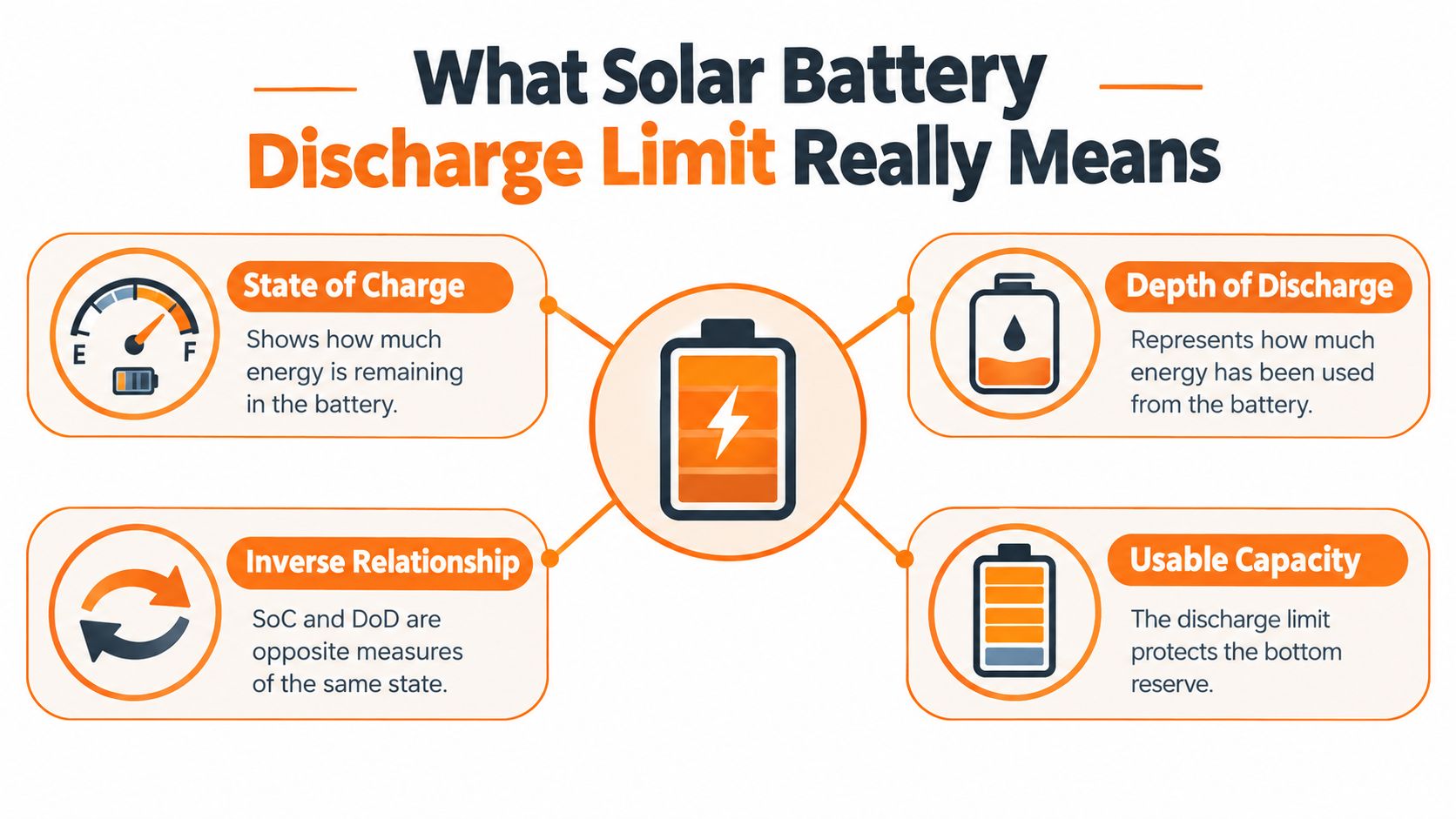
Start with the battery as a fuel tank. State of charge, or SoC, tells you how much fuel remains. Depth of discharge, or DoD, tells you how much fuel you've used. They describe the same storage state from opposite directions.
A battery showing a high SoC has used relatively little of its stored energy. A battery showing a low SoC has discharged more. The two measures are inverse measures, not two separate types of capacity.
Key definition: State of charge is the energy remaining. Depth of discharge is the share of stored energy used before recharging.
The word “limit” can refer to either side of this relationship. A maximum DoD setting restricts how much of the battery can be used. A minimum SoC or reserve setting specifies how much must remain. In everyday operation, both settings can produce the same result, the battery stops before the app appears empty.
A simple usable-energy example
Suppose a battery has a 10 kWh nominal capacity and an approved DoD of 80%. The approximate usable energy is:
- Nominal capacity: 10 kWh, the nameplate storage.
- Approved DoD: 80%, the portion available for discharge.
- Usable energy: about 8 kWh before recharging is needed.
That doesn't mean the remaining energy has vanished. It means the control system has reserved the balance or restricted access to it under the battery's operating rules. Actual delivered energy can also vary with inverter efficiency, temperature, power demand and the battery's condition.
The Clean Energy Council's Australian guidance says most storage systems don't permit the full nameplate amount to be drawn out, and lithium-ion systems typically have a DoD of 80% or above. The NSW guide also notes that some lithium-ion manufacturers allow full discharge, but presents this as a manufacturer-specific exception rather than a universal rule. You should therefore treat the product documentation, not a generic internet percentage, as the controlling reference.
Where the limit appears
Your system may display the setting as:
- Minimum SoC, the percentage kept in reserve.
- Maximum DoD, the permitted share of energy used.
- Backup reserve, energy held for an outage.
- Emergency reserve, a protected lower threshold.
- Discharge cutoff, the point at which the inverter stops supplying loads.
These labels aren't always interchangeable in the app, so check whether the percentage refers to energy remaining or energy used. A 20% minimum SoC generally means the system keeps 20% in reserve. An 80% DoD generally means the system permits 80% of the nominal capacity to be used. For a practical explanation of the related power-output question, see High Flow Energy's guide to battery discharge rate and inverter limits.
Australia's incentive rules reinforce why usable capacity matters. The Clean Energy Regulator says eligible usable capacity for battery STCs is capped at 50 kWh, defining usable capacity as the amount of energy that can be discharged. Its example describes a battery with 70 kWh nominal capacity and 60 kWh usable capacity, where only the first 50 kWh of usable capacity counts for STC purposes. The regulator's solar battery STC guidance demonstrates that nameplate size alone isn't the market's decisive measure.
Why Discharge Limits Exist and How They Are Enforced
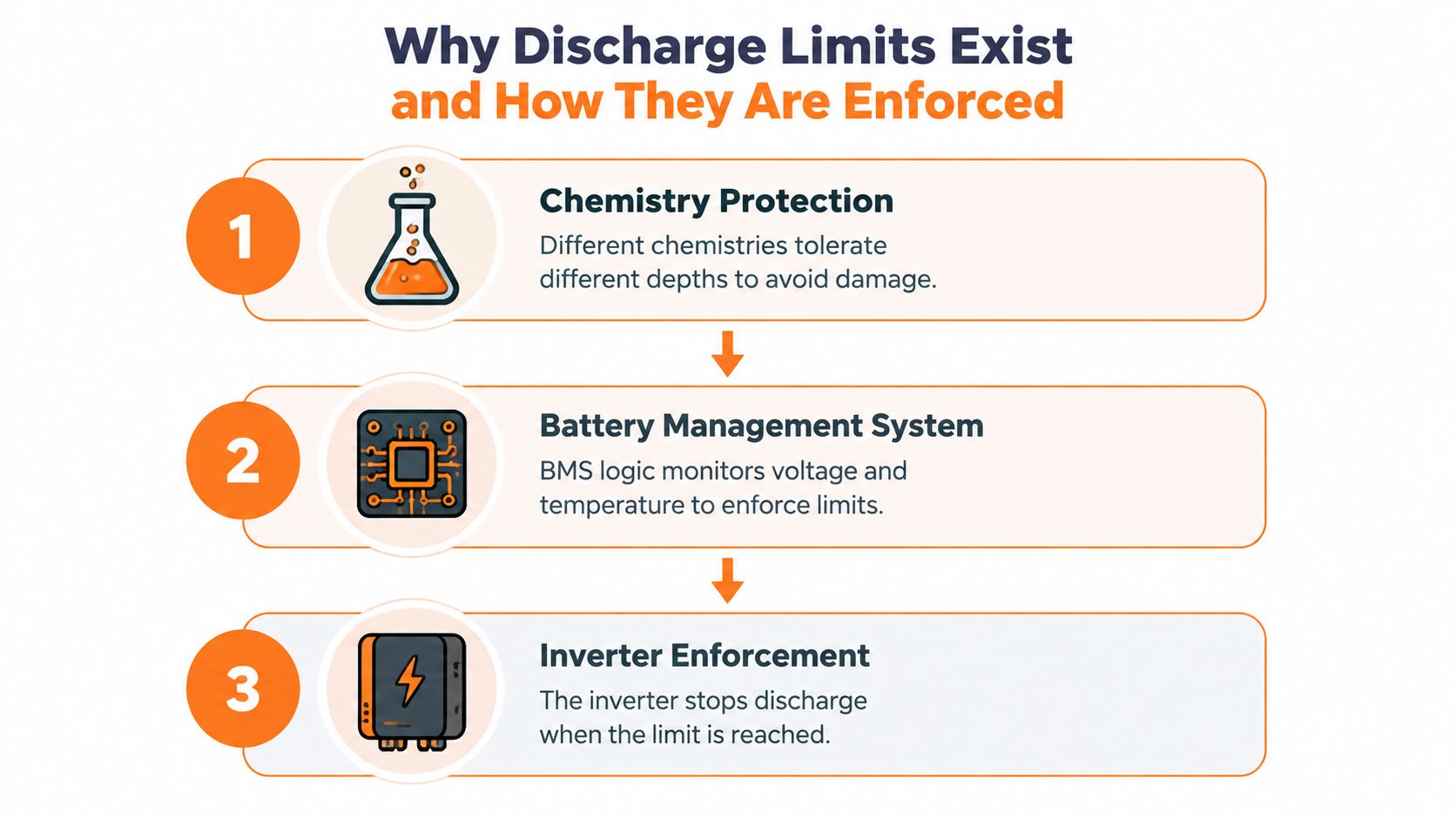
The discharge limit protects the battery's cells and gives the control system a defined operating boundary. It isn't merely a conservative number added to an app. Battery chemistry, cell voltage, temperature, current and warranty conditions all influence how far a system can safely discharge.
Different chemistries tolerate different discharge floors. ARENA testing discharged lithium-ion batteries to between 5% and 20% SoC, depending on their battery management system limits, while lead-acid batteries were held to 50% SoC in the same testing context. The result is clear: there isn't one safe solar battery discharge limit that applies to every technology.
The battery management system
The battery management system, or BMS, monitors conditions inside the battery and controls what the system can do. It can respond to voltage, temperature, current and the battery's reported state of charge. If a cell approaches a protected boundary, the BMS can reduce or stop discharge rather than allowing the inverter to continue.
This explains why an app setting isn't always the final authority. A customer may change a reserve preference, but the BMS can still enforce a lower threshold. That separation protects the battery from a setting that conflicts with its design or warranty.
The inverter provides another stop
The inverter converts battery power into electricity the home can use. It also applies its own operating limits. A Sungrow Australia inverter manual, for example, specifies a maximum discharge current of 65 A, stops discharge at a defined lower battery voltage and lists model-specific low-SoC protection thresholds.
The manual gives thresholds including 6% for Sungrow, 20% for Pylon US2000A, 21% for Pylon US2000B, 16% for LG, GCL and BSG, 11% for BYD, as well as other battery-specific settings. These figures come from one inverter manual, not a universal installation rule. They show why two neighbours can see different cutoff behaviour even when both describe their systems as lithium-ion.
| Control layer | What it protects or controls |
|---|---|
| Battery chemistry | The cell technology's tolerance for discharge |
| BMS | Cell-level operating conditions and safety boundaries |
| Inverter | Current, voltage and system-level discharge behaviour |
| Warranty settings | The manufacturer's approved operating range |
Don't override a protection setting to access the final portion of stored energy. Australian guidance recommends checking the manufacturer's approved DoD before changing a reserve or cutoff, as explained in High Flow Energy's depth of discharge guide. If the app, inverter and battery documentation appear inconsistent, ask the installer or authorised service provider to reconcile them.
How Discharge Limits Affect Battery Life and Daily Energy Use
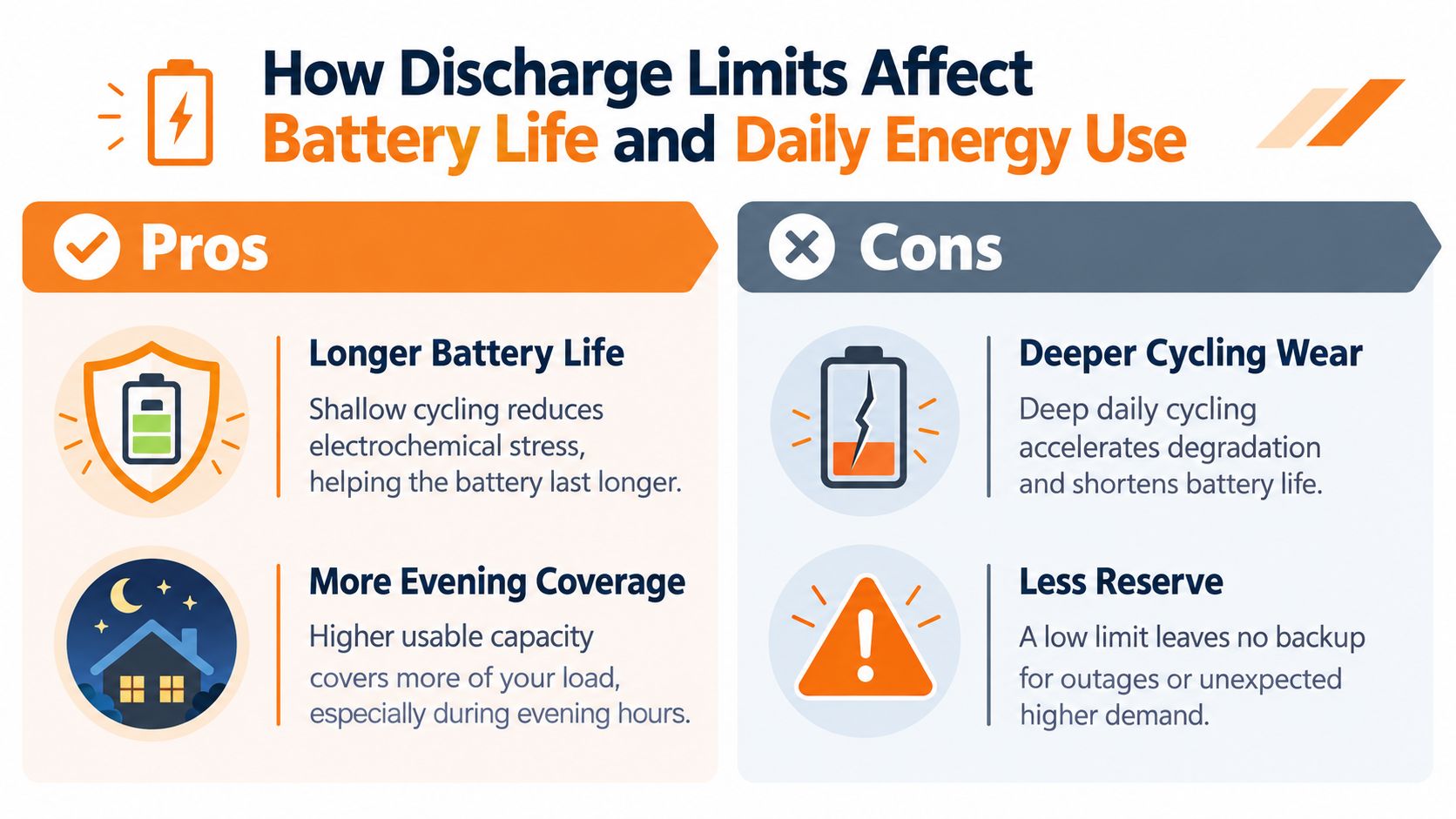
A deeper discharge gives you more energy today, but it places more demand on the battery's electrochemical system. CSIRO explains that a battery cycled through a full 0% to 100% DoD range and back generally delivers fewer total cycles than the same chemistry operated with shallower daily discharge, because deeper cycling increases wear per cycle.
That creates a genuine design trade-off. A household that uses a large evening load may value extra usable kWh for air conditioning, cooking or electric vehicle charging. Another household may prefer a larger reserve and gentler daily cycling because it wants reliable backup or lower long-term cost per delivered kWh.
The same battery can suit different households
Consider two homes with the same nominal battery size. The first has modest overnight consumption and usually reaches its reserve before morning. A lower daily DoD may cover the household comfortably while limiting unnecessary cycling.
The second household runs cooling equipment late into the night and wants to shift more solar energy into evening use. It may benefit from more usable capacity, provided that the battery, inverter and warranty permit the setting. The extra discharge can improve self-consumption and support time-of-use tariff optimisation, but it shouldn't be treated as free capacity. More energy extracted per cycle can mean greater wear over the system's operating life.
CSIRO's Australian batteries for homes guidance is useful background for understanding why cycle depth matters. For broader context on how battery longevity is discussed in energy storage and electric vehicle applications, EV Stats' battery lifespan resource provides a separate reference point. Its figures shouldn't replace the cycle-life specification for your installed home battery.
Practical rule: More usable capacity isn't automatically better. The useful setting is the one that covers your normal load without imposing avoidable wear or removing the reserve you actually need.
The system also has a power limit, separate from the energy limit. A battery might have enough stored kWh to cover a load but still be unable to supply several high-demand appliances at once because the inverter limits output. That distinction is covered in the embedded explanation below.
For Australian owners, the right comparison is therefore cost per delivered kWh, not the headline capacity alone. A larger permitted DoD can reduce the amount of storage left unused each day, while a shallower setting can support longer service life and stronger backup protection. The answer depends on your consumption pattern, tariff, warranty and operating objective.
Discharge Limits and Virtual Power Plant Participation
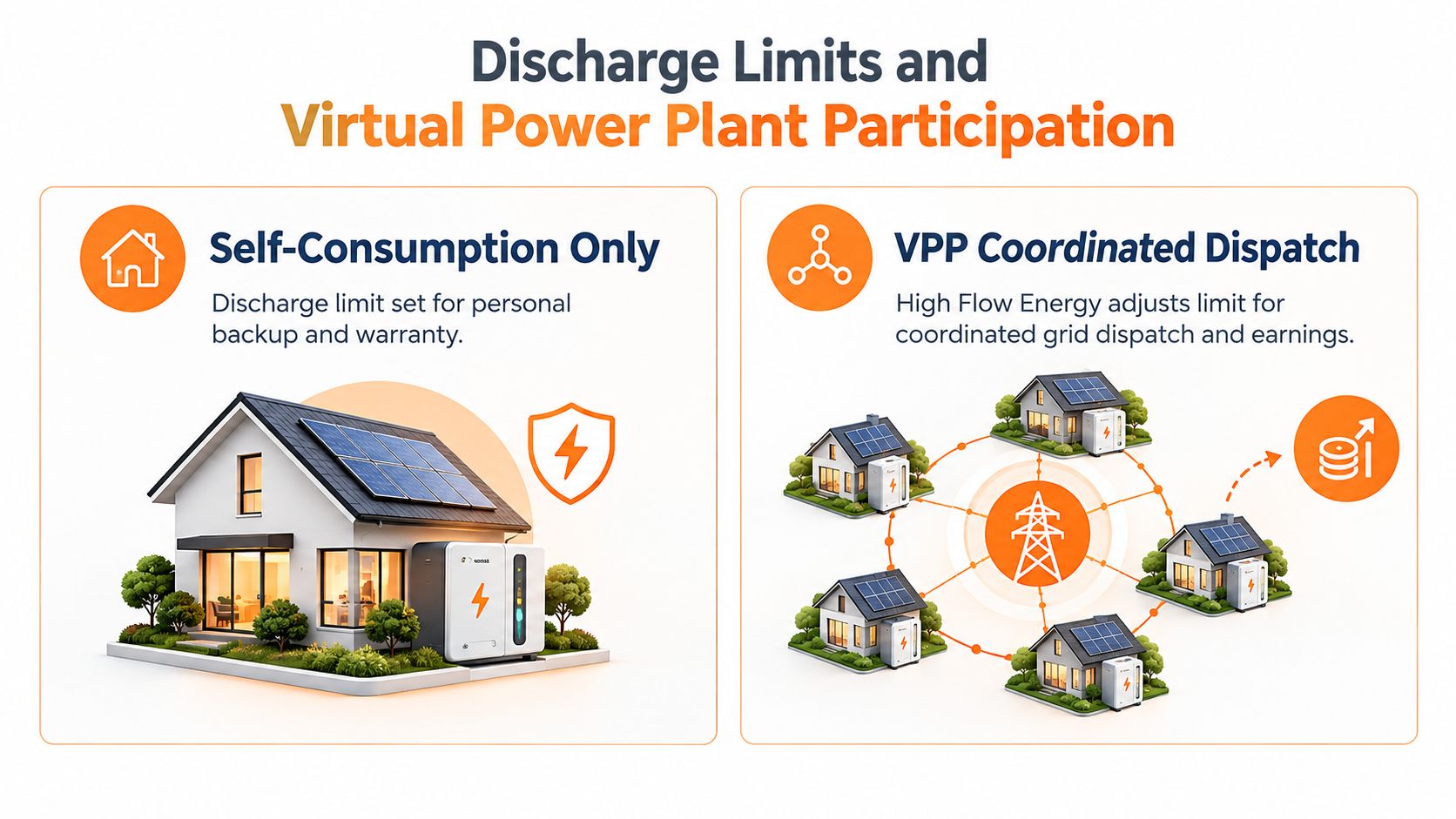
A VPP changes the question from “How much energy can my home use?” to “How much spare energy can the system safely coordinate after my home is protected?” Self-consumption-only operation usually follows the household's own charging and discharge preferences. VPP participation adds controlled responses to grid conditions, demand events and wholesale price volatility.
Those responses can create value when the battery has spare capacity, but they must respect a minimum reserve. Australian VPP explanations commonly describe reserves around 20% to 30%, with some programs reserving 20% or preventing export below a customer-set reserve, as outlined in Australian VPP reserve guidance. The exact setting depends on the program, battery compatibility, network requirements and customer preferences.
Household priority comes first
A credible VPP shouldn't treat the home battery as an unrestricted grid asset. The operator needs rules for household load, backup security and the customer's reserve. In practice, that means a VPP dispatch may use capacity above the protected floor while leaving energy available for the home.
This matters in both NSW and Queensland, where network constraints, export limits and market conditions can vary by location. A battery connected to a VPP may respond to a demand event in one period and hold energy for household use in another. The system's value comes from coordinating those decisions, not from discharging as much as possible at every opportunity.
The public debate has included concerns that VPP operators could drain participant batteries too frequently. In a reported Australian case, a retailer stated that its VPP policy was to leave at least 20% charge and never fully discharge participant batteries, as covered by ABC News' report on household battery reserve concerns. That example highlights why customers should read the reserve policy rather than rely on broad VPP marketing language.
Four outcomes must be balanced
| Priority | What a deeper discharge can do | What a higher reserve can do |
|---|---|---|
| Usable energy | Covers more evening consumption | Leaves more stored energy unused |
| Battery wear | Increases the intensity of daily cycling | Reduces routine discharge depth |
| Backup security | Provides less outage protection | Preserves more emergency energy |
| VPP value | Creates more possible dispatch capacity | Limits dispatch but protects the home |
A VPP allowance or other customer benefit should be assessed alongside these trade-offs. Grid support can create financial upside, but earnings mustn't be separated from cycling, reserve and warranty conditions. For more detail on coordinated operation for existing systems, see the solar battery VPP overview.
How to Check and Optimise Your Discharge Limit Safely
You don't need to be an electrical engineer to identify your current discharge settings. Start with the battery app, inverter portal and installation documents. Look for terms such as minimum SoC, maximum DoD, backup reserve, emergency reserve and discharge cutoff.
Record the setting before changing anything. Also note the battery chemistry, model, warranty DoD, inverter model and whether a VPP operator controls a separate reserve. If an app displays both SoC and DoD, confirm which percentage represents energy remaining and which represents energy used.
A safe checking routine
Read the battery documentation. Find the manufacturer's approved discharge range and warranty conditions. Don't assume a lithium-ion label means every lithium-ion product has the same limit.
Check the inverter settings. The inverter may impose a lower voltage, current or SoC boundary than the app's user preference.
Identify the backup reserve. A VPP or backup configuration may preserve a minimum reserve even if the general self-consumption setting appears lower.
Review actual household behaviour. Compare the battery's discharge pattern with evening load, time-of-use pricing, solar generation and export constraints. A low reserve may not improve bill outcomes if the battery regularly runs out before the expensive period.
Ask before overriding. Contact the installer, manufacturer or authorised retailer if the settings conflict. The BMS protection should never be bypassed to force additional discharge.
Optimisation doesn't always mean deeper cycling
You can often improve system value without pushing the battery closer to its lower limit. Time-of-use charging can preserve energy for a more valuable period, while reserve scheduling can distinguish ordinary evenings from periods when backup matters more. A VPP plan can also coordinate charging and discharge around grid conditions, subject to the battery's approved settings.
AI-driven plans may adjust operation automatically, but customers should be able to understand the reserve logic and override an automated plan when household priorities change. Ask who controls the setting, what happens during a demand event and whether the system can prevent dispatch below your chosen floor.
Leave the factory setting alone when the manual is unclear, the warranty language is restrictive, the inverter reports a protection warning or your household depends on the battery for backup. A small amount of unused capacity is preferable to an unauthorised change that creates safety, reliability or warranty problems.
Key Takeaways and Next Steps with High Flow Energy
The solar battery discharge limit is the boundary between nominal storage and energy you can use. A 10 kWh battery with 80% DoD delivers about 8 kWh of usable energy, as explained in the NSW consumer guidance, but the installed system's BMS, inverter and warranty settings determine the practical result.
Remember these points:
- Nominal capacity isn't usable capacity. The nameplate tells you the battery's total rated storage. The discharge limit tells you how much the system permits you to access.
- SoC and DoD are inverse measures. SoC is what remains. DoD is what you've used.
- Deeper discharge increases daily energy access. It can cover more evening load, but it generally increases electrochemical wear and can reduce total cycle life.
- A reserve is not wasted energy by default. It may protect the cells, preserve blackout backup or satisfy a VPP operating rule.
- VPP dispatch shouldn't mean zero reserve. Australian program guidance commonly describes minimum reserves around 20% to 30%, while the actual rule depends on the program and system.
- A bigger battery doesn't guarantee better value. Tariffs, export limits, household demand, warranty terms and dispatch controls all affect financial performance.
High Flow Energy is an Australian technology-enabled electricity retailer for eligible existing solar and battery owners in Queensland and New South Wales. Its BYOB VPP coordinates spare battery capacity for grid services while prioritising household needs, with app-based monitoring and optimisation, no new hardware and no lock-in contracts.
The useful next question isn't whether your battery can discharge further. It's whether the current limit is helping or restricting your household's overall result. Review your evening usage, reserve setting, tariff exposure and any VPP controls, then request an eligibility assessment if you suspect your battery is underutilised.
If you own an eligible solar and battery system in Queensland or New South Wales, High Flow Energy can assess how its BYOB VPP manages reserve, discharge and household priority. Visit the site to check eligibility and understand whether your existing battery could be contributing more value without adding new hardware.