

Rooftop Solar with Battery Storage: A Practical Guide
A household in Brisbane or Sydney's western suburbs can have a productive rooftop solar system and still leave much of its value unused. Solar generation peaks while many people are at work or school, so excess electricity flows to the grid during the day. Later, when cooking, cooling and hot-water demand rises, the household buys electricity back. A battery changes that pattern, but only if it's charged, discharged and exported at the right times.
Rooftop solar with battery storage combines solar generation, an inverter, household demand and a battery into one energy system. This guide explains how the equipment works, why self-consumption matters, how to think about capacity and inverter limits, and how a retailer-led Bring Your Own Battery virtual power plant, or BYOB VPP, can turn spare battery capacity into a bill-free allowance for eligible Queensland and New South Wales households.
Why Rooftop Solar With Battery Storage Matters in Australia
Australia's rooftop solar fleet has become a central part of the electricity system. By 2025 to 2026, around 4.3 to 4.37 million rooftop solar systems had been installed nationally, with approximately 28.3 GW of capacity. That capacity exceeds the 22.5 GW coal-fired generation fleet reported by the Clean Energy Council's rooftop solar and storage report.
The timing of that generation creates a practical problem. Solar panels produce most of their energy during daylight, while many households use more electricity after sunset. If the battery remains in reserve, charges too late, or follows a simple export-first setting, the home can still send surplus energy away and import electricity in the evening.
The midday surplus and evening demand problem
Rooftop solar supplied 14.2% of all electricity generated in Australia during the second half of 2025, compared with 7.2% in 2020, according to the Clean Energy Council. More daytime rooftop generation can mean more competition for export capacity, especially on local networks with voltage or feeder constraints.
State conditions also differ. New South Wales had nearly 8 GW of installed rooftop PV capacity, while Queensland had about 1.16 million rooftop solar systems, according to the same Clean Energy Council report. Those figures make both states important markets for household battery optimisation and distributed grid support.
Practical rule: A solar system should be judged by the value of the energy it produces and uses, not only by how much it exports.
A battery can capture daytime surplus for later household use. A VPP can use some spare capacity during suitable grid events, while keeping the homeowner's needs ahead of external dispatch. The useful question isn't whether a home has solar and a battery. It's whether the system is configured and operated to make productive use of its available energy.
How Rooftop Solar With Battery Storage Actually Works
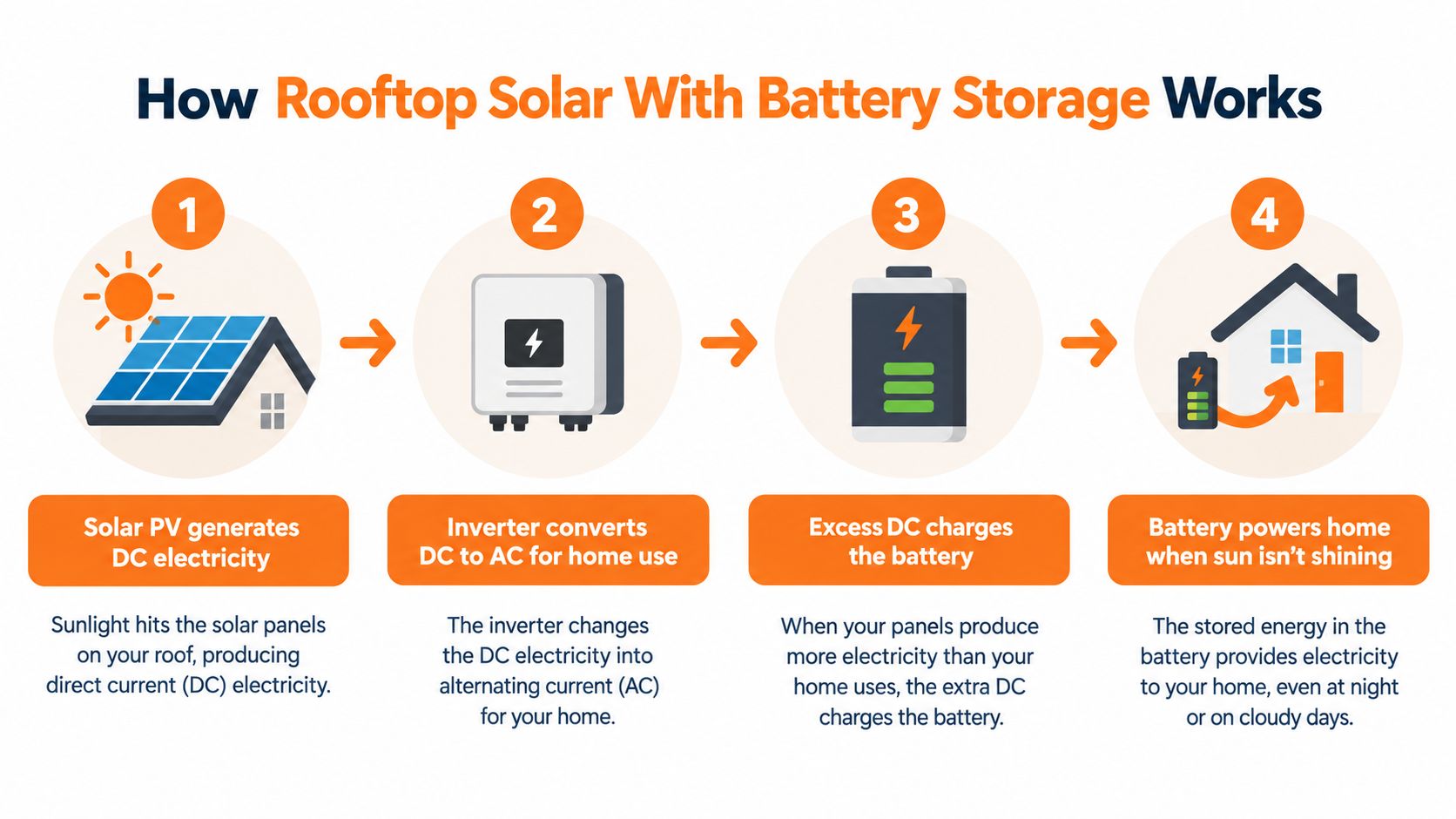
Rooftop solar with battery storage starts with solar photovoltaic panels, commonly called solar PV. The panels generate direct current, or DC, electricity. An inverter converts that electricity into alternating current, or AC, which household appliances can use.
A simple water-tank analogy makes the sequence easier to follow:
- Solar panels act like a tap. Sunlight fills the system with energy during the day.
- The home acts like a hose. Appliances use solar electricity as soon as it's available.
- The battery acts like a storage tank. Excess solar charges it instead of sending all surplus to the grid.
- The grid acts like a backup connection. The home can import electricity when solar and stored energy aren't enough.
What the inverter controls
A hybrid inverter manages solar production, battery charging and household supply within one coordinated device. An AC-coupled battery has its own battery inverter and can often be added to an existing solar system. A DC-coupled battery connects more directly to the solar side, which can reduce conversion steps in some configurations.
The inverter also limits how quickly energy can move. Battery capacity is measured in kilowatt-hours, or kWh. Output is measured in kilowatts, or kW. A battery may store enough energy for several hours but still be unable to run large appliances together if its inverter has a lower continuous output limit.
A smart energy management system decides whether to charge, discharge or export. It can use solar forecasts, household demand, time-of-use periods and grid signals. Homeowners comparing systems should also understand the difference between stored energy and the speed at which the battery can deliver it. The battery discharge rate guide explains that distinction in practical terms.
The Australian Energy Market Operator's household metering analysis indicates that home batteries operate at an assumed 85% round-trip efficiency, meaning around 15% of energy is lost over a complete charge and discharge cycle. Good control matters because charging and discharging at unsuitable times can reduce the value of that stored energy.
The Financial Case for Self-Consumption
The core financial principle is straightforward. Electricity generated by the roof and used later in the home avoids a purchase from the retailer. Electricity exported to the grid earns the household its applicable feed-in tariff, which may be lower than the retail price avoided through self-consumption.
Queensland conditions show why location and plan design matter. Outside South East Queensland, the regulated regional solar feed-in tariff is 8.66 c/kWh from 1 July 2025, down from 12.377 c/kWh the previous year, according to Ergon Energy's tariff information. In South East Queensland, retailers set their own export offers. Published plans commonly range from about 3 c/kWh to 10 c/kWh, with some higher offers subject to caps or conditions, as summarised by EnergyPlans.
A worked example without false precision
Consider a Brisbane household with a 6.6 kW solar array and a 10 kWh battery. The exact financial outcome depends on roof orientation, shading, appliance timing, battery settings, tariff structure and weather. A responsible assessment should therefore use the household's own interval data rather than promise a fixed annual saving.
The table below shows the structure of the calculation, not a claimed forecast for every Brisbane home.
| Energy Stream | kWh/Year | Value (c/kWh) | Annual Value (AUD) |
|---|---|---|---|
| Solar energy used directly in the home | Household data required | Retail rate avoided | Calculate from actual plan |
| Solar energy stored and used later | Battery data required | Retail rate avoided, less conversion losses | Calculate from actual plan |
| Solar energy exported | Inverter data required | Applicable feed-in tariff | Calculate from actual plan |
| Grid electricity imported | Retailer data required | Retail purchase rate | Calculate from actual plan |
The important comparison is between the value of a stored kWh used in the evening and the value of that same kWh exported at a low tariff. The battery creates value by shifting energy across time. Bigger panels alone won't solve a household that has already reached a midday export limit or has little daytime demand.
What to measure
Track solar generation, direct household use, battery charging, battery discharge, exports and imports separately. Then compare the result with the household's tariff, including supply charges, time-of-use windows and export conditions. The solar battery payback guide provides a useful framework for evaluating those inputs without treating a generic payback period as a guarantee.
Sizing a Rooftop Solar With Battery Storage System
Correct sizing starts with the household's evening energy use, not with a preferred battery brand. A system needs enough usable capacity to cover the relevant load, enough inverter output to run appliances at the same time, and enough solar generation to recharge the battery without relying heavily on the grid.
The three measurements that matter
Usable battery capacity is the energy available for normal operation. A battery's advertised capacity may not equal the amount the control system allows the homeowner to use. Reserve settings can also keep energy available for backup or protect the battery from operating at extreme states of charge.
Inverter output determines how much power the system can deliver at once. A household may have plenty of stored energy but still need grid support if the battery inverter can't handle the combined demand from air conditioning, cooking appliances and a pool pump.
The load profile shows when the home uses electricity. Record evening consumption, overnight loads and predictable future additions such as an electric vehicle, pool equipment or a larger cooling system.
A practical sizing path
For many three or four-person Australian households, a battery in the 10 to 13 kWh range may align with ordinary evening use, but it isn't a universal recommendation. A smaller 5 kWh unit can suit a home with modest overnight demand or a narrow backup objective. A battery above 20 kWh may make sense where the household has high evening demand, substantial backup requirements or several large controllable loads.
Avoid three common errors:
- Oversizing storage: A large battery can remain partly empty if the solar array rarely produces enough surplus to charge it.
- Undersizing the inverter: The battery may have stored energy but fail to supply the appliances the household expects to run.
- Ignoring tariffs: A system designed only around solar charging may miss the value of off-peak charging and evening discharge.
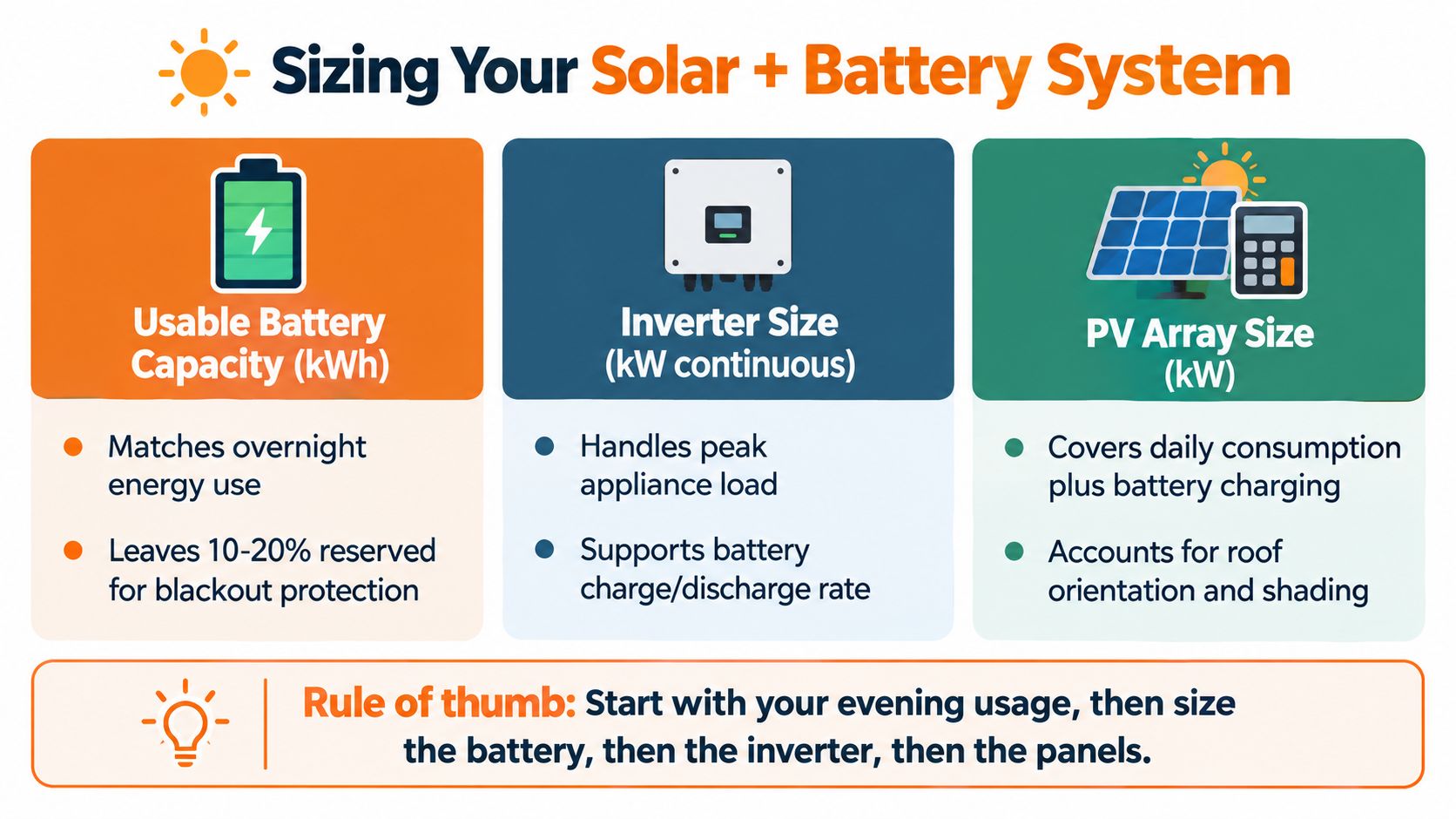
A good sequence is simple: audit evening use, match usable capacity to that pattern, confirm the inverter's continuous discharge capability, then check whether the PV array can replenish the battery under realistic conditions.
Common Configurations and Use Cases
A battery's financial result depends heavily on its operating mode. The same hardware can provide backup, improve self-consumption, shift grid purchases or participate in a VPP. Those functions compete for available capacity, so the homeowner needs to decide which outcome takes priority.
| Configuration | Primary Use | Best Suited For |
|---|---|---|
| Backup-only mode | Preserves energy for outages | Homes where resilience is more important than everyday bill reduction |
| Self-consumption mode | Stores solar for later household use | Homes with daytime surplus and meaningful evening demand |
| Off-peak charging mode | Charges from the grid during cheaper periods and discharges later | Homes with suitable time-of-use tariffs and low export value |
| VPP-participating mode | Uses spare capacity during approved grid events | Eligible Queensland and New South Wales homes seeking additional credits or an allowance |
Choosing the operating pattern
Backup-only mode can make sense in regional Queensland or other locations where supply reliability is a major concern. Its trade-off is that the battery may remain idle during ordinary days, leaving potential bill value unused.
Self-consumption mode is the default choice for many solar households. The battery charges from surplus PV and supplies the home after sunset. Homes with a valuable legacy feed-in tariff may need to compare the export income they give up against the retail purchases they avoid.
Off-peak charging can help where the tariff rewards overnight imports and daytime exports earn little. The battery must be controlled carefully because every cycle incurs conversion losses, and charging from the grid isn't automatically cheaper after all plan conditions are considered.
VPP participation adds a separate value stream. The operator may reserve energy for the household, then access spare headroom during a demand or wholesale event. Homeowners considering physical changes to an existing commercial installation should also coordinate electrical work properly. Guidance on commercial roof solar removal is relevant where panels or associated equipment need to be removed before a compliant redesign.
Adding a VPP to Rooftop Solar With Battery Storage
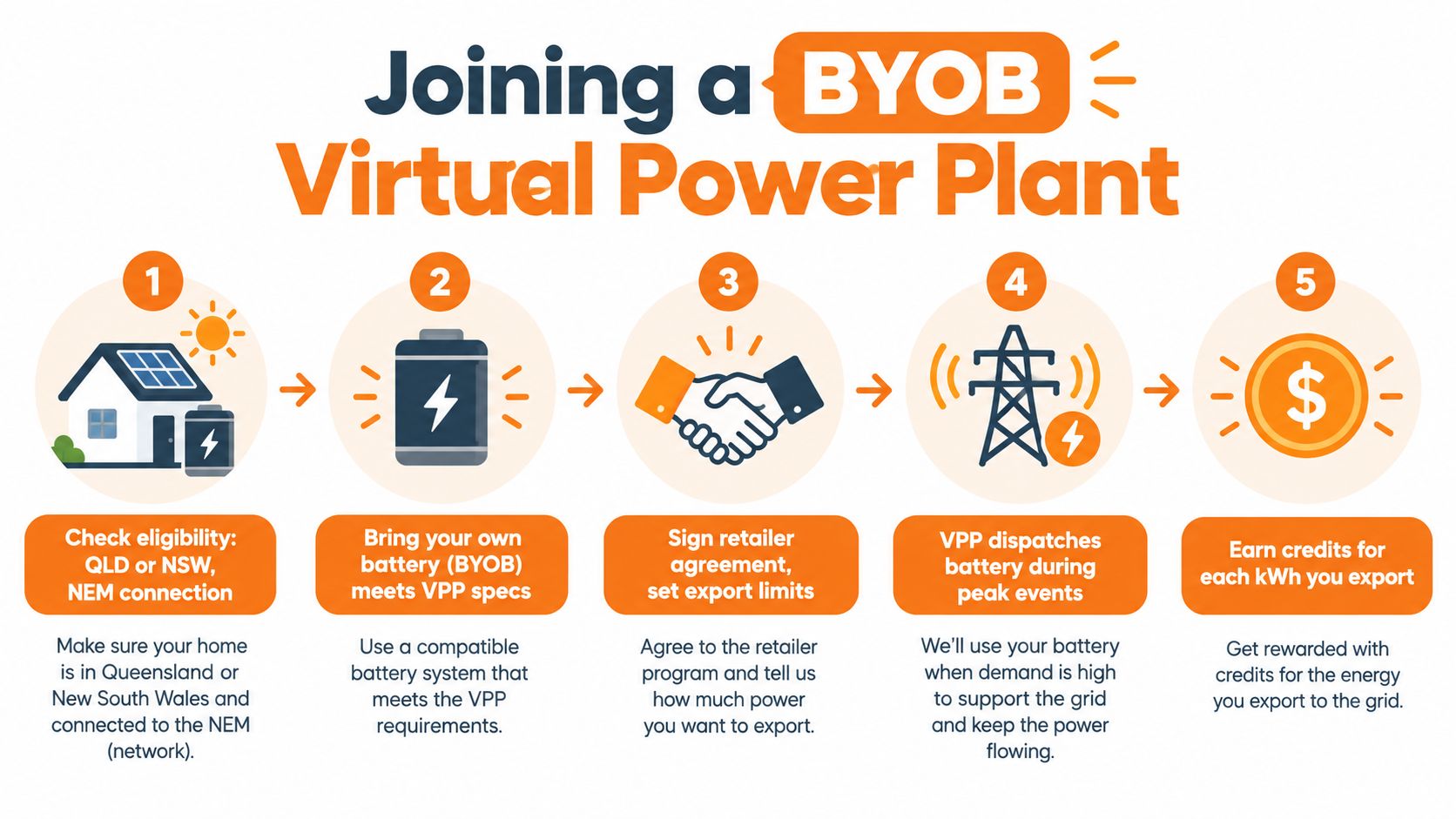
A Virtual Power Plant links many distributed batteries through software. Each battery remains in the home, but the operator can coordinate approved charge and discharge actions as a combined resource within the National Electricity Market.
A BYOB VPP is different from buying a new battery through a bundled programme. The homeowner brings an existing compatible system. The retailer or VPP operator checks the inverter, battery model, communications connection, export settings and relevant network requirements.
How the value is created
During a suitable demand event or wholesale price spike, the VPP can request discharge from participating batteries. The operator manages the combined response, and the household receives value through the programme's defined credits or bill-free allowance. The arrangement only works if the battery has spare capacity after accounting for household needs and any backup reserve.
The Clean Energy Regulator's solar battery requirements state that on-grid solar batteries and their inverters must be capable of participating in a VPP at installation time to qualify for Small-scale Technology Certificates under the Small-scale Renewable Energy Scheme. Participation remains optional, but the system needs an ongoing internet connection and the ability to respond to grid signals.
Control and homeowner priority
A properly documented VPP agreement should explain dispatch windows, minimum reserve settings, export limits, payment or allowance mechanics, warranty responsibilities and exit terms. Homeowners should retain visibility through the app and understand which settings they can override.
HighFlow Energy is an Australian electricity retailer and VPP operator that works with eligible existing solar and battery systems, including compatible BYD, Tesla, AlphaESS and Sungrow equipment. Its model coordinates spare battery capacity while prioritising household use and provides a monthly bill-free electricity allowance, with standard rates applying to energy above that allowance. The solar battery VPP information sets out the service approach for eligible Queensland and New South Wales households.
Misconceptions About Rooftop Solar With Battery Storage
Battery owners often use the wrong measurement when judging system performance. Export volume, warranty length and battery size all matter, but none tells the whole story.
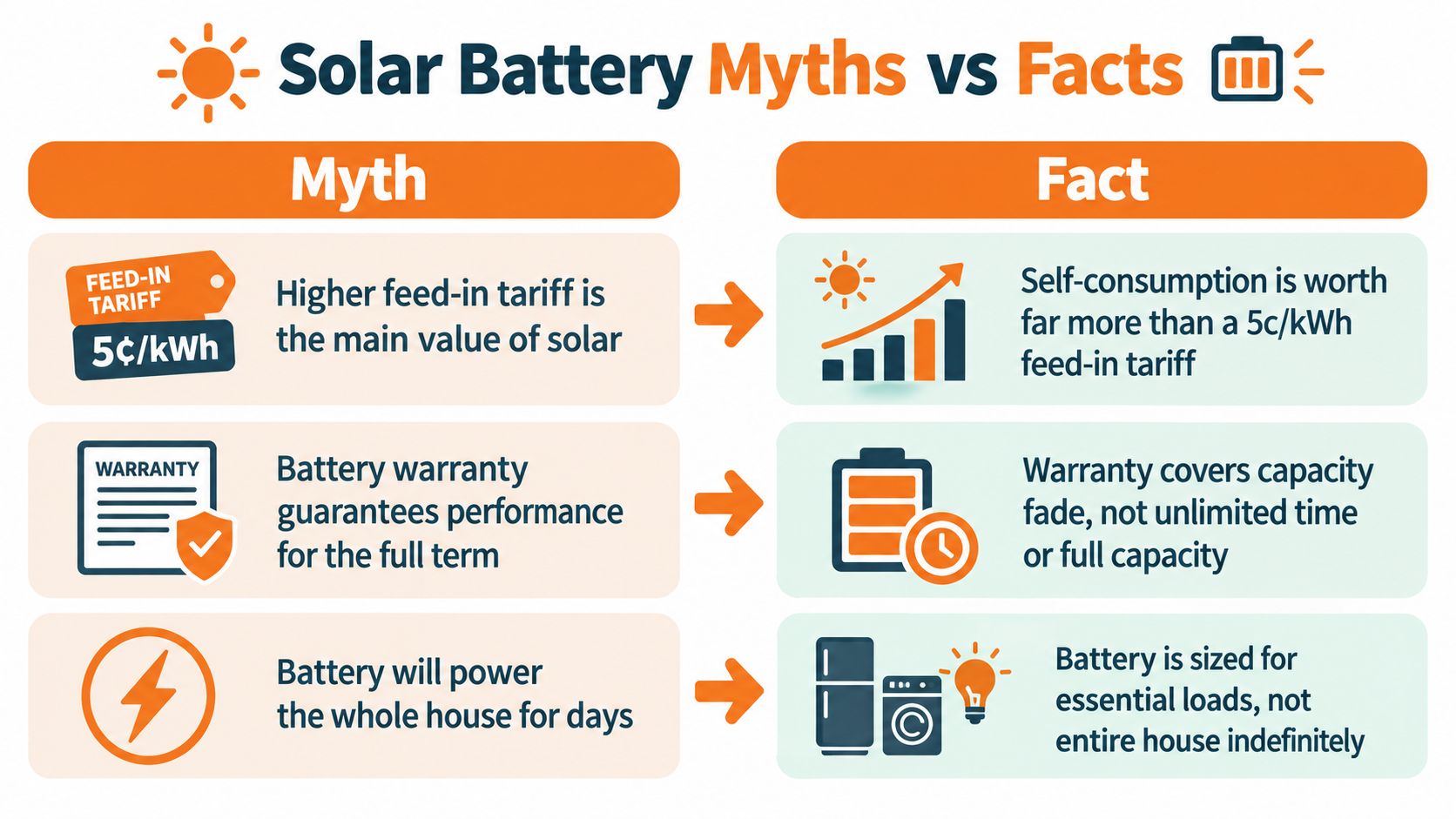
Myth one is that the feed-in tariff defines solar value
A high export rate can be useful, but it isn't the only measure. The household should compare the value of self-consumed and stored energy with the income from exporting it. Two otherwise identical homes can have different outcomes if one exports heavily at a low tariff while the other stores surplus and uses it during evening demand.
The better metric is the self-consumption ratio, supported by import reduction, tariff timing and battery losses. A household that exports less may still achieve a lower bill if it avoids more expensive purchases.
Myth two is that a warranty guarantees full performance
A warranty is a contractual protection, not a promise that the battery will deliver its original nameplate capacity indefinitely. Read the conditions covering capacity retention, operating temperature, cycling, installation, software and approved use. A VPP agreement should also explain how dispatch affects warranty compliance.
Myth three is that a VPP removes homeowner control
VPP participation doesn't mean continuous access to the battery. It normally operates through defined dispatch windows, reserve settings and consented controls. The homeowner should know when external dispatch can occur, how much energy remains protected, and how to leave the arrangement.
A battery also won't necessarily power every appliance indefinitely during an outage. Backup circuits, inverter output and stored capacity determine what remains available.
Practical Next Steps for Homeowners
A Queensland or New South Wales homeowner can assess battery utilisation without ordering a new system quote. Start with actual operating data, then test whether the current retail arrangement rewards the way the system behaves.
Download the last 12 months of consumption data. Use the retailer portal if interval data is available. Separate daytime, evening and overnight demand so the battery's target window becomes visible.
Review the inverter and battery app. Record solar generation, exported kWh, battery charging, discharge activity and reserve settings. Look for repeated days when the battery reaches a high state of charge early but still exports surplus solar.
Calculate the export ratio. Divide exported solar energy by total solar generation. An export ratio above 40% to 50% can indicate underused storage headroom, but treat that threshold as a screening signal rather than a guaranteed diagnosis. The result depends on season, shading, battery capacity and household demand.
Check the retail plan. Review time-of-use windows, supply charges, export rates, export caps and any battery or solar bonus. In South East Queensland, retailers set export offers, while regional Queensland has a regulated feed-in tariff structure, so the address matters.
Compare BYOB VPP terms. Check the allowance or credit structure, dispatch windows, reserve protection, export limits, app controls, warranty treatment, contract length and exit conditions. Confirm that the battery and inverter remain compliant with the relevant network and regulatory requirements.
The decision point is practical. If the battery is regularly full while the home exports substantial surplus, a better operating strategy may be worthwhile. If it rarely charges, the constraint may be solar yield, battery sizing or daytime demand. If it serves only as backup, compare the value of resilience with the potential value of controlled participation.
HighFlow Energy helps eligible Queensland and New South Wales households connect existing compatible solar and battery systems to a retailer-led BYOB VPP, using spare capacity for coordinated grid support while prioritising household energy needs. Visit HighFlow Energy to check eligibility and assess whether your battery could support a bill-free electricity allowance.