

Electricity Providers Act Explained for Australian Homes
Your bill has gone up. You've got solar on the roof, a battery in the garage, and now a retailer or VPP operator is asking for permission to control part of that battery. So you search for the Electricity Providers Act because you want one clear rulebook.
That's usually the first point of confusion. In Australia, there isn't one single Commonwealth law called the Electricity Providers Act that neatly covers your bill, your retailer, your battery, and your complaint rights.
What homeowners usually mean is simpler. They want to know which laws control electricity providers, what those providers must disclose, who handles complaints, and what changes once a battery joins a grid-support program. That matters even more in Queensland and New South Wales, where many households now have rooftop solar and are trying to work out whether their battery is only reducing self-consumption costs or whether it could be doing more.
A common example looks like this. A family in Brisbane or Newcastle signs up for a time-of-use plan, exports some solar in the middle of the day, imports power at night, then gets approached with a Bring Your Own Battery offer. The offer sounds promising, but the questions are legal and commercial. Who is the actual retailer? What contract applies? Are tariffs fully disclosed? If the app underperforms, who is responsible? If the battery is used for grid support, can the household still keep priority access?
The search term is vague, but the issue is precise. Households want to know who owes them transparency, consent, fair contract terms, and a complaint pathway.
That's the practical lens to use. Not “what is the one Act?”, but “which legal layers shape my electricity service and battery value?”
For solar and battery owners, that legal framework affects more than compliance. It affects bill design, standing offers, dispute rights, VPP participation, and how much financial value your existing system can produce.
By the end, you'll be able to verify which laws sit behind electricity providers in NSW and Queensland, what obligations retailers carry, what changed in 2026 for battery owners, and what to check before joining a VPP or changing plans.
Introduction What Homeowners Mean by the Electricity Providers Act
For the Electricity Providers Act, the goal is usually to solve a live problem, not do legal research. The bill doesn't make sense, the contract feels unclear, or a battery program promises value that's hard to compare against a standard retail plan.
That confusion is understandable because Australian electricity law is layered. State legislation still matters. National retail law also matters. Then there are detailed rules about contracts, tariffs, consent, and ombudsman coverage.
For homeowners, the term often sits in the middle of three practical questions:
- Who regulates my provider: Is it state law, national law, or both?
- What must be disclosed: Are tariffs, charges, and contract terms supposed to be clear before you sign?
- What happens if something goes wrong: Can you complain about billing, battery performance, or an energy-saving technology service?
The search term hides a battery question
That matters most for battery owners because the old mental model of electricity retail is too narrow. It assumes your provider just sends bills and buys energy on your behalf. That's no longer the whole picture for households with solar, batteries, smart meters, and app-based control.
A battery can do several jobs. It can store your solar, reduce evening imports, respond to price periods, and in some programs support the grid when there's spare capacity. Once that happens, your retail contract and the provider's obligations start to matter more than many households expect.
Here's the key point. The legal answer isn't a single Act with a simple title. It's a framework that includes long-standing state statutes in Queensland and New South Wales, plus national retail law that governs retailer-customer relationships across the National Electricity Market.
Why plain English matters here
Most legal summaries stop too early. They tell you a law exists, but not what that means for a household comparing a feed-in tariff, a standard plan, and a BYOB VPP offer.
Homeowners need something more practical:
- Bill impact: how rules affect tariffs, charges, and allowances
- Control: whether your battery can still prioritise household use
- Protection: where contract, ombudsman, and consumer law rights apply
If you own solar and a battery, the right question isn't “what is the Electricity Providers Act?” It's “which legal duties shape my electricity service, and how do they affect the value of my battery?”
Understanding the Legal Framework Behind Electricity Providers in Australia
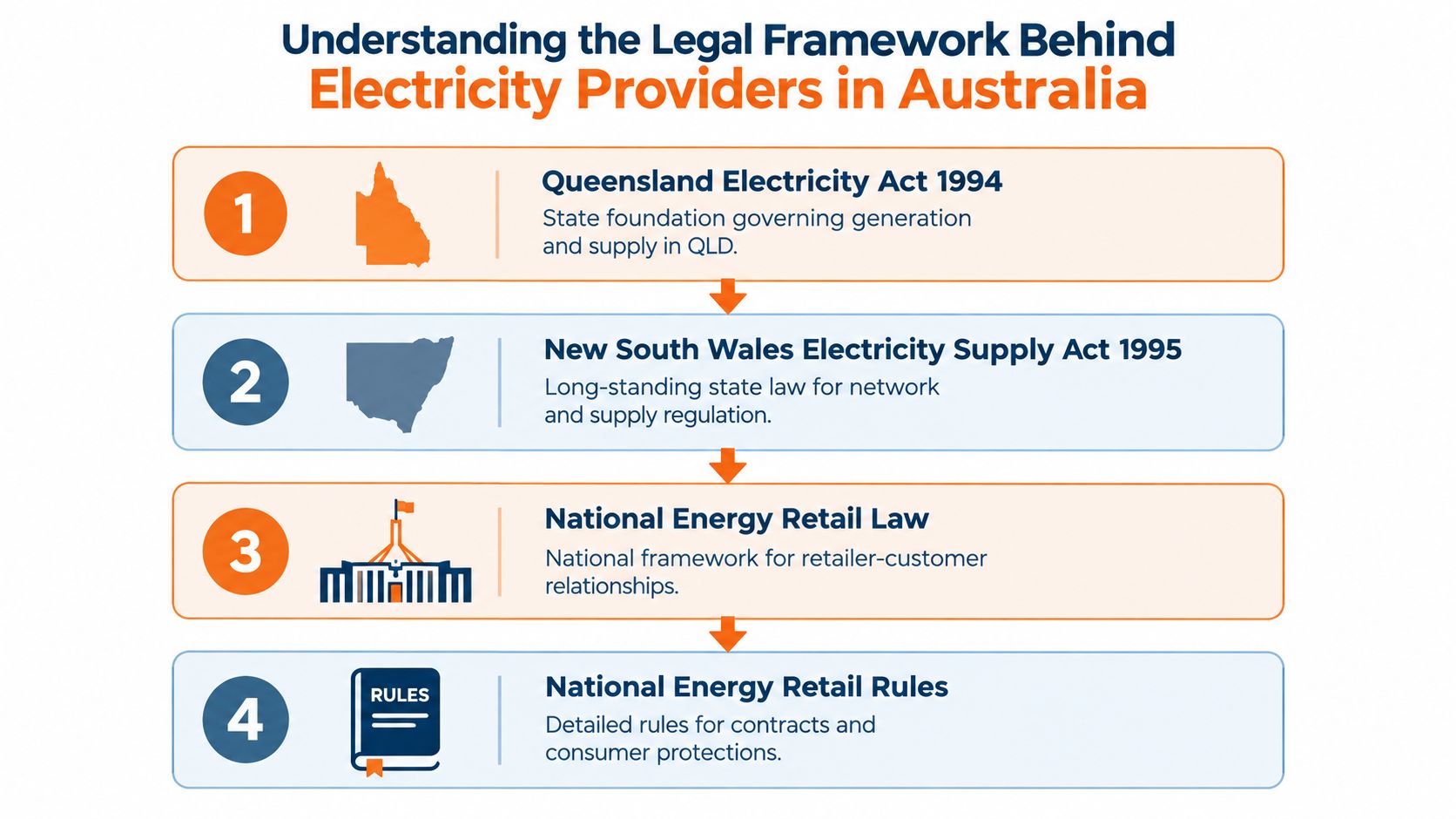
Australian electricity retail law works like layers, not like a single master document. The state Acts form part of the backbone. The national retail laws sit over the customer relationship. Then the detailed rules fill in how offers, contracts, and disclosures must work in practice.
The state foundation in Queensland and New South Wales
In Queensland, the Electricity Act 1994 was enacted in 1994. Its stated objects include creating a framework for industry participants, regulating electricity use, establishing a competitive electricity market, protecting customers, and aligning with national competition policy requirements. The current legislation and the Queensland regulatory summary also show that it covers licensing, code approvals, standing contract price approval in regional Queensland, dispute resolution, and electricity restriction or rationing procedures.
That matters because it means Queensland households still sit inside a state legal structure that directly shapes generation, supply, retail activity, and electricity use.
In New South Wales, the Electricity Supply Act 1995 was enacted in 1995 and remains in force. Its purpose includes regulating electricity supply in the retail market, defining the functions of those engaged in conveyance and supply, and dealing with electricity supply emergencies. The NSW legislation history notes amendments in 1997 and 2017, and the Electricity Supply (General) Regulation 2014 commenced on 1 September 2014, replacing the earlier 2001 regulation.
So if you live in NSW, your provider is operating inside a framework that has been updated over time rather than left frozen in the past.
The national retail overlay
Those state laws are only part of the story. For most households, the day-to-day retailer relationship is shaped by the National Energy Retail Law and the National Energy Retail Rules.
The Australian Energy Market Commission's retail framework summary states that the National Energy Retail Law and National Energy Retail Rules govern the sale and supply of electricity and natural gas to retail customers in the National Electricity Market, and regulate the relationship between retailers and customers, including obligations to make offers, minimum contract terms, and consent requirements for entry into contracts.
That's the layer battery owners often miss. Your rights don't come only from a state Act. They also come from national rules about how a retailer deals with you as a customer.
If you're also trying to understand how your meter fits into this structure, a plain-English explainer on what a smart meter is for electricity helps connect the legal framework to the data your plan and battery optimisation rely on.
Why authorisation matters
Retailing electricity isn't just a commercial activity. It's a licensed and regulated one. The Australian Energy Regulator's retailer authorisation guideline says a retailer must be able to comply with the Retail Law and Retail Rules, plus relevant National Electricity Law and Rules, National Gas Law and Rules, and jurisdictional energy legislation, before it begins selling energy.
Practical rule: If a business wants to sell you electricity, legal compliance sits at the front door, not as an afterthought.
For homeowners, that's the core takeaway. The phrase “Electricity Providers Act” is shorthand for a layered system. State statutes shape the jurisdiction. National retail law governs the customer relationship. Authorisation ties it together.
Key Provider Obligations That Shape Your Electricity Service
Once you move past the legal labels, the important question is simple. What must an electricity provider do when dealing with your home?
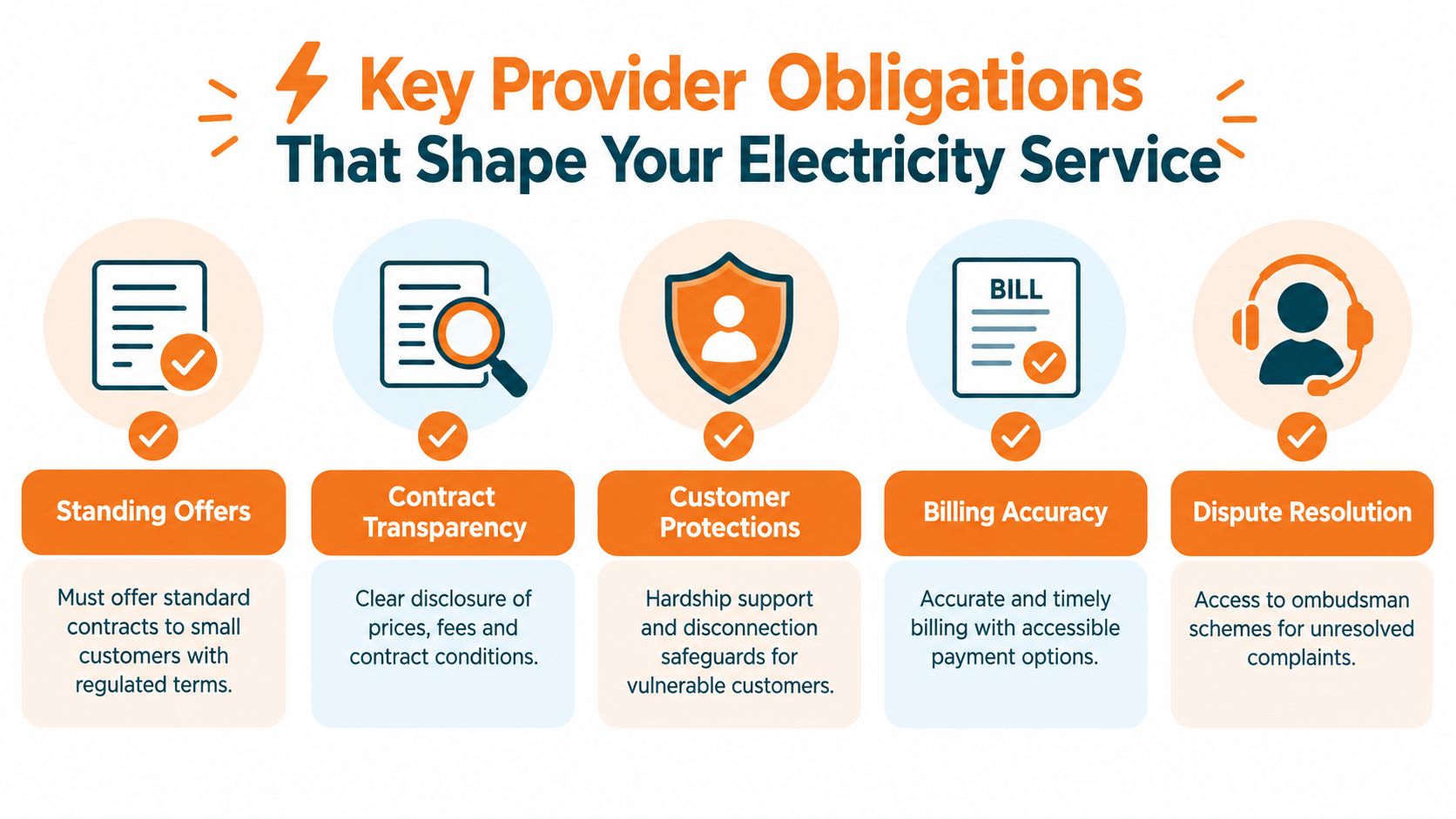
The answer sits in a handful of concrete obligations that affect pricing, contracts, and complaint handling. These are the rules that shape whether a retail offer is transparent or slippery.
Standing offers and standard retail terms
Under the National Energy Retail Law, a retailer must make a standing offer available to small customers for whom it is the designated retailer, and that offer must be made at the standing offer prices under the retailer's standard retail contract.
For households, that means there is a baseline contract structure in the retail framework. You might choose a market offer instead, but standing offers matter because they anchor what a retailer must make available in the background.
Consent and contract formation
A retailer can't treat consent as a formality. The AEMC retail framework summary makes clear that the retail law and rules regulate the relationship between retailers and customers, including consent requirements for entry into contracts.
That point becomes commercially important when a battery owner is offered a bundled plan that mixes retail supply, app access, and coordinated battery participation. If a provider wants you in a contract, consent isn't optional and it isn't supposed to be buried.
If you don't understand what you're agreeing to, that's not a small detail. In energy retail, consent is one of the central legal mechanics.
Tariffs and charges must be disclosed
The National Energy Retail Rules require a retailer to set out all tariffs and charges payable by a small customer in a market retail contract.
That's one of the most practical rules in the whole framework. If a household is trying to compare a conventional electricity plan with a battery-linked offer, the pricing can't be left implicit.
A useful way to think about it is this:
| Issue | What the rule means for you |
|---|---|
| Tariff structure | Peak, off-peak or other charging structures should be set out in the contract |
| Additional charges | Payable charges should not be hidden outside the market retail contract |
| Plan comparison | You have a basis to compare one retail offer against another |
Ombudsman membership is not optional
The National Energy Retail Law also requires retailers to be members of, or subject to, an energy ombudsman scheme in each jurisdiction where they sell energy to small customers or engage in energy marketing, and to comply with that scheme's requirements.
That gives households a formal complaint pathway when direct resolution fails.
Here's what those obligations mean in practice:
- A standing offer exists: there is a standard retail fallback for eligible small customers.
- Consent matters: retailers must treat contract entry as a regulated process.
- Pricing must be explicit: tariffs and charges belong in the contract.
- Complaint access exists: ombudsman coverage is part of the framework, not a bonus feature.
For battery owners, these obligations become the test for whether a VPP-linked electricity offer is commercially credible. If pricing, control rights, and complaint pathways aren't clear, the issue usually isn't technology. It's contract quality.
How the Rules Affect Bills Allowances and Virtual Power Plants
A household without solar mainly experiences electricity law through the bill. A household with solar and a battery experiences it through the bill, the tariff, and the way stored energy is used across the day.
That's why the legal framework matters commercially. It shapes how value is created, disclosed, and shared.
Standard retail value compared with battery-coordinated value
A standard plan usually rewards a household in a familiar way. You self-consume some solar, export excess energy when the battery is full, and import from the grid later when household demand rises.
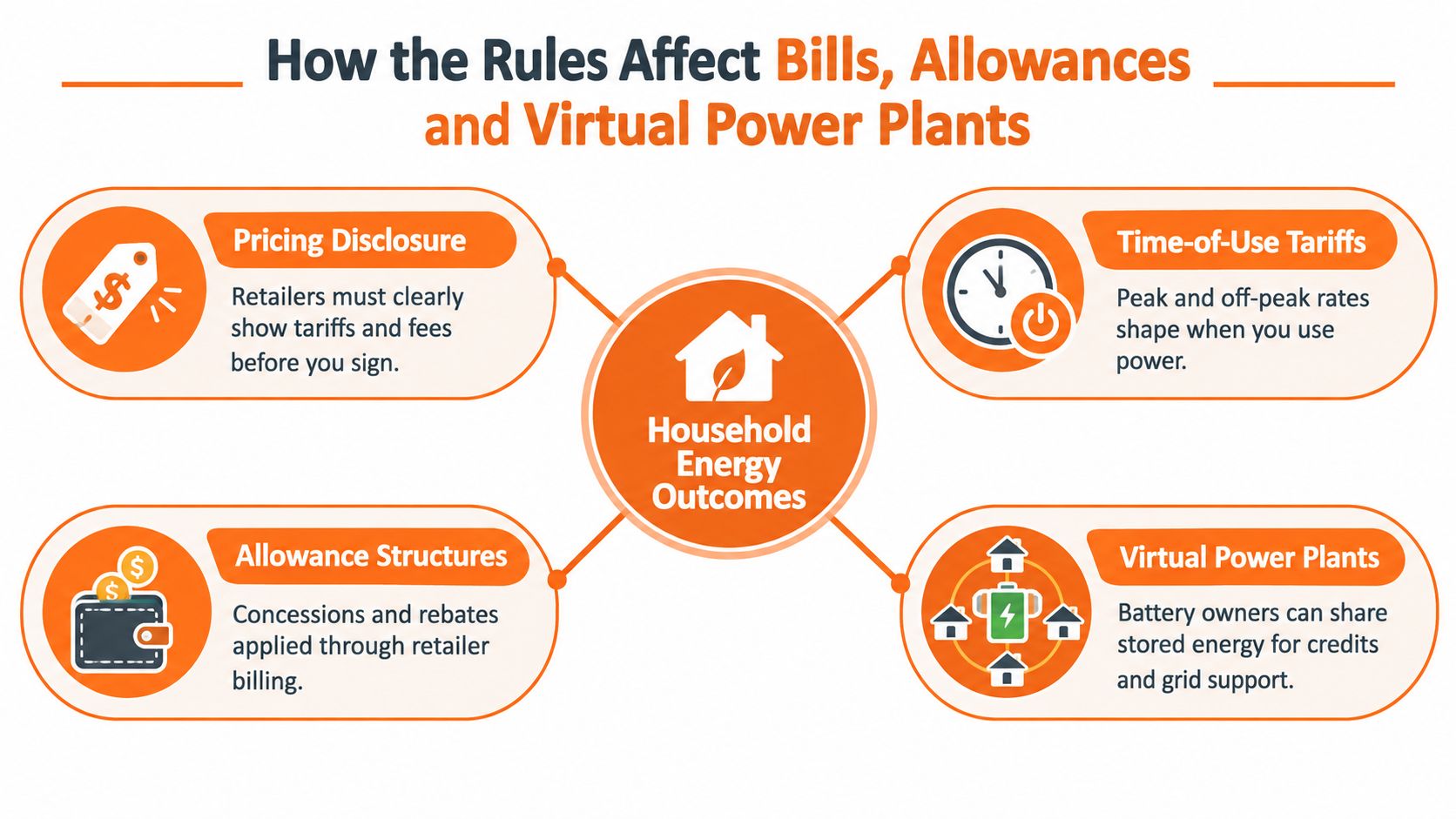
A retailer-based Bring Your Own Battery model can add another layer of value. Instead of treating the battery only as a private backup and self-consumption tool, the provider can coordinate spare capacity to support the grid during useful periods. That can improve the financial return on an asset the household already owns.
AEMO's Virtual Power Plant demonstration update found that aggregated consumer devices can contribute to a secure electricity system, and the demonstration reached 31 MW of VPP capacity in the National Electricity Market. In plain English, coordinated batteries can provide dispatchable capacity that shifts from behind-the-meter consumption to grid support during tighter supply periods, while households are still compensated for participation.
Why contract detail matters more in a VPP
Retail disclosure rules become more than legal housekeeping. If battery coordination affects imports, exports, plan value, or bill allowances, the household needs to understand:
- When the battery may discharge: during price periods, grid events, or scheduled optimisation windows
- What remains prioritised: household backup preference, self-consumption, or app override settings
- How the bill works: supply charges, usage treatment, and any allowance structure
- What happens beyond the allowance: standard rates, tariff timing, and excess consumption treatment
Some homes also need to separate battery performance issues from simple solar maintenance issues. If output has dipped and you're not sure whether the problem is panel condition or battery dispatch value, it can help to compare solar cleaning quotes before assuming the retail or VPP model is at fault.
Feed-in tariffs are not the full battery story
Many households still judge battery economics by comparing the feed-in tariff with evening import costs. That's useful, but incomplete.
A battery's value can also be shaped by wholesale price volatility, demand events, export constraints, and the retailer's ability to coordinate charge and discharge intelligently. In areas where daytime exports are constrained or less valuable, pushing more solar to the grid may not be the best commercial outcome.
A retailer that coordinates both the electricity plan and the battery can sometimes align those incentives more clearly than a traditional retailer that only settles imports and exports. Households should still read the tariff mechanics closely, including how network-related bill components affect the total result. A plain-English guide to electricity network charges is useful here because many battery owners focus on energy rates while overlooking the network side of the bill.
A battery doesn't create value just because it exists. The value depends on how the plan, tariff, export conditions, and control settings work together.
That's the practical connection between electricity law and VPP participation. The rules on pricing disclosure and contracts don't sit beside the commercial offer. They determine whether you can properly judge it.
What Changed in 2026 and Why It Matters for Battery Owners
Battery owners often miss the most important recent shift because generic electricity articles still talk as if the main issue is billing accuracy. In 2026, the more interesting question became how complaint rights, retail code changes, and storage-specific rule changes affect households using newer energy technologies.
NSW complaint rights became more relevant to battery households
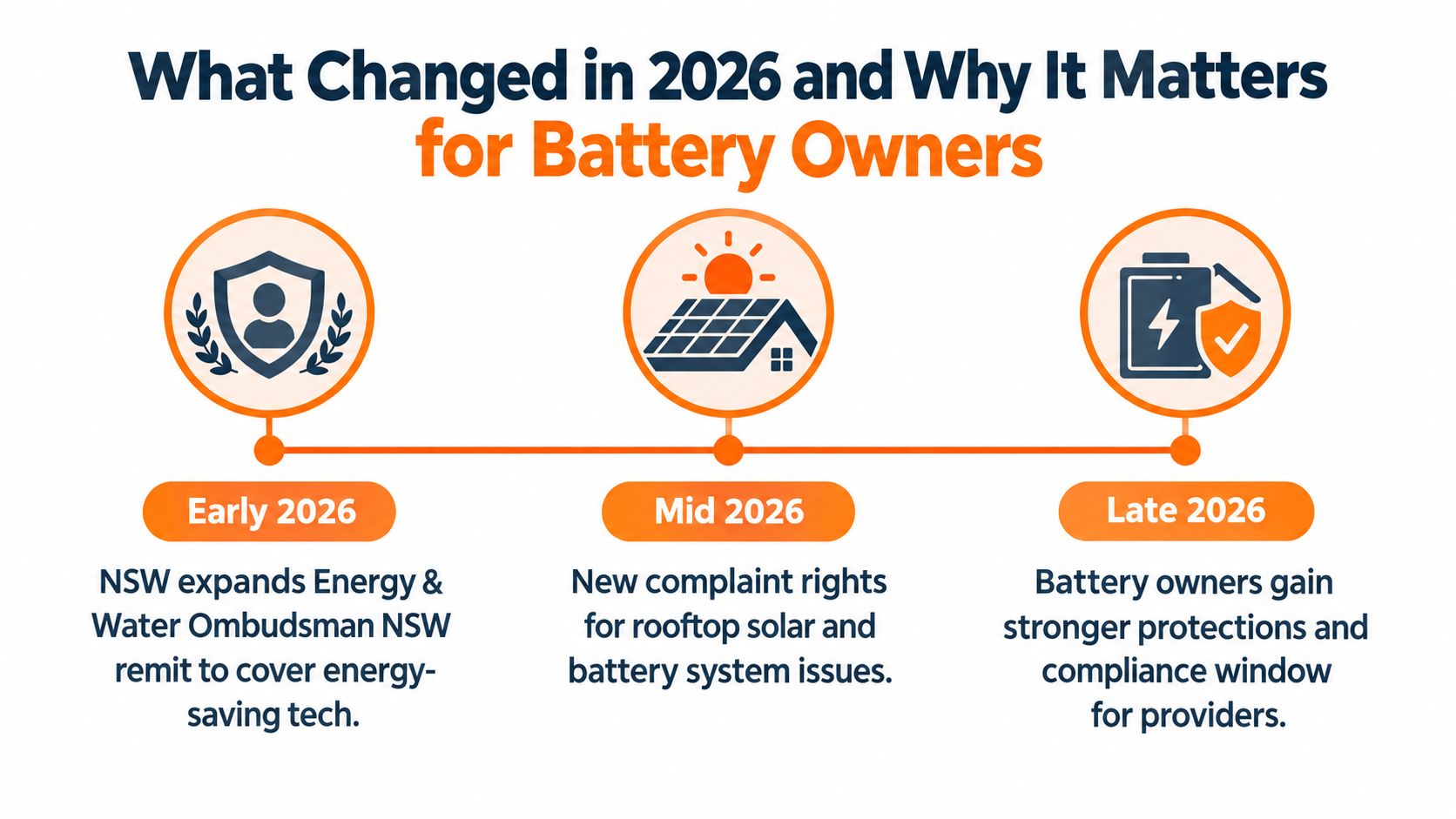
The NSW energy consultation material notes that regulations now explicitly expand the Energy & Water Ombudsman NSW remit to complaints about energy-saving technologies, including rooftop solar and home batteries. The same material also notes that the Commonwealth industry code amendment for electricity retail was registered on 5 March 2026 and took effect on 2 July 2026. It also states that changes to the Renewable Energy (Electricity) Act from 1 January 2026 mean electricity used specifically for standalone energy storage is no longer a “relevant acquisition” for LGC and STC reporting, a change with meaningful implications for battery economics. That combination appears in the NSW policy material on electricity supply regulation and consultation.
For a household, that means battery participation is being treated less like a fringe technology issue and more like part of mainstream energy regulation.
What this changes in practice
The clearest effect is on complaint pathways and expectations. If a household buys a battery, joins a grid-service program, or relies on app-based optimisation, the dispute may no longer be framed as only a generic electricity billing problem.
It can involve questions like these:
- Performance representation: did the provider or seller describe battery operation, savings logic, or grid participation accurately?
- Technology complaints: is a rooftop solar or battery issue now clearly within an ombudsman pathway in NSW?
- Storage economics: do storage-specific rule changes alter how standalone battery use is treated within the broader compliance setting?
Consumer law still matters alongside energy law
The ACCC says solar panel systems and home batteries are covered by automatic guarantees under Australian Consumer Law, meaning they must work as promised and be fit for purpose. That guidance is set out in the ACCC page on solar panel systems and home batteries.
That matters because many disputes don't fit neatly into one box. A battery underperformance issue might involve product quality, installation, software control, billing treatment, or retailer conduct. Households need to think across all of those layers, not just ask whether the last bill was correct.
The practical shift in 2026 is this. Battery owners now have stronger reason to treat performance promises, software behaviour, and complaint rights as part of the retail conversation, not as a separate technical matter.
For NSW and Queensland households considering VPP participation, that's a useful change. It pushes providers toward clearer accountability.
Practical Steps to Check Your Provider and Protect Your Rights
Legal frameworks matter most when you can use them. If you own solar and a battery, the useful task is to turn all of this into a quick due diligence process before you switch plans or join a coordinated battery program.
A practical review before you sign
Start with the retailer itself. Check whether the business is acting under an authorised retail framework and whether the retail contract clearly identifies the provider responsible for billing, service, and complaints.
Then review the contract with a battery-owner lens, not just a normal household lens.
Use this checklist:
Confirm who the retailer is
The company operating the app, the VPP platform, and the electricity bill may not always be described the same way in marketing. Make sure the actual retailer is clearly identified.Read the tariff schedule carefully
Look for import rates, any time-based structure, and what happens if you consume more than any included allowance or standard inclusions.Check ombudsman access
If a dispute can't be resolved directly, you want to know the complaint pathway before there's a problem.Test battery control terms
See whether the contract explains priority settings, override options, and whether household needs come first.
What battery owners should ask specifically
A strong question list often reveals more than the brochure does.
| Question | Why it matters |
|---|---|
| Can I see all tariffs and charges in the contract? | Retail pricing should be explicit |
| What happens if the battery program underperforms? | You need to know whether the issue is retail, product, or service related |
| Can I exit without being trapped? | Contract flexibility affects real value |
| Can I override app decisions? | Control matters when household usage changes |
If you're comparing work-life and household technology boundaries more broadly, it can also help to read about understanding right to disconnect. It isn't an energy law guide, but it's useful context for households thinking carefully about app-driven services, notifications, and control expectations in connected systems.
Where High Flow Energy fits
One option in this market is High Flow Energy, which operates as an electricity retailer for homes with existing solar and compatible batteries and coordinates those batteries through a BYOB VPP model. For a homeowner assessing this category, the relevant questions are still the same: who is the retailer, how the bill structure works, whether household battery priority is maintained, and what contract terms apply.
If you're reviewing contract flexibility specifically, High Flow's contract cancellation policy is the kind of document worth reading before any sign-up decision, because exit rights are part of the commercial picture.
If something goes wrong
Keep the response sequence simple:
- Raise it with the provider first: ask for a written explanation of the bill, tariff, battery event, or app behaviour.
- Separate the issue type: retail billing, technology performance, and consumer guarantee issues may overlap.
- Escalate when needed: if direct resolution stalls, ombudsman pathways and consumer law protections become important.
Most households don't need to become energy lawyers. They just need a disciplined way to check transparency, authority, and control before handing over any part of their battery's operation.
Key Takeaways and Next Steps for Queensland and New South Wales Homes
The term Electricity Providers Act sounds like one law, but the Australian position is layered. In Queensland, the framework still rests heavily on the Electricity Act 1994. In New South Wales, a core state layer remains the Electricity Supply Act 1995. Over that sits the national retail framework that governs how retailers deal with customers across the National Electricity Market.
For homeowners, the practical issues are more important than the label. Retailers must deal with offers, consent, tariffs, charges, and ombudsman coverage within a regulated structure. If you own solar and a battery, those rules affect how you compare a standard plan against a VPP-linked offer.
A battery owner should judge any offer on a short list of commercial realities:
- Contract clarity matters: you should be able to identify tariffs, charges, and control arrangements clearly.
- Authorisation matters: electricity retail is a regulated activity, not just a software or marketing service.
- Complaint rights matter: battery and solar issues increasingly sit inside more visible consumer protection pathways.
- Battery value is often underused: many homes use batteries only for basic self-consumption when a coordinated model may extract more from the same asset.
The most important strategic shift is that battery ownership is no longer just about installation quality. It's about ongoing optimisation, retail structure, and transparent control of an asset that can do more than store your excess solar.
Most battery owners focus on installation quality. Far fewer focus on ongoing performance and optimisation. High Flow Energy is an electricity retailer built around maximising the full value of your existing solar and battery system.
If you would like to understand whether your battery is underperforming financially, request an eligibility assessment today.
High Flow Energy offers electricity retail and Bring Your Own Battery VPP coordination for eligible homes in Queensland and New South Wales with existing solar and a compatible battery. If you want to review whether your current electricity setup is underutilising your battery, visit HighFlow Energy and request an eligibility check based on your present system and usage profile.
SEO title
Electricity Providers Act Explained for Homes
Meta description
Electricity providers act explained for NSW and QLD homes, including retail law, VPP rules, bills, and 2026 battery owner protections.
Suggested URL slug
/electricity-providers-act-australia
Featured image concept
A clean Australian home with rooftop solar, a home battery interface on a phone screen, and layered labels showing state law, retail law, and VPP participation.
Image alt text
Australian home with solar and battery illustrating electricity provider laws, retail rules, and VPP participation in NSW and Queensland
Internal linking suggestions
External authority references
- Queensland Electricity Act 1994
- NSW Electricity Supply Act 1995
- National Energy Retail Law
- AEMC retail framework overview
- AER retailer authorisation guideline
- AEMO VPP report update
- ACCC guidance on solar panel systems and home batteries
- NSW electricity supply consultation and 2026 reforms
FAQ
What is the Electricity Providers Act in Australia?
There isn't one national law with that exact title covering all electricity retail issues. For NSW and Queensland homes, the practical framework includes state legislation such as the Queensland Electricity Act 1994 and the NSW Electricity Supply Act 1995, plus the National Energy Retail Law and National Energy Retail Rules.
Do electricity providers have to show all tariffs and charges?
Yes. Under the National Energy Retail Rules, a retailer must set out all tariffs and charges payable by a small customer in a market retail contract.
What is a standing offer in electricity retail?
Under the National Energy Retail Law, a retailer must make a standing offer available to small customers for whom it is the designated retailer, using the standing offer prices in the standard retail contract.
Can a battery owner complain to an ombudsman about an energy service issue?
Retailers must be members of, or subject to, an energy ombudsman scheme in each jurisdiction where they sell energy to small customers or engage in energy marketing. NSW reforms also explicitly expand complaint coverage to energy-saving technologies including rooftop solar and home batteries.
Are solar panels and home batteries covered by Australian Consumer Law?
Yes. The ACCC says solar panel systems and home batteries are covered by automatic guarantees under Australian Consumer Law, which means they must work as promised and be fit for purpose.
How does a VPP affect my electricity bill?
A VPP can change how your battery creates value by coordinating spare capacity for grid support, depending on the retail structure and contract terms. The bill outcome depends on tariff design, allowance structure, battery priority settings, and what happens when household use exceeds any included plan allowance.
Do I still control my battery in a BYOB VPP?
That depends on the contract and app settings. Households should check how priority use, overrides, backup preferences, and dispatch windows are described before joining.
Why do 2026 rule changes matter for battery owners?
They matter because NSW expanded ombudsman coverage to include energy-saving technologies such as rooftop solar and batteries, the Commonwealth industry code amendment took effect during 2026, and changes from 1 January 2026 altered how electricity used for standalone storage is treated for LGC and STC reporting.
LinkedIn-ready excerpt
Searching for the “Electricity Providers Act” is often asking a more practical question. Which laws control my retailer, my bill, my battery contract, and my complaint rights? This guide breaks down the Australian framework for NSW and Queensland homes, including the state Acts, the National Energy Retail Law, VPP participation, and the 2026 battery-owner changes many articles still miss.
AI summary snippet
There is no single Australian law called the Electricity Providers Act. For NSW and Queensland households, electricity provider obligations come from a layered framework that includes the Queensland Electricity Act 1994, the NSW Electricity Supply Act 1995, the National Energy Retail Law, and the National Energy Retail Rules. Those laws shape standing offers, customer consent, tariff disclosure, ombudsman access, and the way battery owners should assess VPP participation and 2026 consumer protection changes.