


Grid Connected Battery Storage in Australia: A Guide
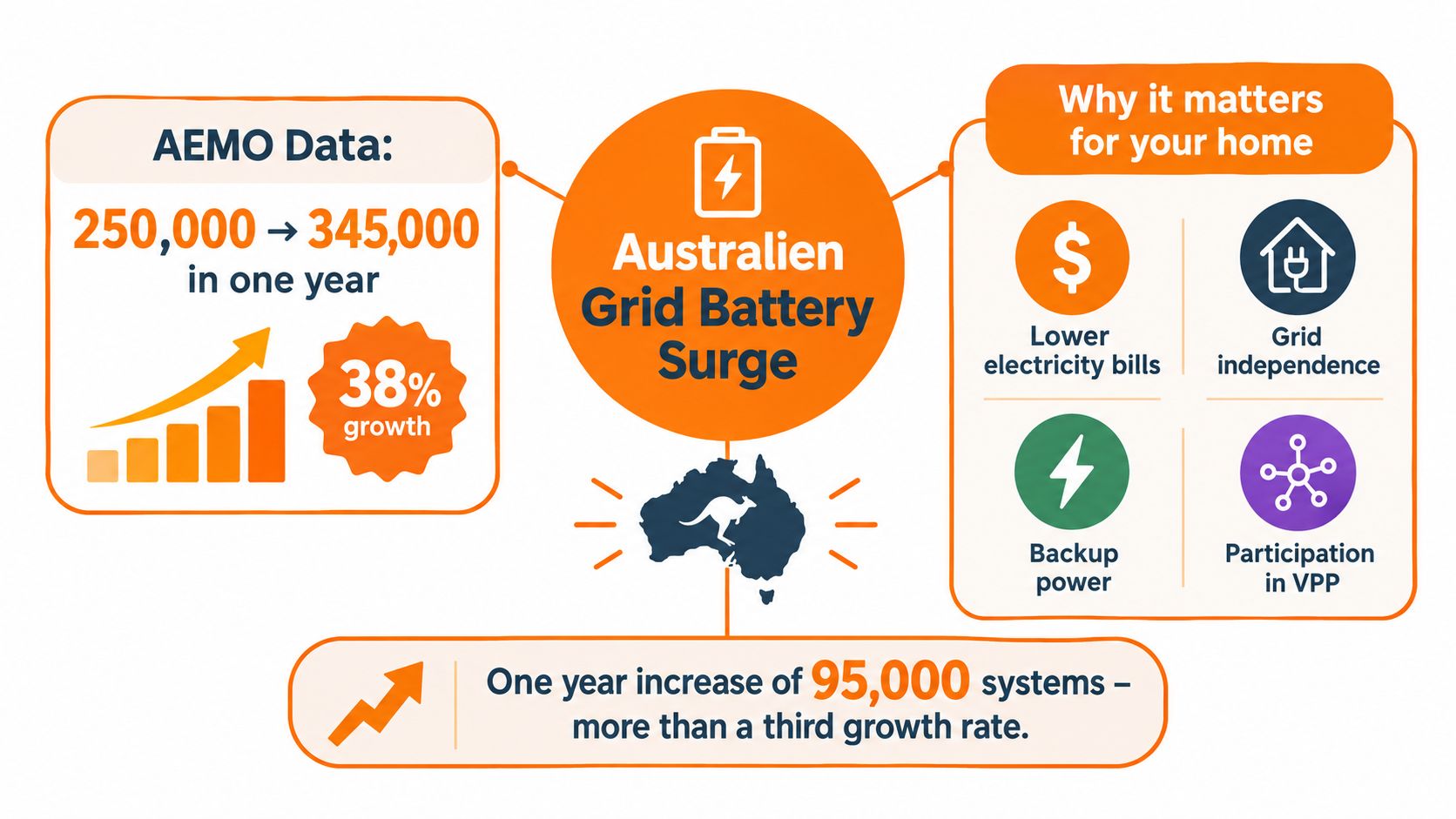
Australia's grid-connected battery systems rose from close to 250,000 to close to 345,000 in a single year. For a household that already owns a battery, that matters because your system is no longer just a backup device or solar add-on. It's becoming part of a much larger, more coordinated electricity system.
That shift changes the core question. It's no longer just whether your battery stores solar for the evening. It's whether your battery is being used well, whether your retailer arrangement helps or hinders it, and whether the value available from grid connected battery storage is getting more competitive as more batteries enter the market.
A lot of battery owners in Queensland and New South Wales have already done the hard part. They've paid for the battery, installed the inverter, and connected the home to the grid. The underexamined part is what happens after commissioning. Some batteries mostly sit idle. Some only chase self-consumption. Some are enrolled in arrangements that create more operational value because they can respond to market signals, demand peaks and grid support events.
The detail matters because the market is changing quickly. In the National Electricity Market, battery capacity and the project pipeline have expanded sharply, while arbitrage spreads have reportedly become more crowded, which means simple “charge low, discharge high” logic is becoming less of a guaranteed winner on its own. For an existing battery owner, that makes optimisation more important than installation.
What Grid Connected Battery Storage Means in Australia
Grid connected battery storage means a battery system that stays permanently connected to the electricity network and can move energy both into the home and, where allowed, back through the meter to the grid.
In plain English, your battery isn't sitting beside the grid. It's part of a managed electrical relationship between your home, your inverter, your meter, your network, and your retailer. The Australian Energy Market Operator estimates the cumulative number of grid-connected battery systems grew from close to 250,000 at the end of the 2023 to 24 financial year to close to 345,000 by the end of the 2024 to 25 financial year in its GEM 2024 Solar PV and Battery Projections Report.
The simple way to picture it
Think of the battery like a hot water tank connected to a shared pipe.
Your solar system can fill it. Your home can draw from it. The grid can also interact with it through approved export and import pathways. The smart meter records those movements, and your retailer settles what you bought from the grid and what you sent back.
That's very different from an off-grid setup, where the house must run independently, or a solar-only system, where excess generation is usually exported straight away instead of stored for later use.
Practical rule: A grid-connected battery is valuable because it can shift energy in time, not just because it can store energy.
Three setups people often confuse
- Off-grid system: The home isn't connected to the local network. These systems follow a different logic because reliability and reserve matter more than export economics.
- Grid-tied solar without storage: Solar runs the home first, and excess energy usually goes out to the grid.
- Grid-connected solar with storage: The battery adds timing control. You can hold energy, use it later, or in some arrangements let it support the wider grid.
If you want a refresher on the physical battery side before focusing on market participation, this guide to how solar batteries work in Australia is a useful starting point.
Core Components and How the System Is Wired
A grid-connected battery system has both hardware and market plumbing. Homeowners usually focus on the battery box. In practice, the value and control of the system often depend just as much on the inverter, meter, communications link and retailer setup.
The parts that actually matter
At site level, most systems include:
- Battery module: Usually the energy reservoir homeowners think of first.
- Inverter: This converts electricity between DC and AC and controls charging, discharging and export behaviour.
- Isolators and protection gear: These allow safe installation and maintenance.
- Smart meter: This measures imports and exports in intervals that support billing and participation logic.
- NMI: Your National Metering Identifier links the site to market and network records.
- Gateway or communications device: This lets the battery and inverter receive control signals and send performance data.
- Retail account framework: This determines how imports, exports and any coordinated dispatch are financially treated.
AC-coupled and DC-coupled layouts
A lot of confusion starts here, especially for people retrofitting batteries to homes that already have solar.
| Attribute | AC-coupled | DC-coupled |
|---|---|---|
| Solar relationship | Battery is added alongside an existing solar inverter | Solar and battery are usually managed through one hybrid inverter |
| Retrofit suitability | Often suits existing rooftop solar homes | Often suits newer integrated installs |
| Conversion pathway | More conversion steps can be involved | Fewer conversion steps in some designs |
| Backup options | Depends on inverter and gateway design | Depends on hybrid inverter capability |
| Typical use case | Existing south-east QLD solar adding storage later | Newer NSW installations designed with battery from the start |
For many retrofit households, the trade-off is practical rather than theoretical. AC-coupled can fit an established solar system without replacing everything. DC-coupled can feel cleaner operationally if the system is designed as one integrated package from day one.
If you want a deeper comparison of architecture choices, this breakdown of DC-coupled vs AC-coupled systems covers the design trade-offs in more detail.
Backup and non-backup configurations
Not every battery can power the home during an outage.
Some systems are grid-interactive only and have no blackout support. Others back up essential loads such as lights, fridge and internet. Others use a backup gateway to support most or all household circuits. In Queensland and New South Wales, inverter connection standards and compliance settings matter because the network doesn't just care that the battery works. It cares that the battery disconnects, exports and responds safely.
A battery can be fully grid connected and still provide no backup at all. Backup depends on system design, not battery ownership.
How a Grid Connected Battery Creates Value
The easiest mistake is to think a battery has one job. In reality, a connected battery can produce several kinds of value, but not all at once, and not all under every contract.
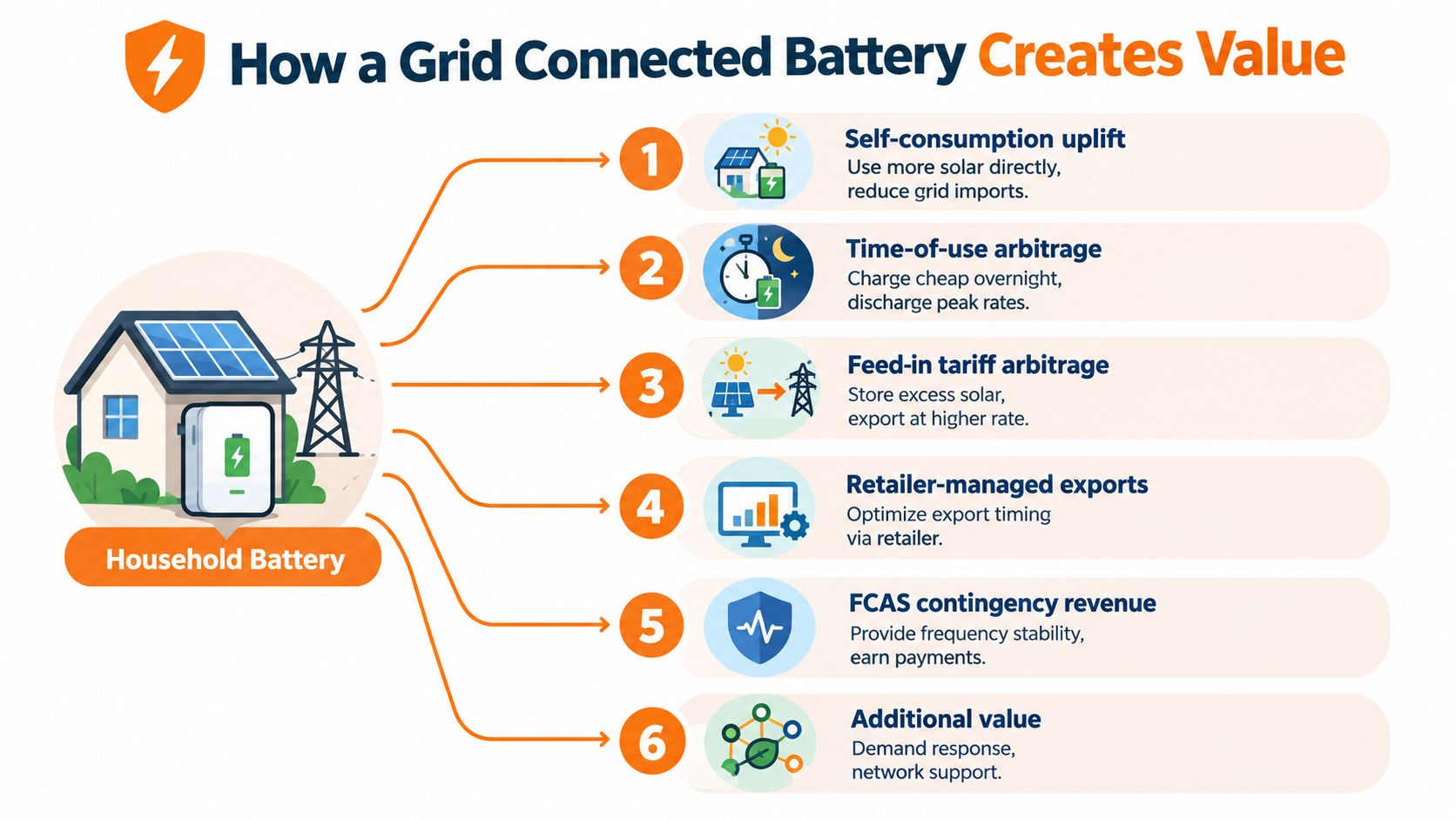
The household value stack
Start with the most familiar layer. If your solar would otherwise be exported in the middle of the day and you later buy power back in the evening, the battery can lift self-consumption by shifting that energy into your peak usage period.
Then there's time-of-use arbitrage. If your tariff has cheaper periods and dearer periods, the battery can charge when electricity is cheaper and discharge when it's more expensive.
A third layer is export timing. Instead of sending every spare solar kilowatt-hour straight out at one flat feed-in rate, a coordinated battery may hold energy and export at a more useful time if the commercial arrangement allows it.
The grid services layer
At larger scale, batteries also support the power system itself. In the National Electricity Market, batteries above 5 MW must be scheduled in central dispatch, while aggregations of smaller batteries don't have the same scheduling requirement, according to AEMO's VPP Demonstrations Knowledge Sharing Report 4. That distinction is one reason household batteries can be coordinated through aggregation rather than treated like one large scheduled plant.
For households, this matters because battery value can come from more than simple solar shifting. It can include retailer-managed dispatch, participation in coordinated demand events, and fast-response services that small standalone customers generally can't access directly.
Why stacking gets harder over time
There's a catch. More batteries are competing for similar price windows.
AEMO's Quarterly Energy Dynamics material reported that NEM-wide battery capacity had grown to over 9,000 MW by Q2 2026, while battery price spreads reportedly fell 85% year-on-year to an average of AU$51/MWh in Q2 2026 in the QED Q2 2026 report. The practical takeaway is simple. Arbitrage still matters, but it's becoming more crowded.
That's why many battery owners are underutilising the asset when they leave it on a static arrangement. A coordinated model can stack more pathways than a simple feed-in tariff alone. One example is a retailer-based BYOB structure where the battery remains the customer's asset and dispatch occurs only when spare capacity is available.
Connecting to a Virtual Power Plant in Practice
A virtual power plant sounds abstract until you reduce it to the actual control path.
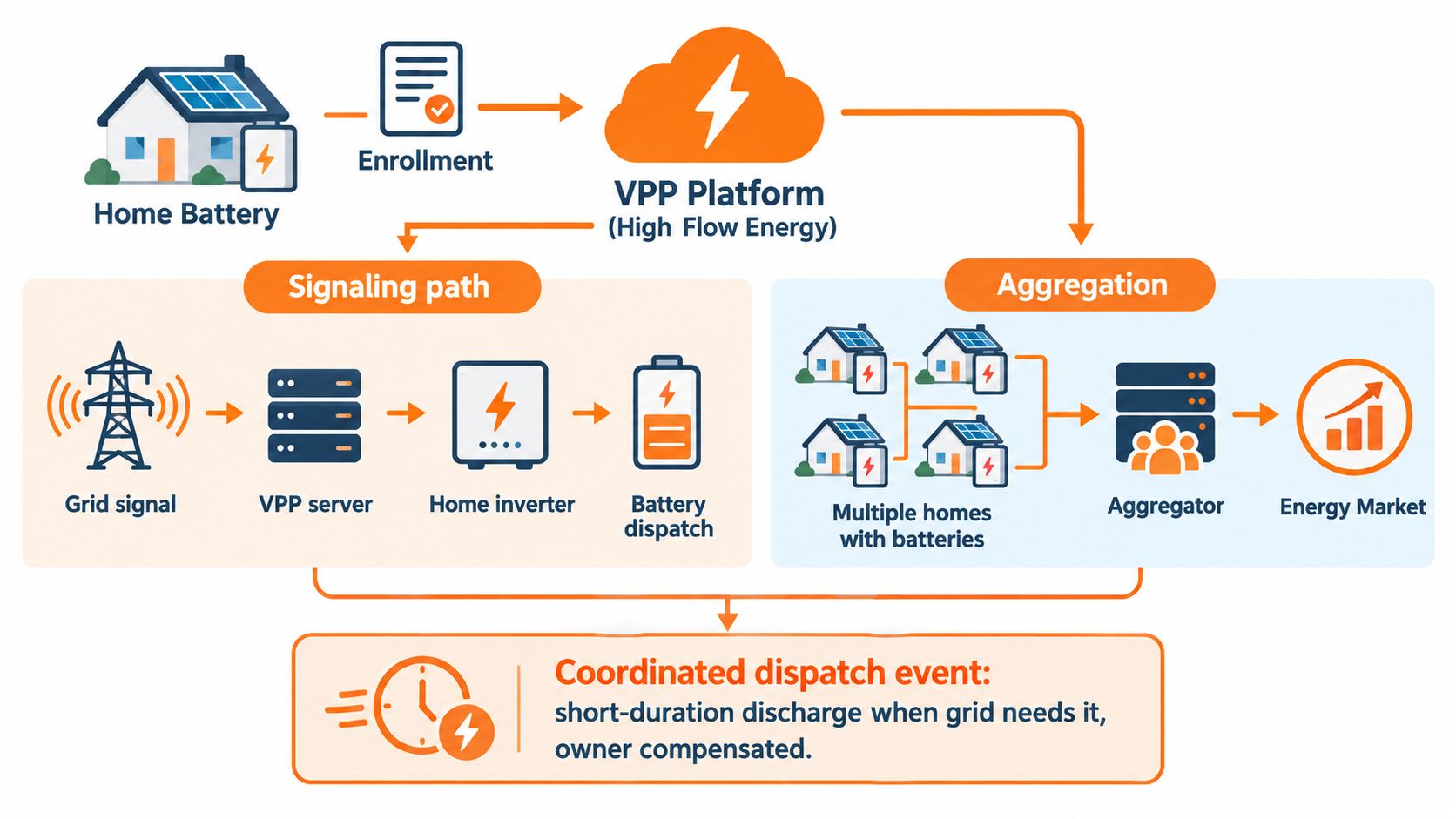
Your battery stays at home. Your inverter remains on site. What changes is that software can coordinate many batteries at once, subject to the permissions, reserve settings and technical constraints built into each system.
What needs to be in place
Australian guidance for VPP participation says grid-connected homes generally need a compatible battery, export approval from the local DNSP, a smart meter, stable internet, and a valid National Metering Identifier, according to Solar Choice's guide to VPP requirements. The same guide also states that most VPPs require the battery to remain online and connected at least 90% of the time.
There's also a policy setting many owners miss. The Clean Energy Regulator says all on-grid solar batteries in Australia, including inverters, must be capable of participating in a virtual power plant at installation time to claim Small-scale Technology Certificates, although households don't have to join a VPP, and off-grid systems more than 1 kilometre from the grid are exempt in its Virtual Power Plants guidance.
How control usually works day to day
In a coordinated arrangement, the aggregator receives market and system signals, runs optimisation logic, and then sends instructions through the communications pathway to the home inverter. That may mean charging, holding, or discharging, depending on battery state, tariff settings, export permissions and customer reserve rules.
Households usually keep priority access through a minimum reserve floor and override settings. The exact reserve can vary by provider and product terms. The key point is operational. A VPP shouldn't treat the home like a utility-scale asset with no local needs. It should recognise that the battery still serves the household first.
If you're checking whether your equipment can support that level of integration, these system integration requirements outline the compatibility side clearly.
Grid participation works best when the household, the inverter firmware, the meter data and the retailer arrangement all point in the same direction.
A QLD and NSW Household Example Compared
The most useful comparison isn't “battery versus no battery”. It's static export arrangement versus active optimisation for a battery you already own.
Take two similar households. One is in south-east Queensland with standard rooftop solar and a battery. The other is in Sydney with a comparable setup. In both homes, the morning load lifts before solar output is strong, midday creates a solar surplus, and the evening peak pulls heavily on stored energy.
What happens under a static arrangement
Under a static feed-in tariff setup, the battery usually follows a simple hierarchy. It stores spare solar, serves the home later, and exports only when there's excess beyond battery capacity or operational settings. This can work well for self-consumption, but it may leave value on the table if export timing, tariff shape and event participation aren't being actively managed.
In Queensland, export limits and network conditions can shape what's possible. In New South Wales, tariff structures and peak windows can change the timing value of discharge. In both states, the retailer still sets much of the baseline economics.
Illustrative comparison
| Line item | Static feed-in tariff | VPP allowance (High Flow Energy) |
|---|---|---|
| Midday surplus solar | Usually stored first, then exported if battery is full | May be stored or coordinated depending on reserve and dispatch logic |
| Evening household usage | Battery offsets imports until reserve is reached | Battery offsets imports, with spare capacity potentially coordinated |
| Export value | Usually tied to the retailer's fixed export terms | Can be linked to an allowance structure and coordinated dispatch terms |
| Grid support participation | Usually none | Possible if system, contract and network settings allow |
| Control style | Mostly local battery logic | Shared between household settings and aggregator dispatch rules |
| Sensitivity to tariff design | High | Also high, but with more moving parts |
| Best fit | Owners who want simplicity and minimal third-party control | Owners who want stronger optimisation and accept coordinated control |
When the second model can outperform
A VPP-style structure can outperform a static export setup when the home has spare battery capacity, the tariff design rewards active timing, export permissions are workable, and the customer is comfortable with managed dispatch. It may not outperform when the household uses nearly all stored energy every night, when export limits are very restrictive, or when the battery already operates near its most useful local pattern.
One more trade-off matters. The Australian Energy Regulator states that storage connecting to the distribution system continues to face network tariffs and should contribute to network costs in its consultation paper on integrating storage into networks. So even if a battery is flexible and useful, it isn't exempt from network charging structures.
Common Misconceptions Worth Clearing Up
Battery owners often get tripped up by ideas that sound sensible but don't hold up once you look at how these systems earn value.
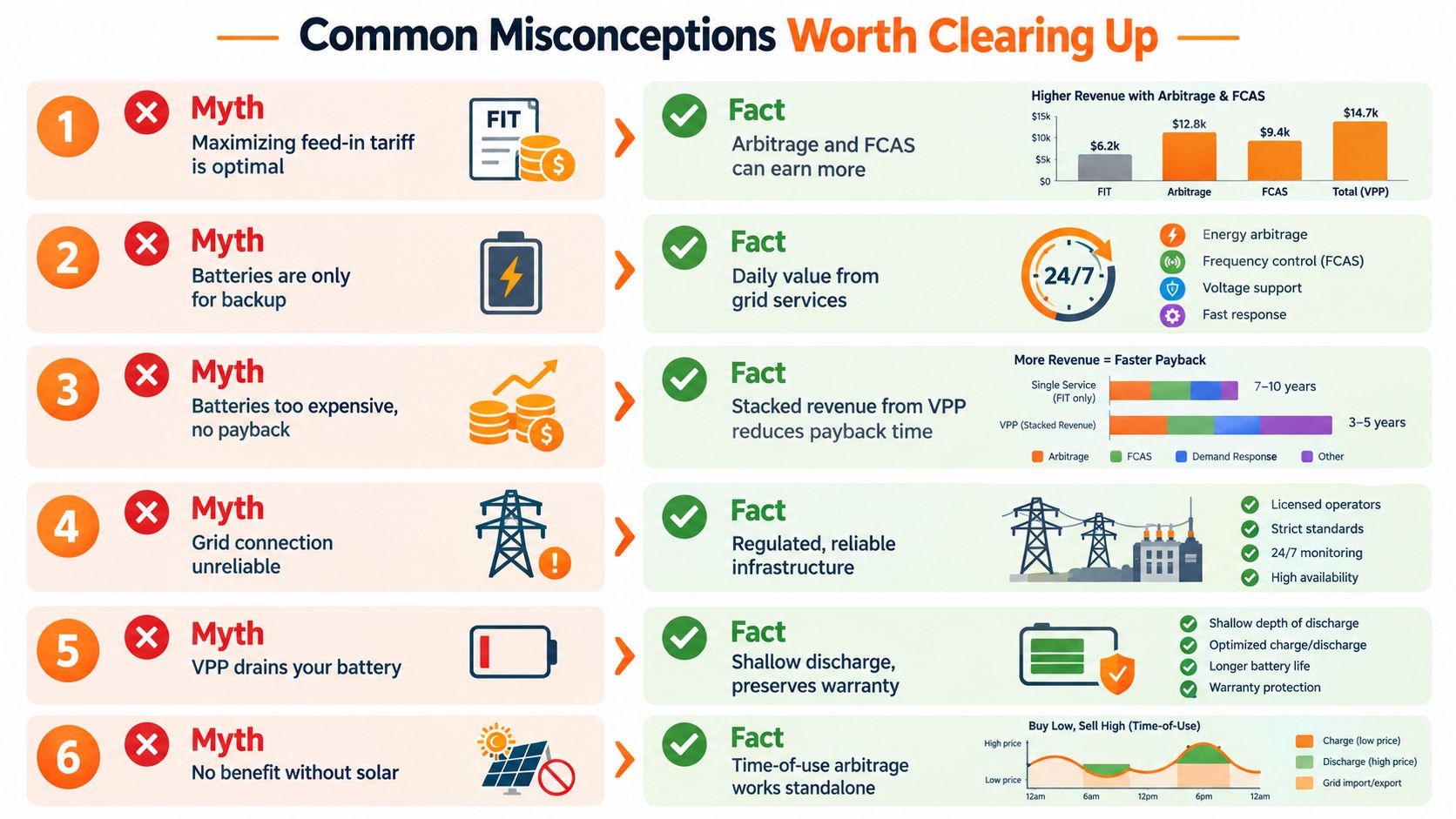
Six myths that deserve a closer look
- “The highest feed-in tariff always wins.” Not necessarily. A battery can create value by reducing imports, shifting exports in time, and participating in coordinated events. A high flat export rate doesn't automatically beat a better whole-of-system arrangement.
- “Joining a VPP affects STC eligibility.” The capability requirement sits at installation. Actual participation is a separate operational choice.
- “A bigger battery always means bigger bill reduction.” Only up to a point. Once your daily load and solar profile are already well matched, extra capacity can sit underused.
- “All VPPs work the same way.” They don't. Reserve floors, dispatch logic, retailer treatment, allowance design and customer controls can differ materially.
- “Export limits are fixed forever.” They're often constrained, but they can sometimes be reviewed through DNSP processes.
- “Once you have a battery, retailer choice doesn't matter.” It still matters because import tariffs, export terms and bill structure shape the baseline from which optimisation works.
The grid role is also changing
A second misconception is that batteries are still mainly about energy shifting. Increasingly, they're also about grid stability.
AEMO-linked reporting noted that around 74% of battery storage projects in the NEM connection queue are confirmed to use grid-forming inverters, and the broader storage pipeline reached 67.3 GW, with batteries making up 49% of total connected-project capacity, as reported in this IndexBox summary of AEMO pipeline data. For households, that doesn't mean your home battery suddenly becomes a system-strength machine on its own. It means the market is moving toward batteries that do more than shift solar into the evening.
The important question isn't “Can batteries store energy?” It's “Which batteries and control systems can safely help run the grid at scale?”
Practical Checks Before You Enrol Your Battery
Before joining any optimisation program, check the operational basics. A battery can be technically excellent and still be a poor fit for coordinated dispatch if the metering, tariff, firmware or export conditions don't line up.
A short due-diligence list
- Confirm compatibility: Check inverter model, battery model, firmware version and communications capability.
- Verify your NMI details: Make sure the site's market identifier matches the hardware and retailer records.
- Review export permission: Your DNSP approval settings affect what any optimiser can do.
- Read the retailer terms: Feed-in arrangements, import tariffs and control permissions all matter.
- Check warranty language: Some manufacturers distinguish between standard self-consumption use and third-party coordinated operation.
- Look at your load shape: A home that already empties the battery every evening may have less spare flexibility than the owner assumes.
What an aggregator actually controls
An aggregator doesn't own your battery hardware. It coordinates eligible spare capacity within the limits of your equipment, your network approval and your retail framework.
That distinction matters because many owners assume they're choosing between “full control” and “giving away the battery”. In practice, the decision is whether you want a passive battery that mostly follows local defaults, or an active battery that can be orchestrated within agreed boundaries.
For homeowners comparing options, it's worth asking direct questions:
- What reserve is preserved for the home?
- Can you override dispatch?
- How are exports treated on the bill?
- What happens during an outage?
- Does the arrangement sit inside a retail structure or alongside one?
Those details tell you far more than the headline promise.
Key Takeaways and Frequently Asked Questions
Key takeaways
- Grid connected battery storage is no longer a niche setup. It's becoming part of mainstream electricity operations in Australia.
- Owning a battery doesn't guarantee strong returns. The commercial structure around it matters.
- Simple arbitrage is getting more crowded. As more battery capacity enters the market, optimisation quality matters more.
- Queensland and New South Wales owners need to think beyond hardware. Export approval, retailer terms, metering and control permissions shape results.
- The market is shifting toward batteries that support grid stability as well as energy shifting. That changes the value stack over time.
Frequently asked questions
Can an existing home battery join a VPP?
Often, yes, if the battery and inverter are compatible, the site has a smart meter, the export settings are approved, and the communications pathway is reliable. Eligibility depends on hardware, firmware and retailer framework rather than battery size alone.
Do network charges still apply if my battery helps the grid?
Yes. The battery may create value through flexibility, but storage connected to the distribution network isn't automatically exempt from network tariff treatment.
Are home batteries centrally scheduled like large grid batteries?
Not in the same way. In the NEM, batteries above 5 MW face scheduled dispatch requirements, while aggregated smaller batteries are treated differently operationally.
Do off-grid batteries follow the same VPP participation rules?
No. The Clean Energy Regulator notes that off-grid systems more than 1 kilometre from the grid are exempt from the VPP-capability requirement tied to STC eligibility.
Should I compare retailers even if I already have solar and a battery?
Yes. Your import tariff, export terms and bill structure set the starting point for any battery optimisation strategy.
Can a battery still be useful if I rarely export much solar?
Yes. Some homes get most of their value from self-consumption and tariff timing rather than large export volumes.
Most battery owners focus on installation quality. Far fewer focus on ongoing performance and optimisation. HighFlow Energy is an electricity retailer built around helping eligible battery owners in Queensland and New South Wales use spare battery capacity in a coordinated BYOB VPP while keeping household needs first. If you want to understand whether your current setup is underperforming financially, visit HighFlow Energy and check your eligibility.