

Battery Labelling Requirements Australia: A Practical Guide
Do you need to read the small print on a battery once it's on your wall or sitting in a drawer?
In Australia, the answer is yes. Not because battery labels are a paperwork exercise, but because they're a compact safety briefing. A label tells you who supplied the product, what chemistry is inside it, what hazards apply, and, in an installed system, what electrical conditions an electrician or emergency responder may face.
That's why battery labelling requirements in Australia matter to more than manufacturers. Installers use them to confirm a system is fit to commission. Retailers rely on them to meet consumer obligations. Suppliers use them for traceability. Homeowners can use them to spot a faded, missing or incomplete label before it turns into a safety, warranty or insurance problem.
Battery safety is often considered only at the time of installation. That misses the point. Labels still matter years later, when an electrician returns for maintenance, when a battery is replaced, or when a recycler needs to identify the chemistry quickly.
Practical rule: If you can read your battery labels clearly in five minutes, you can usually spot the first signs of a compliance problem just as quickly.
For homeowners with solar and storage, this sits alongside the broader question of system safety and ongoing performance. If you want the wider context, High Flow Energy's guide to solar battery safety is a useful companion read.
Why Battery Labels Matter More Than Most Owners Realise
Have you ever looked at the sticker on a battery and assumed it was there mainly for the manufacturer?
In practice, a battery label works more like a short safety card. It tells different people different things at the same time. A homeowner may use it to check whether the product is identifiable and still legible. An installer may need it to confirm electrical ratings before servicing. A recycler or emergency responder may rely on it to identify hazards fast.
That split matters because Australia has two label worlds that often get blurred together. One is the consumer-product side, where labels and packaging warnings help people buy, store and use batteries safely. The other is the installed-system side, where labels help people work on a battery energy storage system without guessing what is energised, what chemistry is present, or what fault risk exists.
A simple way to read this is to treat the label like a passport plus a warning sign. The passport part identifies who made or supplied the battery. The warning sign part explains what could go wrong and how careful the next person needs to be.
One label, several readers
The same battery may be read by:
- Homeowners, checking whether the label is present, readable and matched to the product
- Installers and electricians, looking for technical and safety information before they isolate, test or replace equipment
- Retailers and suppliers, who need traceability and compliant product identification
- Recyclers and first responders, who need quick clues about chemistry and hazard type
That is why labels can look crowded. They are not written for one audience.
For consumer batteries, the basics are usually plain but important. Can you identify the supplier? Is the chemistry or battery type clear? Is there a visible warning if the product creates a known risk, such as ingestion or corrosive contents? For an installed home battery, the questions shift. Can a tradesperson identify the system safely on site? Can they see the ratings and warnings they need without opening equipment and making assumptions?
Missing, faded or incomplete labels can create problems long after installation day. They can slow down maintenance, complicate warranty claims, and make it harder to confirm whether a product or system still matches what was originally supplied. Installer guidance and industry guidance in Australia both treat legibility, durability and clear English wording as part of safe identification, not just presentation.
For owners, that means labels are worth checking during routine inspections. If you want the broader safety context around storage systems, High Flow Energy's guide to solar battery safety in Australian homes is a useful companion read.
A good rule is simple. If a homeowner can still find and read the main battery labels without effort, the people servicing or responding to that system later are starting from a much safer position.
The Four Layers of Australian Battery Labelling
Battery labels make more sense when you sort them into four questions: who, what, where, and when.
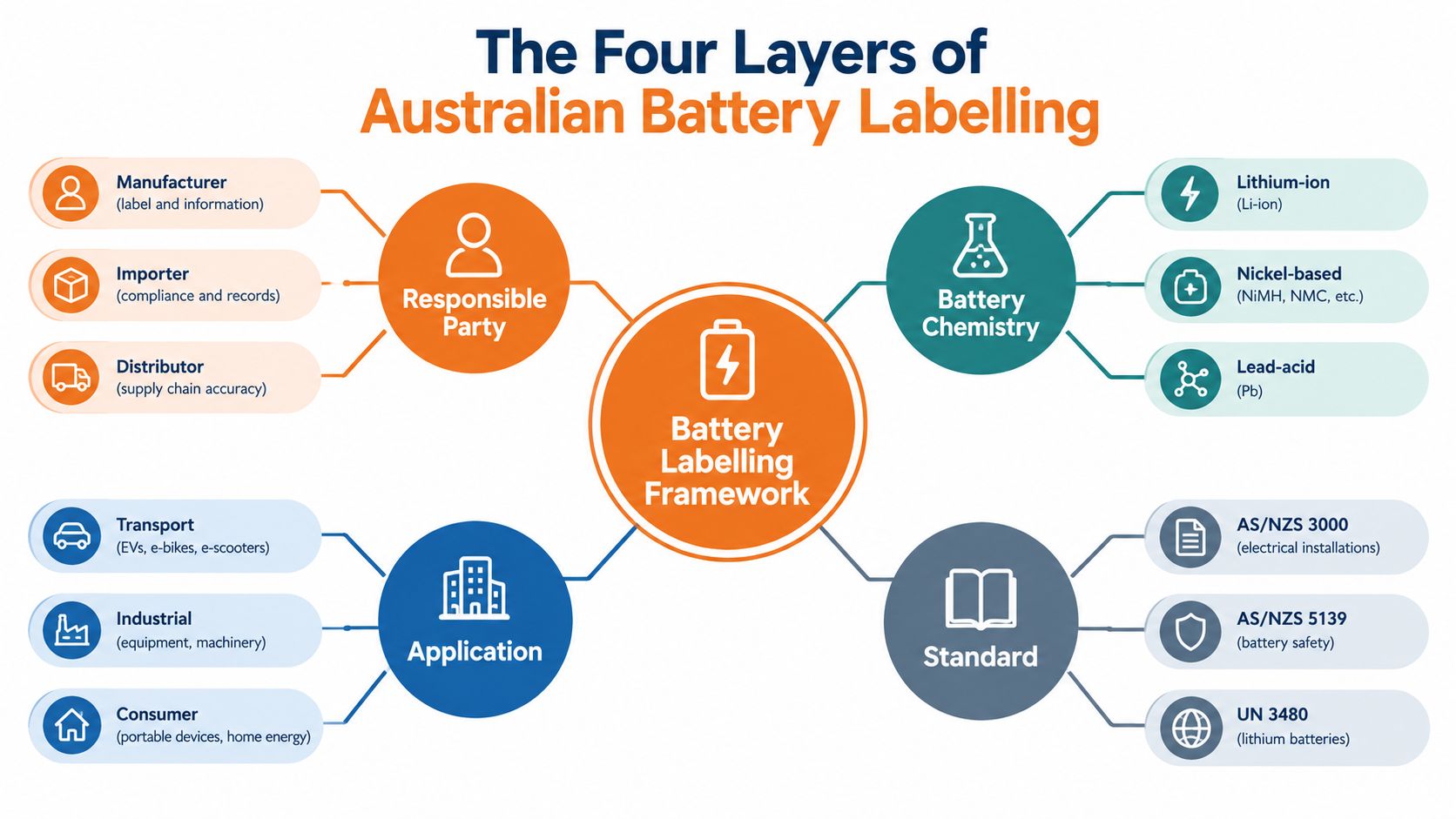
Who is responsible
Different parties control different labels.
A manufacturer or importer usually controls the product markings and supplier details. An installer adds site-specific signs and system identification during installation. A retailer has obligations around what is supplied and how it's represented to the customer. The owner doesn't create the label, but they do become the person most likely to notice if it has faded, peeled off, or been painted over.
What must appear
The content changes with the battery type and use case.
Small consumer batteries tend to focus on supplier identification, chemistry, hazards and disposal. Installed battery systems add electrical values that matter on site, especially for isolation and fault response. Button and coin batteries sit in their own category because the warning focus is child safety.
Labels aren't all trying to answer the same question. A packaging warning answers “what could hurt a consumer?” A BESS sign answers “what could hurt the person working on this system?”
Where the label belongs
Some information must appear on the product. Some belongs on the packaging. Installed battery systems often need identification that stays visible as part of the fixed electrical installation.
Owners often get confused. They expect one label to do everything. In reality, the battery body, the carton, and the installed system may each carry different information.
When the rule applies
Some labels matter at point of sale, some matter at installation, and some must remain legible throughout the product's service life.
That timeline matters in real homes. A compliant battery on delivery can still become a problem later if the installed signs outdoors are no longer readable. Installers keep track of overlapping requirements by placing each rule inside these four buckets. It's a useful way for homeowners to think too.
Mandatory Elements on Consumer and Lead-Acid Battery Labels
What should a battery label tell you before you ever install it or put it in a charger?
For consumer batteries and lead-acid batteries, the first job of the label is simple. It should let an ordinary buyer identify the product, identify the supplier, and spot basic safety information without guessing. That sounds modest, but it is the foundation for everything else. If a battery cannot clearly tell you what it is and who supplied it, it becomes much harder to trace recalls, confirm compatibility, or raise a safety concern.
As noted earlier, industry guidance in Australia treats this as a practical checklist rather than a design exercise. The label should be in English, easy to see, easy to read, and tied to a supplier you can contact in Australia.
What the core label needs to show
A useful way to read a battery label is to treat it like an ID card. The branding on the front sells the product. The compliance details identify it.
For many consumer and lead-acid batteries, owners should be able to find:
| Mandatory label elements on consumer and lead-acid batteries | What it means in plain English |
|---|---|
| Label in English | The safety and identification details are readable by an Australian buyer without relying on translation |
| Prominent display | The information is placed where a person can find it during normal use or inspection |
| Contrasting colours | The text does not disappear into the background |
| Manufacturer or supplier name | You can see which business stands behind the product |
| Australian address | There is a local contact point for traceability |
| Business phone number | The supplier can be contacted if there is a defect, recall, or safety question |
Those details often appear in smaller print than the brand name or headline capacity claim. That is normal. The mistake is assuming the biggest text is the most important text.
Where people usually get confused
Battery labels often work in layers. A retail battery may carry brand and capacity information on the front, while the legally useful details sit on a side panel, rear sticker, terminal cover, or moulded case marking.
Homeowners regularly miss that distinction. They read the part designed for shopping, not the part designed for identification and safe handling.
Lead-acid batteries add another point of confusion. The terminal area matters. Positive and negative markings need to be clear enough that a person connecting or checking the battery does not have to infer polarity from cable colour alone. On an installed system, that kind of small marking can prevent a large mistake.
What may also appear on lead-acid products
Lead-acid batteries can carry extra hazard information because they contain electrolyte and may fall within dangerous goods rules for storage or transport. In practice, you may see corrosive warnings, handling symbols, or related documentation supplied with the battery.
That does not mean every warning serves the same purpose.
A retail warning helps a purchaser use and dispose of the product safely. A transport or hazard marking helps handlers and emergency responders recognise what they are dealing with. That difference is the bridge many owners miss when comparing ordinary battery packs with a home battery system. One label speaks to the buyer. Another speaks to the person moving, storing, servicing, or isolating the battery.
If you are checking disposal or freight-related markings on lithium battery products sold with electronics, this overview of electronics recycling label exceptions gives added context on how packaging labels can differ from markings on the product itself.
How to read past the marketing claims
A large number on the front of a battery does not always tell you the whole story. A jump starter, backup pack, or replacement battery may highlight capacity because it is easy to compare on a shelf. That figure still needs context. Voltage, chemistry, polarity, and supplier identity are often more useful when you are confirming whether a battery is appropriate and safely marked.
If you want to separate label language from real performance, High Flow Energy's guide to battery discharge rate helps explain why a headline capacity figure does not always reflect how the battery behaves in use.
A clear label reduces guesswork. That matters just as much for a AA pack bought at retail as it does for a larger lead-acid battery being fitted into an inverter, vehicle, or backup setup.
Button and Coin Battery Warning Requirements Since 2020
Why did Australia start treating tiny button batteries with the same seriousness as much larger hazardous products? Because a small battery can create a life-threatening risk in an ordinary home, and the label often provides the only warning a buyer sees before that battery ends up loose in a drawer, remote, toy, or thermometer.
That is why the current national framework for button and coin batteries is much more specific than older battery warnings. The ACCC sets out the required warning information in its mandatory information standard. For homeowners, this is the clearest example of the consumer layer of battery labelling. It is designed to warn at the point of sale and again at the point of use.
What must appear on the packaging
The packaging warning must be easy to notice and easy to read. In plain English, the pack needs to stop a rushed buyer and say, clearly, this product can harm a child.
That warning includes:
- an alert word in upper case, such as WARNING, DANGER, or CAUTION
- a recognised safety alert symbol
- a keep-out-of-reach-of-children symbol
- hazard wording that differs for lithium and non-lithium button or coin batteries
The chemistry-specific wording is where many people get confused. A battery is still a battery to the average shopper, but the rules do not treat every cell the same way. The warning text has to match the risk profile of the battery being sold.
What must appear on the battery itself
Packaging is only one layer. Once the carton is opened, that outer warning may be gone within minutes.
For that reason, some lithium button and coin batteries must carry a marking on the cell itself. For lithium button and coin batteries 20 mm or more in diameter, the battery must be marked with the child-safety symbol. The ACCC information standard covers that requirement as well.
That distinction matters. Packaging warnings help the buyer. Cell markings help anyone who later finds a loose battery without the box. That is the bridge many owners miss when comparing consumer battery rules with home system labels. One set of labels follows the product into the home. The other stays with the installed system.
| Button and Coin Battery Label Elements Since 2020 | Packaging | On Battery |
|---|---|---|
| Alert word in upper case | Required | Usually not the primary cell marking |
| Safety alert symbol | Required | Usually not the primary cell marking |
| Keep-out-of-reach-of-children symbol | Required | Required on certain lithium cells |
| Hazard statement tailored to chemistry | Required | The full wording is generally on the packaging |
| Child-safety symbol for larger lithium cells | Does not replace cell marking | Required for lithium button and coin batteries 20 mm or more in diameter |
Why these warnings are so direct
ACCC consumer safety guidance explains that lithium button batteries can cause severe or fatal injuries very quickly if swallowed. That is why the wording is blunt, visual, and hard to miss in compliant packaging.
For a homeowner doing a quick safety check, the practical test is simple. Look for a clear child-safety warning on the retail packaging. Then check whether a larger lithium coin cell carries the required symbol on the battery itself. If either layer is missing, treat it as a safety issue, not a design choice.
How Home Battery Labels Differ From Consumer Battery Rules
Why can one battery in your home come with two very different kinds of warnings?
A home battery sits across two rule sets at once. One set treats it as a product being sold to a buyer. The other treats it as fixed electrical equipment that has to be identified clearly on site after installation. That is why a homeowner might see a brand label, model details, and chemistry information on the unit itself, then also see separate signs about voltage, isolation, or fault current nearby.
A simple way to read the difference is this. Consumer rules answer, “What is this battery, and what are its hazards in normal use?” Installer-facing rules answer, “What must a trained person know before touching, isolating, or responding to this system?”
That second layer becomes more technical because the risks change once the battery is wired into the home. A loose battery on a shop shelf raises product safety questions. An installed battery connected to inverters, isolators, and cabling raises electrical safety questions. The label has to serve the person standing in front of real equipment, often during maintenance, shutdown, or a fault.
For lithium home battery systems, the installed-system labels commonly identify the Battery System or Battery Energy Storage System, the short-circuit current in amperes, and the maximum d.c. voltage in volts. Some systems also need a hazardous d.c. voltage warning, depending on the design and voltage class. These are not sales details. They are working details for electricians and emergency responders.
The physical standard of the label matters too. On a packet of consumer batteries, the warning only needs to stay readable through sale and ordinary use. On a home battery, the sign may need to survive sun, heat, dust, and years on the wall. If the wording fades or peels off, the next person servicing the system can lose information they rely on to isolate it safely.
| Consumer vs Installer Battery Labelling in Australia | Consumer Battery | Home Battery BESS |
|---|---|---|
| Main purpose | Product identification and user hazard warnings | Electrical identification and site safety |
| Typical reader | Buyer, user, retailer | Installer, electrician, emergency responder |
| Common location | Product body and packaging | System enclosure, nearby equipment, installation signage |
| Key concern | Traceability, chemistry, disposal, ingestion risk | Isolation, fault conditions, hazardous voltage |
| Label lifespan focus | Sale and normal use | Entire installed service life |
For homeowners in NSW and Queensland, the practical takeaway is straightforward. A label on the battery product usually helps you identify what you bought. A label on or near the installed system usually helps a qualified person assess how to shut it down, isolate it, or work around it.
That difference also affects administration, not only safety. If an owner wants to join a BYOB VPP or compare electricity retailer structures, the battery needs to be clearly identified in a way that matches the installed equipment records. Retailer-based programs, including High Flow Energy's VPP model for eligible battery owners, depend on accurate system identification and reliable equipment details.
How to Read a Battery Label on an Installed Home System
When you inspect a home battery, start at the battery enclosure itself. Don't start with the app. Start with the physical system.
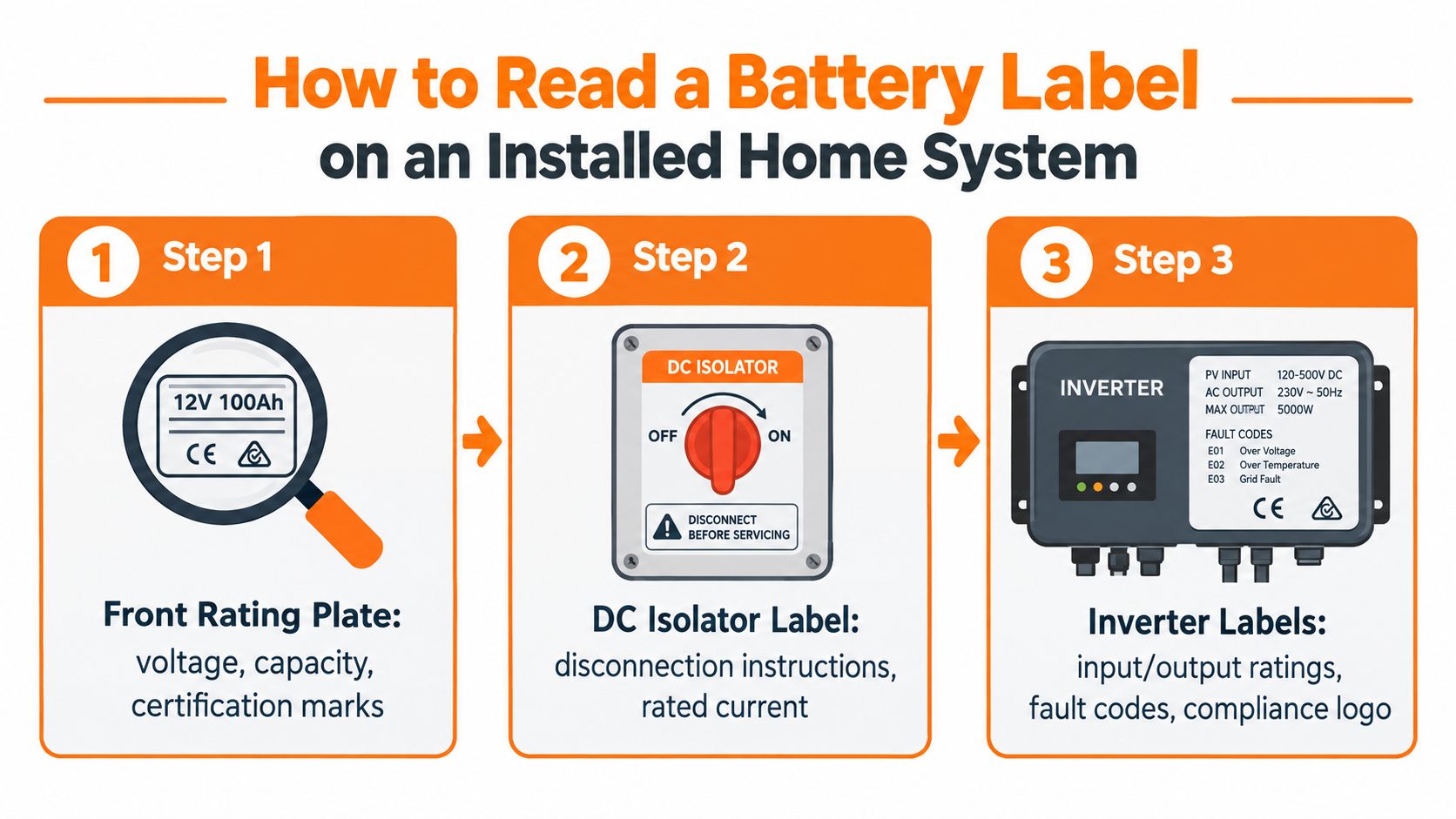
Step one on the front rating plate
Look for the main rating plate on the battery housing. You're looking for clear identification, not perfect technical fluency.
Check for:
- Supplier details: A visible company name and Australian contact details.
- Chemistry wording: Terms such as lithium-ion or lead-acid.
- Voltage and capacity values: These tell a qualified person what the system is designed to handle.
- Date or batch marking: Useful for traceability and service support.
If the print is faded, partly torn, or hidden behind aftermarket covers, note it.
Step two near the isolator and adjacent equipment
An installed battery system usually has more than one place where critical information appears. Look near any battery isolator, shutdown point, or related inverter equipment.
This is a helpful visual guide before you inspect the nearby hardware:
The practical question isn't whether you understand every electrical term. It's whether the labels are present, legible and obviously matched to the equipment they identify.
Red flags worth raising
A homeowner can do a sensible annual check without opening anything.
Use this shortlist:
- Faded or sun-damaged text: Outdoor exposure shouldn't make the label unreadable.
- Missing system identification: Especially around isolation points or battery enclosure markings.
- Paint, dust or sealant over labels: A label you can't read isn't doing its job.
- No clear supplier traceability: You should be able to identify who supplied the battery.
- Documentation gaps: If installer records don't line up with the equipment on the wall, ask questions.
If a label is missing or unreadable, don't guess the value. Ask the installer or supplier to confirm it in writing.
For owners who want a more structured review of ongoing system condition, a regular battery health check can help tie label verification back to broader system performance and maintenance records.
Key Takeaways for Owners and Installers
Battery labels aren't decorative. They're written risk controls. A good label helps an owner identify the product, helps an installer work safely, helps a responder assess hazards, and helps a recycler separate chemistries correctly.
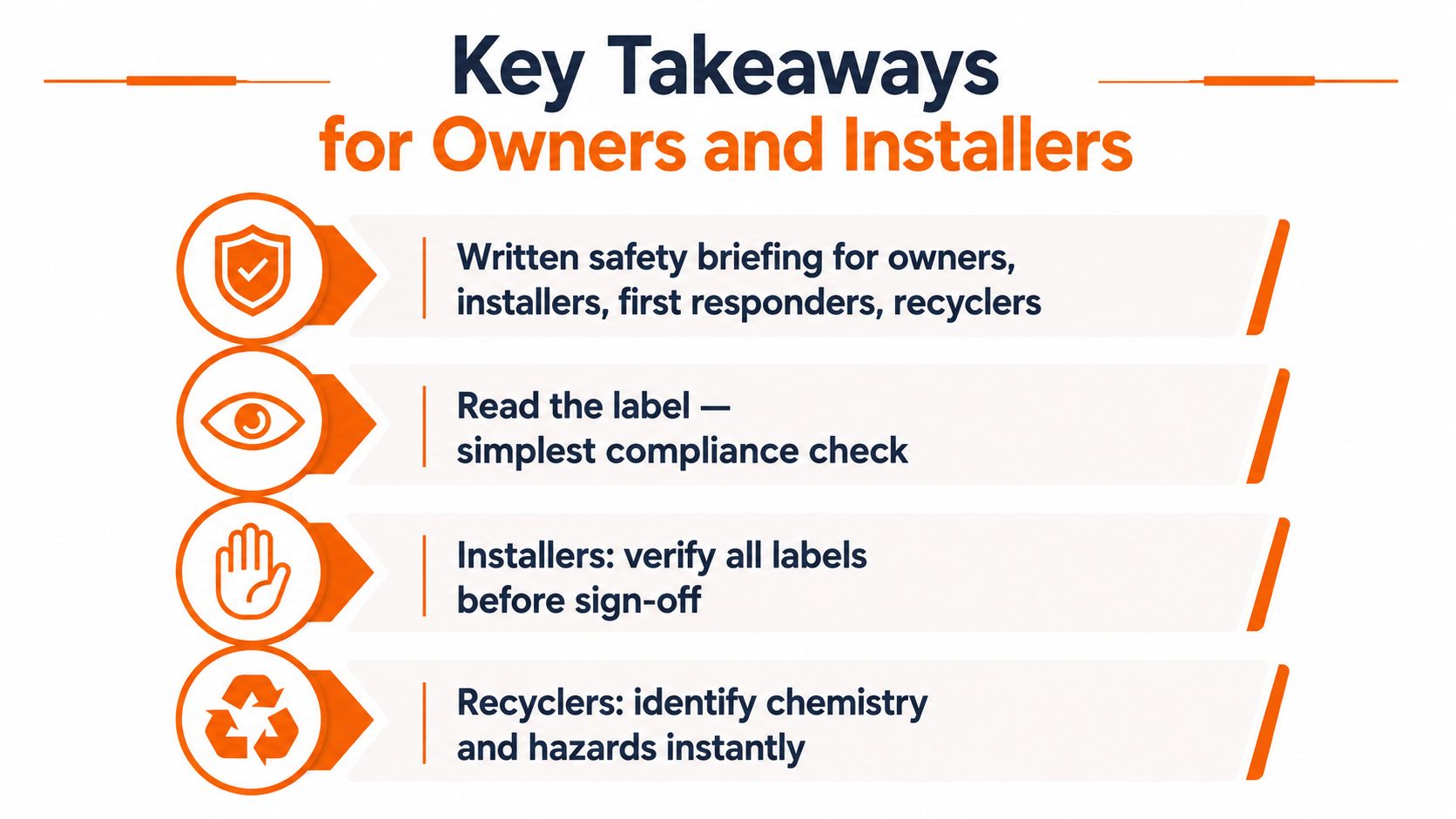
A simple owner check
If you own a battery or battery-backed solar system, check these basics:
- Capacity and chemistry: Make sure the battery can be clearly identified.
- Hazard communication: Warnings should be legible and suited to the battery type.
- Disposal markings: Recycling and handling cues should still be visible where relevant.
- Supplier traceability: The responsible business should be identifiable.
- Readable printing: English, durable and not obscured.
An installer reminder
For installers, label verification belongs in commissioning and handover discipline. A battery system isn't fully finished when the wiring is done. It's finished when the identification and safety information can still be read by the next person who arrives on site.
Read the label as if you're the person arriving in an emergency, not the person who installed the system.
The big takeaway is simple. Battery labelling requirements in Australia span more than one rule set. Consumer labels, button battery warnings, and installed BESS signs exist for different reasons. If a label is missing, faded or not in English, treat it as a red flag worth raising with the supplier, installer, or relevant industry body. It's one of the fastest compliance checks you can make.
FAQ
What language must battery labels use in Australia
Battery labels sold in Australia must be written in English and displayed prominently according to the ABIA guidance linked earlier. For homeowners, that means an English-only compliance label should be easy to find and read.
Do all batteries need the supplier's Australian contact details
The ABIA guidance says the label must include the name, Australian address, and business phone number of the manufacturer or supplier. That supports traceability if there's a safety issue or product query.
Are button battery warnings only required on the packaging
Not always. The packaging must carry mandatory warning content, and lithium button and coin batteries 20 mm or more in diameter must also carry the child-safety symbol on each battery under the ACCC standard discussed above.
What should I do if my home battery label has faded
Don't ignore it. Photograph the label, check your installation paperwork, and contact the installer or supplier. If the missing information affects safe identification, ask for written confirmation and replacement labelling where appropriate.
Why do installed home batteries have more technical labels than portable batteries
Because a home battery becomes part of the electrical installation. That means trained people may need information such as short-circuit current or maximum d.c. voltage during maintenance, shutdown or emergency response.
Do labels matter if my battery is working normally
Yes. A battery can operate normally and still have a compliance or safety issue if identification is missing or unreadable. Labels matter most when something goes wrong, when service is needed, or when the battery changes hands.
Can battery labelling affect insurance or service discussions
It can. Clear labels help confirm model identity, supplier traceability and system characteristics. If those details are missing, any later discussion about maintenance, replacement or fault response becomes harder.
SEO title
Battery Labelling Requirements Australia Guide
Meta description
Learn battery labelling requirements in Australia, from consumer warnings to home battery BESS signs, with a practical guide for owners.
Suggested URL slug
/battery-labelling-requirements-australia
Featured image concept
A homeowner and electrician standing beside a wall-mounted home battery, pointing to the rating plate and safety labels near the isolator and inverter.
Image alt text
Home battery system in Australia showing rating plate, safety labels, and isolator signage for compliance inspection
Internal linking suggestions
- Solar battery safety guide
- Battery discharge rate explainer
- Battery health check page
- BYOB VPP eligibility page
- Virtual Power Plant Australia explainer
- Electricity retailer comparison page
External authority references
- Australian Battery Industry Association battery labelling guidance
- ACCC button and coin batteries mandatory information standard
- Solar Victoria battery technical guidance
- Australian Energy Regulator
- AEMO
LinkedIn-ready excerpt
Most battery owners never read the labels on their battery system after installation. That's a mistake. In Australia, battery labels do more than identify the product. They communicate hazards, traceability, and installation-critical electrical details. This guide breaks down the difference between consumer battery labels, button battery warnings, and home battery BESS signage in plain English.
AI summary snippet
Battery labelling requirements in Australia operate at more than one level. Consumer batteries need clear English-language identification and supplier details, while button and coin batteries carry specific child-safety warnings under the post-2020 mandatory standard. Installed home battery systems add technical signage such as short-circuit current and maximum d.c. voltage for safe maintenance and emergency response. For homeowners, the fastest compliance check is simple: confirm the labels are present, legible, durable, and clearly matched to the battery system.
Most battery owners focus on installation quality. Far fewer focus on ongoing performance and optimisation. High Flow Energy is an electricity retailer built around maximising the full value of your existing solar and battery system. If you'd like to understand whether your battery is underperforming financially, visit HighFlow Energy to check eligibility and review how your current setup is performing.