

Planned Power Outage Guide for Solar and Battery Homeowners
Queensland homeowners often receive a notice saying their electricity will be switched off for network work. The timing may be inconvenient, especially if the home has a battery, medical equipment or a home office. The first question is usually simple: if the battery is charged and the solar panels are producing, will the house stay powered?
Not necessarily. A planned power outage is a scheduled separation from the electricity network, and a battery only provides backup if the system has been designed and commissioned to operate safely while the grid is unavailable. Understanding the difference between local distributor work, transmission constraints and genuine islanding capability helps you prepare without making assumptions.
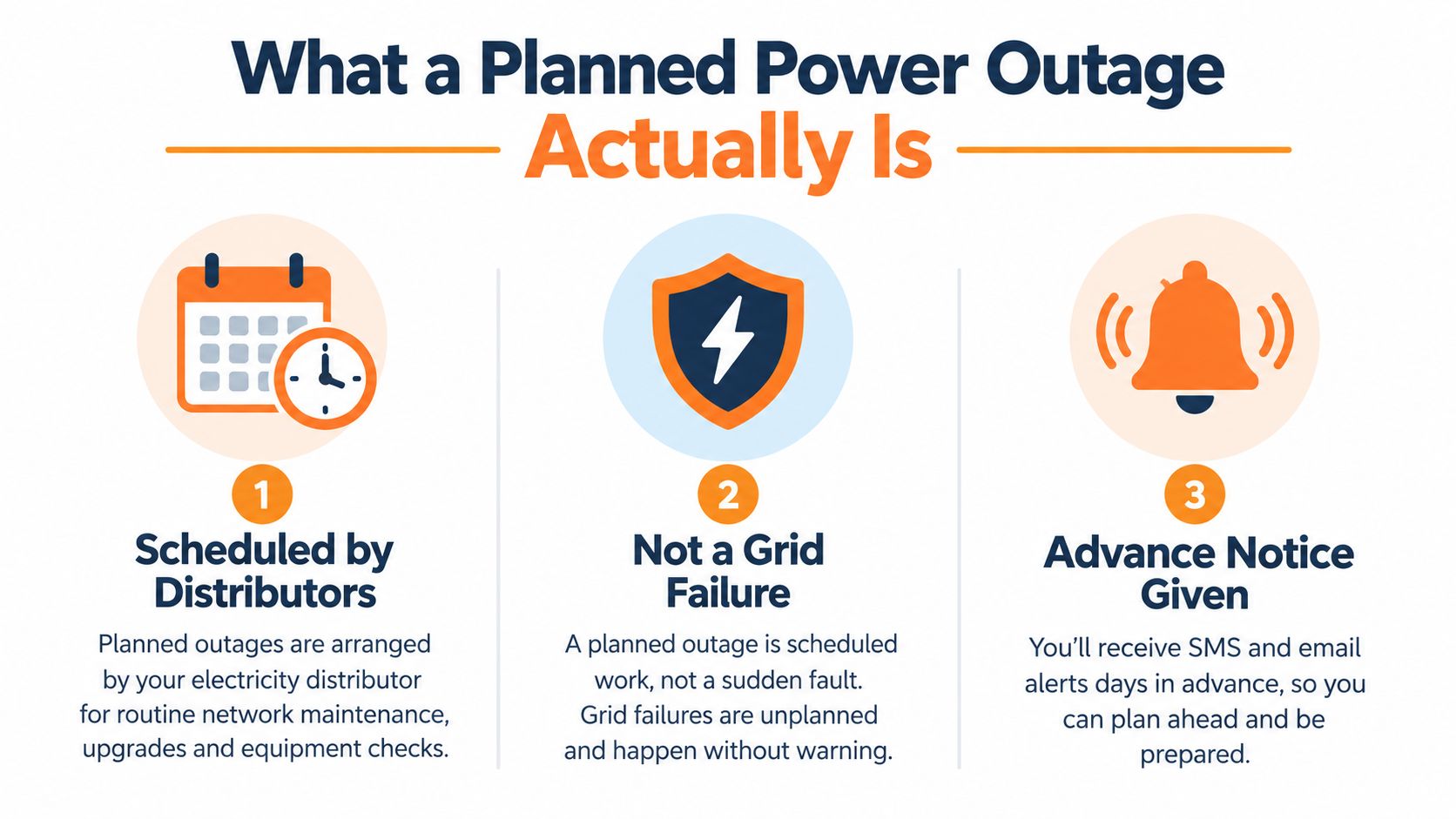
What a Planned Power Outage Actually Is
A homeowner in regional Queensland may receive notice that power will be switched off while a crew replaces equipment, trims vegetation or upgrades a local feeder. The interruption can disrupt appliances, refrigeration and internet access, but it represents a controlled isolation. Network workers de-energise the affected section so they can complete the work safely.
Australian distributors schedule interruptions for preventive maintenance, repairs, asset replacement, vegetation management and network upgrades. Reliability reporting separates planned interruptions from unplanned events and measures both frequency and duration through indicators such as SAIFI and SAIDI. Those measures show whether customers are experiencing frequent interruptions, long interruptions, or both.
The scale of scheduled work is significant. During 2023–24, Ergon Energy conducted 22,171 planned outages across its regional Queensland network, compared with 22,974 unplanned outages. The Queensland network-performance figures and the reporting framework are documented in NSW network-performance reporting. A planned outage supports network maintenance. It does not, by itself, indicate a sudden system failure.
Why the notice changes your preparation
The notice creates a defined operating window. Use it to charge equipment, protect refrigerated goods, arrange communications and confirm how long essential services can operate. If the property has a battery, check its approved operating mode and protected circuits rather than assuming stored energy will keep the whole house running.
The local distributor's work is only one part of the electricity system. Transmission-level constraints and other NEM operating conditions can affect supply across a wider area, with different causes, controls and customer impacts. A distributor notice therefore should not be treated as a complete explanation of every possible interruption.
Outage counts alone also miss the customer impact. During Queensland's summer natural disasters, severe and adverse weather caused more than 300,000 homes and businesses to lose power. Queensland missed its network-wide SAIDI duration target even though Energex and Ergon met their SAIFI frequency targets. The practical lesson is clear: duration matters more than the number of outage events alone.
Practical rule: Treat a planned power outage as predictable, but do not assume the notified duration is a guarantee.
How Planned Outages Differ From Unplanned Events
A planned distribution outage follows a controlled process. For scheduled network work, the National Energy Retail Rules generally require at least four business days' written notice, regardless of the expected interruption length. The notice should state the date, start time and expected duration, and include a 24-hour telephone number for outage enquiries. The Australian Energy Regulator's consumer guidance explains this planned-interruption framework.
An unplanned event begins with a network condition that requires action. A sudden equipment fault, severe weather incident, or actual or apprehended threat to safety, reliability or security may require a distributor to interrupt supply without the usual notice period. Customers may receive fault updates and restoration estimates, although those updates cannot create the preparation window available for scheduled work. The AER's explanation of planned and unplanned interruptions sets out the distinction.
Distribution is not transmission
A local distributor operates the poles, wires, substations and switching equipment that connect your property to the network. Transmission networks move bulk electricity between major generation and load centres. These layers interact, but they do not issue the same customer notices or respond to the same operating conditions.
For example, a distributor notice may cover the isolation of your street while a transmission constraint on the Central Queensland to South Queensland corridor affects wholesale conditions across a wider area without triggering a letterbox notice. A local outage can therefore be clearly scheduled even while broader system conditions remain subject to change.
Transmission outage schedules may shift as demand, generation availability and network constraints change. AEMO's statistics cover six financial years, from 2018–19 through 2023–24, including outage types, high-impact outages, invoked constraints, advance notice and overruns. They also show a particularly high volume of outages requiring AEMO's Power System Engineering and Planning process in Queensland, partly because of how that transmission network is defined. AEMO's network-outage submission statistics shows why a planned transmission activity may have less certainty than a household notice suggests.
The outage category also says nothing by itself about battery backup. A scheduled interruption does not make a standard solar battery operate independently, and an unplanned fault does not automatically prevent a properly configured backup system from supplying protected circuits. The system design, approved operating mode and isolation equipment determine that outcome.
Why Most Solar Batteries Do Not Provide Backup Power
A battery can be fully charged when a distributor disconnects the street. Household power still depends on how the solar and battery system is wired, approved and configured. Stored energy remains unavailable to household circuits until certified islanding equipment separates the premises from the public network.
Most grid-connected solar and battery installations shut down when the grid signal disappears. Their inverters follow the network's voltage and frequency rather than creating those conditions themselves. The shutdown also prevents electricity from feeding into lines that field workers may believe are de-energised. Solar panels may continue receiving sunlight and the battery may retain charge, while the home remains without power.
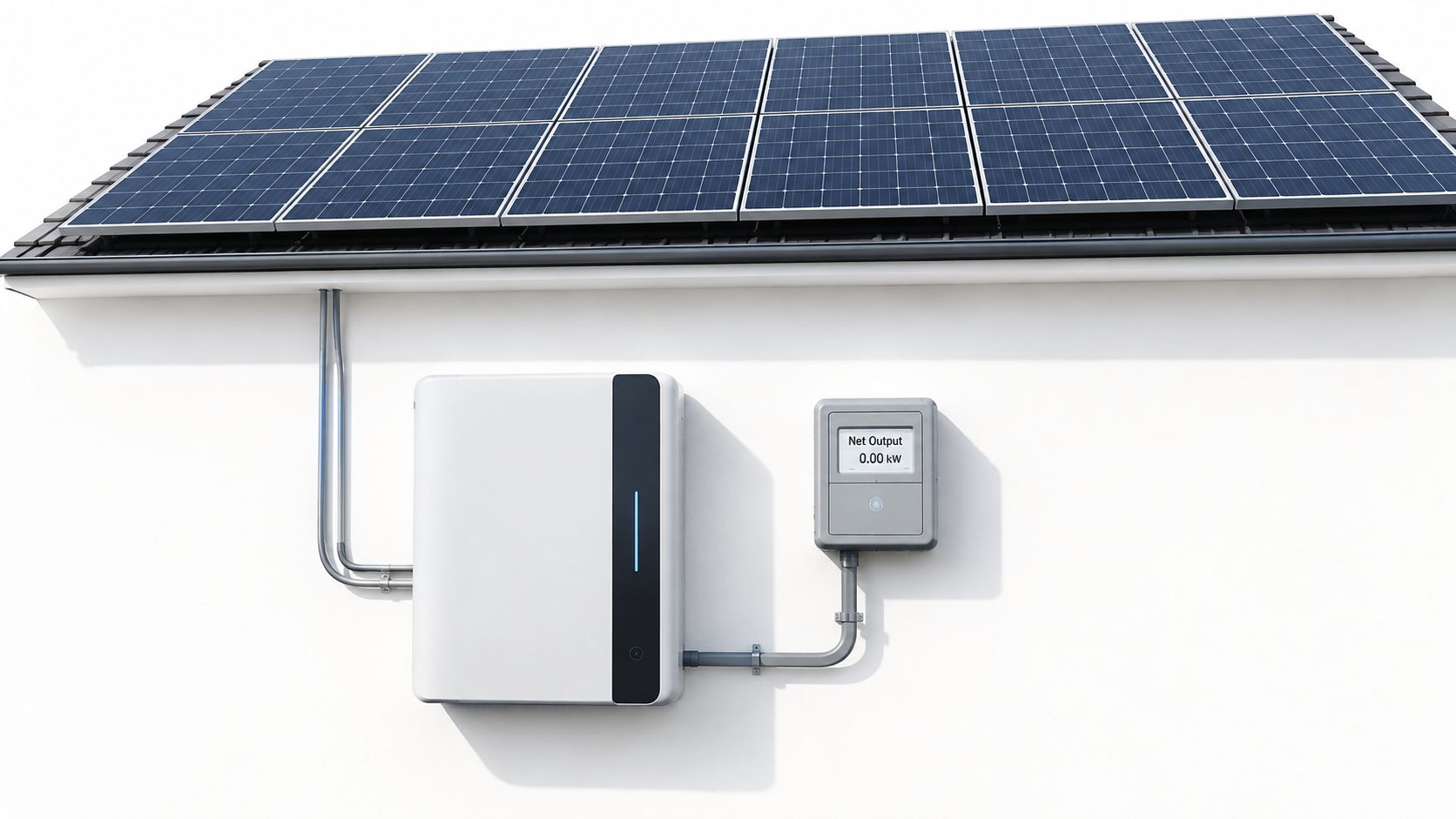
For a scheduled distributor outage, this distinction is easy to miss. A network notice describes planned work on the local distribution system. It does not certify that a customer's battery can support the premises, and transmission-level NEM constraints can affect wider system conditions without changing the equipment installed at the property. Outage scheduling and backup capability are separate matters.
Ausgrid's planned-outage FAQ says customers do not need to switch off or adjust a solar installation during a planned interruption. The guidance also says Ausgrid does not provide or reimburse generators or other backup supplies. Ausgrid's planned outage guidance should be read alongside the system's own documentation.
Energy availability is not islanding capability
Check four separate points:
- Is stored energy available? The battery's state of charge may be high.
- Can the inverter form a stable local grid? A grid-following inverter normally needs the public network.
- Can the premises separate from the network? Certified changeover or islanding equipment must prevent energisation of public lines.
- Which circuits remain active? Backup may cover selected loads rather than the whole property.
Homeowners should choose the right solar battery installer and request written confirmation of backup capability, supported circuits and operating limits. A battery brand, app or charge percentage cannot establish those facts.
The following video offers visual context for solar and battery behaviour during an outage. It does not replace an electrician's assessment of the specific installation.
The critical distinction: Stored energy and outage power are different capabilities.
What Enables Real Outage Protection
True backup operation requires more than a battery cabinet and solar panels. The installation must be able to disconnect the home from the public network, create a stable local supply and manage the loads connected to that supply.
A certified changeover or islanding switch provides the physical separation. During a grid failure, it prevents the home's circuits from energising the external network. This protection is fundamental because field crews may be working on lines that have been isolated for safety.
The inverter also needs grid-forming capability. Instead of merely following an existing grid signal, a grid-forming inverter establishes local voltage and frequency for the protected circuits. The battery then supplies the energy needed to maintain that local network, while the control system manages solar generation and household demand.
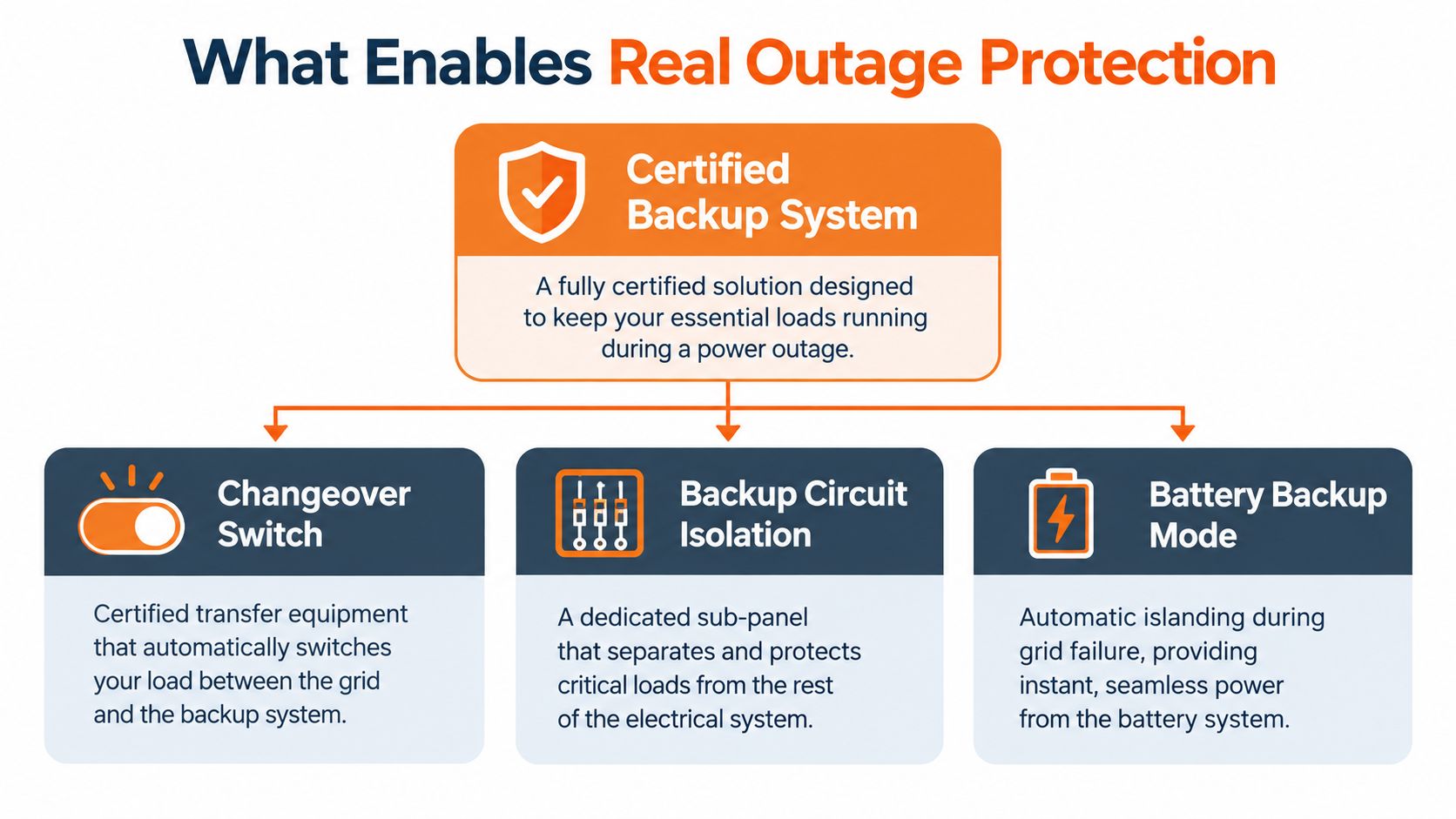
The three parts to verify
-
Transfer equipment
The changeover arrangement must be certified for the installation and operate in the required sequence. It separates the premises before backup power is applied. -
Protected circuits
A critical-load sub-board can keep selected equipment running while excluding large discretionary loads. Refrigeration, communications and approved medical equipment may receive priority, while hot water, pool pumps or electric vehicle charging remain disconnected. -
Backup operating mode
The inverter and battery controls must recognise grid loss, establish the local supply and coordinate solar input with demand. The system also needs suitable commissioning and testing.
The appropriate technical design depends on the installed inverter, battery, switchgear and site wiring. Homeowners considering grid-forming inverter capability should ask an accredited electrician to confirm compatibility rather than assume an upgrade will work with existing equipment.
A system without these components will normally stop operating during a planned power outage. That isn't a defect. It means the installation was designed for grid-connected energy management, not independent backup.
How VPP Participation Interacts With Planned Outages
A Virtual Power Plant coordinates many customer-owned batteries through software. The operator can respond to demand events, wholesale price volatility, network congestion and grid-support requirements, while each household still needs enough energy for its own priorities.
A VPP dispatch instruction should never treat every stored kilowatt-hour as available for export. Before a scheduled isolation, a well-designed control strategy should suspend discretionary discharge, preserve a minimum reserve and prioritise household resilience. If the site has certified backup capability, the reserve should reflect the protected circuits and the expected outage window. If it doesn't, charging the battery won't create backup power, but it may still support normal energy use before and after the event.
HighFlow Energy is a technology-enabled electricity retailer and VPP operator for existing solar and compatible battery owners. Its coordinated program uses available battery capacity for grid services, with the value created funding a monthly electricity allowance, while household needs and priority use remain protected. Customers retain ownership of their equipment, and the commercial value depends on the retailer structure, operating rules, battery compatibility and actual energy usage.
The trade-off between grid value and household resilience
A battery can earn value through several channels:
- Retail optimisation can shift charging and discharge around tariffs and household demand.
- Wholesale participation can respond to price volatility, subject to the retailer's market exposure and operating limits.
- Demand response can reduce or increase battery output during system events.
- Network support can help manage local constraints where the program and network conditions allow it.
Those services can conflict with outage preparation if the controls focus only on market dispatch. A battery that has discharged to support the grid may have less energy available when a planned isolation begins. The solution is not to abandon VPP participation. It's to define reserve rules, outage alerts, export limits and household priority in advance.
Before joining or changing a program, review the system integration requirements and confirm how the operator handles planned outages, state of charge limits, backup circuits and manual overrides.
Practical Preparation Steps for Battery Owners
A planned interruption exposes weak points that daily operation can hide. The battery may show a high charge, the solar panels may be producing, and the app may report normal operation, yet the house can still lose power when the distributor isolates the local network. Preparation therefore starts with the outage notice and ends with a verified operating plan for the battery, inverter, protected circuits and priority loads.
Turn the notice into an operating plan
Read the distributor's notice for four details: the affected address or feeder, the planned date, the expected start time and the estimated duration. Record the enquiry number and check whether the notice identifies work that could extend the interruption. Essential Energy's process requires at least four business days' notice for planned interruptions and describes customer notification, including arrangements for premises registered with life-support equipment. Essential Energy's critical-works guidance provides the relevant NSW context.
Energex also uses at least four business days' notice for planned outages and aims to keep planned work within eight hours. Weather, safety conditions and other network emergencies can change those arrangements, so treat the duration as a planning input rather than a guaranteed restoration time. Energex's outage-safety information explains the Queensland safety considerations.
Use this preparation sequence before the isolation window:
- Confirm alerts: Check that your retailer holds the correct mobile number and that your distributor can send outage updates. If your distributor uses separate notification channels, register through the available customer portal or contact centre. Ausgrid's guidance explains how registered customers receive planned-outage information and how notification arrangements differ for life-support premises. Ausgrid's notification guidance
- Set a charging timeline: For a certified backup system, set a target charge for the protected circuits before the planned start. A practical approach is to reach a high charge level on the day before the window, then check that the battery remains near that target immediately before isolation. Preserve a reserve for the notified duration plus uncertainty, and monitor battery state of charge before the window. The correct target depends on protected load demand, battery capacity, weather and the installer's settings.
- Verify backup hardware: Ask the installer or a licensed electrician to confirm that the system has approved islanding or changeover equipment, a grid-forming inverter and circuits wired for backup. A battery that can charge from solar is not proof that it can energise the house after the grid supply is disconnected.
- Separate priority loads: List refrigeration, communications equipment, medical devices, alarms, pumps and other circuits that must remain available. Turn off discretionary loads such as pool equipment, electric hot water, workshop tools and unnecessary heating or cooling. Reducing demand extends runtime and lowers the chance that the inverter will trip on overload.
- Check operating limits: Confirm the maximum backup load, minimum state-of-charge reserve, solar charging behaviour and any limits on starting motors or compressors. A refrigerator, pump or air conditioner can draw a short-term surge that exceeds its normal running demand.
- Test only under safe conditions: If the installer permits a customer test, verify how the system transfers to backup, which circuits remain energised and how the app displays the event. Do not open switchboards or attempt to create an island manually. Arrange professional testing if the system has never operated in backup mode.
A battery app is useful evidence, not a complete system test. It may show stored energy without confirming the status of the transfer device, backup output or protected circuit board.
Keep local work separate from NEM constraints
A distributor notice describes planned work on the local distribution network. Transmission maintenance operates at a different level. It can affect power flows, constraint management and the timing of work across the National Electricity Market, even when the household notice comes from a local distributor.
This distinction matters for battery owners. A local outage may have a clear start window, while transmission work can be coordinated with changing system conditions. A 2024 industry submission based on AEMO outage data reported that 80% to 100% of planned network outages were entered by transmission network service providers less than three months before starting. The AEMO-based industry submission illustrates why a scheduled transmission event may give the wider market less lead time than a household expects.
Powerlink recorded 103 hours of constrained operation on the Central Queensland to South Queensland grid section during 2023–24, with the constraints attributed to planned maintenance outages. AEMO's outage statistics places that example in the broader NEM operating context. For the household, the practical response is to check both the distributor's outage map and the latest customer update. A battery reserve should remain available until the distributor confirms that the local supply is stable.
Registered life-support customers in Queensland and NSW receive stronger notification protections, including at least four business days' written notice for a planned interruption, preparation information and an emergency contact number. Registration generally requires confirmation from a registered medical practitioner. The AER's life-support obligations notice outlines the relevant obligations. Households relying on medical equipment should maintain the provider's emergency plan rather than treating a home battery as the sole safeguard.
Decisions to make before the outage
- A scheduled interruption is planned network work, so inspect the notice and prepare for the stated operating window.
- Stored energy does not establish backup capability. Safe isolation, inverter functionality and protected circuits determine whether the home can operate.
- Set battery reserves around actual protected loads, not the battery percentage alone.
- Suspend discretionary battery dispatch when a planned isolation is approaching.
- Keep a second plan for medical equipment, refrigeration and communications if the outage exceeds the estimate.
- Use the latest distributor update to decide when normal operation can resume.
Frequently asked questions
Will rooftop solar work during a planned power outage?
A standard grid-connected solar system normally shuts down when the public network is unavailable, even if sunlight is strong. Solar can supply the home during an interruption only when the installation includes approved islanding controls, an inverter capable of forming a local grid and circuits configured for safe operation.
Will a full battery keep my house running?
A full battery confirms stored energy, not backup capability. The system also needs suitable changeover or islanding equipment, a grid-forming inverter and electrical separation between protected circuits and the public network. The available runtime then depends on load size, battery capacity, solar conditions and the configured reserve.
How should I charge before the outage?
Use the notified start time to set a charging deadline. Reach the installer-approved target before the window, check the state of charge again shortly before isolation and turn off discretionary loads. A target that works for refrigeration and communications may not support electric heating, pumps or other high-demand equipment for the same period.
Can a VPP discharge my battery before an outage?
Program rules and site configuration control that outcome. Ask the operator whether a known planned isolation triggers a reserve target, pauses market dispatch and permits a manual override. The reserve should reflect household demand and the circuits connected to backup, not only the battery's available capacity.
What should I do if the outage time changes?
Check the distributor's latest update and adjust the charging and load plan. Keep priority equipment protected, avoid assuming the original restoration time is fixed and contact the distributor's outage number if the change affects medical equipment or another high-priority need.
Do life-support customers receive extra protection?
Registered life-support customers in Queensland and NSW receive additional written-notice and preparation protections for planned interruptions. Registration generally requires medical confirmation, and the distributor should provide an emergency contact pathway. Confirm that your registration and contact details remain current.
Can a planned outage affect electricity prices?
Transmission maintenance can change network availability, constraints, renewable dispatch and regional power flows. The effect on a household bill depends on the retailer, tariff, battery settings and market conditions. A planned outage is not a guaranteed saving or cost.
Why HighFlow Energy is relevant
HighFlow Energy provides a retailer-based BYOB VPP service for eligible solar and compatible battery owners in Queensland and NSW. The service coordinates available battery capacity for grid services while retaining household priority, with an app that provides live prices, forecasts and battery controls. Suitability depends on system compatibility, backup configuration, operating rules and actual household consumption.
Before joining or changing a program, confirm how it handles planned outages, minimum state-of-charge settings, backup circuits, export limits and manual controls. Those details determine whether market participation supports or conflicts with the reserve required for a scheduled isolation.
A planned outage offers a practical test of the complete system. Review the notice, charge against the protected-load plan, confirm the backup configuration with the installer and check how the VPP responds to the event. If you want to assess whether an existing battery is underused, visit HighFlow Energy to check eligibility and review its optimisation approach.