


Solar Energy Storage Australia in 2026
Australian home battery sales reached 74,582 in 2024, up from 46,127 in 2023, according to the Clean Energy Council's rooftop solar and storage report. That growth reframes the question behind solar energy storage in Australia. Installing batteries is only the beginning. The harder question is how much stored energy remains available after household needs, backup reserves and export restrictions are accounted for.
For Queensland and New South Wales homeowners, installed capacity isn't the same as financial value. A battery can perform exactly as designed and still leave opportunities unused. Understanding the difference between storage, usable surplus and coordinated grid participation helps you judge whether your existing system is working effectively.
Solar Energy Storage Scale Across Australia
Australian solar and storage scale
The Clean Energy Council's rooftop report provides the residential figures below. The dates and measures matter: sales, installed units, generation and capacity describe different things.
| Measure | Figure | Period | What it does not mean |
|---|---|---|---|
| New rooftop solar systems | More than 300,000 | 2024 | Not all have batteries |
| New rooftop PV capacity | About 3 GW | 2024 | Nameplate, not evening output |
| Rooftop systems installed | Above 4 million | End of 2024 | Includes older systems without storage |
| Rooftop solar generation | 30,178 GWh, 12.4% of electricity | 2024 | Generation, not stored energy |
| Home batteries sold | 74,582, up from 46,127 | 2024 vs 2023 | Sales, not VPP enrolment |
| Cumulative home battery units | 185,798 | End of 2024 | Different count from later half-million estimates |
| New solar sold with a battery | 28.4% | Second half of 2024 | Attachment rate, not fleet share |
| NSW home battery sales | 14,686 | Second half of 2024 | Highest state count that half, not total capacity |
| Large-scale batteries under construction | 8.7 GW / 23.3 GWh | End of 2024 | Grid plant, not home storage |
The large-scale construction figure comes from the Clean Energy Council's big-battery investment report, which records 8.7 GW / 23.3 GWh under construction at the end of 2024, compared with 5 GW / 12 GWh in 2023. These are grid projects, not batteries sitting behind household meters.
GW measures power, meaning the rate at which equipment can deliver electricity. GWh measures energy, meaning how much electricity it can hold or supply over time. Neither unit tells you how many homes have enrolled in a coordinated battery program.
Why installation counts need labels
A separate, later industry snapshot puts Australian adoption at more than 4.2 million solar homes and about half a million batteries, increasing by up to 6,000 batteries a week. That snapshot uses a different date and counting basis from the historical residential-unit total. It shouldn't be treated as a directly comparable update to the same series.
For an existing owner, national totals establish scale, not personal returns. An older battery with limited usable capacity, a restrictive export connection and substantial evening consumption offers a different opportunity from a lightly used system with spare energy.
The important distinction: Installed hardware is not automatically available evening capacity, and available capacity is not automatically Virtual Power Plant participation.
A useful assessment therefore starts with what your battery does in practice. Its operating history matters more than the size printed on its casing.
Battery Wear Export Limits and Reserves
A battery's original capacity isn't a permanent operating allowance. AEMO's distributed PV and battery forecasting methodology assumes annual capacity degradation of 1.8%, which would take a nominal 10 kWh battery to approximately 9.82 kWh after one year and 8.34 kWh after ten years, compounded annually.
That's a planning assumption, not a prediction for every battery. Temperature, operating conditions and manufacturer specifications still matter. The practical lesson is to calculate dispatchable energy from current usable capacity, not the original nameplate.
Separate energy from discharge power
Your battery app may show enough stored energy for the evening, but the inverter can only release it at a particular rate. Running several large appliances together can therefore require grid imports even while the battery contains energy. Our guide to battery discharge rate explains this distinction.
Export capability adds another limit. The battery inverter's rating doesn't override the network connection agreement, and communications delays can affect how quickly a remote instruction becomes a physical response.
A sensible reserve calculation protects expected household demand and the chosen backup allocation before identifying surplus for grid services. A Queensland summer afternoon and a NSW winter evening won't produce the same surplus, even with identical equipment.
Checks you can make without new equipment
- Read usable capacity: Open the battery manufacturer's app and distinguish available energy from the original advertised capacity. Check whether a backup reserve is already excluded.
- Find the export setting: Review the connection approval and installer paperwork. Confirm whether the limit applies to the whole site and whether flexible export conditions apply.
- Compare sunset with morning: Match battery state of charge against overnight grid imports and household consumption. Look for repeated patterns rather than an isolated evening.
- Review warranty conditions: Check permitted operating modes, throughput or cycling provisions before changing schedules.
A battery that remains well charged overnight while the household imports electricity deserves investigation. The cause might be a reserve setting, discharge schedule or power limit, rather than a need for more storage.
Practical rule: Don't lower a reserve simply to increase exports. Establish what the reserve protects, then calculate what remains genuinely spare.
An empty battery before the expensive evening period can indicate premature discharge, unusually high demand or insufficient stored energy. It doesn't, by itself, prove the battery is faulty.
How a Home Battery Becomes Grid Storage
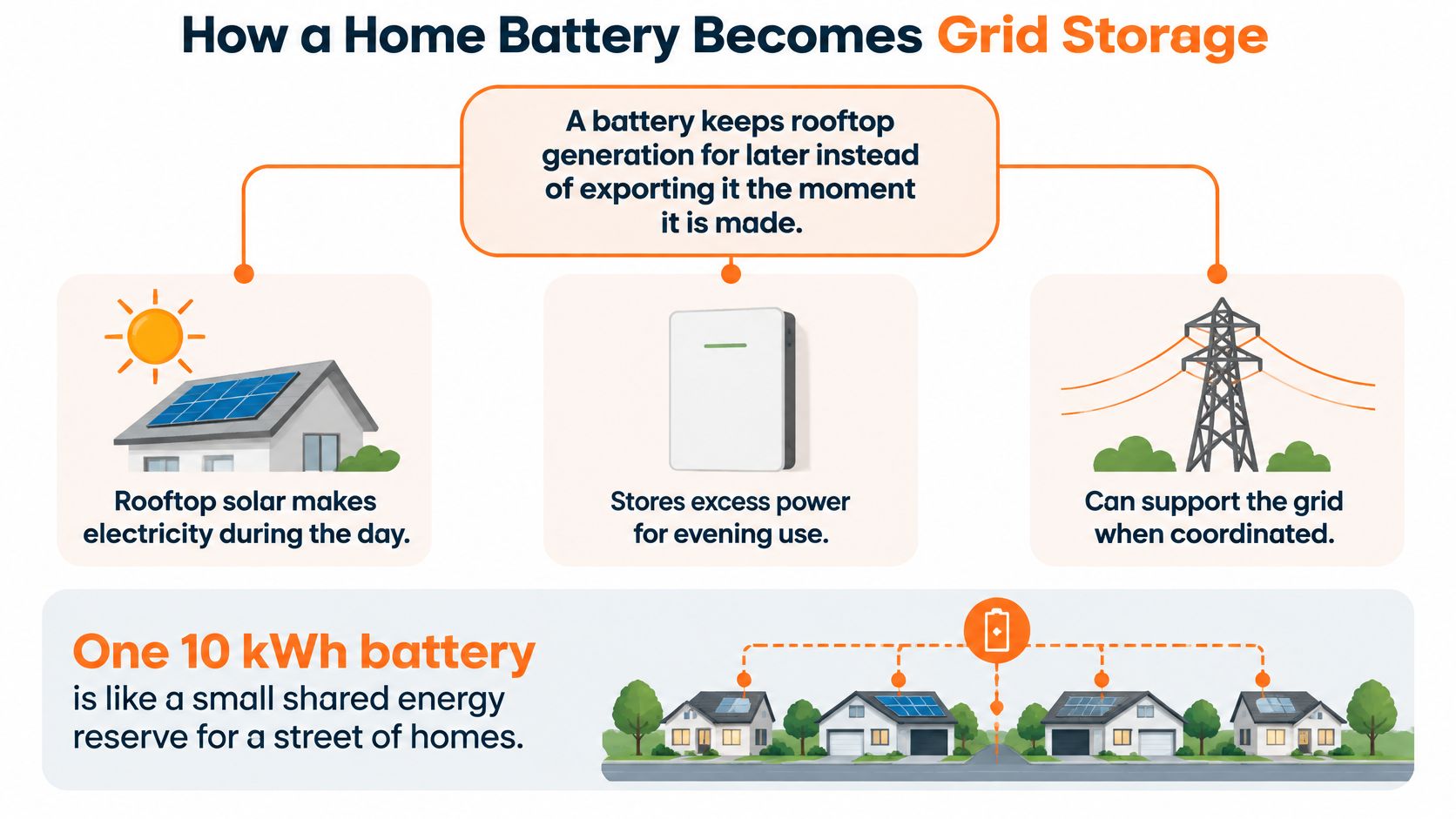
Solar energy storage means keeping rooftop-generated electricity in a battery for later instead of exporting it as soon as it's produced. Say a household generates surplus electricity during the day. Its battery retains that energy for cooking, lighting and other evening demand.
Think of the battery as a household water tank. Coordinating many tanks doesn't make each one larger, but it lets an operator organise their combined contribution. Each household still has its own equipment and meter.
The relationship between household storage and coordinated grid support is illustrated below.
Coordination is more than an internet connection
A Virtual Power Plant, or VPP, coordinates distributed batteries so their combined response can support electricity-system needs. An app that displays battery performance isn't enough. Monitoring shows what happened; coordinated control changes what the fleet does.
ARENA's AGL Virtual Power Plant demonstration connected systems across 1,000 residential and business premises, allowing the combined fleet to operate like a 5 MW plant. The project also demonstrated local demand and voltage-management services, showing that battery value can extend beyond household self-consumption.
AEMO's distributed PV and batteries/VPP forecast describes an early-stage market with limited historical information and models different coordination assumptions rather than treating uptake as a single measured forecast. That distinction matters when comparing claims about how much household storage is already coordinated.
The operator needs the available capacity
AEMO's VPP demonstration data specification sets out five-minute operational visibility, including aggregated generation or load, stored energy available for discharge and device-level information. An operator needs this visibility to distinguish a battery that exists from one that can respond.
At HighFlow Energy, we coordinate spare capacity automatically and securely, charging at suitable times and discharging small amounts when available. Household energy use is always prioritised before grid support. Our explanation of solar battery Virtual Power Plants describes the household arrangement.
- Charging decisions consider available solar, expected consumption and system conditions.
- Discharge decisions must respect household priorities and equipment limits.
- Fleet forecasts need to account for unavailable devices, rather than assuming every battery can contribute.
NSW and Queensland Storage on the NEM
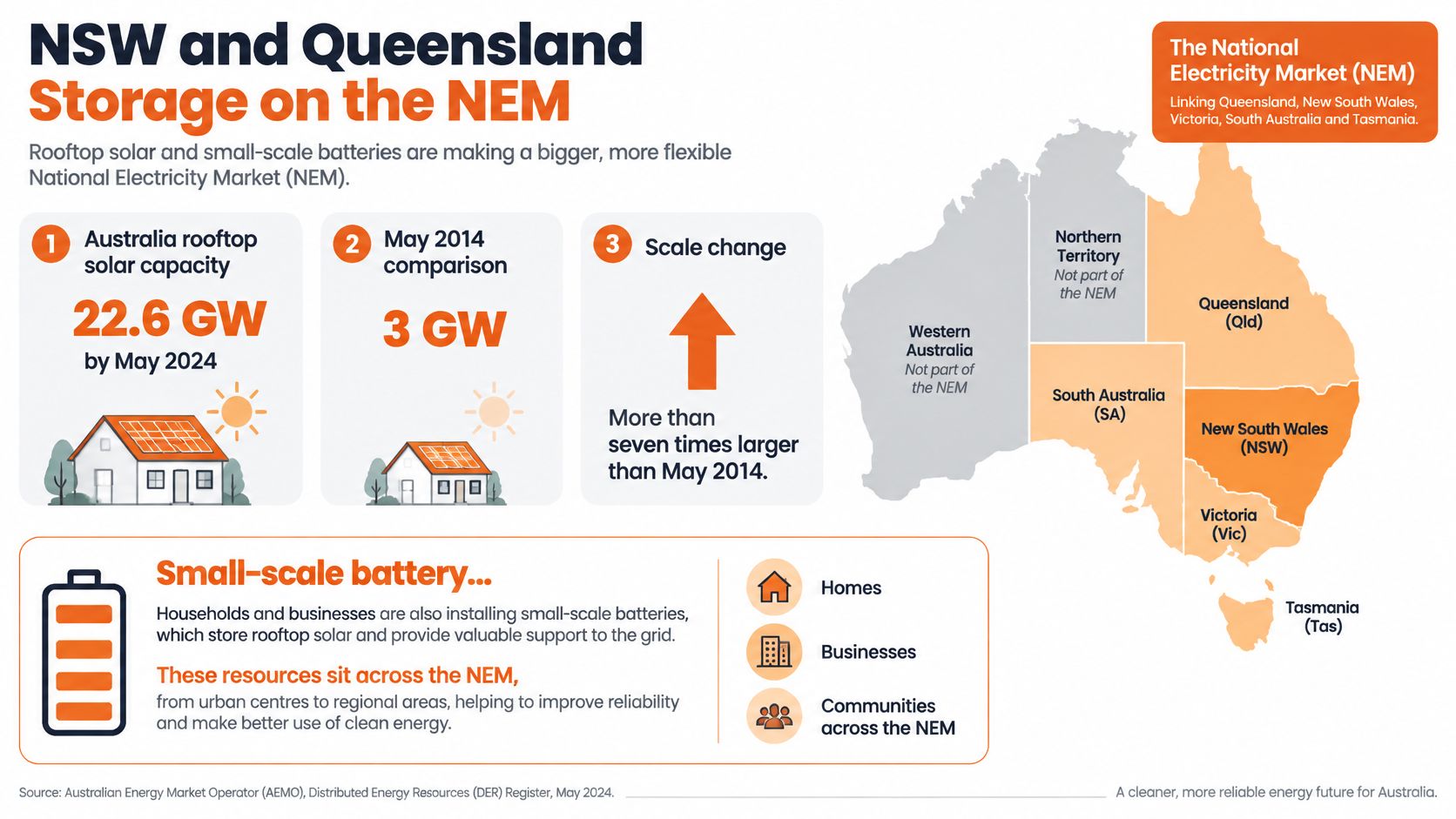
Small-scale battery capacity across the National Electricity Market (NEM) stood at approximately 1 GW. The Australian Government's National Consumer Energy Resources Roadmap says AEMO's 2024 Step Change scenario projects a requirement for 6.6 GW by 2029–30. The roadmap also records 22.6 GW of Australian rooftop solar by May 2024, up from 3 GW in May 2014.
The NEM connects electricity markets across eastern and southern Australia, including NSW and Queensland. Rooftop solar supplies generation, while batteries can shift some of that energy to other times. Installed capacity alone does not show how much stored energy is usable, approved for export or available to a VPP.
Wholesale opportunity and local permission are different
Wholesale prices change with electricity supply and demand. Strong solar output can push midday prices down, while high evening demand, generator outages or low wind output can tighten supply. A battery operator may respond to these conditions, but household value depends on the retail or VPP agreement.
Wholesale prices do not automatically set household rates. A fixed retail tariff may not pass through a wholesale price spike, and a high spot price does not guarantee a matching payment for household exports.
Local connection rules also matter. In Queensland, check the property's requirements with Energex or Ergon. NSW households must meet their distributor's requirements. Voltage rise or local congestion can limit exports even when conditions across the wider market favour battery discharge.
Participation counts need their own scope
An AEMO consumer-panel document reported approximately 90,000 solar-and-battery installations across the NEM as of January 2025, with an estimated 38,200 participating in VPPs. It also reported participation growth of roughly 22% every six months between 2022 and 2025.
The document cites IPART findings that NSW VPP customers' median quarterly bills were 34% to 72% lower than those of other solar-and-battery households. These are comparisons between customer groups, not a promised outcome for an individual home.
- Keep datasets separate: A NEM solar-and-battery sample is not the same measure as a national count of residential battery units.
- Check current incentives: Federal and state consumer-energy settings can change. Consult the Australian Government's energy website and relevant state program information.
- Use the property's export approval: A state-wide assumption cannot confirm what a specific connection allows.
Feed-in Tariffs Versus Coordinated Battery Value
Ways an existing solar battery can earn value
| Approach | Who controls discharge | What the evidence supports | Binding limit |
|---|---|---|---|
| Self-consumption only | Household | Avoided grid imports at the retail rate | Small evening load leaves capacity idle |
| Flat feed-in tariff | Household exports surplus | A per-kWh credit at the contracted export rate | Export limits and weak midday prices |
| Time-of-use shifting | Household or a fixed schedule | Peak imports avoided on a known clock | Misses short wholesale spikes |
| Coordinated VPP | Aggregator within household protections | Potential bill reduction from coordinated operation | Reserve, cycling, export cap and trust |
| Solar with no battery | No storage | Daytime self-use plus feed-in credits | Cannot retain daytime generation for evening use |
The ACCC reports that solar-and-battery customers participating in VPPs had bills typically $762–$1,093 lower than comparable customers, a 57–63% reduction rather than bill elimination. The same report found approximately 24% of customers with installed batteries in NSW, Victoria, South Australia and south-east Queensland participating at the start of 2026, even though participation grew 67% in the six months to January 2026. That figure describes a defined group of battery owners in a defined period, so read it as a measure of uptake, not of every installed battery in the country.
Compare the whole bill
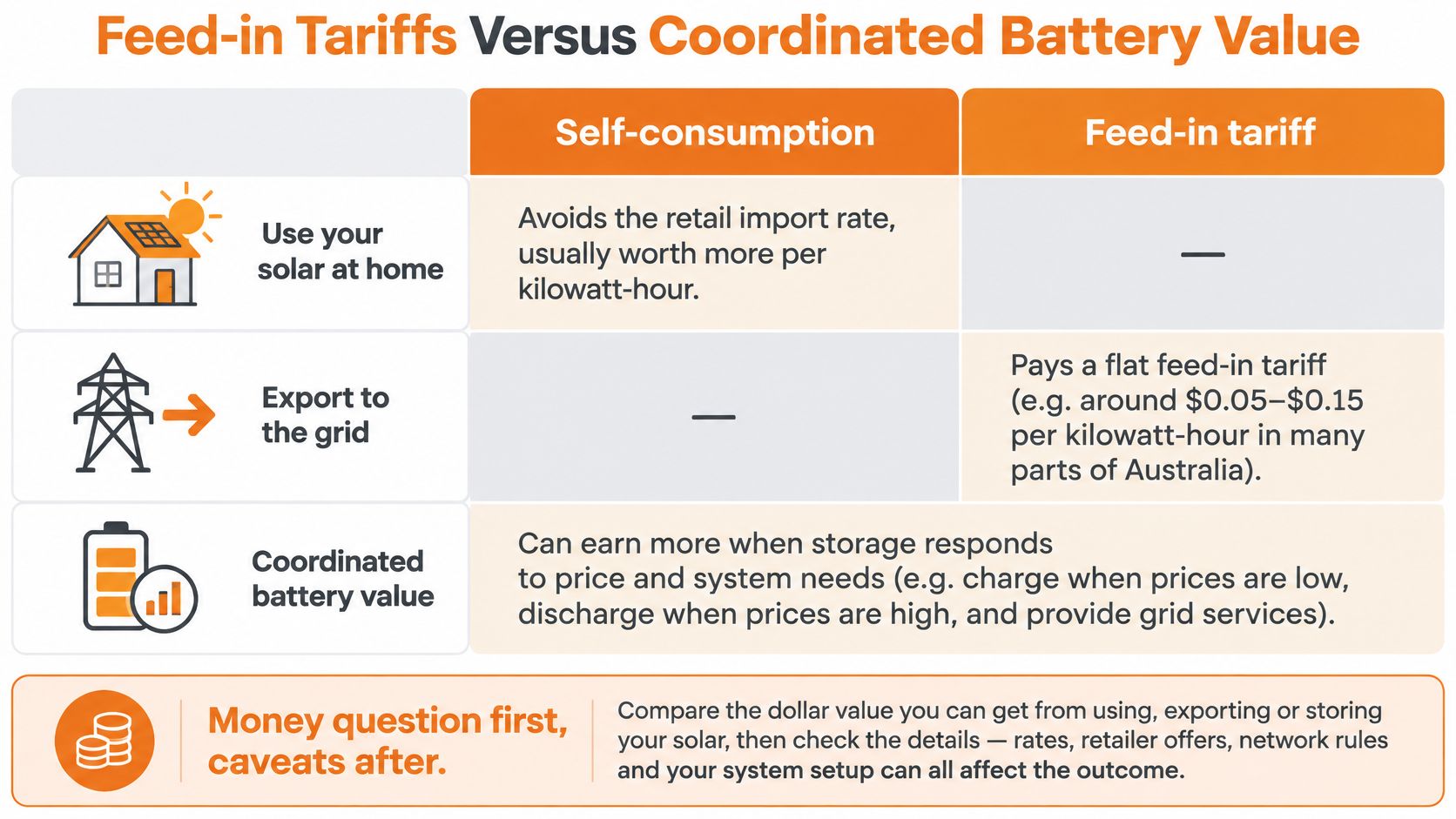
A feed-in tariff pays for electricity exported through the meter. Self-consumption avoids buying electricity. Compare your actual import and export rates: retaining energy can be worth more than exporting it, but only if the household later uses that energy. A battery's nameplate capacity sets the ceiling here. The usable share, the reserve held back and the property's export permission decide how much of that ceiling turns into real value.
A time-of-use schedule works from a fixed retail clock and suits households with predictable routines. A coordinated VPP responds to changing electricity-system conditions, which adds another possible source of value on top of avoided imports. Exporting surplus at a known rate remains a legitimate choice where those conditions don't apply.
Retailer-based coordination can connect dispatch value with bill credits or an electricity allowance, while a separate rewards program may leave the bill itself with another retailer. Comparing multiple battery revenue streams helps show where each dollar lands.
For a meaningful energy retailer comparison, examine:
- Import costs: Usage rates, time-of-use periods and daily supply charges.
- Export treatment: Feed-in payments, dispatch rewards and any limits on credits.
- Allowance rules: What's covered, what isn't, and how excess usage is charged.
- Operating costs: Additional cycling, conversion losses and reserve requirements.
A strong VPP offer should explain the bill that remains, not just the value it might create.
Battery size, daily consumption, available solar, export permission and actual dispatch frequency all affect the outcome. The Australian Energy Regulator oversees retail-market conduct, which makes offer disclosures important, but a headline offer still needs checking against the contract and your own consumption profile.
What Households Keep When a VPP Dispatches
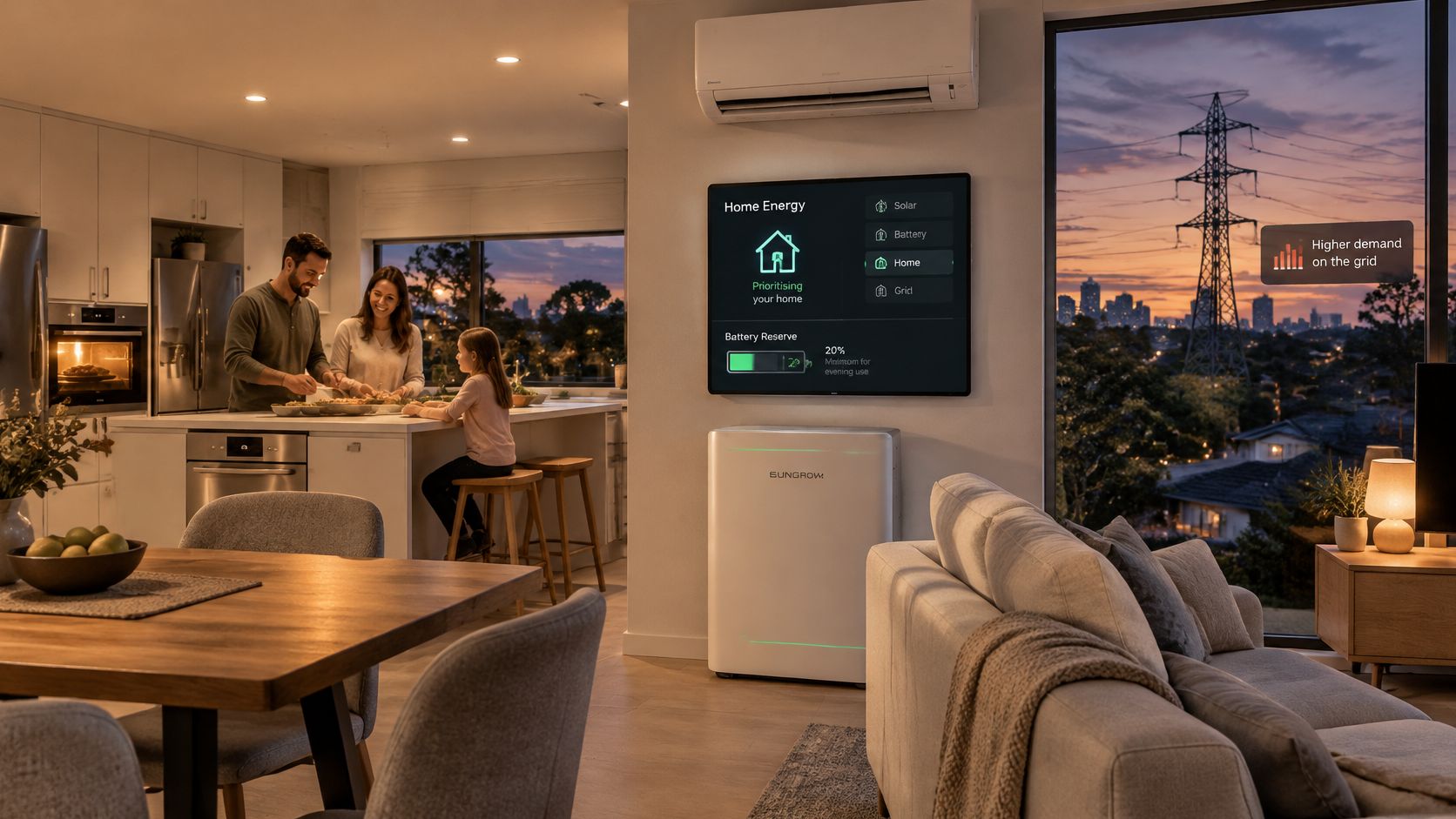
At dinner time, the oven, air-conditioning and an electricity-system demand event can coincide. The control question is straightforward: which instruction wins when the house and grid both want stored energy?
The household setting is the right starting point for understanding those protections.
Australian consumer concerns go beyond purchase cost. ESS News' coverage of Australian battery consumer research identifies limited technology understanding, safety and privacy concerns, maintenance uncertainty and distrust of VPPs as barriers. Its discussion of Energy Consumers Australia findings also distinguishes structural barriers, such as renting and apartment ownership, from the concerns of people who already own equipment.
Control needs visible rules
Say a NSW or Queensland household has a well-charged battery before dinner. A defensible control plan protects the household's expected needs and agreed reserve, then permits a short discharge from surplus. It should also change course if the household unexpectedly uses more electricity.
- Visible reserve: The customer should understand the protected level and what it's intended to cover.
- Manual override: Our customers can override automated plans at any time through the app.
- Explainable operation: Live prices, household energy information and forecasts help explain charging and discharge decisions.
- Warranty discipline: Review manufacturer limits and account for cycling against current usable capacity.
- Clear exit: Our arrangement has no lock-in contracts or exit fees and doesn't require new hardware.
Remote participation still changes battery state of charge. We may remotely charge or discharge a customer's battery for market participation, affecting the stored energy available at a given moment. That operating reality should be understood before enrolment.
The video below provides another way to consider household participation and control.
Backup and privacy remain separate responsibilities
Blackout performance follows the battery manufacturer's backup design, circuit configuration and installation. A grid-connected battery doesn't automatically power every appliance during an outage.
Cybersecurity and data handling deserve the same attention as financial terms. We generally store and process personal information in Australia and are bound by the Australian Privacy Principles under the Privacy Act 1988 (Cth). Customers remain grid-connected and don't need to monitor dispatch or change their day-to-day behaviour to participate.
Solar Storage Questions NSW and Queensland Owners Ask
Is solar energy storage the same as a VPP?
No. Storage is a physical capability. A VPP is a coordinated operating arrangement involving multiple distributed resources. When comparing a Virtual Power Plant in Australia, establish whether the service actively coordinates batteries or merely monitors them.
How does home storage differ from a grid battery?
A home battery sits behind a customer meter and operates within household equipment and connection limits. A grid battery is a separate electricity-system asset. Adding their capacities together doesn't tell you how much either can deliver during a particular event.
Do VPP customers pay nothing for electricity?
Not necessarily. A household's outcome follows its consumption, retail terms and participation arrangement. Treat electricity bill reduction and a bill-free allowance as different propositions: an allowance has coverage rules, while a percentage saving describes a comparison.
What remains under household control?
Battery ownership doesn't transfer because the equipment participates in coordinated dispatch. Reserve settings, override access, backup configuration and exit terms determine the practical boundaries. Read those provisions together rather than relying on a general statement that customers retain control.
Which organisations should settle competing claims?
Use AEMO for electricity-system operation and forecasting, and the Clean Energy Council for its published industry counts. The ACCC and Australian Energy Regulator are relevant to consumer and retail-market questions. For incentives, confirm the current government program conditions rather than relying on an undated summary.
Key takeaways
- Count the right thing: Installed units, power, stored energy and coordinated participation aren't interchangeable.
- Protect the household: Spare capacity must be calculated after customer needs and operating limits.
- Assess net value: The useful result is a better overall electricity outcome, not just more exports.
- Require transparency: Clear controls and bill rules matter as much as the optimisation software.
Check Whether Your Battery Is Underused
A battery performance review should start with eligibility and operating history, not a discount code. HighFlow Energy supports homeowners in Queensland and New South Wales who already have solar, a compatible home battery and continuing electricity bills.
A practical eligibility sequence
Confirm the property and network. Establish that the address is within our NSW or Queensland service areas, including eligible Energex and Ergon properties. Have a recent electricity bill available so usage and charges can be reviewed.
Identify the existing equipment. Record the battery and inverter models, usable capacity and internet connection status. Eligible equipment must meet minimum usable-capacity, inverter and VPP compatibility standards.
Define household protection. Record the current reserve and backup configuration. Evening consumption and backup requirements need to be understood before any spare capacity is assessed.
Bring operating evidence. Collect battery-app information showing sunset charge, overnight imports and discharge timing, together with the site's export approval. These records help distinguish unused capacity from a system already working near its limits.
Assess the allowance against consumption. Our Bring Your Own Battery, or BYOB VPP, uses coordinated value to fund the Bill-Free Electricity allowance, with current tiers from 300 kWh to 1,000 kWh per billing month, depending on system size. It covers daily supply charges, usage within the allowance, and network and distribution charges on that portion. Usage beyond the allowance is billed at standard rates.
Why HighFlow Energy
We manage customer communications, eligibility and the Bill-Free Allowance program. ERC Energy provides regulated retail services in accordance with Australian energy laws. This separation makes it important to understand both the participation arrangement and the retail terms.
Many owners judge installation quality closely but pay less attention to ongoing performance. Battery optimisation asks a different question: whether the system's daily decisions are producing appropriate value while preserving household priorities. An eligibility assessment should answer that question without promising that every electricity bill will disappear.
HighFlow Energy helps eligible NSW and Queensland homeowners assess whether their existing solar and battery system can deliver greater value through coordinated participation. Visit HighFlow Energy to request an eligibility assessment and review your potential allowance against your equipment, household needs and current electricity use.