


Electricity Moving House Guide for QLD and NSW
Moving house is already a sequence of deadlines. Add electricity to the list and a missed notice can mean an empty property remains connected, the new home isn't ready when you arrive, or your first bill covers the wrong meter period. Electricity moving house in Queensland and New South Wales needs more than an account update when the property has rooftop solar, a home battery or Virtual Power Plant participation. You need to coordinate the retailer, distributor, meter access, hardware and battery settings as one move plan.
SEO title: Electricity Moving House Guide for QLD and NSW
Meta description: Plan electricity moving house in QLD and NSW, including retailer timelines, meter reads, solar batteries and VPP participation.
Suggested URL slug: electricity-moving-house-qld-nsw
Featured image concept: A homeowner coordinating a move beside a switchboard, smart meter and home battery, with a simple timeline showing old-home disconnection and new-home connection.
Image alt text: Homeowner planning electricity moving house in Queensland and New South Wales with a solar battery and smart meter.
Planning Your Electricity Move in QLD and NSW
Start with the move-in date, not the removal truck. That date determines when the new property needs supply, when the old property should stop being billed to you and whether your battery or VPP service needs a separate account action.
In Queensland and New South Wales, established homes generally have an existing meter. That usually makes the process an account and connection event rather than a completely new electricity arrangement. A new build, a property with a removed meter or a home with an unsafe installation can require extra distributor work and more preparation. Canstar's moving-house energy guide recommends nominating the move-in date first and keeping the old address connected until the day after moving out.
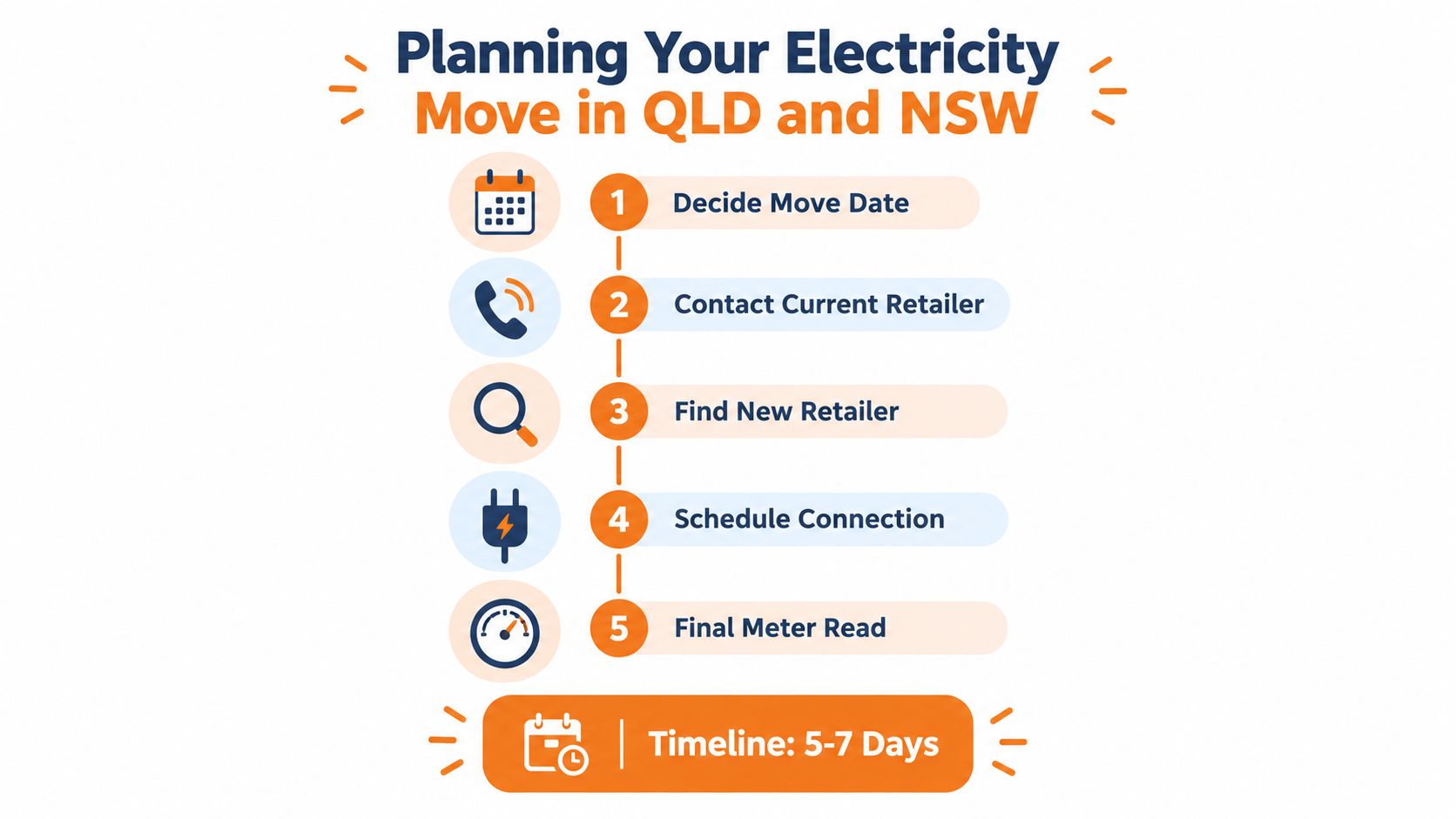
A workable electricity moving house sequence
Confirm both addresses and dates. Record the old address, new address, handover date, preferred connection date and the date you expect to leave the old property. Keep the old supply available until you no longer need power there, but confirm with the retailer how the final billing date will be handled.
Contact the current retailer. Ask for the final meter-read process, disconnection arrangements, any account closure requirements and whether your existing plan can be offered at the new address.
Check the new property. Confirm whether electricity is currently connected, whether the meter is accessible and whether the property has solar, a battery or a special connection arrangement.
Arrange the new connection. Provide the retailer with the address, move-in date and access details. If you're changing retailers, compare the plan, network availability, tariff structure and any connection-related charges rather than assuming the old contract can easily follow you.
Keep records. Save confirmation numbers, emails, meter photographs and the final and opening readings. These records give you a clear reference if an estimated read or delayed bill creates a dispute.
Practical rule: Treat the electricity move as two linked services, closing supply at the old home and establishing supply at the new one.
The Australian Energy Regulator's explanation of energy services is useful when you need to separate retailer responsibilities from the physical network work. That distinction becomes particularly important if you're moving across a distribution boundary.
Understanding Retailer and Distributor Timelines
At the new property, the retailer and distributor handle different parts of the move. Your retailer manages the account, plan, billing and connection request. The distributor operates the local electricity network, including the meter, service lines and physical supply connection. You normally deal with the retailer, which then coordinates any required distributor work.
The distinction matters within the National Electricity Market, or NEM. A new address may sit in a different distribution network, so an existing contract may not be available even when the same retailer operates at both properties. Canstar's advice on moving between distribution networks explains why the network boundary can affect contract availability in Queensland, New South Wales and Victoria.
How much notice should you give?
Allow one to three business days for common connection or disconnection work. Regional locations can require five to six business days, according to Synergy's moving and building connections information. Same-day or next-business-day service may be available when the request is made early and the property meets the provider's conditions.
Treat these periods as planning benchmarks, not guarantees. A new build or a property without an installed meter may require 10 to 20 days. AGL's moving-house guidance identifies late notice, an unsafe or inaccessible meter, and a main switch left on before connection as possible causes of delay.
| Situation | What to plan for |
|---|---|
| Established home with an accessible meter | Retailer-led connection or transfer request |
| Regional property | More time for distributor scheduling |
| New build or removed meter | Distributor application and possible meter installation |
| Different distribution network | Confirm whether the current plan remains available |
| Solar, battery or VPP system | Check technical, tariff and account requirements |
A retailer can confirm whether your existing plan is offered at the new address. Request written confirmation about the tariff, export limits, feed-in treatment and any VPP participation. A battery may depend on time-of-use pricing, approved export settings or demand-response rules, and those settings may not carry across a network boundary.
Moving retailers can also change how your solar and battery value is calculated. Review this guide to changing your electricity provider alongside the connection discussion. It covers the commercial change, while the retailer must still confirm the property's physical connection status and technical requirements.
Executing Accurate Final and Opening Meter Reads
The meter reading creates the financial boundary between the two homes. Your final bill should reflect usage at the old property up to the agreed closing point, while the opening reading establishes the starting point for your new account.
Take your own reading even when the retailer or distributor has arranged an official read. Photograph the meter display, make sure the address or meter location is clear in your records and note the date and time. For a digital meter, capture the displayed register carefully. For a traditional meter, record the digits from left to right and check whether the retailer asks for a particular register.
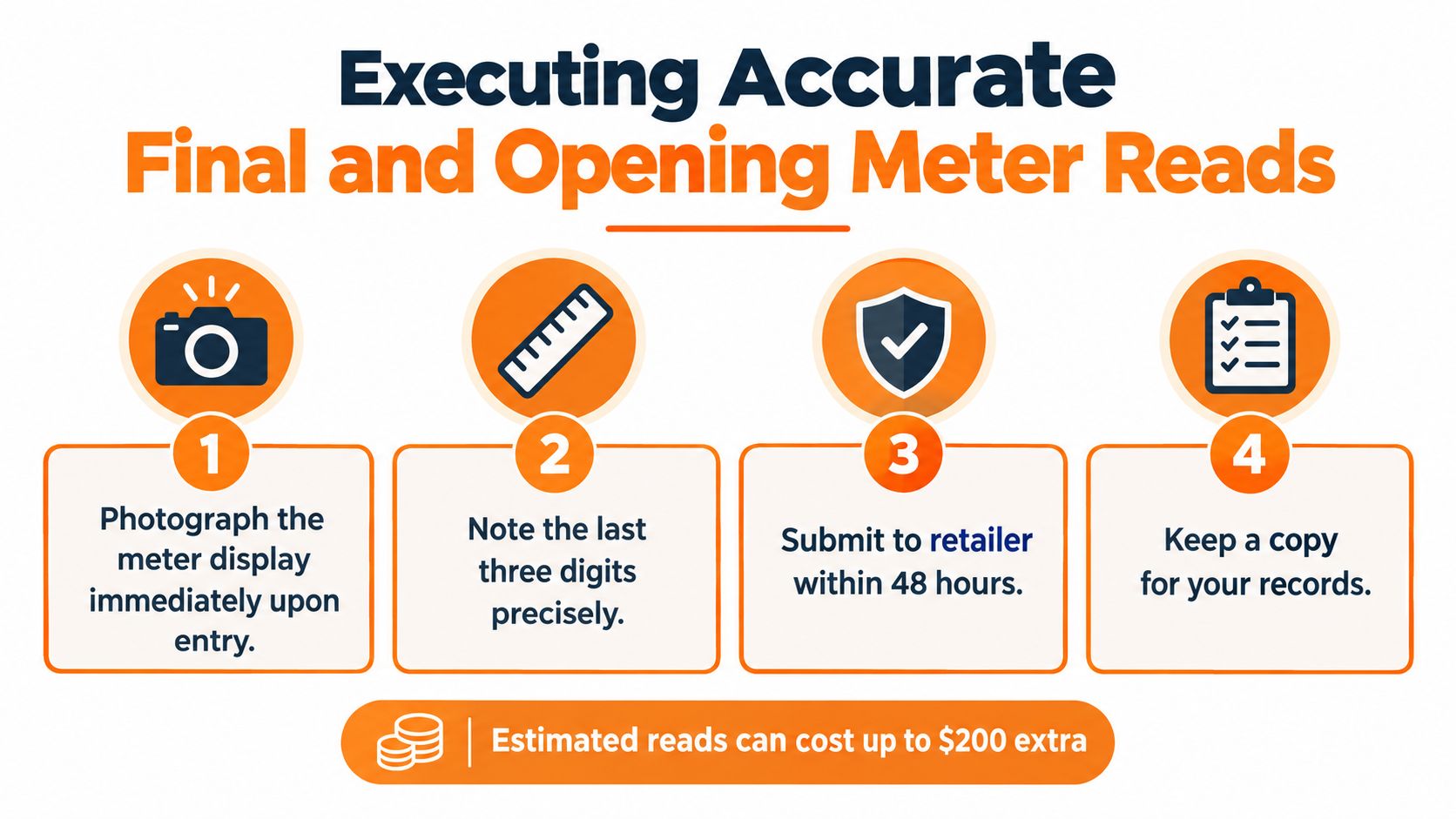
Make the meter accessible
A technician can't complete a reliable final read if the meter is behind a locked gate, blocked by stored items or unsafe to approach. Clear the path before handing over the property, arrange access with the agent or new owner where necessary and keep pets away from the work area.
South Australian network guidance provides a precise example of this requirement. SA Power Networks' moving-house instructions say customers should notify their retailer at least four working days before handing over the keys, with the path clear, gates or roller doors open and dogs on leads. Although the network example is South Australian, the practical lesson applies to any move where a distributor needs physical access.
If access is blocked, the distributor may notify the customer and retailer and leave an access card, requiring another final reading to be arranged. That creates avoidable administration and can delay the point at which the account is finalised.
Reconcile the bills after moving
Keep the following together:
- Old-home closing photograph: Match the reading against the final bill.
- New-home opening photograph: Compare it with the first bill's opening register.
- Connection confirmation: Retain the retailer's reference and scheduled date.
- Solar and battery records: Note whether generation or battery operation was active during the handover.
Don't assume an estimated read is automatically wrong, but challenge it when it doesn't align with your photographs or occupancy dates. If you need a refresher on register displays and meter terminology, use this guide to reading an electricity meter.
Homeowners managing a move often coordinate several trades at once. A practical resource on seasonal marketing for electricians also illustrates why clear scheduling and access communication matter when electrical work is part of a wider property handover.
This video provides a visual reference for the type of meter information homeowners may need to identify during the process:
Relocating Solar Batteries and VPP Participation
A home battery turns electricity moving house into both a property logistics issue and an energy-market issue. The hardware may be physically removable, but it can't be treated like ordinary furniture. A qualified installer must assess isolation, cabling, switchboard arrangements, inverter compatibility and the requirements of the new premises before decommissioning or recommissioning the system.
The new home may have different export limits, network conditions, tariff options or switchboard constraints. Those factors affect how much solar can be exported, when the battery can charge and how it can discharge during high-demand periods. A system that worked effectively at the old address may need new settings at the new one.
Separate the hardware move from the account move
Plan these as separate workstreams:
- Installer booking: Confirm who will safely disconnect, transport and reinstall the equipment.
- Warranty position: Ask how removal and reinstallation affect manufacturer and workmanship warranties.
- Network approval: Check whether the new address needs an updated application or technical assessment.
- Retail account: Arrange the new supply and confirm tariff and billing details.
- VPP participation: Ask whether the agreement can transfer, whether the new network is supported and what happens during the gap between addresses.
A VPP coordinates participating batteries so they can respond to grid conditions, wholesale price volatility and demand events. The battery still needs to protect household priorities, maintain a suitable reserve and respect the operating limits set by the manufacturer and network.
That creates a practical trade-off. Maximising discharge during a valuable grid event can increase the value of participation, but it may leave less stored energy for evening household use. A sound programme should make the priority order clear, explain how customer control works and show how allowances or other payments are treated during a move.
Protect continuity of value
Ask the VPP operator specific questions before the removal date:
- Does participation end automatically when the old electricity account closes?
- Must the new address pass a separate eligibility check?
- Will the battery remain in self-consumption mode while the new connection is pending?
- How are outstanding allowances, credits or final charges handled?
- Can the household override automated charge and discharge decisions?
High Flow Energy is an Australian electricity retailer offering a Bring Your Own Battery, or BYOB, VPP service for eligible existing solar and battery owners in Queensland and New South Wales. Its service uses coordinated battery operation, a companion app with live prices and forecasts, and an allowance structure that can apply to supply charges and usage up to the allowance, while household energy needs remain the priority. Customers should confirm eligibility and moving-account treatment for the new address rather than assuming the service transfers automatically.
For technical planning, review the system integration requirements before an installer removes equipment. Battery performance also depends on the condition of the wider solar system. A general guide to solar panel cleaning frequency by climate can help you consider maintenance as part of the property handover, although cleaning doesn't replace electrical inspection or network approval.
Avoiding Common Connection and Billing Pitfalls
Move-day electricity failures often begin with an assumption: a retailer's confirmation guarantees that the physical connection will proceed. It does not. The property still needs a safe, accessible meter, an appropriate switchboard arrangement and, where solar or battery equipment is installed, a connection procedure that matches the system on site.
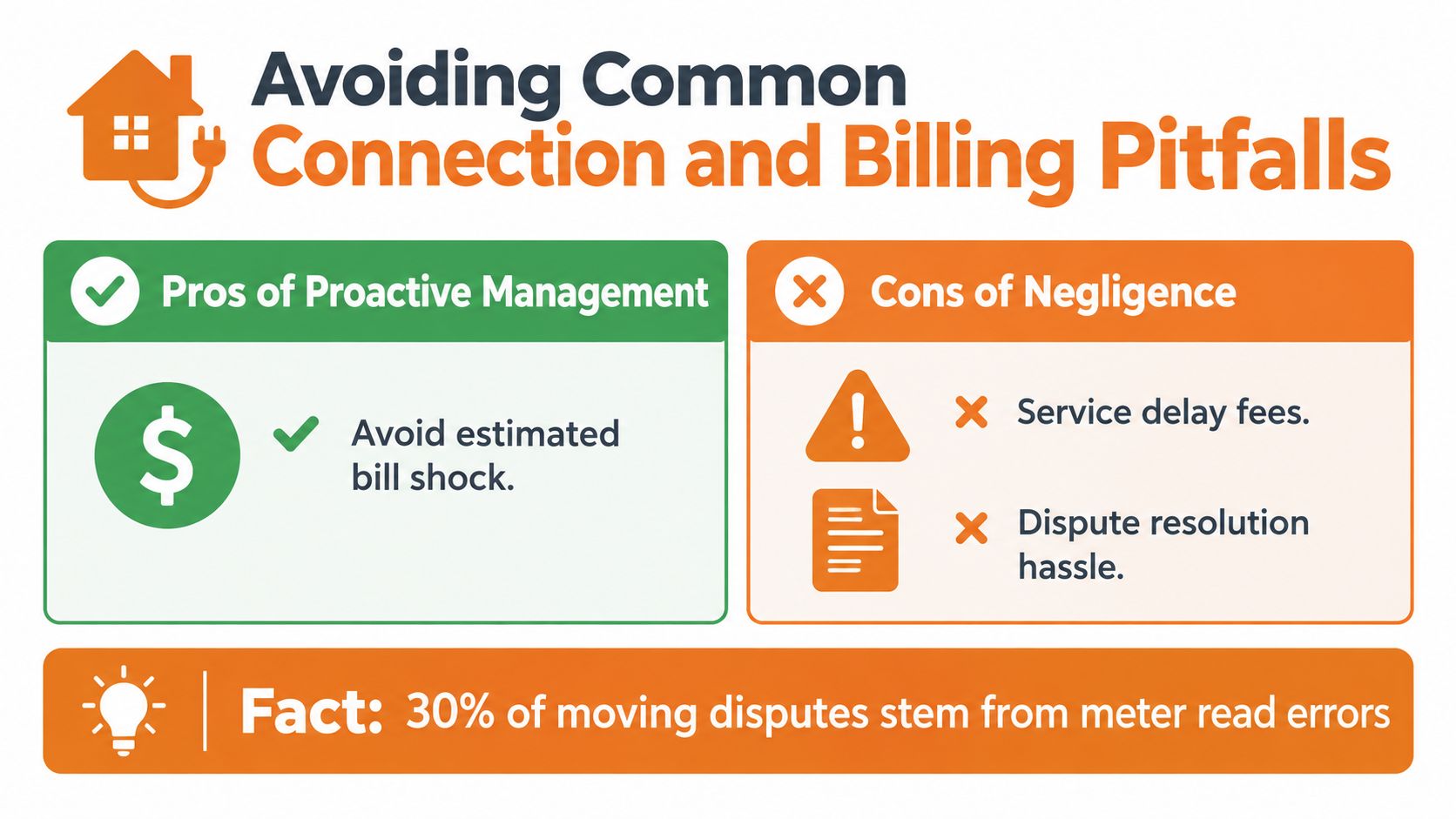
Missing notice, unsafe access, an obstructed meter or an incorrect main-switch position can turn a scheduled connection into a follow-up call, an access appointment or a billing investigation. These details matter more when the property has an inverter, battery or VPP-enabled equipment, because the expected electrical configuration may differ from a standard connection.
What tends to go wrong
- The old account stays open: Confirm the final supply date and provide the final meter reading. Otherwise, charges may continue after you have left.
- The new meter isn't checked: A connection request can be lodged while access remains blocked or the meter area is unsafe. Clear gates, pets, stored items and vegetation before the appointment.
- The main switch is left on: Follow the retailer's instructions for the connection procedure. Do not improvise at the switchboard, particularly where solar or battery equipment is connected.
- The network changes: A plan available at the old address may not be offered at the new one if the distribution network or retailer service area differs. Recheck tariffs, supply charges and export arrangements before accepting the account.
- Battery operation is ignored: A disconnected inverter or battery can alter the property's electrical configuration. Use an appropriately qualified professional for isolation, removal, recommissioning and any required network approvals.
- Estimated readings go unchallenged: Compare final and opening bills with your photographs, occupancy dates and transfer confirmations. An incorrect estimate can affect both the outgoing account and the new account's starting balance.
A reconnection fee may apply. EnergyAustralia's moving-house energy guidance explains that a distributor may charge when electricity is connected after a customer moves in, or when a meter is read where applicable. Ask the retailer whether a network charge applies, who will bill it and how it will appear on the account.
A packing and utilities guide can place meter access, switchboard checks and retailer notifications alongside the broader moving schedule, rather than leaving them until the final hours.
Use a short handover record
Create one record containing:
- old and new addresses
- move-out and move-in dates
- retailer names and confirmation references
- final and opening meter readings
- meter photographs
- solar, battery and installer details
- VPP contact and account status
- access instructions for gates, pets and switchboards
This record provides evidence if a bill is disputed. It also gives the retailer, distributor or installer a clear timeline of what changed, when it changed and which party handled each step.
Optimising Your Energy Asset with High Flow Energy
A move is a useful point to review battery performance, not just reconnect the system. The new address may expose different export constraints, tariff settings, household demand patterns and network conditions. Those variables influence whether the battery mainly serves self-consumption, shifts energy away from expensive periods or participates in coordinated grid services.
A BYOB VPP can connect an existing compatible battery to a retailer-led programme without requiring the homeowner to buy a new battery or solar system. The operator may coordinate charging and discharge around household priorities, network requirements and market conditions. The commercial value depends on eligibility, the agreement, battery capability and the way allowances or other benefits are calculated.
A battery is an energy asset, not merely backup equipment. Its financial performance depends on how consistently its available capacity is used within safe operating limits.
Before completing your move, ask for a review of:
- Eligibility at the new address: Confirm the network, inverter and battery remain supported.
- Household priority settings: Check the reserve level and the conditions for automated discharge.
- Allowance treatment: Understand when any bill-free electricity allowance starts and ends.
- Control and visibility: Confirm how the app displays prices, forecasts, savings and overrides.
- Exit and warranty conditions: Read the agreement and confirm how relocation affects participation.
The retailer relationship should be transparent about retail charges, network components, battery control and the circumstances in which the programme may not operate. Don't judge the arrangement only by the advertised allowance. Assess how it fits your household's actual demand, backup expectations and willingness to participate in demand-response events.
Key takeaways
- Notify the retailer before the move and confirm both the old-home closure and new-home connection.
- Allow for different timelines in metropolitan and regional areas.
- Check whether a distribution-network change affects your current plan.
- Photograph both meter readings and keep the records with your bills.
- Use a qualified installer for battery removal and recommissioning.
- Confirm VPP eligibility, household priority and allowance treatment at the new address.
- Review battery performance after the move instead of assuming the old settings remain suitable.
Most battery owners focus on installation quality. Far fewer focus on ongoing performance and optimisation, especially when a change of address alters tariffs, network conditions and household demand.
HighFlow Energy connects eligible existing solar and battery systems to a BYOB Virtual Power Plant, with coordinated battery operation and a bill-free electricity allowance structure subject to the service terms. Visit HighFlow Energy to check eligibility for your new address and assess whether your battery is being underutilised financially.