


Home Solar Battery System: Guide to Savings
A home solar battery system stores excess solar energy for evening use, and it can also earn value through a Virtual Power Plant. Australia had 454,753 household battery installations by the end of 2025, with 183,245 units sold in the second half of that year alone. Clean Energy Council data shows how quickly storage has moved into the mainstream.
The popular advice is simple: install a battery, use your own solar after sunset and reduce grid imports. That advice is useful, but incomplete. A battery that only follows default self-consumption settings can sit idle, charge when electricity is already plentiful or discharge before the most valuable demand period arrives. Owning the hardware isn't the same as optimising its financial output.
For Australian households, the important question is no longer only whether a battery can store energy. It's whether the system is sized, controlled and connected to the right electricity arrangement so it can serve the home first while contributing value to the grid.
Understanding the Home Solar Battery System
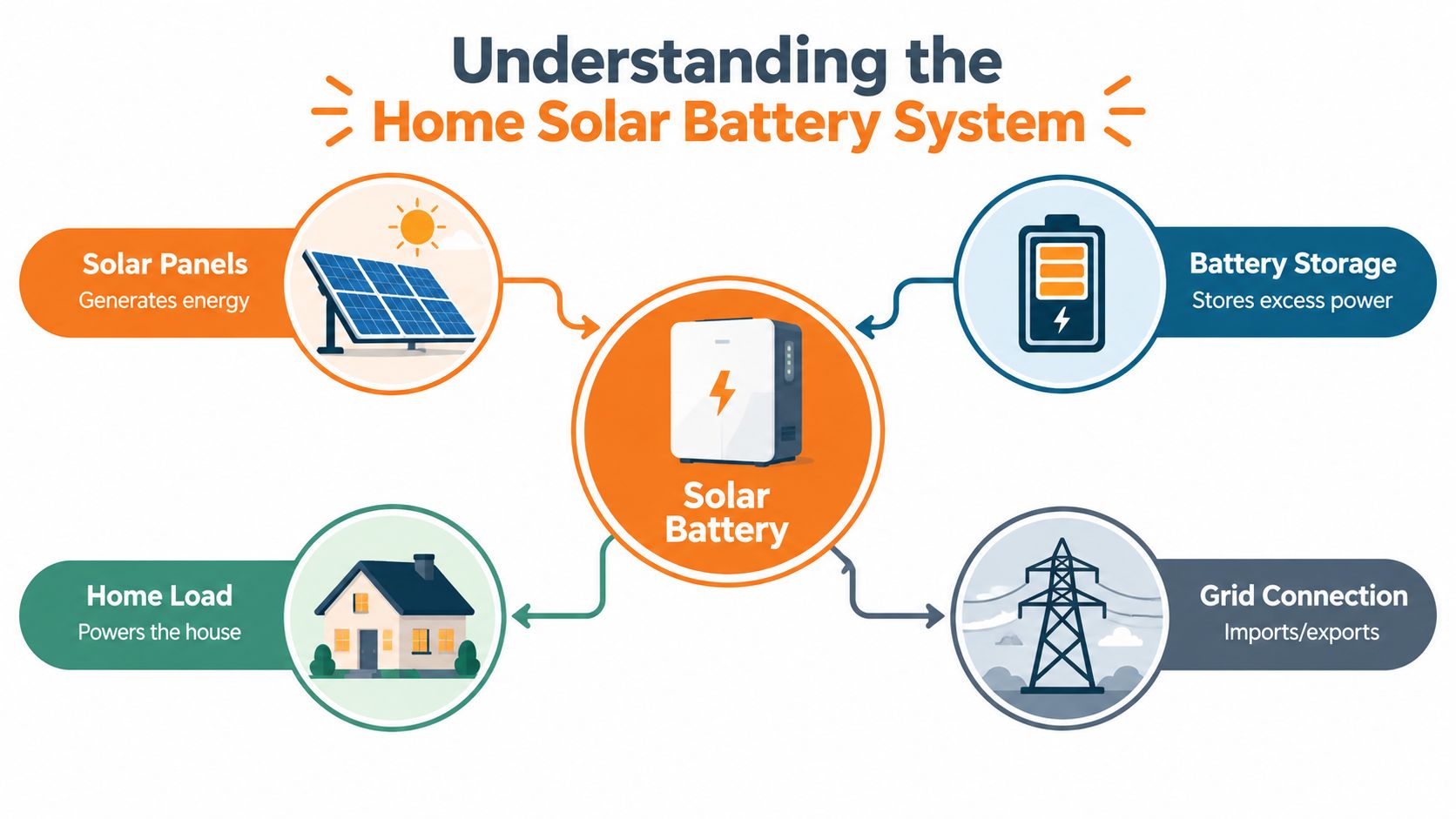
A home solar battery system combines solar generation, an inverter, battery storage, household demand and a grid connection. Solar panels produce electricity as direct current, while household appliances generally use alternating current. The inverter manages that conversion and controls how energy moves between the panels, battery, home and grid.
The operating sequence is straightforward:
- Solar generation comes first. Electricity produced during the day supplies appliances such as refrigeration, heating, pumps and cooking equipment.
- The battery receives surplus energy. If generation exceeds household demand, the control system can direct the excess into storage rather than exporting it immediately.
- Stored energy supports later demand. After solar production falls, the battery can supply the home instead of the household drawing as much from the grid.
- The grid remains part of the system. It can provide electricity when the battery is depleted, and some systems can export energy when permitted by the network and retailer arrangement.
The specifications that affect value
A battery's headline capacity isn't enough to judge performance. Usable capacity tells you how much stored electricity can be discharged. Depth of discharge indicates how much of the battery can be used during a cycle, while efficiency reflects how much energy remains available after charging and discharging losses.
YourHome identifies capacity, depth of discharge, efficiency, life cycle and electrical connection as key specifications to compare in a battery system. CHOICE explains battery capacity in kilowatt-hours, but a larger nominal rating doesn't automatically produce more useful energy if the system has restricted usable capacity or inefficient control.
The battery also needs a suitable location, compatible inverter and reliable communications. For a practical explanation of how battery controls monitor operating conditions, see this battery management system guide. The hardware stores energy, but software determines when storage charges, discharges, preserves a reserve or responds to an external signal.
For a deeper Australian explanation of system components and operation, review how solar batteries work in Australia.
Practical rule: judge a battery by the energy it can use at the times your household needs it, not by its largest printed capacity figure.
How a Battery System Works in the NEM
The National Electricity Market, or NEM, links electricity generation, networks, retailers and consumers across Australia's eastern and southern states. A household battery interacts with that market through its inverter and retailer arrangement, even when the owner only sees a simple app showing charge levels.
During periods of strong solar production, wholesale supply can be abundant and export constraints can limit how much rooftop generation a household can send to the network. A battery provides another destination for that energy. It can absorb surplus generation, then release electricity later when household demand rises or when grid conditions make dispatch more valuable.
The energy path has several layers:
- Generation: rooftop solar produces electricity for immediate household use.
- Conversion: the inverter converts and manages electricity in a form the home and grid can use.
- Storage: the battery holds energy within its operating limits.
- Dispatch: a local controller or authorised remote platform determines when the battery supplies the home or supports the grid.
- Settlement: the retailer applies the relevant tariff, allowance, credit or export treatment to the customer account.
Why timing matters
A battery's financial result depends on timing, not only total energy moved. Charging from solar and discharging during evening demand can reduce grid purchases. In other circumstances, preserving stored energy for a forecast demand event may produce more value than discharging immediately after sunset.
The controller must balance several competing objectives. It needs to protect the household's reserve, respect inverter and network limits, avoid unnecessary cycling and respond to changing electricity conditions. A simplistic schedule can miss those trade-offs. Remote optimisation can make more informed decisions, provided the customer understands the rules and retains appropriate control.
A VPP operator also needs visibility of the system's connectivity and technical state. The AEMO market notices resource is useful context for understanding how rapidly changing grid conditions can affect dispatch decisions, although a household doesn't need to interpret market notices manually to benefit from a properly managed service.
VPP readiness is now part of eligibility
The Clean Energy Regulator requires on-grid solar batteries and inverters to be capable of VPP participation at installation time to qualify for STCs under the Small-scale Renewable Energy Scheme. The regulator's VPP requirements point to practical requirements such as remote dispatch capability, reliable internet connectivity and equipment that can accept grid-service signals.
That doesn't mean every owner must enrol immediately. It does mean VPP capability is increasingly part of the technical baseline. In NSW guidance, participation also depends on a compatible battery, reliable internet and an inverter that can be managed remotely.
Maximising Value Through Virtual Power Plants
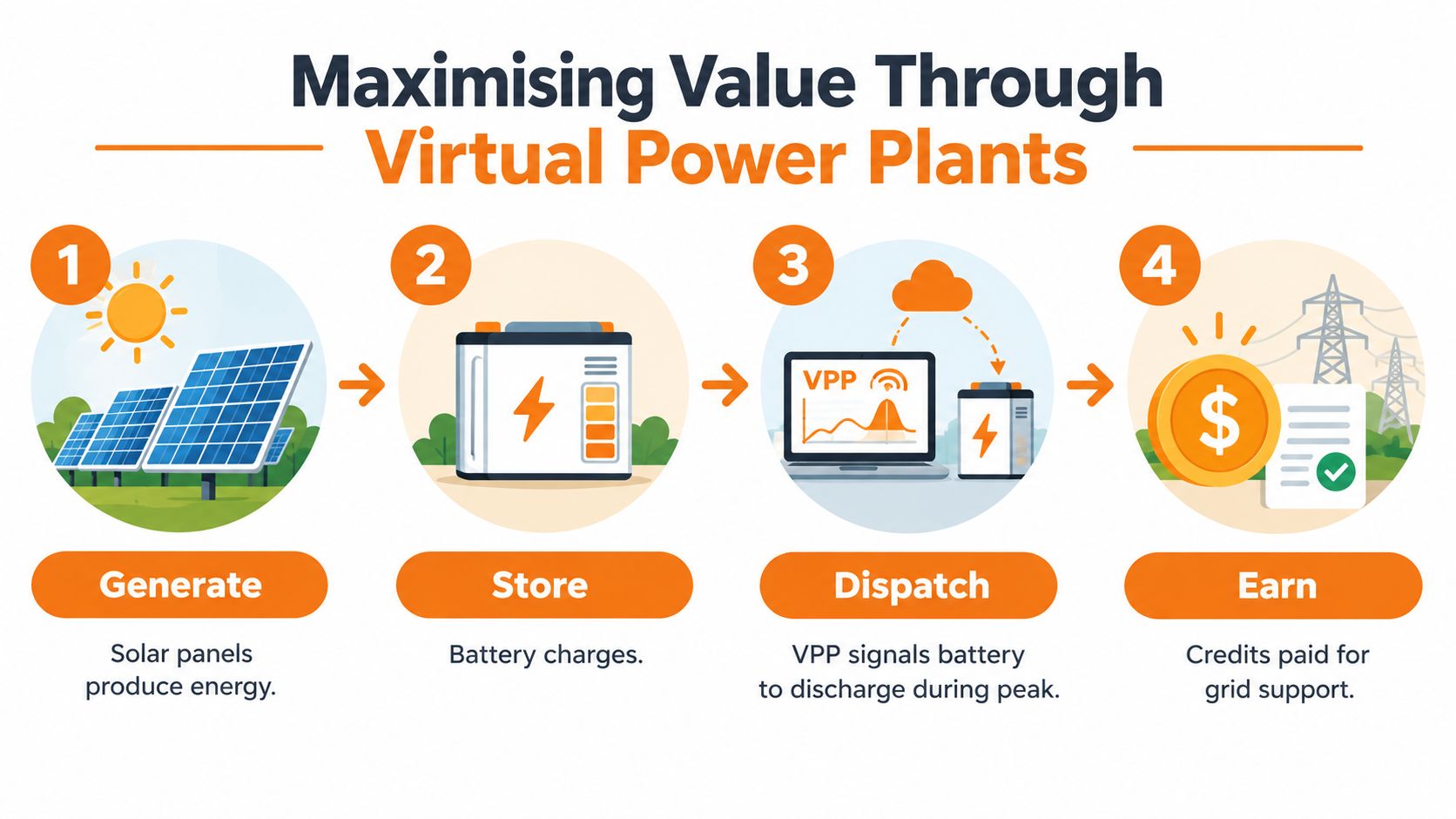
A Virtual Power Plant Australia program coordinates many distributed batteries through software. Each battery remains at the customer's property, but the operator can treat available capacity across participating homes as a flexible grid resource.
The arrangement works through controlled dispatch. A participating battery may charge from available solar, retain a household reserve and discharge some available capacity when the grid needs support. The operator then applies the agreed customer benefit, which might involve credits, an allowance or another transparent bill treatment.
BYOB changes the decision
A BYOB VPP, or Bring Your Own Battery program, is relevant to households that already own a compatible battery. The customer isn't buying new storage from the retailer. Instead, the existing system is enrolled into a coordinated program that uses spare capacity under agreed operating conditions.
That distinction matters because the value question changes. A household that has already paid for solar and storage should assess how to improve the performance of its existing asset before considering additional hardware. A BYOB arrangement can provide another revenue stream without replacing the battery, assuming the system meets compatibility, connection and warranty requirements.
The customer should ask:
- What gets controlled? Clarify whether the operator can control charging, discharging, export or only selected dispatch events.
- What remains available? Confirm the household's reserve, priority use and ability to override an automated plan.
- How is value calculated? Check whether benefits appear as bill credits, an allowance, wholesale-linked payments or another structure.
- What happens during an outage? VPP participation doesn't automatically mean backup power, so confirm how the system behaves when the grid fails.
- What are the exit terms? Review lock-in conditions, fees, retailer requirements and warranty implications.
Grid services can complement self-consumption rather than replace it. A properly designed strategy may preserve stored energy for household use while making limited capacity available during a demand event. The value of a battery therefore comes from multiple uses, not just one discharge every evening. Multiple revenue streams for battery owners provides further context on this broader approach.
Australia's battery market is moving towards stronger network integration. The Australian Energy Market Operator's Step Change scenario forecasts VPP participation rising from 15% of consumer battery installations in the NEM in 2026 to 24% by 2035 and 40% by 2050. AEMO's trajectory is summarised by the Climate Council, and it reinforces a practical point: future battery value will increasingly depend on software, market access and coordinated dispatch.
Traditional Usage vs VPP Participation
Most household battery systems begin with a self-consumption objective. The battery charges from surplus solar and discharges when the home needs electricity. That approach can be sensible, particularly for a household with predictable evening demand and a tariff where reducing imports delivers clear value.
It can also leave opportunities unused. A fixed schedule might discharge stored energy before a later peak period, export when local network conditions are restrictive or keep the battery full when a grid-support event could have created value. The right strategy depends on the household's demand, solar production, tariff, export limit, battery warranty and VPP terms.
| Feature | Traditional Self-Consumption | VPP Optimisation |
|---|---|---|
| Primary objective | Reduce household grid imports | Balance household use with coordinated grid services |
| Control method | Installer or owner-set schedule | Software-assisted dispatch under agreed rules |
| Evening use | Battery discharges according to a fixed reserve or schedule | Battery can respond to forecasts, household demand and event conditions |
| Grid participation | Usually limited or absent | Available where equipment, retailer and program rules support it |
| Customer priority | Focuses directly on household consumption | Should preserve an agreed household reserve and priority use |
| Financial treatment | Value mainly comes from avoided grid purchases | May combine avoided purchases with credits, allowances or other benefits |
| Main risk | Poor timing and idle capacity | Conflicts between grid dispatch, reserve requirements and battery wear |
The trade-off is control versus coordination
Traditional settings are easier to understand. The owner decides when the battery charges and discharges, and the system follows those instructions. That simplicity can be attractive, but the owner also carries the burden of interpreting tariffs, forecasts and network conditions.
VPP participation introduces external coordination. The operator may dispatch the battery when a demand event occurs, but the customer needs clear limits. A transparent program should explain how much capacity can be made available, how household demand is prioritised and how the customer can override an automated plan.
A VPP shouldn't ask customers to choose between grid support and household security. It should define the reserve, dispatch rules and financial treatment clearly enough that both objectives can work together.
Feed-in tariffs aren't the only comparison
A feed-in tariff pays for electricity exported to the grid under the retailer's terms. A VPP may create value through a different mechanism, such as coordinated dispatch or an allowance attached to participation. Neither option is automatically superior for every household.
Compare the complete outcome. Include avoided imports, export treatment, supply charges, network charges where relevant, dispatch limits, battery cycling and the value of keeping energy available for later household use. The advertised rate alone doesn't describe the financial result.
The right comparison is therefore traditional battery use versus a documented VPP offer, not a generic claim that every VPP will outperform every tariff. Queensland and New South Wales households should also check local network constraints and whether their retailer supports the relevant program.
The Reality of Underutilised Battery Assets
Australia's storage expansion has created a large installed base, but participation in coordinated programs remains much smaller than battery ownership. The Clean Energy Regulator reported more than 111,000 batteries approved under the Cheaper Home Batteries Program in Q2 2026. Other reporting cited by the regulator indicated that about 7% of Australian battery-owning households were enrolled in a VPP in April 2026, with earlier snapshots ranging from 4% to 10%. The regulator's quarterly market report provides the relevant market context.
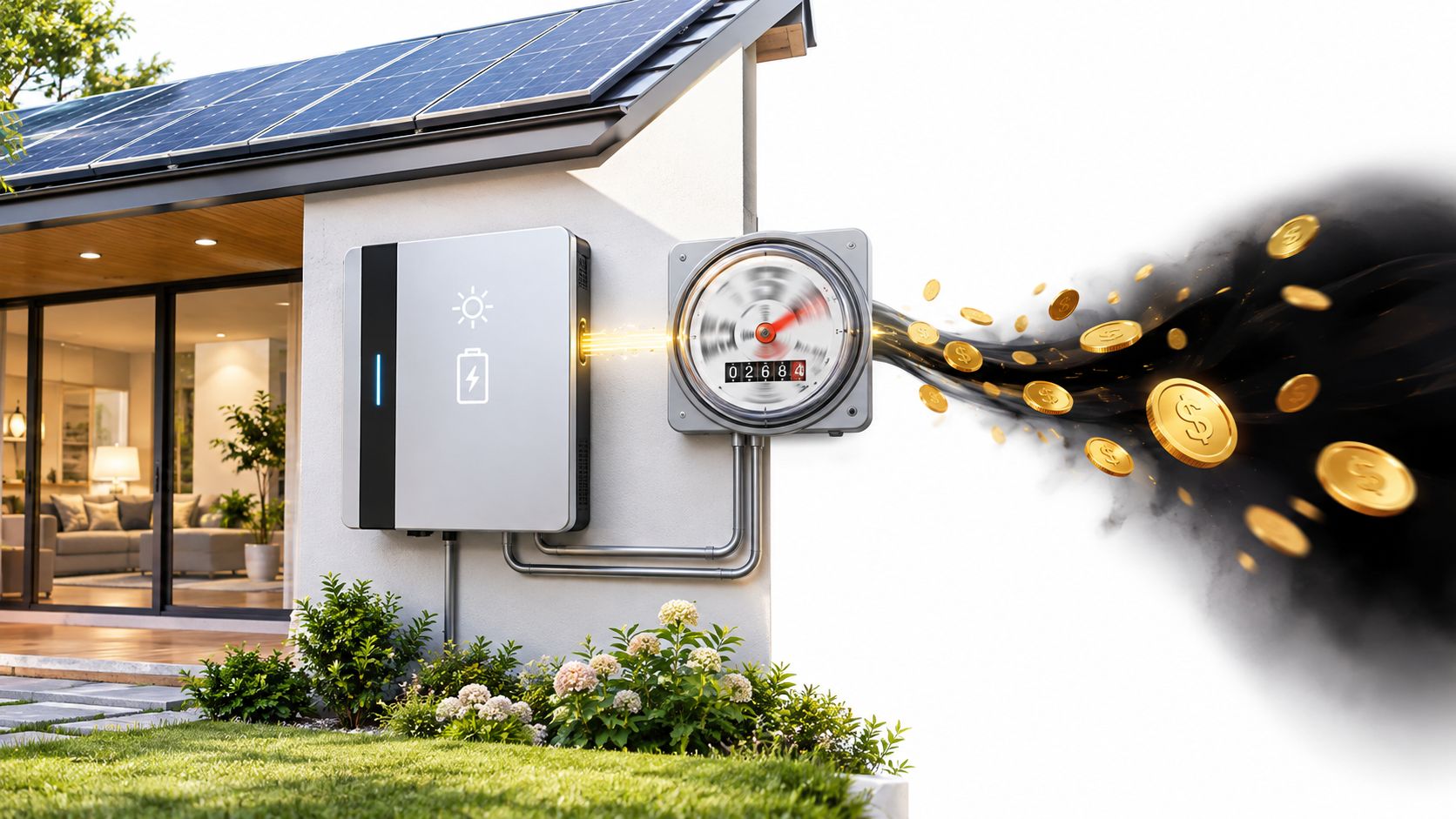
The implication is practical. Many owners have already purchased the asset, but they haven't connected it to a program that can coordinate spare capacity with wider grid needs. A battery may still reduce imports under self-consumption settings, yet unused capacity has no financial role while it sits at a high state of charge or waits for a manually selected schedule.
Bigger systems need better control
System size can create its own optimisation problem. Industry reporting from SunWiz found that 221,000 residential battery systems were installed in 2025, adding nearly 5 GWh of storage, while the average battery size rose to 21.6 kWh from 11.8 kWh the year before. RenewEconomy's coverage of the 2025 battery market also reported that registrations fell 28.3% month-on-month in June 2026 as the rebate market recalibrated.
Those figures don't prove that a larger battery is always better. They show why sizing and control deserve equal attention. A system that regularly remains partly unused may have paid for capacity the household rarely needs, while a smaller system with better dispatch can sometimes serve a clearer financial purpose.
The strongest question isn't “How large a battery can I install?” It's “What size and operating strategy fit my tariff, export limit, household demand and VPP options?” That question is especially relevant in NSW and Queensland, where battery installations and capacity growth have been prominent.
Next Steps for Optimising Your Energy System
Start with the system you already have. Collect the battery model, inverter model, usable capacity, installation date, warranty terms, retailer, tariff, export limit and recent electricity statements. Your monitoring app should help you identify when the battery charges, when it discharges and whether it frequently reaches full or empty states.
Follow a practical assessment sequence
Check technical compatibility. Confirm that the battery and inverter can support remote management and VPP participation. The equipment must remain within the manufacturer's operating requirements, and the internet connection needs to be reliable enough for dispatch signals.
Review actual energy behaviour. Look at daytime solar surplus, evening demand, grid imports and exports. Don't rely only on the system's nominal kilowatt-hour figure. Compare usable capacity with the household's recurring demand after solar production ends.
Read the financial structure. Ask whether the program provides credits, an allowance, export payments or another benefit. Check how supply charges, usage charges, network charges and consumption above any allowance are treated.
Protect household priorities. Confirm the reserve level, backup behaviour and override controls. A VPP should state when the operator may dispatch the battery and how the household can retain priority access to stored energy.
Examine battery wear and warranty terms. Cycling can create value, but unnecessary cycling can reduce the economic benefit of participation. Ask how dispatch is managed, who monitors performance and whether participation affects the manufacturer's warranty.
Compare the complete retailer offer. Assess the VPP against your current tariff using actual statements rather than a headline promise. Include the value of self-consumption, export treatment, supply charges and any conditions attached to the program.
NSW has a specific VPP incentive that calculates an upfront amount using battery capacity made available to the grid, up to 28 kWh. Eligible batteries must be more than 2 kWh and up to 50 kWh, the incentive can be claimed once per National Metering Identifier and not every retailer is VPP-compatible. NSW VPP incentive guidance sets out those conditions.
Off-grid eligibility also differs. Batteries installed more than 1 km from the grid don't need to be VPP-capable to qualify, while premises within that distance generally need VPP-capable equipment or written evidence that grid connection would cost more than $30,000, excluding extra internal property extension costs. Clean Energy Regulator guidance on battery eligibility explains the distinction.
Key takeaways
- A battery stores surplus solar, but software and market access determine how much value it creates.
- Self-consumption can reduce imports, while a VPP can add coordinated grid-service value.
- Household reserve, warranty protection and clear dispatch rules matter as much as the payment structure.
- The best system size depends on demand, tariffs, export limits and participation options.
- Australian owners should assess their actual battery performance before buying more hardware.
Before choosing a VPP, request an eligibility assessment and ask for a clear explanation of allowance or credit calculations, household priority, dispatch controls and exit terms. HighFlow Energy provides a Bring Your Own Battery VPP service for eligible solar and battery owners in Queensland and New South Wales, with app-based monitoring and automated optimisation that customers can override, so visit HighFlow Energy to review whether your existing system is being underutilised.