

How Can I Make My Solar Battery Last Longer? Top 2026 Tips
If you already have rooftop solar and a battery, you're probably asking a practical question now, not a theoretical one. You've paid for storage, you watch the app, and you want the system to keep working well for as long as possible.
That's the right mindset. A home battery isn't a set-and-forget appliance. It's a working energy asset, and the way it's charged, discharged, installed, cooled, and monitored directly affects how much useful life you get from it.
Many owners start by looking at panels, inverters, and tariffs. Fewer look closely at battery operating settings. That's usually where lifespan is either protected or shortened. If you're searching for how can I make my solar battery last longer, the answer is rarely one single fix. It's a combination of discharge limits, temperature control, software settings, and avoiding revenue strategies that push the battery harder than necessary.
Protecting Your Solar Battery Investment
Most homeowners don't worry about battery lifespan on day one. They're focused on getting the system working, shifting solar into the evening, and cutting reliance on the grid. The concern usually shows up later, when summer heat arrives, the battery starts cycling harder, or a Virtual Power Plant option appears and raises a new question about wear.
That's when the battery stops feeling like a gadget and starts looking like what it really is. A major household asset that needs active management.
I've seen the same pattern repeatedly. The owners who get the best long-term performance aren't usually the ones with the most expensive hardware. They're the ones who treat battery settings as operational controls, not background defaults. They check reserve limits, look at charge windows, and pay attention to where the battery is installed.
A lot of the same thinking that applies to looking after panels applies to storage as well. If you already maintain the rest of your system carefully, this broader guide to protecting your solar investment is a useful companion resource because it reinforces a simple point. Energy assets last longer when owners stay engaged.
A battery usually degrades from everyday operating habits, not from one dramatic failure.
For households in Queensland and New South Wales, there's another layer. Batteries don't just serve your home anymore. They can also participate in grid events, respond to tariff signals, and support bill reduction strategies. That can be valuable, but it also means longevity and revenue can pull in different directions.
The best outcome comes from managing both. Protect the battery first. Then optimise what's left.
The Fundamentals of Battery Health DoD SoC and Cycle Life
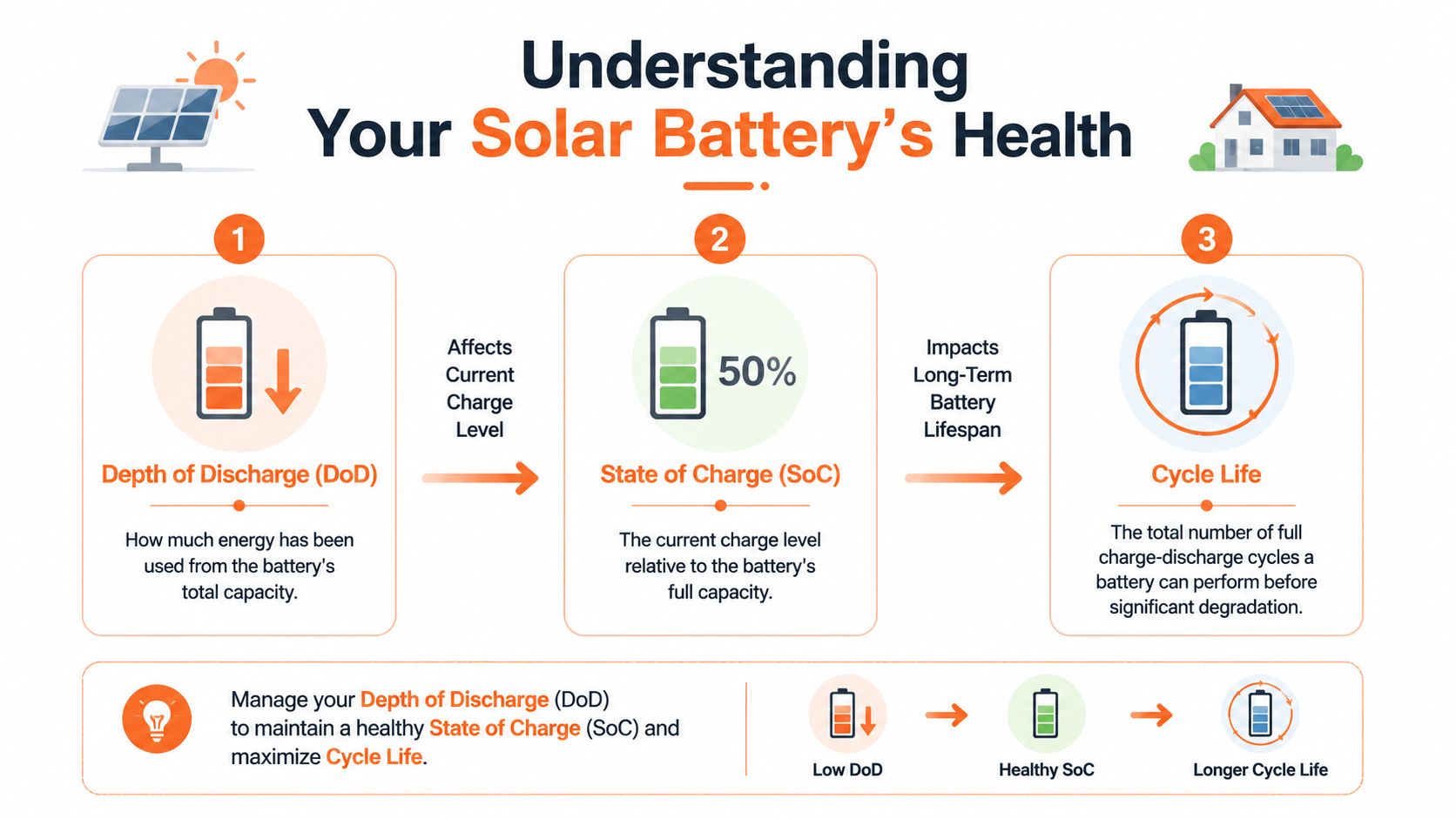
Battery lifespan is set less by one dramatic event than by thousands of ordinary charging decisions. The three terms that explain most of that wear are Depth of Discharge (DoD), State of Charge (SoC), and cycle life.
What DoD actually means
Depth of Discharge is the share of stored energy used before the battery recharges. If a 10 kWh battery delivers 8 kWh, that cycle used 80% DoD.
That matters because deeper cycling usually increases cell stress and shortens total usable life. A battery can be technically capable of deep discharge and still age faster if it does that every day. For Australian households, that trade-off shows up quickly in the economics. Pull more energy out each night and you may save more on imports in the short term, but you also bring forward degradation and reduce the years in which the battery can keep delivering those savings.
What SoC tells you day to day
State of Charge is the battery's current charge level. It tells you how full the battery is at a given moment, and it matters because lithium-ion cells generally prefer the middle of their operating range over the extremes.
A battery that spends long periods near empty or at 100% usually ages faster than one that cycles through a narrower band. Heat makes that worse. In Australian conditions, especially in garages and west-facing utility spaces, a battery sitting at a high SoC during hot afternoons is under more stress than the app screen suggests.
If you want a clearer technical background on how different chemistries behave in home storage, this guide to lithium-ion batteries for solar systems is a useful reference.
Why cycle life matters more than most owners realise
Cycle life is the number of charge and discharge cycles a battery can deliver before its capacity falls to a defined threshold. In practice, this is what turns battery care into a financial question.
A battery that is pushed hard for tariff arbitrage or frequent Virtual Power Plant dispatch may generate more short-term revenue. The cost is often paid in faster capacity loss. Once usable capacity drops, the battery stores less solar, covers less evening demand, and becomes less valuable both to the household and to any VPP program relying on it.
Here is the practical relationship:
| Term | Plain English meaning | Why it matters |
|---|---|---|
| DoD | How much of the battery you use in a cycle | Deeper cycles usually increase wear |
| SoC | How full the battery is right now | Time spent near empty or full can accelerate ageing |
| Cycle life | How many useful cycles the battery can deliver over its life | It shapes long-term savings and replacement timing |
Owners who understand these three settings make better decisions about reserve limits, export behaviour, and VPP participation. The objective is not to maximise battery activity. The objective is to get the best total return from the asset over its full service life.
Core Strategies for Extending Battery Lifespan
A common Australian battery pattern looks good in the app and expensive on the balance sheet. The battery charges to full by early afternoon, sits hot through the day, then discharges hard through the evening or during a VPP event. That operating pattern can increase short-term bill savings or grid-trading income, but it also tends to bring replacement costs forward.
Use partial cycling instead of chasing every last kilowatt-hour
The middle of the battery's SoC range is usually the least stressful place to operate. As noted earlier, Australian guidance on lithium battery care consistently points to shallower cycling and avoiding routine use of the full capacity window.
For a homeowner, that means setting the battery to do slightly less each day so it can keep doing useful work for longer. Giving up a small amount of daily discharge can preserve more usable capacity over the years, which often matters more than extracting every available kilowatt-hour in year one.
A practical setup usually includes:
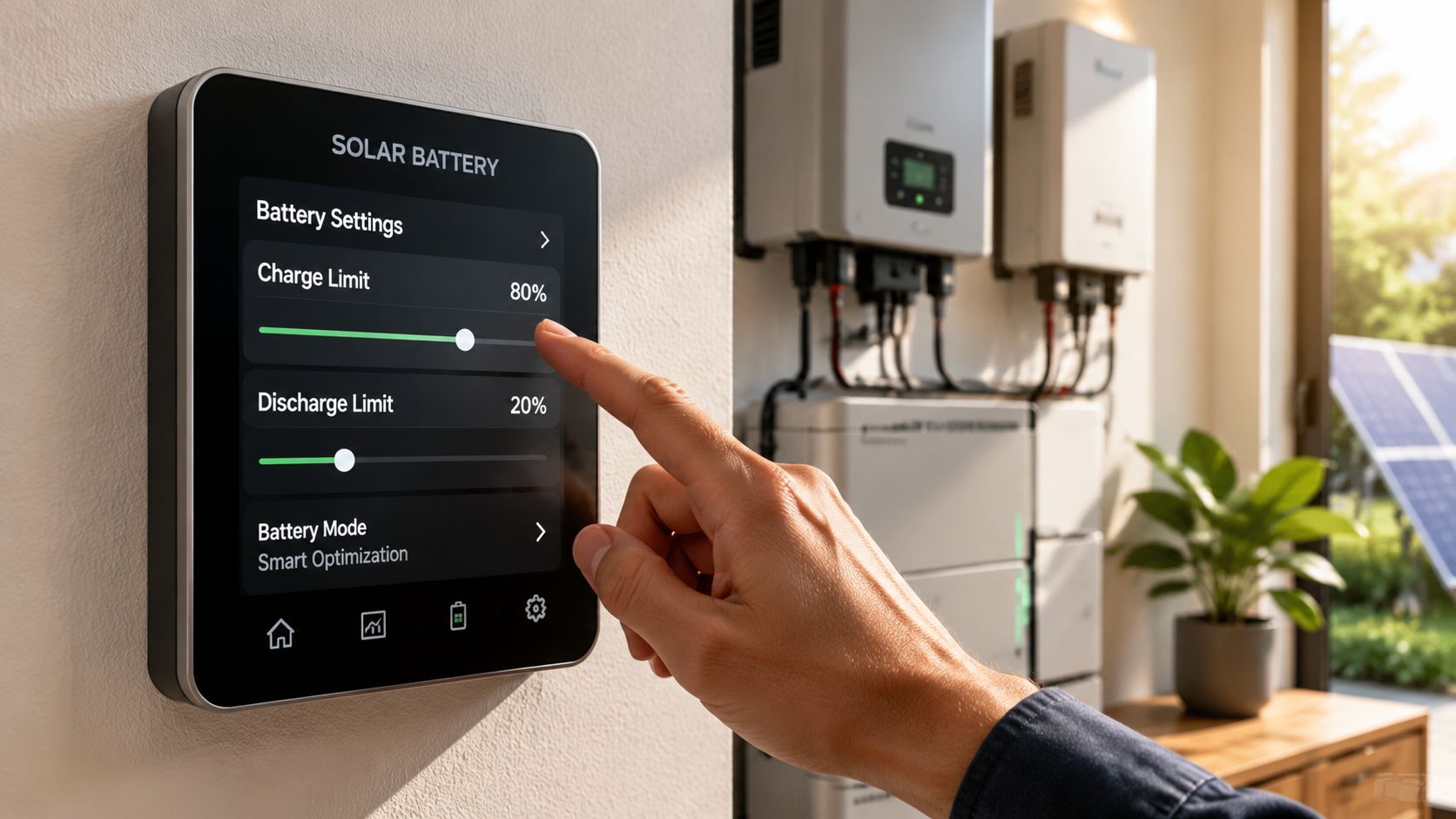
- A reserve floor around 20% SoC: This reduces repeated low-end stress during normal daily cycling.
- A charging ceiling below full where the system allows it: Many batteries age more slowly when they do not sit at 100% for long periods.
- Deliberate use of app controls: Reserve limits, charging windows, and export settings are asset-management tools, not just convenience settings.
This matters even more for homes enrolled in a VPP. Extra dispatches can turn a moderate daily cycle into frequent deeper cycling, so conservative limits often improve total return even if they trim some event revenue.
If you want a better technical grounding on how charging behaviour affects performance, this guide to solar battery charging behaviour and system operation explains the mechanics clearly.
Avoid low-end stress
Repeated deep discharge is one of the fastest ways to increase wear. Emergency backup is different. Daily operation is the primary concern.
Running the battery down to very low SoC every evening may reduce grid imports for a while, but it also pushes the chemistry harder and leaves less buffer for overnight loads, cloudy mornings, or unexpected outages. In practice, a battery that keeps some reserve often delivers better long-term value because it retains usable capacity for longer.
The trade-off is straightforward. Lower reserve settings can improve self-consumption or VPP responsiveness today. Higher reserve settings often protect the asset that is supposed to keep saving money for the next decade.
Don't hold lithium-ion batteries at full charge
Full charge is not automatically harmful. Time spent sitting full is the problem.
In many homes, the battery reaches 100% well before late afternoon, especially in spring and summer with a generously sized solar array. If it then stays full in a warm garage or on an exterior wall through the hottest part of the day, calendar ageing accelerates. That wear does not always show up immediately in the app, but it shows up later as lower usable capacity.
The better operating pattern is to charge in a way that matches expected use. If the battery is mainly there for evening self-consumption and backup, there is little benefit in holding it full for hours on mild grid days. If the system is participating in a VPP, the answer is more nuanced. Some programs want maximum state of charge ahead of forecast peaks. Owners should understand that this can improve event revenue while increasing battery stress, especially in hot weather.
Heat management matters in Australia
Temperature often decides whether a battery ages gracefully or quickly. This is especially true in Queensland and inland parts of New South Wales, where summer ambient temperatures and hot installation locations can push battery cabinets well beyond comfortable operating conditions.
Heat amplifies other forms of stress. A battery at low SoC in high temperatures is under more strain than the same battery cycling mildly in a cool, ventilated location. That is why installation quality and seasonal settings matter financially, not just technically.
Useful summer adjustments include:
- Install in the coolest practical location: Shade, ventilation, and protection from western sun make a measurable difference over time.
- Review reserve settings before hot weather: A slightly higher minimum SoC in summer can reduce stress during hot afternoon and evening cycling.
- Check the actual enclosure environment: Garages, plant cupboards, and masonry walls can run much hotter than the outdoor air temperature.
- Be realistic about VPP dispatch during heat events: High-price summer peaks can be profitable, but they also tend to be the harshest operating conditions for battery health.
This video gives a practical overview of battery management concepts in real-world conditions:
What works and what usually doesn't
| Approach | Usually works | Usually doesn't |
|---|---|---|
| Charge limits | Operating in a moderate SoC band most of the year | Daily cycling from near-full to near-empty just because the battery can |
| Temperature management | Shaded, ventilated installation with awareness of summer heat load | Treating all install locations as equivalent |
| Seasonal tuning | Adjusting reserves for summer conditions and usage patterns | Leaving one static profile in place year-round |
| VPP participation | Setting participation rules that protect reserve and temperature margins | Chasing every dispatch event without checking the wear cost |
| App use | Reviewing settings, alerts, and operating history a few times each season | Accepting defaults for years without verification |
Batteries last longer when they are run with margin. The goal is not maximum daily activity. The goal is the best lifetime value from the asset.
Advanced Optimisation VPPs Firmware and Active Monitoring
A battery can look healthy on paper and still age faster than expected because the control layer is working it too hard. I see this most often after a household joins a VPP, changes tariffs, or leaves the system on old firmware for too long. The hardware has not changed. The dispatch logic has.
VPP participation changes the wear profile
A battery used mainly for evening self-consumption usually follows a predictable cycle pattern. A battery enrolled in a VPP may discharge on external signals, hold capacity for grid events, or recharge at times that suit the market more than the home. That changes both the number of cycles and the conditions under which those cycles happen.
The Climate Council's overview of home batteries and VPPs in Australia highlights a gap that matters to owners. VPP value is often discussed at grid level, while the battery wear cost at household level gets far less attention. In practice, that means a VPP can improve revenue while also increasing throughput, summer dispatch exposure, and time spent near operating limits.
That is where the trade-off becomes financial, not just technical. Extra export revenue only makes sense if it exceeds the long-term cost of faster degradation, earlier capacity loss, or reduced warranty headroom.
If you are assessing a program, first get clear on how a Virtual Power Plant works. Then examine the operating rules: minimum reserve, dispatch frequency, temperature protections, charge and discharge limits, and whether the operator can override your normal settings during peak events.
Firmware affects battery life and value
Firmware controls the decisions the battery management system makes every day. It governs how the system responds to cell temperature, SoC windows, charge tapering, inverter communication, and fault recovery. A good update can reduce unnecessary stress. A poor configuration can do the opposite.
This gets overlooked because firmware is invisible until something goes wrong.
Owners tend to watch feed-in tariffs and bill credits closely, yet many never check whether the battery and inverter are running current approved software. That is a mistake, especially in VPP arrangements where dispatch logic depends on clean communication between multiple devices and platforms.
Focus on three checks:
- Battery firmware version: Updates may improve thermal control, charge limits, and cell balancing behaviour.
- Inverter and gateway compatibility: Communication faults can trigger inefficient charging, missed reserve targets, or erratic dispatch responses.
- Warranty conditions tied to software: Some manufacturers require approved firmware and supported operating modes for full warranty coverage.
Active monitoring catches hidden problems early
The app is not just for watching daily savings. It is the quickest way to spot behaviour that shortens asset life without delivering enough value in return.
Review trends, not single snapshots. A one-off deep discharge may be harmless. Repeated deep discharge during hot evenings, followed by aggressive recharge overnight, is a pattern worth investigating. The same applies to frequent operation at very high SoC, temperature alarms, or a sudden change in usable capacity after a firmware update or VPP enrolment.
A practical review routine usually covers:
- SoC patterns across a week: Check whether the battery is spending too much time near full or near empty.
- Temperature during peak weather: Look at battery temperature on hot afternoons and during evening dispatch events.
- Dispatch behaviour after plan changes: Compare operation before and after tariff changes, firmware updates, or VPP activation.
- Exception handling: Escalate repeated alarms, communication dropouts, or unexplained cycling before they turn into a warranty dispute.
Well-run batteries are monitored like assets, not appliances. That approach usually delivers the best outcome for both longevity and lifetime return.
Finding the Smart Balance VPP Participation Without Compromise
A summer heatwave in Australia is where weak VPP design shows up fast. The battery discharges hard into an evening event, the home buys power back later at a high tariff, and the system spends another night pushing back to full charge. Revenue may look good on one statement. Asset wear, backup risk, and long-term value can tell a different story.
The right question is how much value a VPP extracts for each unit of battery wear.
A sound operating model treats the battery as a household asset first and a grid asset second. That means setting dispatch rules around owner priorities, manufacturer limits, and local conditions, then allowing market participation inside those boundaries. If the VPP logic cannot respect those constraints, the offer is too aggressive for a long-life system.
As noted earlier, deeper cycling and more time at temperature extremes will generally shorten useful battery life. That matters financially because battery economics are not only about today's bill credit. They depend on how many healthy years and usable kilowatt-hours the system still has in year eight, ten, or beyond warranty.
What a balanced operating model looks like
Balanced VPP participation usually has four features:
- A protected household reserve: Enough stored energy remains available for evening self-consumption, outage backup, or both.
- Dispatch limits that reflect battery health: Export events stay within sensible DoD and SoC bands rather than chasing every market spike.
- Temperature-aware control: Hot weather should reduce stress, not trigger more aggressive cycling.
- Owner control over exceptional periods: The homeowner can tighten settings during heatwaves, storm seasons, or planned outages.
That last point is often missed. A battery in Melbourne and a battery in western Sydney do not face the same thermal conditions in January. Good optimisation accounts for climate, installation conditions, and tariff structure, not just wholesale price signals.
Revenue only makes sense if the wear is priced properly
There is a real trade-off. Extra VPP income can be worthwhile, but only if it exceeds the value lost through faster degradation, reduced backup availability, or less solar self-consumption at the wrong times.
In practice, I would assess a VPP like this. If the program regularly pushes the battery near empty on hot evenings, then refills it to a high SoC overnight just to be ready for the next event, the battery is doing a lot of work. The owner should expect clear compensation for that use. If the credits are modest and the cycling is heavy, the VPP is capturing more value than the household.
The stronger model sits in the middle. It accepts some additional cycling, because batteries are there to be used, but it avoids unnecessary extremes that erode long-term returns.
For many households, the target is not maximum dispatch. It is maximum lifetime value per kilowatt-hour cycled.
Your Battery Longevity Checklist and FAQs
A long-lasting battery usually follows a short list of disciplined habits. None of them are glamorous. All of them matter.
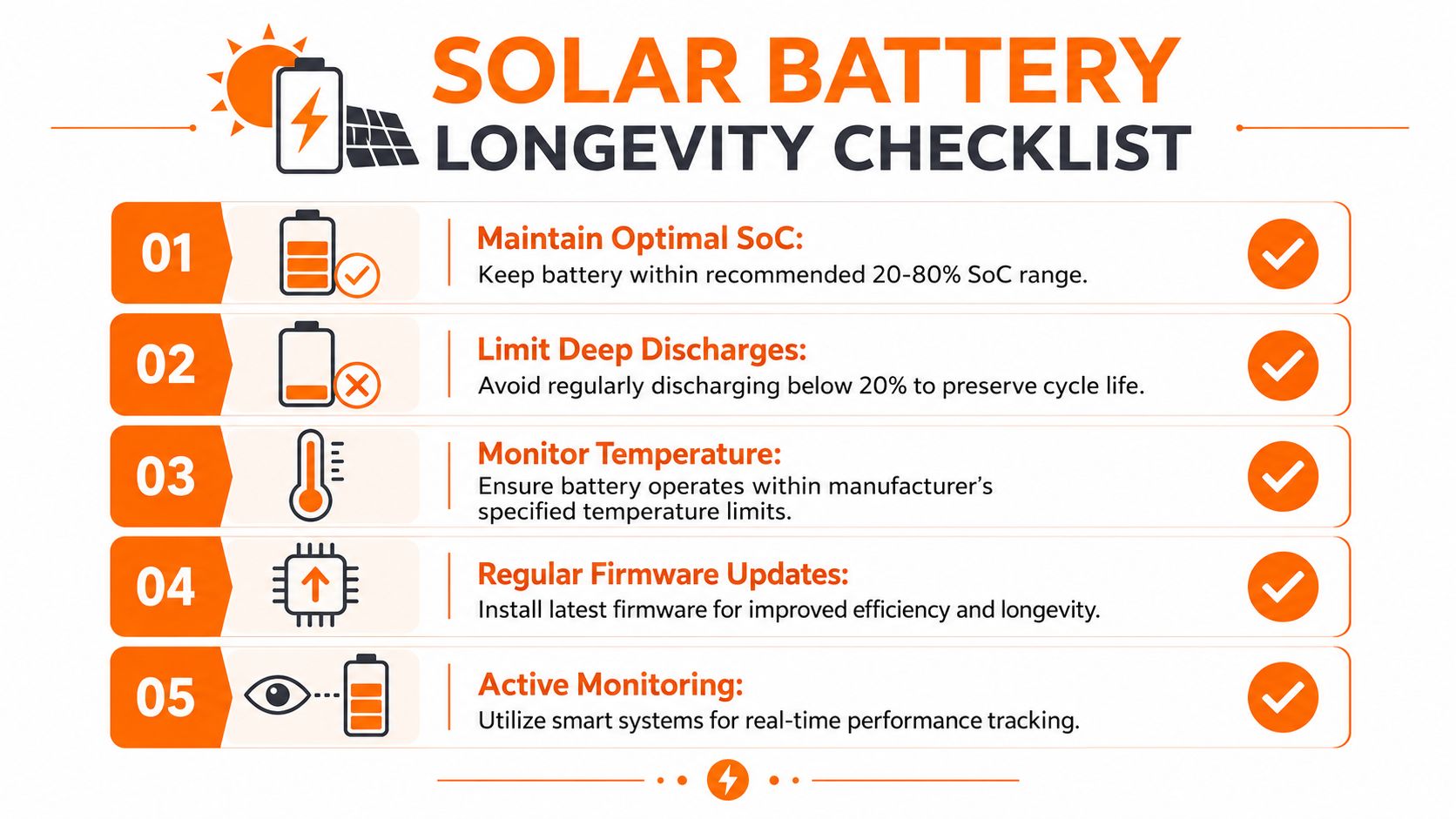
Key takeaways
- Keep the battery in the middle band: For lithium-ion systems, partial cycling is generally healthier than daily full swings.
- Protect the low end: Repeated operation below a sensible reserve can shorten useful life.
- Avoid long periods at full charge: Evergreen Electrical recommends aiming for a partial charge of 80% and preventing deep discharges below 20% to extend cycle life.
- Treat heat as a major risk: Installation location and summer settings matter, especially in Queensland and New South Wales.
- Monitor the app properly: Check trends, not just snapshots.
- Be selective with VPP participation: Revenue is only worthwhile if the operating logic protects the asset.
Common questions from battery owners
Will joining a VPP void my battery warranty?
Not automatically. The important point is whether operating behaviour stays within manufacturer conditions. Check the warranty documents and confirm how dispatch settings interact with reserve limits, charge limits, and approved operating modes.
What's more damaging, heat or deep discharging?
Both matter. In practice, repeated deep discharge during high ambient temperature is one of the combinations owners should take most seriously.
Should I charge to 100% before a storm or outage risk?
That can make sense for resilience. The issue is routine behaviour, not occasional preparation for backup use.
Do I need to change settings between winter and summer?
In hotter regions, seasonal tuning can be sensible. A higher reserve floor in summer can reduce stress when the battery is operating in warmer conditions.
How often should I check the battery app?
Often enough to spot changes in behaviour. You're looking for exceptions, alerts, and operating patterns that drift outside normal settings.
Can firmware updates really help lifespan?
They can. Firmware affects how the battery management system handles charging, temperature response, and protective logic.
If my battery still works, is everything fine?
Not necessarily. Batteries usually lose performance gradually. Useful life isn't just about whether the system turns on. It's about whether it still delivers the level of storage value you planned for.
Most battery owners focus on installation quality. Far fewer focus on ongoing performance and optimisation. High Flow Energy is an electricity retailer built around realizing the full value of your existing solar and battery system.
If you would like to understand whether your battery is underperforming financially, request an eligibility assessment with High Flow Energy today.
SEO title: Make Your Solar Battery Last Longer in Australia
Meta description: Learn how to make your solar battery last longer with practical tips on DoD, heat, monitoring, and VPP trade-offs in Australia.
Suggested URL slug: /how-can-i-make-my-solar-battery-last-longer
Featured image concept: Australian homeowner reviewing solar battery settings on a wall-mounted control panel in a shaded garage, with app data visible and emphasis on battery health management.
Image alt text: Homeowner adjusting solar battery charge settings to improve battery lifespan and performance
Internal linking suggestions:
External authority references:
- Australian Energy Regulator
- Australian Energy Market Operator
- Climate Council Australia
LinkedIn-ready excerpt:
Most battery owners think about installation day. Fewer think about the operating settings that determine whether the battery performs well for years or wears out early. This guide explains the practical steps that protect battery lifespan in Australia, including DoD limits, summer heat management, app monitoring, firmware, and the often-ignored trade-off between VPP revenue and long-term battery health.
AI summary snippet:
Homeowners can make a solar battery last longer by avoiding deep daily discharge, limiting time spent at full charge, and managing heat carefully. For lithium-ion batteries in Australia, operating within a mid-range State of Charge is generally better for cycle life than chasing maximum daily use. VPP participation can add financial value, but owners should check whether the dispatch model respects battery reserve limits, temperature conditions, and warranty requirements.