

Power Consumption of Washing Machine: Costs and Savings
A typical 5 kg, 3-star washing machine uses about 0.91 kWh per warm wash cycle, costing roughly $0.26, while a cold wash can reduce machine energy use by up to 80%. The number on the appliance's wattage plate doesn't tell you what laundry really costs, because water temperature, load size, cycle settings and timing often matter more.
Could your washing machine be using more electricity to heat water than to wash your clothes? That's the gap in many explanations of the power consumption of washing machine systems. Annual kWh ratings are useful, but they're based on a standardised use pattern that may bear little resemblance to a household that washes cold, runs full loads and schedules laundry around rooftop solar.
Understanding Real Washing Machine Energy Use
What does one load of laundry add to an Australian electricity bill? Start with the cycle, not the wattage printed on the machine.
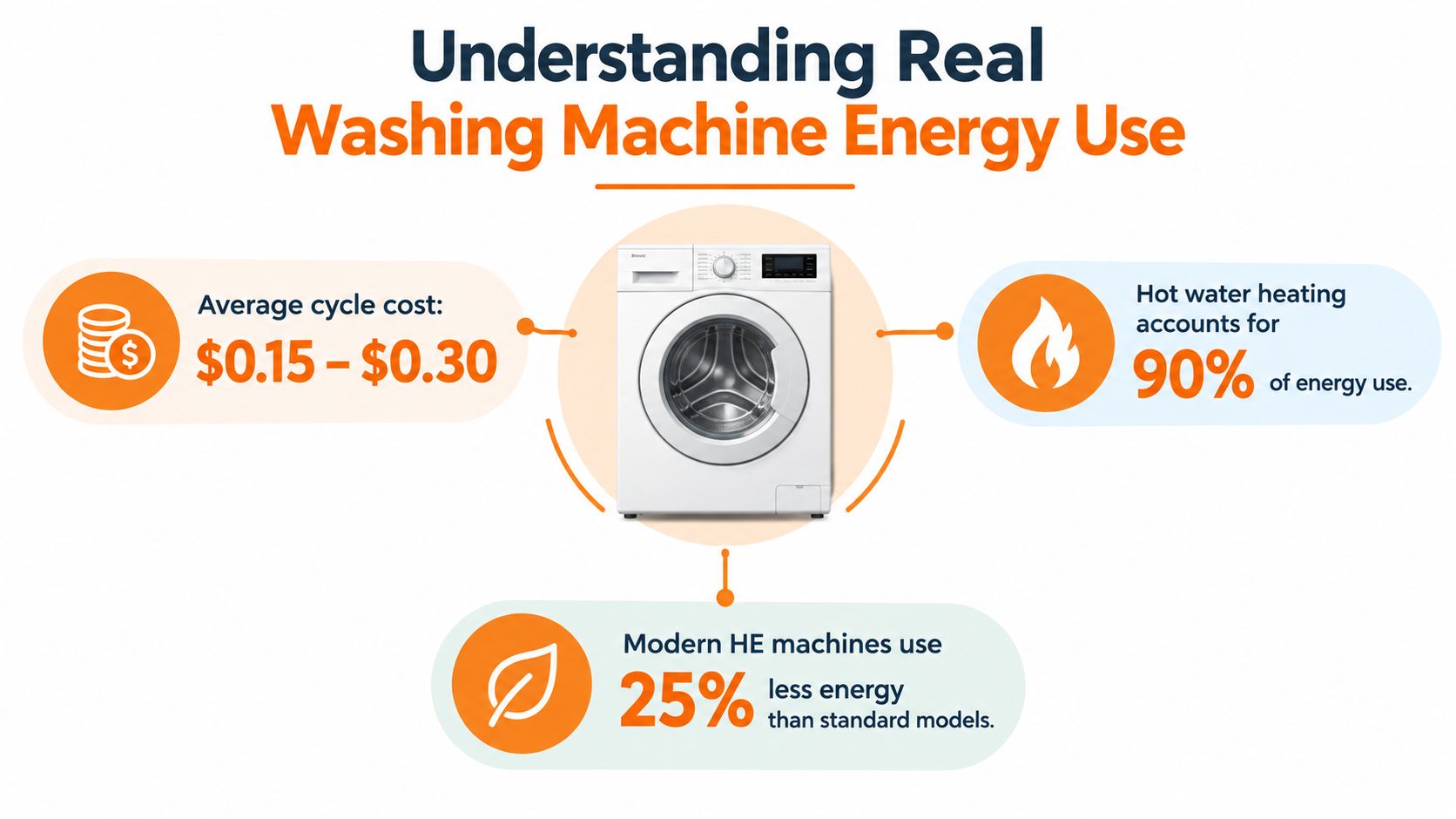
A 5 kg washer with a 3-star rating uses about 0.91 kWh per warm wash, which the cited Australian guidance estimates at roughly $0.255 per cycle at its assumed electricity price. That figure is a practical benchmark, but it isn't a universal tariff. Your result changes with the machine, temperature, programme, electricity plan and whether the water is heated electrically.
The national energy label provides a more useful comparison than nameplate wattage. Its annual energy figure assumes one wash per day on the labelled setting, capturing duty-cycle effects such as water heating, programme duration and efficiency. A household washing mostly cold will generally use less than that label assumption, while frequent warm or hot washes can move actual consumption closer to, or beyond, the benchmark. Australian energy-rating guidance explains how to interpret appliance labels.
Put laundry in the household context
Washing machines account for about 3% of total energy consumption in an average Australian household, while appliances and equipment represent an average of 25% of residential energy consumption, according to YourHome's Australian appliance guidance.
That share is easy to overlook because each cycle is a modest expense. Repeated across a household's normal routine, however, it becomes a recurring load that can be reduced through settings and scheduling. If you want to identify how laundry fits into your broader household demand, use a power usage monitoring tool rather than relying only on the label.
Front-Load Versus Top-Load Efficiency Differences
Machine design influences energy demand before you choose a cycle. Front loaders tumble clothing through a smaller volume of water, while top loaders generally use more water to move garments. Using less water can reduce the energy required for heating, although the outcome depends on the model, capacity and programme.
An Australian analysis found that an average front loader used 40% less energy than an average top loader. That comparison is useful for similar household conditions, but individual results vary. The same analysis recorded average front-loader energy use rising from 236 kWh per year in 2003 to 334 kWh per year in 2014, partly because rated capacities increased. The figures are reported in Australia's whitegoods efficiency trends analysis.
| Decision factor | Front loader | Top loader |
|---|---|---|
| Washing action | Tumbling | Agitation or alternative drum movement |
| Typical water approach | Lower water volume | Often higher water volume |
| Energy implication | Less water can mean less heating demand | More water can increase heating demand |
| Main trade-off | Longer programmes and different loading habits | Familiar loading and potentially simpler access |
Capacity changes the result. A larger efficient washer may show higher annual kWh than a smaller model because it handles more laundry or runs longer programmes. Compare the annual energy figure and water information on the label alongside the star rating and maximum load. Those details give a better view of likely operating costs than capacity or stars alone.
Your household's loading pattern matters most. Select a machine sized for your usual laundry volume, then fill it appropriately without restricting movement. An oversized washer can lose some of its efficiency advantage when it regularly runs underfilled. For homes with rooftop solar or a battery, the machine's lower water-heating demand also makes its cycle easier to align with available daytime energy.
The Hidden Costs of Hot Washes and Partial Loads
The most important setting on many washing machines is the temperature button. Australian energy guidance identifies water heating as the biggest energy user in laundry, and cold washes can reduce machine energy use by up to 80%. The clothes-washer guidance from the Australian energy-rating programme supports the practical conclusion: for suitable everyday clothing, changing from warm to cold can matter more immediately than replacing an otherwise serviceable appliance.
That doesn't mean every load should be cold. Heavily soiled items, hygiene-sensitive laundry and fabric-care requirements may justify a warmer programme. The useful approach is to treat warm washing as a deliberate choice, not the automatic default.
Fill the drum intelligently
Partial loads create another avoidable cost. Machines often use nearly the same energy and water for a partial load as for a full load unless they include load sensing or a half-load setting. Running several small loads can therefore increase total demand even when each individual load feels smaller.
Use the machine's capacity without compressing clothing so tightly that it can't move freely. Check whether your model detects load size, then test the result through a plug-in energy monitor or the machine's compatible app if it provides cycle data.
What changes the bill most
For most households, the priority order is straightforward:
- Temperature: Reduce unnecessary water heating first.
- Load size: Consolidate suitable items into full loads.
- Programme: Use an eco or standard cycle when it delivers the required clean.
- Replacement decision: Compare labelled annual energy and water figures before buying.
A new washer can improve efficiency, but behaviour changes work on the machine you already own. That makes them the first intervention to test.
Syncing Laundry Cycles with Solar and Battery Systems
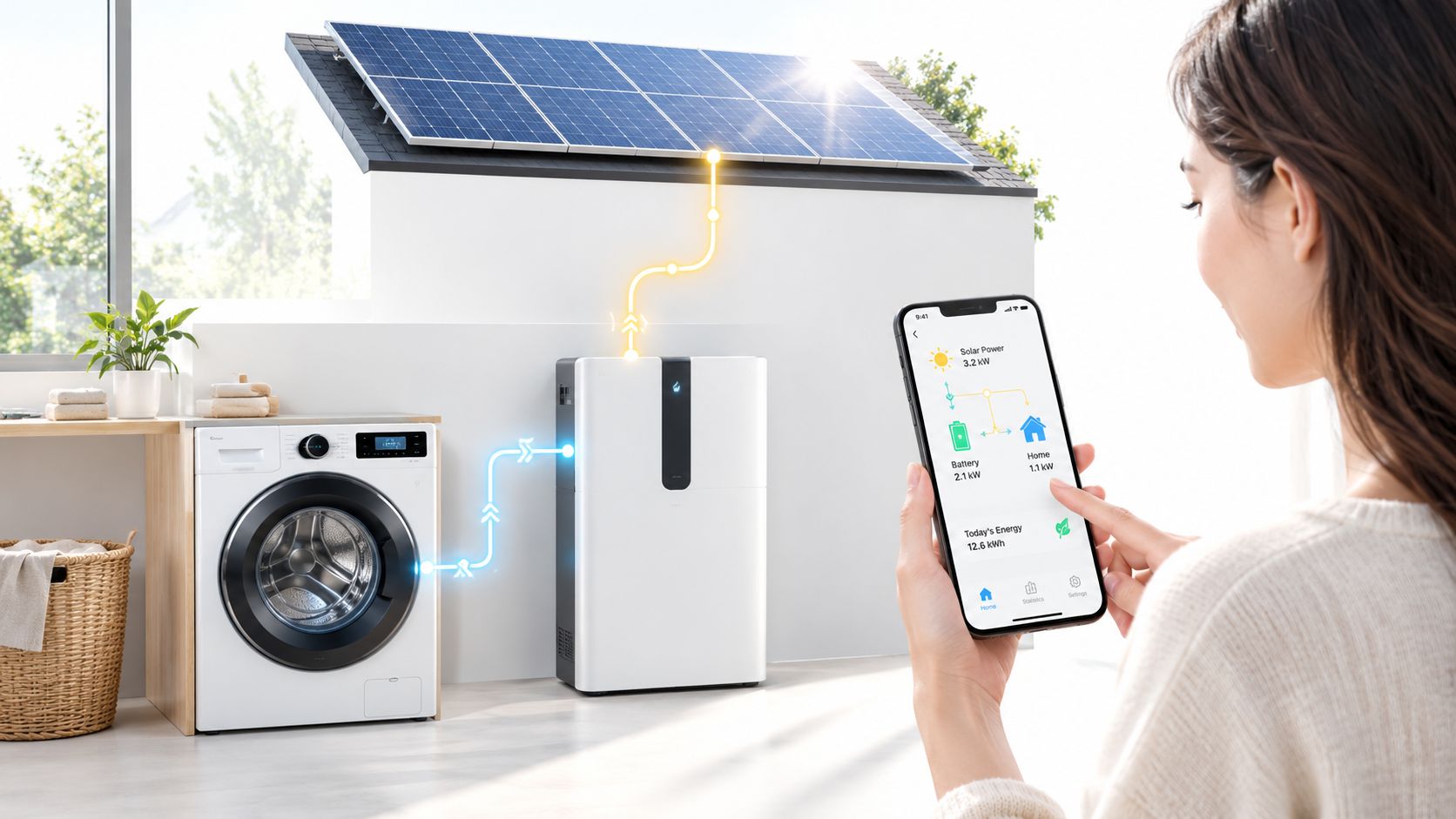
For a home with rooftop solar and a compatible battery, washing-machine consumption is also a timing problem. A warm cycle may draw electricity when the battery is already supporting evening demand, or it may run during the day when solar generation could supply it directly. The lowest-cost schedule depends on your solar output, tariff, battery operating rules and household priorities.
A 5 kg, 3-star machine's 0.91 kWh warm-cycle benchmark and state guidance showing warm-wash costs of about $0.20 to $0.37 per cycle illustrate why temperature and timing belong in the same decision. This Australian electricity guide provides the cycle-level comparison.
A practical scheduling hierarchy
Use this order rather than assuming that one time is always cheapest:
- Run cold loads when convenient. Their energy demand is already lower, so convenience and solar availability can guide the timing.
- Place warm loads inside strong solar-generation periods. This can increase direct solar self-consumption and reduce grid imports.
- Use battery energy selectively. Don't discharge a battery for laundry if that stored energy is more valuable for a later peak period or a scheduled demand event.
- Check time-of-use pricing. A cheaper grid window may be preferable when solar output is low and the battery needs to preserve charge.
- Review actual results. Compare imported energy, solar generation and battery state of charge after several similar cycles.
Solar owners should also maintain the generation asset that makes daytime scheduling possible. Practical maintenance guidance, including how often to clean solar panels 2 to 4 times, can help households keep their production assumptions realistic.
A VPP adds another layer. In the National Electricity Market, coordinated batteries can respond to wholesale price volatility, demand events and grid-support needs. That creates a trade-off: allowing a retailer-based VPP to use spare battery capacity can provide value, but household needs and reserve settings must come first. A suitable programme should show how dispatch works, what allowance structure applies and how customers retain priority access to stored energy.
Use a smart home energy app to view live demand, solar production and battery behaviour where compatible. The objective isn't to chase every price movement. It's to align ordinary loads with solar and tariff conditions without compromising comfort or battery availability.
Calculating Your Exact Annual Energy Costs
What will your washing machine add to the annual electricity bill? The energy label provides a useful comparison point, but your tariff, wash temperature, frequency and timing determine the household result. Annual kWh is a starting estimate, then you adjust it for real usage.
A simple calculation
Follow this process:
- Read the annual kWh figure. Find the estimated yearly consumption on the washer's national energy label.
- Check the label setting. The figure reflects the labelled programme and an assumed pattern of one wash per day.
- Apply your electricity rate. Multiply annual kWh by your usage rate in dollars per kWh.
- Allow for tariff timing. With time-of-use pricing, apply the rate charged during your usual laundry window.
- Keep fixed charges separate. A cycle calculation measures appliance usage in isolation from the daily supply charges on your household bill.
Australian consumer guidance gives broad annual cost ranges for different star ratings, assuming five washes a week. A one-star machine is estimated at $108 to $180.09 per year, while a ten-star machine is estimated at $6.48 to $10.53 per year. Treat these as comparisons rather than a promise for your home. Your model, wash temperature, load pattern and tariff can change the outcome, particularly when hot-water heating makes up a large share of each cycle.
Why nameplate wattage misleads
Wattage measures instantaneous electrical power. It does not show how long the heating element runs, whether the washer heats water internally, how the motor cycles, or how the programme controls rinsing and spinning. Two machines with similar nameplate wattage can therefore use different kWh across a complete wash.
For a purchase comparison, record annual energy use, water consumption, capacity and star rating. For an existing washer, measure a representative cycle using your normal temperature and load settings. A dedicated Australian energy cost calculator can convert consumption into a bill estimate. Enter your actual tariff, including time-of-use rates, and compare hot and cold cycles separately where possible.
The practical question is: “How many kilowatt-hours does my household use for the way we wash?” That figure supports better decisions about settings, solar timing and battery use than wattage alone.
Practical Strategies to Minimise Power Consumption
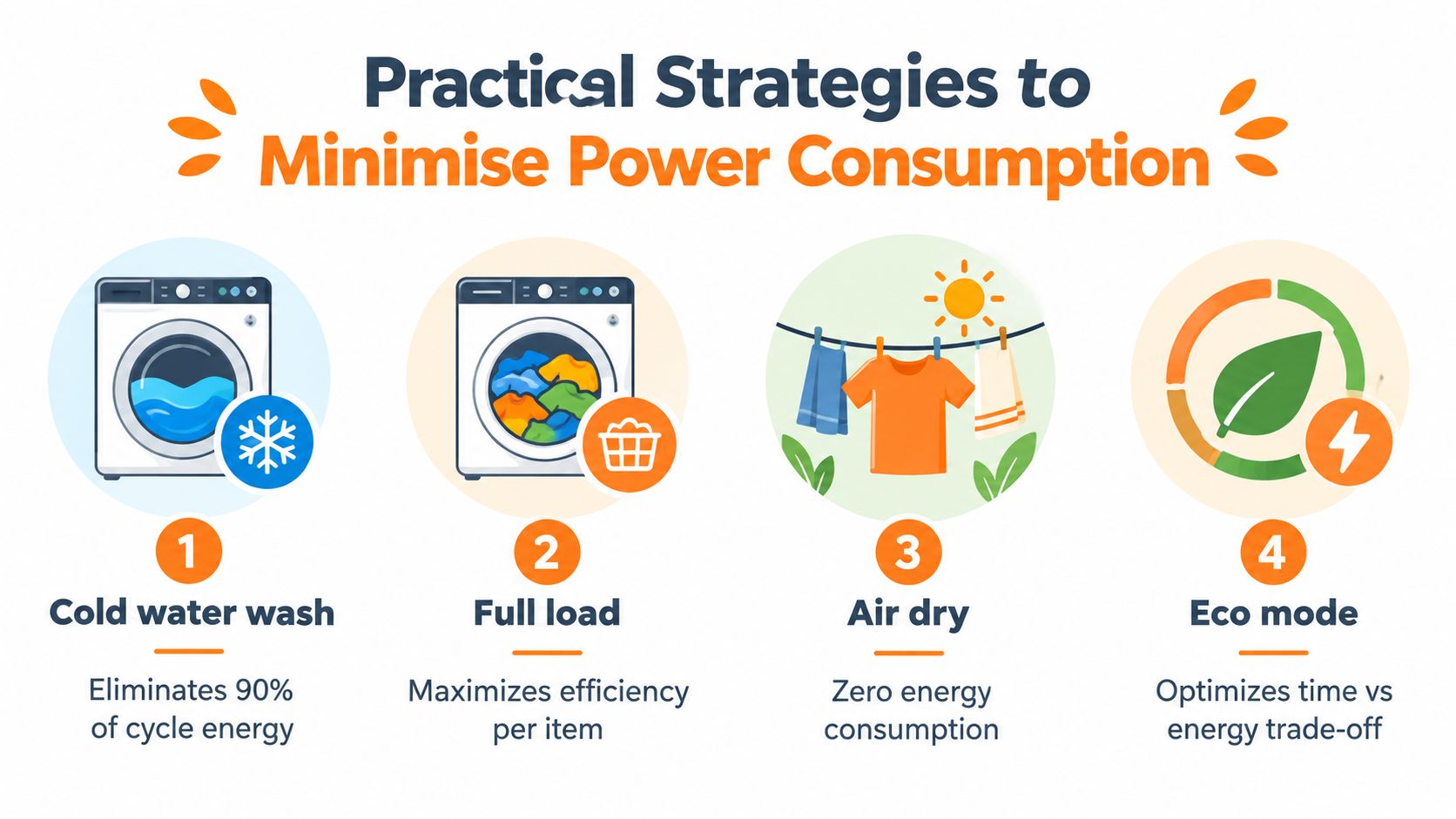
The cheapest energy-saving measure is usually a setting change. Start with the choices that reduce heating demand and avoid unnecessary cycles.
- Choose cold water where appropriate. This targets the largest energy component of a standard wash without requiring new hardware.
- Run full loads. Fill the drum sensibly so each cycle cleans more clothing, but don't overload it.
- Check load sensing. If your household often needs smaller loads, confirm whether the machine adjusts water and energy use automatically.
- Use suitable eco programmes. Test whether the longer, lower-intensity setting meets your cleaning needs rather than assuming the shortest cycle is the most efficient.
- Schedule around solar or tariffs. Daytime solar may suit a solar household, while an off-peak window may suit a home without sufficient generation.
- Switch off standby demand. Measured standby consumption for washing machines is about 1 to 6 watts, with an annual standby cost of roughly $2.62 to $14.90, according to Australian standby-power reporting.
Air drying can also reduce the energy required after washing, although that saving belongs to the dryer rather than the washer itself. The same principle applies to maintenance: keep the appliance operating correctly, follow the manufacturer's cleaning instructions and don't use a high-energy programme for routine loads when a lower-demand option is adequate.
This video provides a visual introduction to practical washing-machine energy choices:
Maximising Value with High Flow Energy VPP
Reducing laundry demand is only one part of household energy management. Solar and battery owners also need to decide when to consume, when to store and when to export or participate in grid services.
Most battery owners underuse their asset when the system charges from solar and discharges during a narrow evening period. A coordinated VPP can respond to demand events and wholesale market conditions, subject to the programme's operating rules, network constraints and battery compatibility. The financial value may come through a bill allowance or another defined structure, rather than through laundry savings alone.
High Flow Energy is an Australian electricity retailer and VPP operator for eligible existing solar and battery owners in Queensland and New South Wales. It connects compatible batteries to a coordinated VPP, while prioritising household energy needs and allowing customers to retain ownership and priority use of their stored energy. The service uses an app to show prices, forecasts and savings, and its automated plans can be overridden by the customer.
Check the trade-offs before joining
A responsible assessment should cover:
- Battery operation: Understand when the programme may charge or discharge the battery.
- Household priority: Confirm the reserve settings and how essential household demand is protected.
- Allowance structure: Check how grid-service value is converted into bill allowances and which charges those allowances cover.
- Network conditions: Recognise that Queensland and New South Wales networks can have different export limits and operating constraints.
- Contract terms: Review lock-in, exit-fee and warranty provisions before enrolment.
- Extra usage: Know what happens if household consumption exceeds the included allowance.
The practical sequence is simple: lower unnecessary warm-wash demand, fill loads sensibly, run flexible appliances when solar or tariff conditions suit, then assess whether your battery is earning value when it isn't serving the home. That approach treats the washing machine as one controllable load inside a wider NEM-connected energy system.
High Flow Energy connects eligible existing solar and compatible home batteries to a retailer-based Virtual Power Plant, with household needs prioritised and app-based control over energy performance. Visit High Flow Energy to check eligibility and review whether your current battery and laundry scheduling are underutilising available value.