

Smart Grid Explained: How It Works for Australian Homes
A smart grid is an electricity network that uses sensors, two-way communication and software to monitor and manage supply, demand and distributed generation in near real time. Across Australia's distribution networks, more than 2.9 million customers already export rooftop solar back into local power lines, turning a century-old one-way delivery system into a live, two-way marketplace.
If rooftop solar and a home battery were supposed to make your house independent from the electricity network, why do so many Australian battery owners still receive regular power bills while their storage sits idle for hours every day? Most homeowners treat a battery purely as a private backup tank. Yet the grid outside your meter box no longer operates like a simple pipe pushing power in one direction, and the value sitting inside your battery depends on how well it interacts with that wider system.
Understanding how a smart grid works in Queensland and New South Wales changes how you judge your solar battery value. It also exposes the trade-off every household faces: knowing when sharing spare battery capacity creates genuine grid value and bill reduction, and when poorly structured grid dispatch can erode your backup security during a blackout.
What a Smart Grid Means in Plain English
At its core, a smart grid is a live electricity network that combines field sensors, two-way digital communications and control software to monitor and coordinate power supply, household demand and distributed generation in near real time.
Think of the traditional electricity system as a one-way highway running from a handful of giant coal, gas and hydro power stations out to millions of suburban homes. Traffic moves in a single direction, and the road authority only knows there's a jam once drivers start calling in to complain. A smart grid works more like a metropolitan road network fitted with live traffic cameras, dynamic lane signals and navigation apps that reroute cars before congestion locks up an intersection.
You don't need an electrical engineering degree to follow how that traffic system works. Three everyday terms cover almost everything happening between your roof and your local substation:
- Distributed energy resources (DER): Small-scale energy devices located at homes and businesses rather than central power stations, including rooftop solar panels, home batteries, community batteries, electric vehicles and controllable appliances like hot-water systems.
- Demand response: Shifting when electricity is drawn from or sent back to the network in response to tight supply, local voltage limits or changing wholesale prices.
- Smart meters: Digital revenue meters that record how much power a household imports and exports at short intervals, replacing old spinning-disc meters that someone read manually once a quarter.
Why Australia Needed a Layered Grid
A smart grid isn't a single gadget bolted to your wall. It's a stack of three operational layers working together: sensing what's happening on the wires, communicating that data rapidly, and sending automated control instructions to devices that can respond.
That layered architecture has become essential in Australia because rooftop generation grew faster than traditional central planning ever anticipated. According to an Australian Parliament House briefing on Australia's energy transition, the National Electricity Market (NEM) now hosts more than 24 gigawatts (GW) of rooftop-solar capacity, including an estimated 15 GW spread across more than 3 million household systems, with Queensland among the regions where rooftop-solar penetration approaches 50% of homes.
Coordinating millions of small generators requires major back-office upgrades as well as field hardware. Many network businesses rely on modern data engineering and analytics frameworks, such as Kagool's utility operations modernization services, to unify legacy billing, outage and telemetry records so operators can act on live feeder data. The shift turns every solar-and-battery household from a passive end-of-line consumer into an active participant in the electricity system.
Smart Grid Versus Traditional Grid at a Glance
Comparing the legacy network with a modern two-way system shows that the biggest changes aren't just concrete poles and thicker copper cables. The deeper shift lies in who can see local power flows and how quickly equipment can respond.
| Feature | Traditional grid | Smart grid |
|---|---|---|
| Power flow | One-way, from large power stations to homes | Two-way, with homes exporting from rooftop solar and batteries |
| Visibility | Limited, mostly at substations | Near real-time data from smart meters and network sensors |
| Demand management | Mainly by building peaking capacity | Demand response and time-varying prices shift use |
| Customer role | Passive consumer | Active participant that can export, store and respond |
| Fault response | Manual detection and slower restoration | Automated detection and isolation, faster restoration |
| Renewable integration | Relies on central generation and transmission upgrades | Coordinates distributed solar, storage and flexible loads |
Three rows in that comparison affect your household directly: power flow, visibility and customer role. Under the old model, your electricity distributor could monitor high-voltage transmission lines and zone substations, yet had almost no live insight into what happened along your residential street. When thousands of homes started pushing surplus midday sunshine back into those same low-voltage feeders, line voltage climbed and networks had to impose blunt static export limits.
The Two-Way Scale Already Running on Australian Streets
This transition isn't theoretical. The Australian Energy Regulator 2024 export services network performance report shows that in the 2023-24 financial year, more than 2.9 million Australian distribution-network customers exported electricity from on-site solar systems, while roughly 45,000 customers were able to export electricity from a battery. Customers with measurable exports fed more than 14 million megawatt-hours (MWh) back into distribution networks, equal to 10% of all electricity delivered by distribution network service providers (DNSPs), up from 11.8 million MWh (8%) in 2022-23.
Participation widened across the board over that same twelve-month window, with 27% of DNSP customers using export services in 2023-24, up from 25% the year before. In high-solar states like Queensland and New South Wales, local feeders built fifty years ago for evening demand now carry heavy reverse flows around midday.
Here's the practical test of whether a network qualifies as a smart grid: it can absorb and redirect those two-way household flows safely through live visibility and active coordination, rather than defaulting to expensive poles-and-wires upgrades that push up network charges on everyone's power bill.
The Core Components That Make a Smart Grid Work
Six distinct layers have to work in concert for a two-way electricity network to function smoothly from your garage inverter out to the regional substation.
| Component | Primary role | Where it sits |
|---|---|---|
| Smart meters | Measure household electricity imports and exports at short intervals | Meter box at the property |
| Network sensors and monitoring | Track line voltage, current and transformer loads in near real time | Local feeders and substations |
| The communications network | Carries encrypted telemetry and dispatch instructions securely | Cellular, broadband and utility radio links |
| Distributed energy resources | Generate, store or flex electricity on site | Rooftop solar, home batteries, EVs and smart loads |
| Inverters and controls | Convert DC to AC power and enforce charge, discharge and export setpoints | Wall-mounted next to the battery or switchboard |
| Software platform | Analyses weather, prices and constraints to schedule coordinated actions | Cloud control platform operated by a retailer or aggregator |
The diagram below maps how those six layers connect, with the software platform sitting at the top of the hierarchy and the communications network linking field devices back to the control centre.
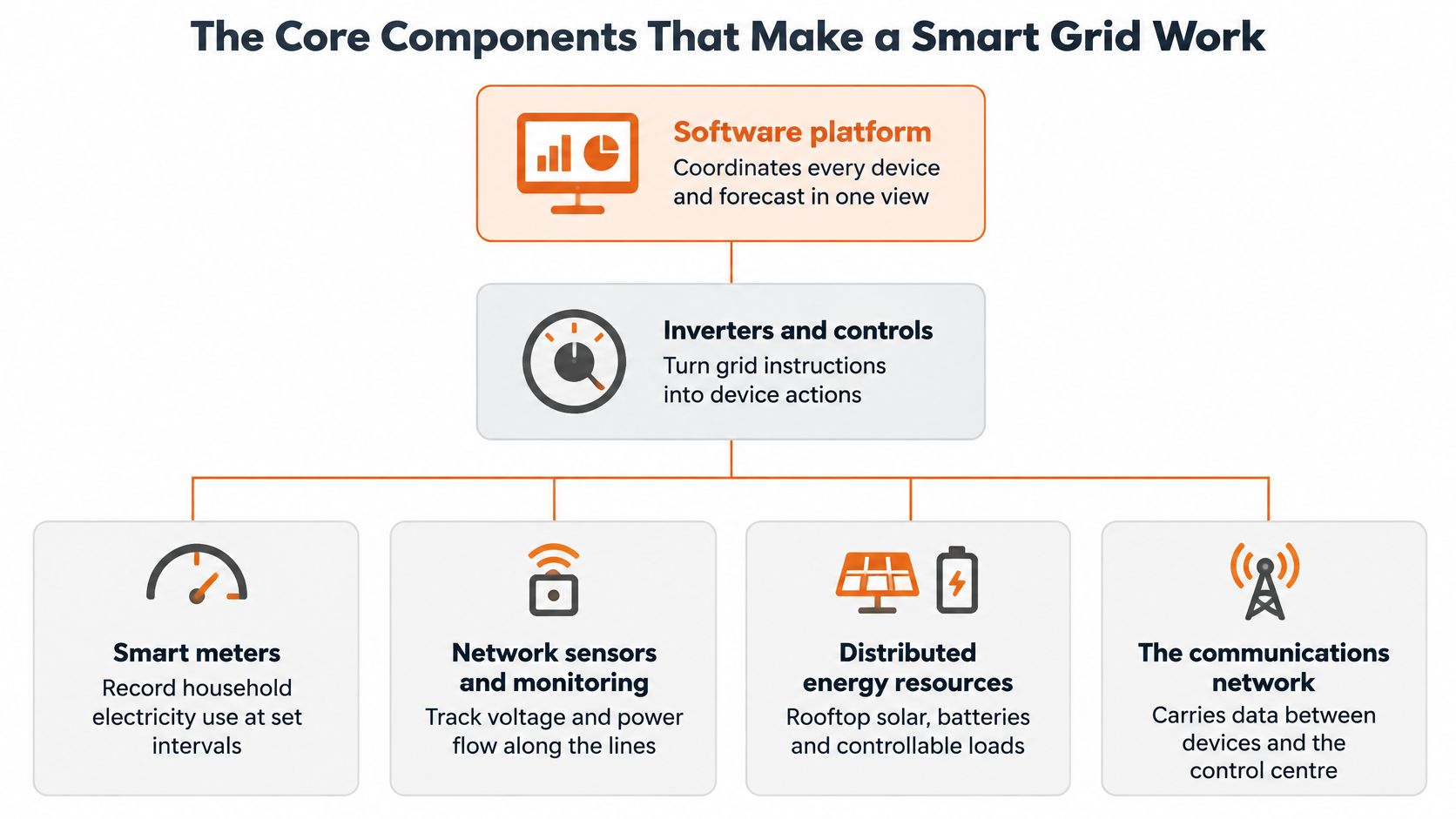
It helps to picture this architecture like a human nervous system. Smart meters and feeder sensors act as nerve endings detecting voltage and usage, which is why understanding how smart meters measure interval energy data is the starting point for any homeowner reviewing their tariff. The communications network serves as the spinal cord carrying signals back and forth, the software platform acts as the brain weighing forecasts, and your inverter is the muscle turning instructions into physical power flow.
Consider a concrete household scenario to see the layers interact. Suppose your home has a 10 kWh battery sitting at 60% state of charge, which means your inverter reports 6 kWh of stored energy available over your home internet link. Under a local network export constraint, the inverter enforces a 5 kW export cap so street voltage stays within safe limits. Reading clear skies in the next morning's solar forecast, the control software schedules a steady 2 kW battery charge window between 10am and 2pm, soaking up excess midday solar that would otherwise be curtailed or exported for pennies.
Why the Inverter and Compatibility Matter Most
Among all six components, the inverter is the critical gatekeeper for battery owners. It decides, second by second, how much power flows into the battery, out to your home appliances or back across the meter to the street.
Interoperability is where real-world smart grid setups most often stumble. Because battery and inverter manufacturers use different communication protocols, a software control platform can only schedule your system if it officially supports your exact hardware brand and firmware. Checking a written inverter compatibility statement before joining any energy program saves you from discovering halfway through onboarding that your battery can't receive automated dispatch signals.
Data governance deserves the same plain-English scrutiny. Any reputable smart-grid platform relies on encrypted communication links, strict access controls and clear customer-data rules defining who can view your interval usage and how dispatch commands are authenticated. Before moving on, take two minutes to list the six components above and tick off the ones you already own at home: solar panels, inverter, battery, smart meter and broadband link. Most solar-and-battery households already hold five of the six pieces and are only missing the coordinating software layer.
How a Smart Grid Balances Supply and Demand Step by Step
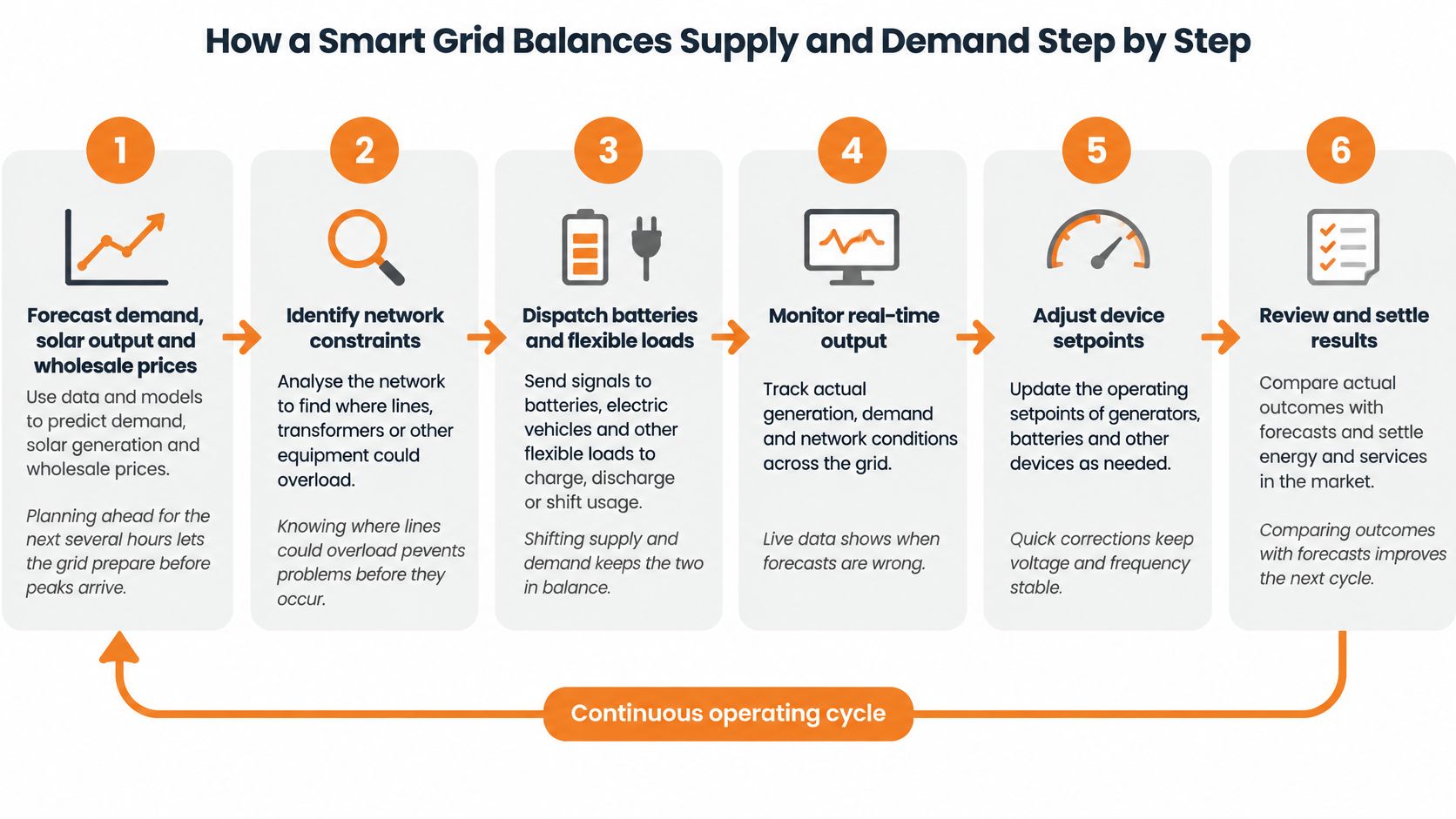
Electricity can't sit idle on the wires waiting for someone to flick on a kettle; supply and demand across the NEM have to match every single second to hold grid frequency steady. A smart grid maintains that balance through a repeating six-step operating loop rather than relying solely on spinning up expensive gas peaker plants.
- Forecast demand, solar output and wholesale prices. Control software pulls weather feeds, historical household load curves and NEM price projections for the next several hours so it can anticipate midday solar gluts and evening spikes before they arrive.
- Identify network constraints. The platform checks local feeder limits, distributor export caps and tight regional supply periods so scheduled dispatches don't overload street transformers.
- Schedule daytime charging. Batteries are instructed to absorb surplus rooftop solar or charge during low-priced wholesale windows, cutting reverse power flow and reducing renewable curtailment pressure across sunny Queensland and New South Wales feeders.
- Dispatch stored energy into evening peaks. Once rooftop solar output drops away after late afternoon, coordinated batteries discharge small, controlled amounts into the network right when wholesale prices and household demand climb.
- Monitor live conditions and adjust setpoints. Sudden cloud banks or heatwave air-conditioning surges routinely break morning forecasts, so the platform watches real-time telemetry and recalculates inverter targets within minutes. That continuous feedback loop mirrors high-tempo operational desks in other sectors, much like Doczen's breakdown of real time monitoring for order desks, where spotting a live deviation immediately stops minor delays from snowballing into system-wide bottlenecks.
- Settle outcomes and report back to the household. Once each trading interval closes, meter data reconciles exactly how much energy moved, credits the household accordingly and feeds actual results back into the next forecast cycle.
The infographic below traces this six-step operating cycle from initial forecasting right through to post-event settlement.
Why Coordinated Storage Outperforms Isolated Batteries
A single home battery running purely on basic self-consumption fills up by late morning, sits at 100% while surplus midday solar spills onto an already crowded street feeder, and then discharges during the evening without responding to wider grid stress. Coordinating distributed energy resources across Australia turns that same hardware into a dual-purpose asset.
Grid planners now treat storage as core system infrastructure rather than a niche household gadget. According to AEMO's 2025 Electricity Statement of Opportunities, AEMO's 2024 Integrated System Plan already counted 3.7 GW of storage capacity and 10.8 GWh of storage energy classified as committed or anticipated across the National Electricity Market. AEMO's 2025 report also states that batteries coordinated through an aggregator or retailer as a Virtual Power Plant are expected to have a greater effect on lowering peak operational demand than uncoordinated behind-the-meter batteries.
Operating rule: Reserve the household's forecast evening energy first, then let software optimise spare capacity around wholesale price volatility and grid availability rather than treating simple self-consumption as the only goal.
How Household Batteries Join a Virtual Power Plant
The Australian Energy Market Operator defines a Virtual Power Plant (VPP) in its AEMO Virtual Power Plant consumer insight report as software-coordinated distributed energy resources, such as rooftop solar, batteries and controllable loads, that work together to deliver services traditionally supplied by a conventional power station.
Picture a regional taxi fleet to see how aggregation works in practice. Each car stays parked in its own suburb rather than sitting inside one massive depot, yet a central dispatcher can mobilise dozens of vehicles simultaneously when a concert finishes or a storm hits. In a VPP, your battery stays physically mounted on your own wall while cloud software coordinates thousands of participating homes as one dispatchable fleet.
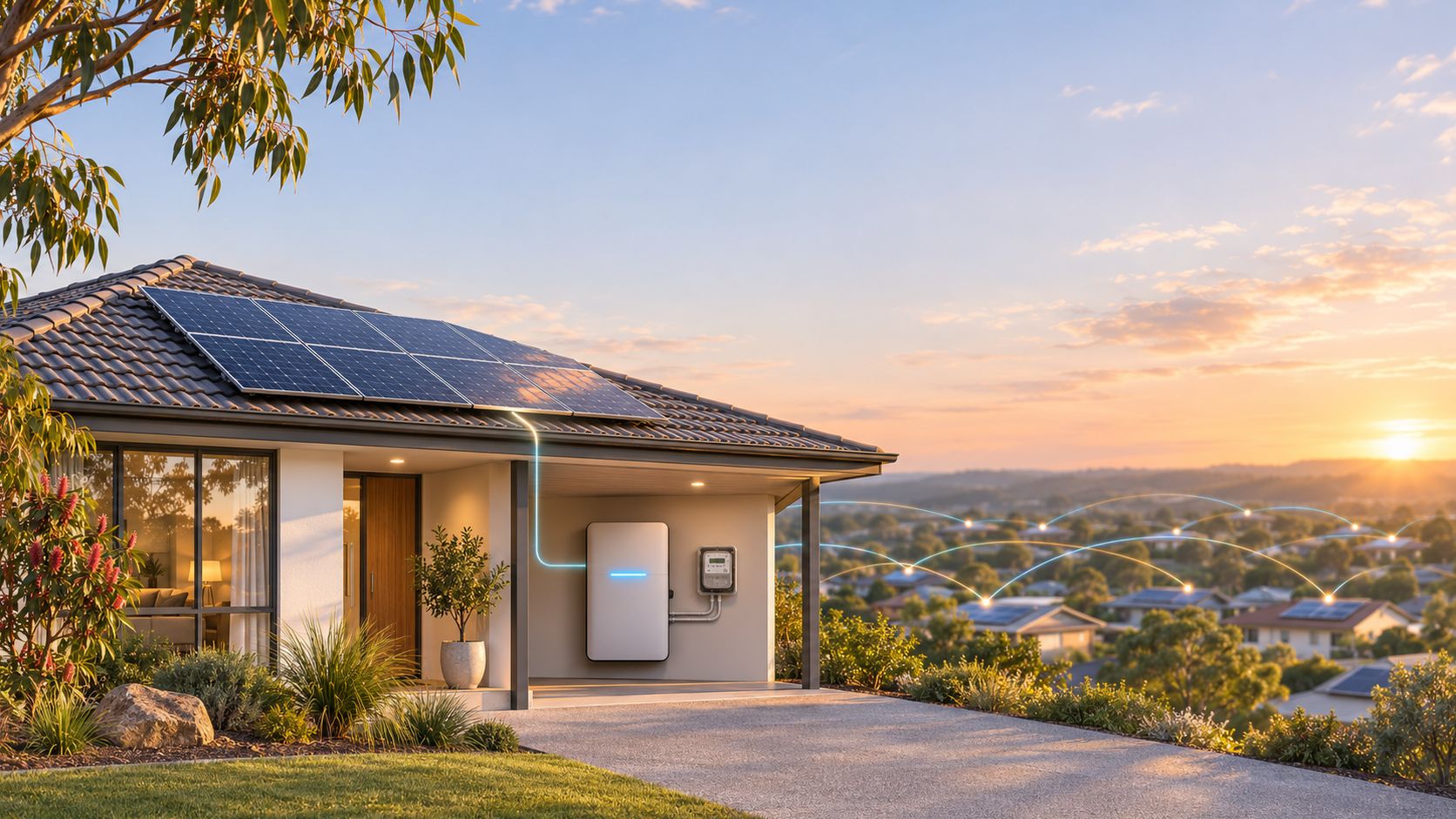
A residential solar and battery setup connected to the wider network looks identical from the street to an uncoordinated system, as shown below, because the intelligence lives in the cloud software rather than extra rooftop hardware.
When coordinated at scale, a fleet of home batteries can deliver three distinct grid services: participating in the wholesale energy market during high-price events, trimming regional operational peak demand on scorching afternoons, and supplying Frequency Control Ancillary Services (FCAS), where fast-responding inverters inject or absorb tiny bursts of power within seconds to steady grid frequency after a generator trips.
Not every battery role treats your household's stored energy the same way. The table below breaks down how four common smart-grid roles balance network value against home priority.
| Role | How the battery acts | Household priority | Typical timing |
|---|---|---|---|
| Self-consumption | Stores daytime solar for evening use | Full priority | Daytime charge, evening discharge |
| Wholesale price response | Charges at low prices and discharges at high prices | Reserve kept for forecast use | Price-driven, often in peak windows |
| Peak demand support | Discharges during network or system peaks | Reserve set by the household | Evening peaks and heat events |
| Fast grid services | Responds to frequency signals | Limited, needs fast telemetry | Seconds to minutes |
Self-consumption gives your home 100% priority, yet leaves valuable spare capacity unused on mild days and completely misses wholesale price spikes. Under a retailer-based Bring Your Own Battery Virtual Power Plant, an electricity retailer coordinates participating homes directly rather than adding a separate third-party aggregator on top of your retail bill. HighFlow Energy uses spare battery capacity from home batteries to charge at optimal times and discharge small amounts to support the grid, coordinating activity across many homes automatically and securely while the customer stays connected to the grid, keeps full ownership and stays in control of their battery.
Why Many Battery Owners Still Hesitate to Join
If coordinated dispatch creates extra grid value, why haven't most Australian battery owners signed up? The gap comes down to control, backup anxiety and trust rather than hardware limitations.
Data reported by RenewEconomy covering ACCC energy bill findings shows that in 2025-26, solar-and-battery customers recorded median annual electricity bills $329 to $909 lower than customers without those systems. However, the ACCC also flagged a practical trade-off: VPP participation can reduce the stored energy left inside your battery during a blackout, or force you to buy power back from the grid later if an aggressive discharge empties your reserve ahead of an evening peak.
That backup concern hits home for anyone who bought a battery for resilience. Households protecting medical devices, home servers or essential fridges often evaluate backup capacity the same way IT buyers compare UPS types and runtime before committing to a load profile, calculating exact kilowatt-hour reserves before letting external signals touch their storage.
Consumer surveys back up that caution. According to the Energy Consumers Australia survey on battery adoption and VPP barriers, 36% of respondents identified insufficient understanding of how VPPs work as the leading barrier to joining, while 26% didn't trust energy companies or providers to manage their battery; separately, the ACCC reported that only around 24% of customers with installed batteries participated in a VPP as of January 2026.
The short explainer video below walks through how modern smart-grid software links household solar and battery storage into wider network balancing.
Before you let any operator connect to your inverter, put three direct questions in front of them:
- Which grid services are dispatched: Clarify whether your battery will be used for wholesale price arbitrage, local network peak support, fast FCAS events or a combination of all three.
- Whose priority wins during a dispatch event: Ask how the minimum reserve threshold is enforced before export begins, and confirm whether you can override a scheduled event through your app.
- How activity shows up on your screen: Expect clear visibility of live state of charge, upcoming charge or discharge windows and itemised settlement rather than opaque bill credits.
Trade-offs and Misconceptions About Smart Grid Participation
Marketing around smart grids often flattens complex engineering and commercial trade-offs into neat slogans. Separating three common myths from Australian grid evidence helps you evaluate any VPP offer with clear eyes.
Misconception 1: Joining a smart grid cuts your electricity bill automatically.
Connecting a battery to a VPP doesn't guarantee savings on its own. Your actual financial result depends on your underlying retail tariff, daily supply charges, household usage patterns, system size and how much spare capacity remains after covering your own evening load. Traditional electricity retailers rarely optimise battery value because their core revenue still comes from selling kilowatt-hours, and declining solar feed-in tariffs leave uncoordinated batteries working far below their earning potential.
Misconception 2: Virtual power plants are already operating at massive national scale.
Australian VPP growth has accelerated recently, yet early projections outpaced real-world delivery by a wide margin. An IEEFA analysis of Virtual Power Plants in Australia notes that when AEMO announced its VPP Demonstrations in 2019, it forecast 700 MW of VPP capacity across Australia by 2022; by the end of the demonstrations in 2021, only 31 MW had been enrolled, representing about 3% of the contingency FCAS market, with 28 MW concentrated in South Australia.
As ARENA's AEMO Virtual Power Plant Demonstrations report details, those 31 MW spanned eight portfolios and roughly 7,150 consumers across mainland NEM states, while exposing a major regulatory gap: large batteries above 5 MW and generators over 30 MW faced central dispatch rules, yet aggregated VPPs could remain exempt even above 100 MW. Earlier trials, such as ARENA's South Australian VPP Milestone 1 report covering 1,000 storage systems rated at 5 MW with more than 9 MWh of dispatchable energy, proved that cloud software could stack voltage, network and wholesale services, yet scaling customer enrolment and technical standards took years.
Recent regulatory tracking shows the market finally gaining traction. The ACCC July 2025 Inquiry into the National Electricity Market report found that NEM VPP customer numbers grew at an average rate of 21.9% every six months across the two and a half years to January 2025, while grid-connected battery storage capacity across New South Wales, South Australia, Victoria and South-East Queensland rose 73% over the same period.
| Measure | Figure | Source |
|---|---|---|
| VPP customers, NEM, to January 2025 | Average growth of 21.9% every six months over two and a half years | ACCC |
| Battery storage capacity, NSW, SA, Vic and South-East Qld, same period | Up 73% | ACCC |
| AEMO VPP Demonstrations, 2019 forecast | 700 MW of VPP capacity by 2022 | AEMO |
| AEMO VPP Demonstrations, enrolled by end 2021 | 31 MW across 8 portfolios and about 7,150 consumers | AEMO |
| Share of contingency FCAS market demonstrated | About 3% | AEMO |
| Demonstration capacity located in South Australia | 28 MW of the 31 MW | AEMO |
| ARENA-supported SA VPP project design | 1,000 storage systems, 5 MW rated, more than 9 MWh dispatchable | ARENA |
Understanding Backup Reserve, Outages and Warranties
Misconception 3: Grid services drain your battery dry and leave you powerless during a storm.
A well-designed program doesn't treat your battery as an unlimited resource, though the trade-off between revenue and backup security is real. Setting a lower reserve threshold frees more capacity for wholesale events and peak support, whereas keeping a higher reserve leaves extra kilowatt-hours ready for humid summer air-conditioning evenings in Queensland, cold winter peaks in New South Wales or sudden grid outages.
Be clear on who fixes the wires when a storm hits. Your local electricity distributor manages outages and network faults, not your electricity retailer or VPP operator. HighFlow Energy handles power outages and electrical emergencies by directing customers to their local electricity distributor and doesn't manage network faults.
Customers keep full ownership of their battery when participating in a compliant Virtual Power Plant, yet you should still cross-check dispatch cycling against your manufacturer's warranty throughput limits before signing up.
Every charge-and-discharge cycle adds incremental wear to lithium cells. Reviewing your battery warranty's annual throughput limit and confirming whether your operator caps daily dispatch frequency protects your hardware investment over a ten-year horizon.
Decide Whether Your Home Should Join a Smart Grid Program
Here's the direct verdict for Australian solar-and-battery homeowners. Joining a smart grid or Bring Your Own Battery VPP program is worth pursuing if your battery routinely finishes the day with spare capacity beyond evening self-consumption and the operator commits in writing to a household reserve and priority use. It's not the right move if your home sits on an unreliable rural feeder where you regularly depend on a full battery to ride through frequent outages, or if a provider won't put reserve limits and settlement maths in black and white.
Six Checks Before Connecting Your Battery
Work through these six practical checks before switching plans or granting remote inverter access:
- Confirm your state and local network distributor. Eligible homeowners for our Bring Your Own Battery VPP live in Queensland or New South Wales, already own rooftop solar and a compatible home battery, and still receive electricity bills. Check your latest bill to identify your local distributor, which in NSW and QLD may be Ausgrid, Endeavour Energy, Essential Energy, Energex or Ergon Energy.
- Verify your core home hardware and internet link. You don't need new panels or extra batteries to join an existing-asset program, yet you do need a compatible solar system, a compatible home battery and a reliable internet connection for the battery so live telemetry and control signals stay active.
- Obtain the inverter and battery compatibility statement. Never rely on verbal reassurance from a sales call. Ask for the current compatibility list confirming your specific inverter and battery models integrate properly with the operator's controller.
- Get the household reserve policy in writing. Confirm the minimum percentage or kilowatt-hour buffer held back for your home, check how the system handles forecast evening demand, and verify that you can override automated schedules when severe weather is approaching.
- Clarify outage procedures and life-support registration. Save your local electricity distributor's fault line, since the distributor manages outages and electrical emergencies rather than the VPP operator. If anyone in your household relies on registered life-support equipment, confirm your retailer coordinates directly with the distributor so you receive advance written notice of planned interruptions.
- Audit contract terms, fees, settlement and warranty limits. Look for no lock-in contracts and zero exit fees, check how daily supply charges and standard non-energy fees (such as disconnection, reconnection, special meter reads or dishonour fees) apply, insist on itemised settlement, and verify that expected dispatch cycling stays safely inside your battery warranty.
Most battery owners spend weeks researching installation quality and panel brands, yet far fewer audit ongoing financial performance once the installer leaves the driveway. HighFlow Energy is an Australian electricity retailer built specifically around getting greater return from your existing solar and battery system across Queensland and New South Wales, using spare battery capacity automatically in the background while putting your household's energy use first. The value generated through our VPP funds a monthly bill-free electricity allowance covering daily supply charges, usage within the allowance and $0 network and distribution charges on that portion, backed by transparent app visibility, no lock-in contracts and no exit fees.
If your solar and battery system is still leaving you with stubborn quarterly electricity bills, it may be underutilised under a traditional retail plan. HighFlow Energy connects existing rooftop solar and compatible home batteries in Queensland and New South Wales into an automated, household-first Virtual Power Plant designed to turn spare storage capacity into a monthly bill-free electricity allowance. Check your hardware compatibility and request a straightforward eligibility assessment today at HighFlow Energy.