

Solar Battery Maintenance 2026: A Practical Owner Guide
By 30 September 2026, the Clean Energy Regulator had inspected 4,322 Australian solar-battery installations, according to its solar battery inspection results report. That number reframes solar battery maintenance. A home battery isn't a private appliance you forget about after handover anymore. It's part of a fleet that gets audited, and the paperwork behind it now matters as much as the hardware.
What that audit culture rewards is simple: a monthly visual check you can do safely, an annual inspection by someone licensed, and a record that proves both happened. The rest of this guide separates those jobs, sets the intervals, and shows where a warning sign stops being a phone call to the installer and becomes a call to emergency services.
Solar Battery Maintenance Schedule at a Glance
Most home battery maintenance is owner observation plus scheduled professional inspection. There's no oil to change and no moving parts to service. Australian government guidance treats the work as preserving safe operating conditions and managing degradation, which is a different discipline from mechanical servicing (YourHome, Australian Government).
The lifespan figures explain why degradation, not breakdown, sets the timetable. YourHome puts lithium-ion home batteries at commonly more than 10 years and around 5,000 total charge-discharge cycles. A separate federal guide gives average service life of 5 to 10 years for lead-acid and 10 to 15 years for lithium-ion, noting that daily charging and discharging shortens service life compared with occasional use.
In plain English, a battery doesn't fail on a calendar date. It loses usable capacity as cycles accumulate, and the rate depends on how hard it works, how hot it runs and how clean and ventilated its enclosure stays. That makes operating history the main maintenance variable for households in Queensland and New South Wales.
| Task | How often | What it covers | Who does it |
|---|---|---|---|
| Visual enclosure check | Monthly | Dirt, debris, insects, vermin, damage, noise, warning messages | Owner |
| Usage and settings review | Monthly | Cycling pattern, charge limits, reserve setting | Owner |
| App data and baseline record | Monthly | Usable capacity, throughput, temperature warnings, faults | Owner |
| Safety and firmware inspection | Annually | Protective devices, firmware, fault logs, safety testing | Licensed electrician accredited by Solar Accreditation Australia |
| Inspection after alarm or repeated fault | As needed | Fault logs, capacity loss, BMS behaviour | Accredited technician |
Why the two-yearly service is a different job
Federal guidance recommends a solar-system service about every two years, performed by an accredited solar installer or qualified electrician, and that visit may include inspecting equipment and cleaning panels. Treat it as the array-and-inverter appointment. The battery schedule in the table above runs on its own clock, and a clean panel doesn't tell you anything about cell balance.
Owners must not open the enclosure or attempt battery repairs. Electrical faults, damaged enclosures or incorrect reconnection create fire and shock risks, and the equipment can stay live after the isolator is switched off.
Heat, dust, humidity and vermin drive enclosure and connection problems faster in Queensland and NSW than in cooler, drier climates, so the monthly check earns its keep there.
You know the schedule is working when three things hold: no unexplained alarms, capacity tracking inside the manufacturer's tolerances month to month, and a complete, dated service record. Owners running larger arrays on a shed, farm building or small commercial premises will recognise the same inspection discipline in this solar guide for facility managers, which scales the checks up to three-phase equipment.
Owner Checks and Warning Signs
Two layers, one method. You do the outside work monthly, a qualified technician does the electrical work at least annually, and anything the battery management system flags escalates immediately. The checks below take about ten minutes and need no tools beyond a torch, a soft brush and your phone.
The monthly owner routine
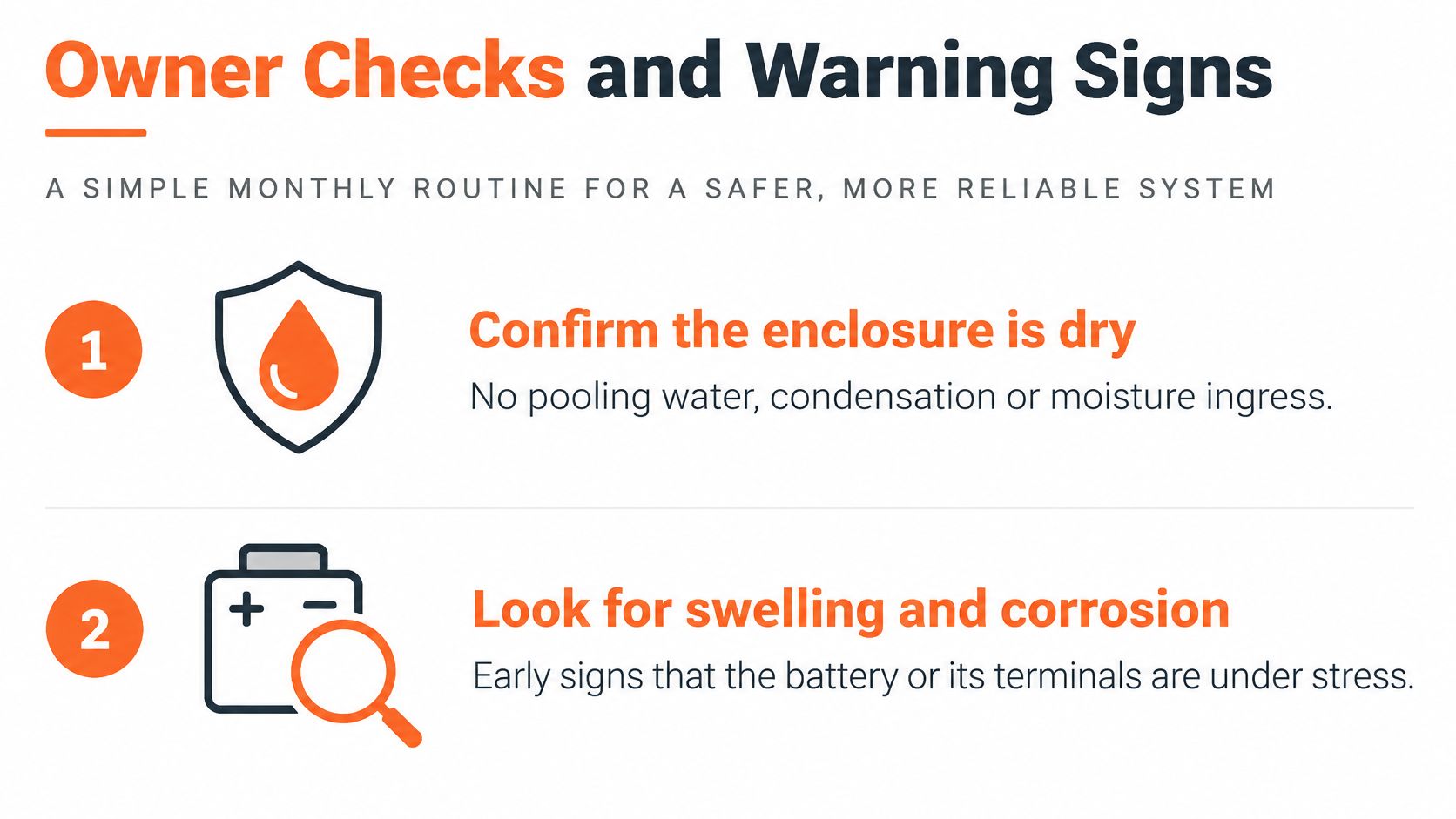
- Confirm the enclosure is dry. Look for pooling water, condensation and moisture trails at cable entries. Water at a terminal is the fastest route to corrosion and a failed connection.
- Check for swelling, corrosion, impact damage or unusual odours. These are early signs the battery or its terminals are under stress, and they're visible without opening anything.
- Keep ventilation openings clear. Stored boxes, overgrown plants and dust blankets all raise operating temperature, and a hot battery ages faster than a cool one.
- Look for dirt, debris, insects and vermin, then clean dry. A soft brush, a dry cloth or a vacuum with a soft nozzle. Never a hose, and never a pressure cleaner.
- Listen for buzzing, clicking or a fan running differently. Note the time and what the system was doing, because a technician can match that against the fault log.
- Record every warning with a date and a photo. Inverter screen, app alert, unusual noise, all of it. A pattern across three months is far more useful than a single memory of "it beeped once".
Hard limit: the enclosure stays closed. No opening it, no touching wiring, no multimeter, no hosing it down, and no overriding the battery management system to clear an alarm.
A pass is dry, clear, quiet and no new warnings. Anything else goes straight to the table below.
When a check fails
| Warning sign | Likely cause | Action |
|---|---|---|
| Unexpected maintenance cycle restricting discharge | BMS periodic maintenance | Log the date and call a technician if it repeats |
| Repeated inverter trips | Inverter fault, grid disturbance or battery communication error | Book an accredited technician inspection |
| Persistent state-of-charge imbalance | Possible BMS or cell fault | Technician to review fault logs |
| Unexplained capacity loss | Degradation or hidden fault | Independent accredited inspection before any replacement decision |
| Swelling, corrosion or impact damage | Physical damage or water ingress | Keep clear, do not open, call the installer |
| Heat, smoke, hissing, leaking or strong chemical smell | Serious fault | Isolate the area, keep people away, call emergency services and the installer |
The NSW Government battery-storage guide notes that some systems run a periodic maintenance cycle during which discharge may be restricted for up to a day (NSW Government). That's normal behaviour, not a fault. A cycle that repeats, or arrives without explanation, is the trigger.
If the unit is hot, smoking, hissing, leaking or giving off a strong chemical smell, isolate the area, keep people away and call emergency services and the installer. Don't approach it to check.
If you want to understand how ambient heat and airflow change the picture, this explanation of a thermal management system covers how temperature control protects cell life.
The short video below walks through the kind of external inspection that's safe to do yourself.
What the annual inspection covers
The Clean Energy Regulator recommends having a solar battery checked for safety every year by a licensed electrician accredited by Solar Accreditation Australia. Its checklist allows owners to inspect for vermin, dust, debris and visible damage, but not to touch wiring or electrical components, and it notes that batteries may need firmware updates, system-health checks and safety testing over time (Clean Energy Regulator).
A technician's annual procedure should cover BMS and inverter fault logs, manufacturer firmware and recall notices, clearances and enclosure condition, isolator labelling and accessibility, and protective device testing.
The standards behind that work are specific: AS/NZS 5139 for battery system safety, AS/NZS 3000 wiring rules and SA TS 5398 for electrical energy storage equipment. The Queensland Electrical Safety Office also points out that solar and battery systems can remain energised when mains power is switched off, which is why repairs aren't a homeowner task (Queensland Electrical Safety Office).
Usage Settings That Protect Battery Life
Rated life for a home battery sits at 4,000 to 6,000 cycles, roughly 10 to 16 years at about one cycle per day, according to the Queensland Battery Buyers Guide. Every setting you change moves the battery toward or away from that number.
The clearest example is cycling intensity. The same guide warns that fully charging and discharging a battery more than two or three times per day can shorten its lifespan, which makes automated energy-management settings a maintenance tool rather than a convenience feature. Depth of discharge matters just as much: completely emptying a battery reduces its lifespan, so the reserve setting should be confirmed with the installer rather than guessed at.
Where the wear actually comes from
Temperature, ventilation and cleanliness are wear factors, not just safety factors. A battery in a sun-exposed or poorly ventilated spot runs hotter, and heat accelerates capacity loss. Queensland and NSW summers make placement and airflow decisions you'll live with for a decade.
| Setting | Benchmark | Effect on life | Maintenance action |
|---|---|---|---|
| Full charge and discharge | More than 2 to 3 times per day | Shortens service life | Use automated plans with usage limits |
| Rated cycle life | 4,000 to 6,000 cycles | About 10 to 16 years at one cycle per day | Track cycle count each quarter |
| Depth of discharge | Complete emptying | Reduces lifespan | Confirm the reserve setting with the installer |
| Operating temperature | Manufacturer's stated operating range | Heat and freezing accelerate wear | Keep the battery within that range |
| Ventilation and clearance | Manufacturer's stated clearance specification | Restricts heat dissipation | Keep openings clear during the monthly check |
There's an honest trade-off here. If your battery participates in an automated energy plan or a grid service, cycle counts can rise, and that additional cycling can accelerate degradation even while the battery stays perfectly safe. That's not a reason to opt out. It's a reason to review cycle count each quarter against the rated life and to ask whether the extra throughput is earning its keep. If the reserve level matters to you, this guide to battery depth of discharge explains how the setting changes both backup capacity and wear.
Don't change battery management parameters yourself. Ask the installer to confirm any change, then track throughput and temperature warnings for the following month before touching another setting.
Baseline Records, Warranty Evidence and Your Plan This Week
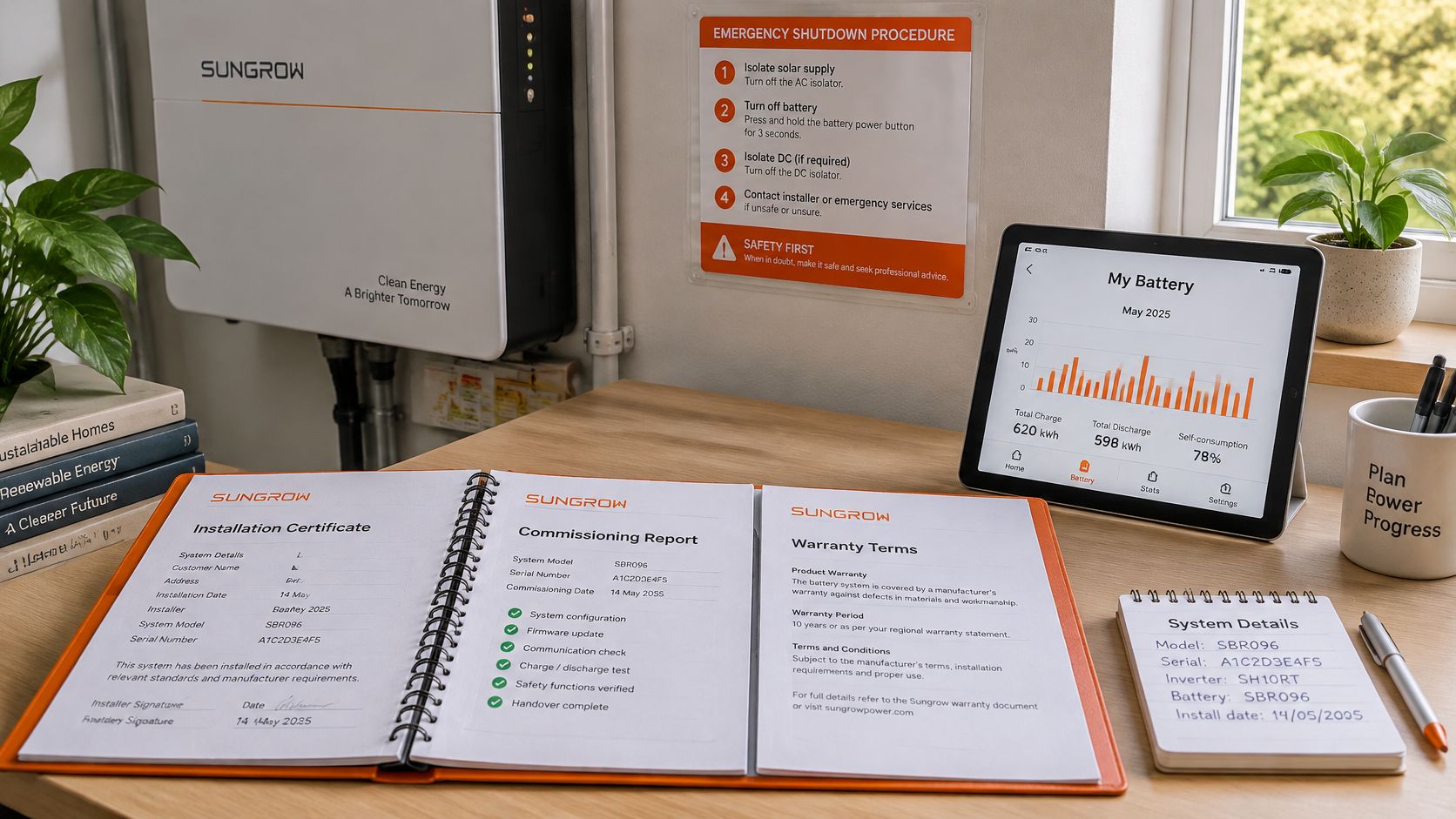
Start with the file you should have been handed at commissioning: installation certificate, model and serial numbers, commissioning report, warranty terms and the emergency shutdown procedure. Most owners have these somewhere. Far fewer can produce them on the day a fault appears.
What the national inspection results tell you
The Clean Energy Regulator's first Australian solar-battery inspection program completed 3,425 inspections of systems installed from 1 July 2025 to 30 April 2026. Only 37.86% were rated adequate, while 61.19% were substandard and 0.95% unsafe (Clean Energy Regulator inspection report highlights).
Read that carefully. Owner maintenance doesn't fix installation defects. What those figures do is set a risk-control sequence: get the documents, have an accredited technician verify mounting, enclosure location, cable routing, isolation, ventilation, clearances, protection and battery-inverter-BMS compatibility, then record baseline operating data and keep dated photographs and service records.
That last step is the one most owners skip, and it's the one that decides warranty outcomes.
Three warranties, three evidence trails
| Warranty type | What it usually covers | Evidence to keep |
|---|---|---|
| Product | Defects in the battery hardware | Proof of purchase, serial number and product documentation |
| Performance | Retained capacity over the warranty term, often tied to years or lifetime cycles | Diagnostic data, error logs, dated capacity readings and photos |
| Installation | Workmanship and installation defects | Installation certificate, commissioning report and installer details |
NSW guidance notes that batteries degrade normally, that warranties may be based on either years or lifetime cycles, and that many manufacturers offer around 10-year product warranties (NSW Government battery guide). That's the gap nobody explains at handover. What matters most is not how long the battery lasts, but how you prove your operating pattern hasn't breached the terms, and who pays when capacity falls.
A claim may need proof of purchase, installation documentation, error logs, photos or diagnostic information, and the battery serial number. Warranties typically exclude damage from fire, extreme heat, freezing or other environmental abuse, water damage, moisture ingress, installation in unsuitable locations, and modification, tampering or unauthorised repairs to the battery pack. Confirm in your own terms whether any virtual power plant participation is covered. With HighFlow Energy, participating in the Virtual Power Plant does not affect the battery's warranty.
If the installer has closed, manufacturer obligations may still apply under Australian Consumer Law, which is exactly why invoices, serial numbers and maintenance logs matter. The discipline of documenting a handover and then honouring a claim isn't unique to energy. Builders work to the same logic in this post-close operations for homebuilders resource, and the evidence trail looks almost identical: dated records, named responsibility, and a clear process when something fails.
Your plan this week
- Store the baseline documents with dated photos of the installation, enclosure and isolators.
- Check which warranty types apply and whether your installer still trades.
- Book an accredited inspection if the last one is more than a year old, or if any warning sign in the previous section has appeared.
- Log the first baseline month of app data: usable capacity, maximum charge and discharge power, daily throughput, temperature warnings and fault events. Compare against the manufacturer's tolerances rather than app estimates alone.
These duties stay with you whoever manages the battery's energy use. If you're weighing up how long the asset should last before replacement enters the conversation, this explainer on how long solar batteries last sets realistic expectations by chemistry and cycle count.
Key Takeaways, FAQs and Next Steps
- Owner checks run monthly. Dry, clear, quiet, no new warnings.
- Accredited inspection is at least yearly, by a licensed electrician accredited by Solar Accreditation Australia.
- Rated life is 4,000 to 6,000 cycles, or about 10 to 16 years at one cycle a day.
- More than two or three full cycles per day shortens life, so automated plans need limits.
- Warranty evidence starts on day one, not the day something breaks.
Can I open or clean the battery myself?
No. Owners limit themselves to dry external checks. No opening the enclosure, no touching wiring, no electrical testing, no hosing.
Does virtual power plant participation shorten battery life?
Additional cycling can accelerate degradation even when the battery is safe. Track cycle count quarterly against the rated life and judge whether the throughput is earning its keep.
How often should a battery be inspected?
Monthly owner checks plus at least one professional inspection a year, and an immediate inspection after any alarm or repeated fault.
What does a capacity drop mean?
It means degradation or a hidden fault, and the two look identical from the app. Get an independent accredited inspection before you commit to a replacement.
Does the installer going out of business end my warranty?
Not necessarily. Manufacturer obligations may still apply under Australian Consumer Law, which is why serial numbers, invoices and maintenance logs matter.
HighFlow Energy is an electricity retailer built around getting more value from existing solar and battery systems through a Bring Your Own Battery virtual power plant. We don't sell or install panels or batteries, and customers keep ownership and priority use of stored energy.
Most battery owners focus on installation quality. Far fewer focus on ongoing performance and optimisation. HighFlow Energy is an electricity retailer built around getting the full value from your existing solar and battery system, using spare battery capacity for grid support while your household's needs come first. If you'd like to understand whether your battery is underperforming financially, visit HighFlow Energy to request an eligibility assessment for Queensland or New South Wales. Results depend on system size, allowance tier and eligibility, and no savings are guaranteed.