

Solar and Battery Gold Coast: How It Works and Pays
The Gold Coast's rooftops carry an estimated 3.4 gigawatts of technical solar potential, according to evidence submitted to a Queensland parliamentary committee. That places the city behind Brisbane's 7.1 GW and comfortably ahead of Logan's 2.2 GW. The same submission counts more than 1.1 million rooftop solar systems across Queensland, over half of all homes.
So why does a solar and battery Gold Coast household still open a power bill every quarter with a real number on it? Because generation and consumption happen at different times of day, and the grid pays very little for the gap between them.
What follows is the full accounting. It tracks a single kilowatt-hour from the moment the inverter wakes up to the moment it's spent, sold or stored, then shows where the money leaks and what a coordinated fleet can add. By the end you'll be able to judge whether your own battery is doing useful work and what participation in a virtual power plant would change.
Why Gold Coast Solar and Battery Homes Still Pay Power Bills
Queensland became the first Australian state to pass one million rooftop solar installations, a milestone recorded in the Clean Energy Council's rooftop solar and storage report for the second half of 2023. The same report traced battery attachments to rooftop systems past 150,000 since 2020, with more than a third of those installed during 2023 alone, and counted 18,427 battery installations in Queensland in the fourth quarter of 2023, a 35.3 per cent jump on the same quarter a year earlier. The Clean Energy Council's July to December 2024 report puts 8,555 home-battery sales in Queensland for that half year.
The hardware keeps arriving, yet the bill keeps arriving with it, and the reason is mechanical rather than a fault in the equipment. A Gold Coast system generates its heaviest output in the middle of the day, when the house is quietest. The surplus leaves for a few cents a kilowatt-hour. Then cooking, cooling and hot water all land between 5pm and 10pm, and the household buys power back at the retail rate, with a daily supply charge added whether anyone is home or not. Each kilowatt-hour sold cheaply at noon and repurchased at 7pm travels the same wires twice at two very different prices, and that difference is where the bill lives.
Generating cheap and buying expensive is the entire problem. A well-scheduled battery is the only piece of equipment on the property that attacks it directly.
A battery only closes that gap when stored solar is still available once the evening peak arrives. Systems that drain early, or that hold less than the dinner-time load demands, leave the grid supplying a slice of the most expensive hours of the day, which is why households that already own a battery can still see a stubborn number on the bill. For Energex-network homeowners running solar and storage, the question is whether every kilowatt-hour is doing its most valuable job. Capacity left over after the household is covered can earn through a virtual power plant, where coordinated dispatch pays for spare battery capacity while the home keeps first call on its own stored energy.
How a Solar and Battery Home Runs Through a Gold Coast Day
Four pieces of equipment do all the work. Panels generate direct current, the inverter converts it to mains power and steers each kilowatt-hour toward the house, the battery or the grid, the battery holds what the house can't use at that moment, and the meter measures everything crossing the boundary with the Energex network.
| Time of day | Rooftop solar | Household demand | Battery action | Grid flow |
|---|---|---|---|---|
| Early morning | Low and ramping | Breakfast, hot water, cooling | Discharges overnight reserve | Small grid import |
| Midday | Peak output | Low, home often empty | Charges from surplus solar | Limited export once full |
| Late afternoon | Declining fast | Rising as households return | Holds charge for evening | Balanced, minimal flow |
| Evening | None | Peak, cooking, cooling, lighting | Discharges stored solar | Minimal import |
| Overnight | None | Baseline loads | Idles at reserve level | Imports from grid |
Read the table downwards and you have the whole system in one view. Before sunrise the battery is draining whatever it held back overnight, and the grid covers the rest. From mid-morning the panels take over the household load, then fill the battery, and only once the battery is full does the surplus leave the property. Through the late afternoon the battery sits still, waiting.
The evening rows are where the money is decided. Between roughly 5pm and 10pm the panels contribute nothing, the house draws its heaviest load of the day, and every kilowatt-hour that comes out of the battery is a kilowatt-hour you don't buy. Overnight, the battery drops to its floor and holds there, leaving baseline consumption to the grid.
What self-consumption actually means
Self-consumption is the share of your solar output used inside the house instead of exported. A solar-only home sends its midday surplus away because there's nowhere to keep it. Add storage and those same electrons come back at dinnertime, when the retail rate peaks.
Think of a water tank. Fill it when water is plentiful and cheap, draw it down when it's scarce and expensive.
Why a Gold Coast roof earns more from storage than export
Thousands of roofs across the coast generate in the same hours, so the local network absorbs a flood of export at midday and then faces a hard evening peak. That mismatch is precisely the gap a battery closes, and it closes it without touching the panels or the inverter's settings.
The loss nobody mentions
Nothing moves energy for free. Expect to lose roughly a tenth of what you put into the battery across a charge and discharge cycle, through conversion and standby draw. That doesn't weaken the case, because the gap between an export credit and an evening retail rate is far wider than the loss. It does mean charging from the grid to chase a small price difference rarely pays.
Start with a five-minute audit. Write down the three largest loads in your home after 5pm, which on the coast are usually air conditioning, cooking and hot water, and work out which could run from stored solar instead.
What a Virtual Power Plant Actually Is
A virtual power plant is a fleet of household batteries, solar systems and controllable loads coordinated by software so the group behaves like one dispatchable power station. The Australian Renewable Energy Agency describes exactly that arrangement, noting that Australian fleets can respond to wholesale price signals, energy shortfalls and local network requirements.
Coordination runs in two directions. The fleet charges when supply is abundant and wholesale prices are low, and it discharges small amounts during demand peaks, shortfalls or frequency events. Neither action requires the household to do anything at the time.
On its own, a home battery is a bicycle. Coordinated by an operator, a suburb of batteries moves load the way a single power station does.
The grid service that rewards speed
Frequency control ancillary services, or FCAS, correct second-to-second imbalances between supply and demand on the grid. Batteries suit the work because they switch on and off in fractions of a second, which ARENA's explanation of virtual power plants identifies as the quality that makes them useful for fast frequency and voltage support. Thousands of small systems answering together produce one large, controllable resource.
Where the revenue comes from
Three streams feed the pool. Wholesale price spreads reward charging low and discharging high. Grid service payments reward fast, reliable response. Network support rewards discharge in the places and hours the local grid is under strain. The operator converts that pool into something a household can use, usually bill credits or a monthly allowance.
That model has been demonstrated at scale in Australia. ARENA's AGL Virtual Power Plant project connected solar-and-battery systems across 1,000 residential and business premises in Adelaide under cloud-based control, with the fleet discharging during high demand and supporting the grid during instability while algorithms balanced household, retailer and network interests.
Keep one distinction in mind for everything that follows. A virtual power plant monetises the spare capacity around the battery's household job. It doesn't replace that job.
Where Every Kilowatt-Hour Goes and What It Earns
| Destination | When it happens | What it earns or saves | Trade-off |
|---|---|---|---|
| Daytime self-consumption | Solar hours, appliances running | Offsets the full retail usage rate | Requires shifting loads to daylight |
| Battery charging | Midday surplus after home use | Stores value for the evening peak | Each cycle costs a little stored energy |
| Grid export on feed-in tariff | Battery full, solar still generating | Low credit, often a few cents per kWh on limited daily volume | Least valuable use of surplus |
| Evening battery discharge | Peak pricing window | Offsets peak retail usage rates | Draws down the stored reserve |
| VPP dispatch | Grid events, price spikes, network needs | Funds bill credits or a monthly allowance | Limited to spare capacity above household needs |
The bill has three parts
Before valuing anything, separate the charges. There's a daily supply charge that arrives whether you use a single kilowatt-hour or not, usage charges that may be flat or time-of-use depending on the plan, and feed-in credits for export. Energex-area retailers set their own feed-in tariffs, and many apply preferential rates only to a limited daily export volume rather than every exported kilowatt-hour. A headline rate of ten cents often turns out to be five cents across most of the day, which is why net metering and how solar exports are credited deserves a closer look than the rate on the front of the offer.
The order of value
The table ranks the destinations from left to right in value. A kilowatt-hour used in the home or discharged from the battery during the evening peak avoids the full retail rate. The same kilowatt-hour pushed to the grid earns a few cents. That gap, not the feed-in tariff, is where bill reduction lives. Chasing export credits is the least productive hobby in household energy.
What the savings evidence does and does not prove
Real numbers exist, and they're uneven. The ACCC found that solar-and-battery customers in VPPs typically had bills $762 to $1,093 lower, between 57 and 63 per cent below comparable bills, while Energy Consumers Australia measured median VPP credits of about $55 a quarter, as collected in this breakdown of Gold Coast solar bill outcomes. The same analysis notes that VPP households can hold higher feed-in tariffs yet earn less in feed-in credits than solar-only homes, because they self-consume more.
Practical rule: a higher export rate isn't automatically better value. If dispatch eats into self-consumption or leaves you short during an outage, total value falls even as one line on the bill improves.
What that means locally is simple. Results depend on your tariff, your usage pattern, system size and how well the operator performs, and nobody can promise a zero bill in advance. Pull your latest bill tonight and record three numbers: the daily supply charge, the usage rate, and the feed-in rate. Everything else in this conversation is arithmetic on top of those three.
Practical Ways to Make Stored Energy Work Harder
Optimisation is mostly scheduling. The battery already does the hard part; your job is to make sure there's surplus to store and demand to meet when the sun is out.
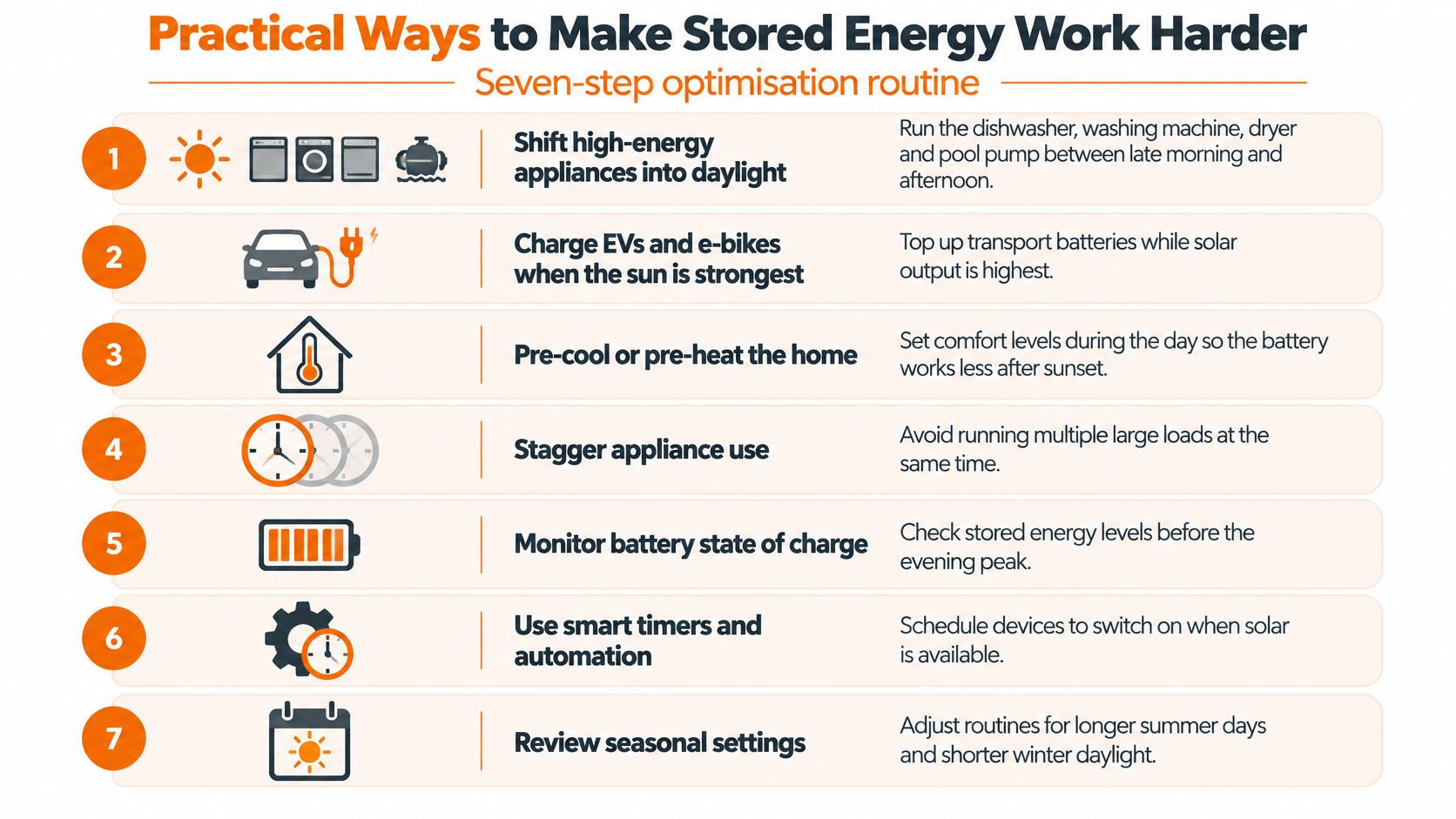
- Shift high-energy appliances into daylight. Run the dishwasher, washing machine, dryer and pool pump between late morning and mid-afternoon. These are the heavy loads in the house, and every one that runs at noon is one that doesn't import from the grid at 7pm.
- Timer the hot water. A heat pump or electric storage tank set for midday heats water on solar instead of importing at 8pm. Hot water runs on a schedule either way, so pointing that schedule at the sun costs nothing.
- Pre-cool before the peak. On a summer afternoon, cool the house to a couple of degrees below your comfort setting while the panels are still producing, so the evening air conditioner coasts on stored solar rather than grid power.
- Cut pointless overnight draw. Charge devices and run appliances before bed, and check for standby loads in the garage or home office that import all night.
- Set an evening reserve and leave it alone. Find the battery's minimum state-of-charge setting and set it to cover the loads you can't afford to lose. A reserve that changes weekly isn't a reserve.
- Review discharge patterns weekly. Open the battery or retailer app and compare the discharge curve against what happened in the house. A flat discharge at 6pm usually means a load nobody thought about.
- Service the system to the manual. Panels and batteries degrade. Follow the manufacturer's maintenance guidance and check the inverter for fault codes after storm season.
Five minutes in the app tells you more than any brochure.
The payback logic is straightforward. Move a pool pump and one dishwasher cycle from evening to midday and you convert two grid imports into solar runs, each worth more to the bill than the feed-in credit those same kilowatt-hours would have earned. HighFlow Energy's guidance for battery owners runs along the same lines: run high-energy appliances during daylight hours, avoid unnecessary overnight grid usage, and maintain the solar and battery system according to manufacturer guidelines.
Why cycling isn't free
Every extra cycle draws on the battery's rated cycle life and adds a small amount of degradation. That is the honest trade-off, and it is why the aim is smarter cycling rather than maximum cycling. Shifting loads costs nothing and adds no cycles at all, so do that first. Then let dispatch use whatever spare capacity remains inside the warranty envelope.
Pick two appliances to move this week and compare the next bill against the one before it.
How to Connect Your Battery to a VPP in Queensland
Two identical batteries on the same Gold Coast street can get different answers at enrolment. Capacity alone does not qualify a system for coordinated dispatch, because participation depends on how the battery is configured and how it connects to the network.
Work through these checks in order.
1. Confirm your eligibility. Participation starts with a residential address in Queensland or New South Wales, existing rooftop solar, a compatible home battery, and a working internet connection for the battery.
2. Match the battery to the standard. Eligible batteries must meet minimum usable capacity, inverter requirements and VPP compatibility standards. A capable battery on paper can fail on inverter firmware alone.
3. Verify the network side. Queensland's regulatory framework requires a Dynamic Connection for VPP operation, as the Queensland Government battery buyers guide sets out, and the same guide describes a VPP as an aggregation of small devices that charges during surplus supply and discharges at peak demand. Check the Energex connection agreement, the inverter operating mode and the export limits before assuming your battery can provide grid services.
4. Check the signalling rule. Queensland requires a generation signalling device for new or replacement rooftop solar and battery systems rated 10 kVA or more, from 6 February 2023. If your system crosses that threshold, the communications requirement applies.
5. Enrol, keeping your hardware. You bring the panels and battery you already own. Nothing on the roof or the wall changes.
6. Set household priorities last. Reserve levels and override preferences come before enrolment is complete, and app telemetry should be reporting correctly on day one.
| Requirement | What to check | Why it matters |
|---|---|---|
| Location and network | Residential address in Queensland or New South Wales, on Energex or Ergon | Determines whether the VPP service is available |
| Battery capacity | Minimum usable capacity against the operator's standard | Enough spare energy for household needs plus grid events |
| Inverter compatibility | VPP compatibility and operating mode of the inverter | Allows coordinated charging and discharging |
| Internet connection | Reliable connection for the battery or gateway | Telemetry, control and performance verification |
| Dynamic Connection | Energex connection agreement, export limits, inverter mode | Queensland requirement for VPP operation |
| Systems 10 kVA or more | Generation signalling device for new or replacement systems from 6 February 2023 | Queensland compliance for larger installations |
The two blockers that stop most enrolments
The first is a battery with enough capacity but the wrong inverter configuration, which is a paperwork and firmware problem rather than a hardware one. The fix is usually a firmware update or a settings change, not a new battery. The second is a connection agreement that was never set up for dynamic export, so the network side does not permit coordinated dispatch until Energex or Ergon updates it.
If you're weighing hardware at the larger end of the market, browse commercial energy storage systems from ATEK Distribution to see how capacity and inverter ratings scale, though most Gold Coast homes need far less than that.
Our system integration requirements set out what we verify before a battery enters the fleet. Before you request a check, find two documents: the Energex connection agreement and the battery model number from the inverter or battery label.
What a VPP Will and Will Not Do to Your Battery
The question that rarely gets a straight answer is whether coordination compromises backup power or household control. The evidence says it depends entirely on how the program is designed. CSIRO's survey of 323 battery owners found that the ability to monitor or override VPP events ranked among the most positively valued features, and 52 per cent of people who had left a VPP cited wanting more control over their battery, as the CSIRO living lab findings record. Energy Consumers Australia separately identifies loss-of-control concerns, low trust and limited understanding as major barriers to participation.
That points to a design principle rather than a marketing line. The arrangement that works puts household needs first: dispatch is limited to spare capacity above a preserved minimum state of charge, and automation can be paused or overridden at any time. Your household energy use is always prioritised before supporting the grid.
Four misconceptions are worth correcting directly.
- "Ten kilowatt-hours means ten kilowatt-hours to the grid." It doesn't. Outage reserves, inverter power ratings, household demand and export limits all cut the dispatchable share. The battery discharge rate is often the binding constraint, not stored energy.
- "Joining guarantees a zero bill." No configuration can promise that. Tariff, usage, system size and operator performance all move the outcome.
- "The biggest headline payment wins." Not if dispatch eats into self-consumption or leaves the reserve short when you need it.
- "Control and participation are opposites." A well-run fleet needs override capability to keep customers enrolled.
Ask before you sign: what minimum state of charge will you hold, what happens to my reserve during an outage, and how do I pause dispatch myself?
Those three answers tell you more about an operator than any brochure. Ask for all three in writing, then compare.
Frequently Asked Questions About Solar and Battery Systems
Will a battery keep the lights on during a blackout?
Only if it still holds charge and the backup function is wired for the circuits you care about, such as the fridge, lights and Wi-Fi. A battery works like a small reserve tank: once the stored energy and inverter limit are reached, the house falls back to whatever backup design was installed. A VPP should leave the outage reserve intact rather than draining it for grid support.
Does joining a VPP always cut my bill?
No. The outcome depends on your tariff, evening usage, solar and battery size, network limits and how the operator dispatches spare capacity. No configuration can promise a zero bill, so treat the allowance or credit as variable, not guaranteed.
Can I still use my battery if I join a VPP?
Yes. Your household demand comes first, and coordinated charging or discharging should use only the headroom above the reserve you choose. If you want the battery kept fuller overnight, the settings should reflect that before any grid event is considered.
Is a generation signalling device required?
In Queensland, some new or replacement systems may need extra signalling or control equipment so the network can see and manage exports safely. The requirement depends on system size, inverter setup and connection rules, so confirm it with your installer and network before approval rather than after the system is built.
Does a VPP affect my battery warranty?
It depends on the manufacturer's terms. Extra cycling can count toward cycle-life or energy-throughput limits, so check how the warranty treats dispatched energy, reserve settings and daily depth of discharge before you enrol.
What does an eligibility assessment involve?
A practical review checks whether you are a residential homeowner in NSW or QLD, your solar and battery are compatible, the battery has enough usable capacity, the inverter meets VPP requirements and the battery has an internet connection. It should also look at your network connection, tariff and recent bills to estimate how much spare capacity could be used without touching the energy your household needs first.
Your Next Step as a Gold Coast Battery Owner
Four points carry the whole argument.
- Value follows the day cycle. Stored evening energy is worth many times what the same kilowatt-hour earns as a midday export.
- Load shifting comes first. It costs nothing, adds no cycles and reduces grid imports before any coordination is involved.
- A well-designed VPP pays for capacity you weren't using. It monetises spare room above your household needs, not your reserve.
- Control settings decide whether it stays attractive. Reserve levels, outage behaviour and override access matter more than headline rates.
Most battery owners focus on installation quality. Far fewer focus on ongoing performance and optimisation. HighFlow Energy is an electricity retailer built around maximising the value of a system you already own, running a Bring Your Own Battery VPP for homeowners in Queensland and New South Wales who have solar, a compatible battery, and bills they'd rather shrink.
The mechanics are simple. You bring the existing solar and battery, the battery joins the coordinated fleet, we support the grid using spare capacity only when your battery is available, and the value funds a monthly bill-free electricity allowance with tiers from 300 kWh to 1,000 kWh per billing month depending on system size. You stay connected to the grid, stay in control of the battery, and don't need to monitor anything day to day. No new hardware, no lock-in contracts, and no exit fees. The allowance depends on eligibility and system size, and standard rates apply to anything you use beyond it.
If your battery is holding capacity it never gets paid for, that's worth quantifying rather than guessing at. HighFlow Energy turns the spare capacity in your existing solar and battery system into a monthly bill-free electricity allowance of 300 kWh to 1,000 kWh, while your household keeps first call on stored energy. Visit HighFlow Energy to request an eligibility assessment and find out whether your battery is underperforming financially.