


Solar Battery Incentives in Australia for QLD and NSW
The federal Cheaper Home Batteries Program discounts eligible battery systems by roughly 30% upfront, and more than 500,000 systems had been installed by mid-August 2026. NSW households can stack additional state support, while Queensland households rely mainly on the federal scheme.
You may have already experienced the confusion. One headline says a battery rebate is available, another announces that a state program has closed, and an installer offers a discount without explaining which part comes from the government and which part comes from the retailer. The practical answer depends on where you live, how large the battery is, whether it can join a Virtual Power Plant, and how intelligently it's operated after installation.
This guide focuses on solar battery incentives in Australia, with specific attention to New South Wales and Queensland. It also deals with the part most rebate guides leave out. An upfront discount lowers the cost of the asset once. A well-structured VPP can create continuing value through battery dispatch, bill allowances and grid-service participation.
Why Solar Battery Incentives Matter Right Now
A Queensland homeowner with rooftop solar may have a battery quote in front of them, but no active state rebate to add to it. A New South Wales homeowner may see a different picture, with the federal discount combined with VPP support and access to energy-upgrade finance. Both households need to separate available support from old schemes, marketing claims and assumptions carried over from previous policy settings.
The federal Cheaper Home Batteries Program has become the central Australian battery incentive. It's administered through the Clean Energy Regulator and discounts eligible small-scale battery systems by about 30% upfront. Official figures recorded more than 500,000 installations by 14 August 2026 and more than 507,000 by 17 August 2026. Reuters reported that strong demand led the government to expand the scheme to A$7.2 billion over four years, up from an initial A$2.3 billion.
That scale changes the market. Battery support is no longer mainly a collection of isolated state rebates. Federal assistance now reaches households, small businesses and community organisations across Australia, while states are adding different forms of finance and grid-participation support.
Practical rule: Treat the rebate as the starting point of the payback calculation, not the whole calculation.
The key differences are straightforward:
- Federal support: Reduces eligible battery installation costs through the STC mechanism.
- NSW support: Adds a VPP incentive and a Home Energy Saver loan pathway.
- Queensland support: Relies mainly on the federal program after the state Battery Booster scheme closed.
- Ongoing value: Comes from self-consumption, time-of-use optimisation, demand response and VPP participation.
The rest of the decision comes down to system design and operation. A battery that sits full during low-value periods, exports at constrained times or reserves too much capacity for backup may receive the rebate but still underperform financially. The incentive matters, but battery optimisation determines what happens after the installer leaves.
Understanding How Battery Incentives Actually Work
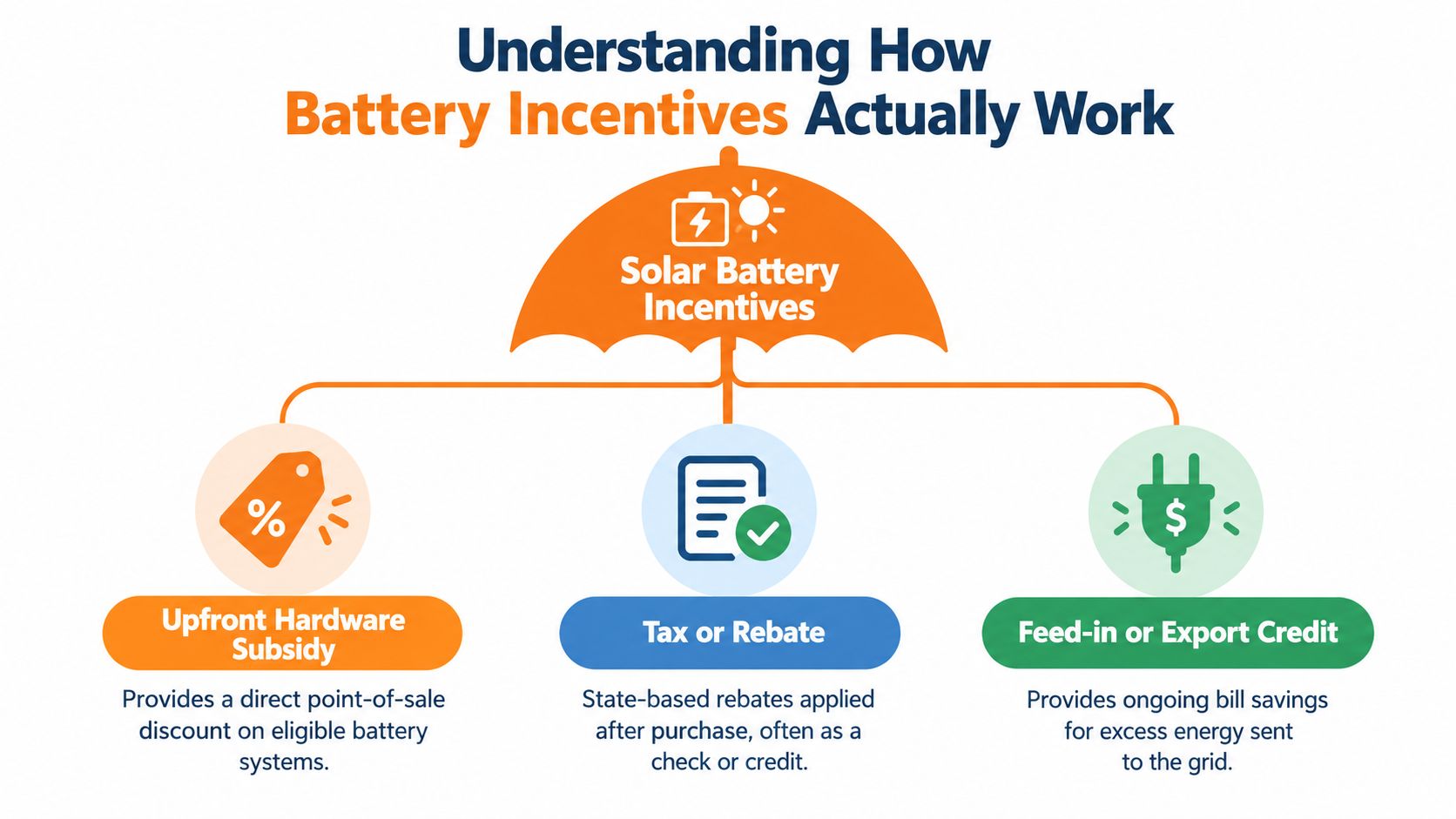
“Solar battery incentives” covers several different mechanisms. They all reduce the effective cost or improve the value of storage, but they work at different points in the battery's life.
Three mechanisms with different financial effects
Upfront hardware subsidies reduce the purchase or installation cost at the beginning. The federal program is the main example in Australia, with the discount calculated through Small-scale Technology Certificates.
Low-interest or zero-interest finance doesn't necessarily reduce the quoted system price. It changes cash flow by spreading repayment over time. NSW's Home Energy Saver Program is an example, offering zero-interest loans for eligible household energy upgrades.
Market-participation payments reward a battery owner for making stored energy available when the electricity system needs support. A VPP coordinates many household batteries so an energy retailer or operator can respond to wholesale price volatility, demand events and network requirements.
The difference is important. A hardware rebate is a one-off discount on the asset. VPP participation is an ongoing value stream from the same asset, although the actual result depends on the program rules, dispatch settings, tariff and household usage.
The terms you need to understand
- STCs: Small-scale Technology Certificates that help calculate the federal battery discount.
- Usable capacity: The energy the household can access, rather than the battery's full nameplate capacity.
- VPP: A Virtual Power Plant that coordinates distributed batteries as a flexible grid resource.
- Feed-in tariff: A payment credited for electricity exported to the grid.
- Demand response: Changing battery behaviour or electricity use in response to grid conditions or market prices.
- Dispatch: Charging or discharging the battery at a particular time for a defined purpose.
Australian policy is moving towards participation as battery uptake expands and battery costs fall. The policy direction increasingly rewards systems that can respond to the grid, rather than systems that exist behind the meter. That doesn't make the upfront subsidy irrelevant. It means the subsidy should be assessed alongside export constraints, tariff design, cycling strategy and retailer exposure to wholesale prices.
A battery owner also needs to distinguish retail value from wholesale value. The retailer charges for electricity under a retail plan, while wholesale prices can vary sharply across the NEM. A VPP operator uses software and market access to decide when a battery should preserve household energy, avoid expensive imports or support the grid.
The commercial question is simple: does the operating model create more value than the household gives up through export timing, battery availability or reduced feed-in income? A headline rebate can't answer that.
The Federal Cheaper Home Batteries Program Explained
A battery quote can look attractive until you check how much of its capacity receives the strongest incentive. The federal program is administered by the Clean Energy Regulator, with eligibility rules covering approved equipment, installation and technical capability. As noted above, the scheme has expanded significantly in response to demand, but the rebate still depends on how the battery is configured and sized.
From 1 May 2026, the rebate applies a tiered structure based on usable battery capacity. The Clean Energy Regulator designed the change to keep the discount at around 30% while reflecting falling battery costs. Each capacity band has its own factor, so adding storage above the first band produces less incentive value.
Federal Battery Rebate Tiers From 1 May 2026
| Usable capacity | STC factor | Practical implication |
|---|---|---|
| 0 to 14 kWh | 100% | The first capacity band receives the full STC factor. |
| 14 to 28 kWh | 60% | Additional capacity receives a lower factor. |
| 28 to 50 kWh | 15% | Larger systems receive a substantially lower factor on this band. |
The Clean Energy Regulator's explanation of the 1 May 2026 battery rebate changes is the right reference before signing a quote. The calculation uses usable capacity, not the nameplate figure in a product brochure.
Independent Australian estimates in this battery rebate analysis put federal support at about A$252 per kWh and roughly A$3,800 for a popular household battery size. Treat those amounts as estimates, not promised discounts. Eligibility, system design and the certificate calculation determine the final result.
Installers, distributors and commercial buyers comparing equipment can review procurement energy storage systems for storage procurement context. Homeowners should confirm the approved product, installer requirements and application pathway with their accredited installer.
The rebate changes the upfront price. It does not decide the right battery size.
A larger system may improve evening self-consumption or provide more backup, yet the lower factors on higher bands weaken the case for oversizing. Assess evening demand, solar output, export limits, backup priorities and the capacity a VPP can dispatch without reducing household value. Allowances and supply-charge offsets from VPP participation can contribute to payback over time, so compare that ongoing operating value with the one-off hardware discount before choosing a larger battery.
Comparing NSW and Queensland Battery Support
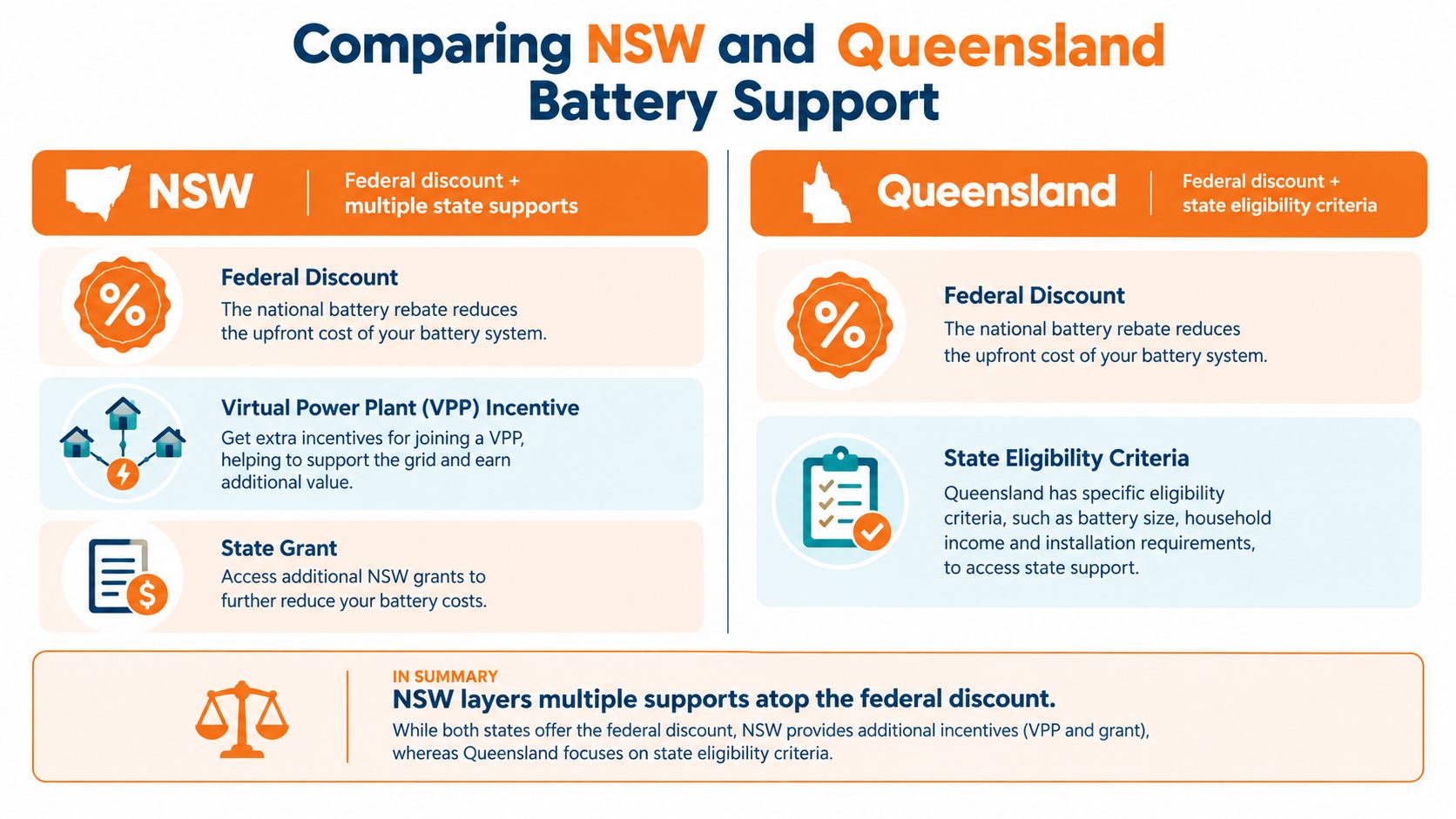
New South Wales and Queensland now present different incentive decisions. NSW has layered state support over the federal discount. Queensland households generally depend on the federal program because the state Battery Booster scheme closed in 2024.
The NSW VPP incentive became available from 1 July 2026. It applies to batteries up to 50 kWh, but the upfront payment calculation is capped at 28 kWh of capacity made available to the grid. The payment is therefore linked to dispatchable capacity, not the battery's total nameplate size.
NSW also launched the Home Energy Saver Program from 1 July 2026, with zero-interest loans of up to $15,000 for solar, batteries and electrification. This support changes the financing decision, especially for a household that can manage repayments but doesn't want to fund the entire installation upfront.
Queensland's position is more limited. The dedicated Battery Booster program is closed, so eligible households mainly assess the federal discount, their electricity tariff and any VPP pathway available through a participating retailer. The legacy 44c Solar Bonus Scheme remains relevant for some customers until 2028, which can make export decisions especially sensitive for those households.
NSW vs Queensland Battery Incentives at a Glance
| Support type | New South Wales | Queensland |
|---|---|---|
| Federal battery discount | Available for eligible systems | Available for eligible systems |
| State battery rebate | No equivalent general rebate described here | Battery Booster closed in 2024 |
| VPP support | Separate incentive from 1 July 2026, with batteries up to 50 kWh eligible and calculation capped at 28 kWh | No active dedicated state battery rebate described here |
| Finance | Home Energy Saver Program, zero-interest loans up to $15,000 from 1 July 2026 | No equivalent support listed here |
| Legacy solar support | Depends on the customer's arrangement | The 44c Solar Bonus Scheme remains relevant for some customers until 2028 |
NSW households should review the NSW battery rebate and VPP pathway before sizing a system. The VPP payment may change the economics more than an additional increment of battery capacity, particularly where the household already has enough storage for its normal evening load.
The policy contrast also explains why incentive-driven uptake has been stronger where federal and state programs combine. NSW offers several value layers. Queensland households need to be more disciplined about the operating case, because there's less state assistance to cushion an oversized or poorly optimised system.
Network conditions matter in both states. Export limits, local congestion and demand events can affect when energy has value. A battery that can export at any time on paper may face practical limits imposed by the network, inverter configuration or VPP rules.
Eligibility and Application Steps for Homeowners
The federal battery incentive is a compliance pathway, not an automatic discount attached to every battery quote. The Clean Energy Regulator requires supported batteries to meet equipment, installation and interoperability conditions.
A household should confirm eligibility before paying a deposit. Fixing an ineligible equipment choice after installation is expensive and may remove the financial support that shaped the original payback calculation.
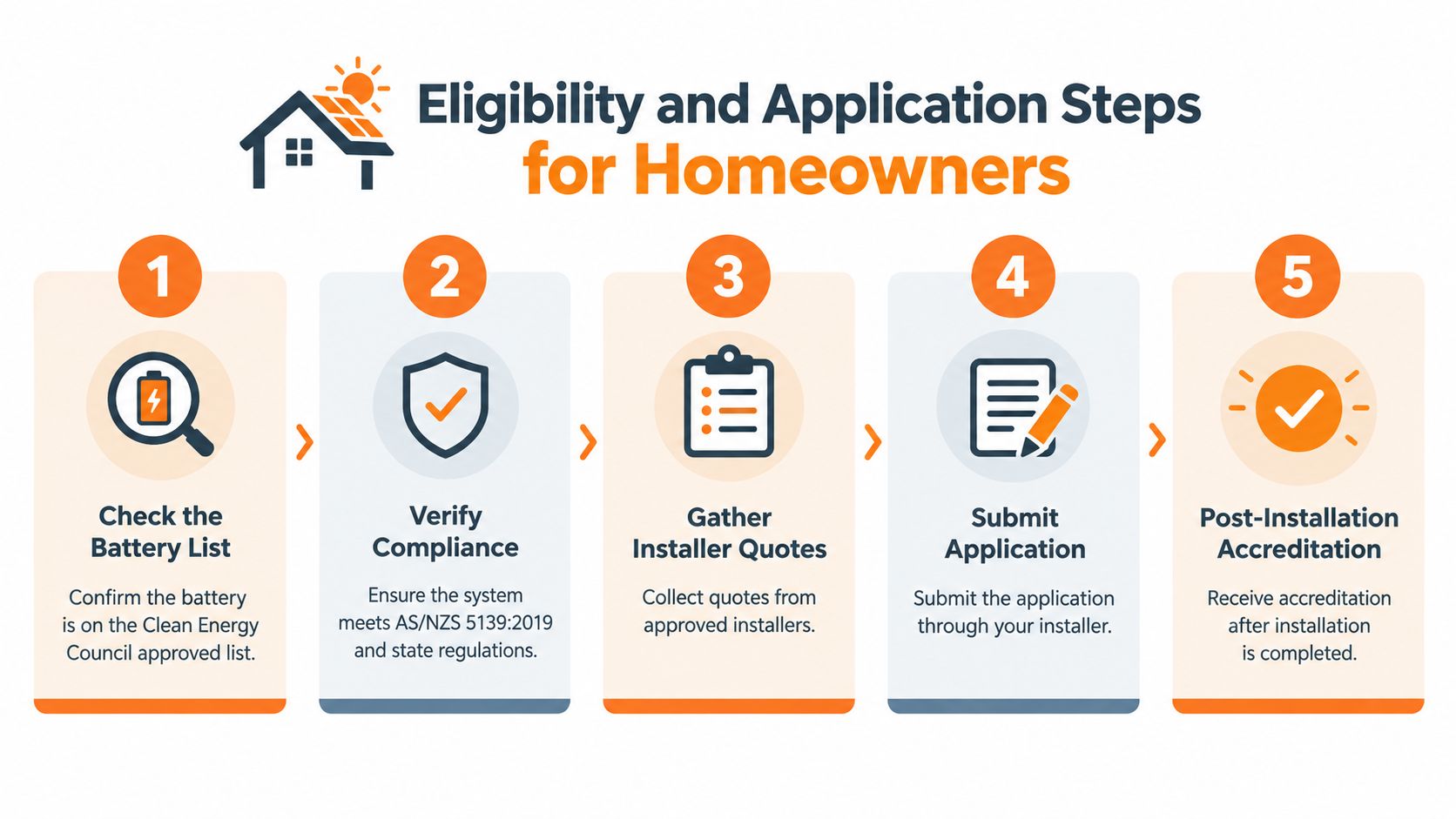
A practical application sequence
Check the battery on the approved list.
The supported battery must appear on the Clean Energy Council approved list, as set out in the Clean Energy Regulator battery requirements.Confirm electrical compliance.
The system must comply with AS/NZS 5139:2019 and the electrical safety laws that apply in the installation state.Verify the installer.
The installer must be accredited by Solar Accreditation Australia and hold the relevant battery endorsement. Don't rely on a general solar accreditation if the installer can't confirm battery authority.Check VPP capability before purchase.
A grid-connected battery must be technically capable of VPP participation where the program requires it. Ask whether the inverter, battery management system and communications interface can support the intended VPP.Install and retain the records.
Keep the product details, installation documentation and compliance evidence. The installer generally manages the certificate process, but the owner should retain their own records.
Verification checklist
Before proceeding, confirm:
- Product: The exact battery model is approved.
- Capacity: The quoted usable capacity matches the incentive calculation.
- Installer: The installer has Solar Accreditation Australia battery endorsement.
- Standards: The design meets AS/NZS 5139:2019 and state safety requirements.
- VPP: The system supports the VPP pathway you intend to join.
- Commercial terms: The quote identifies what is included, what is excluded and who claims the certificates.
Queensland homeowners can use the Queensland home battery scheme guidance as a starting point, but they should verify current eligibility directly with the regulator and installer. NSW applicants also need to distinguish federal eligibility from NSW VPP eligibility. They overlap, but they're not the same test.
How Incentives Stack With Virtual Power Plants
The rebate reduces the cost of installing the battery. A VPP determines how much value that battery can produce afterwards.
A retailer-based BYOB VPP, such as the model offered by HighFlow Energy, connects an existing compatible battery to a coordinated grid resource. The operator can respond to wholesale price volatility, demand events and network needs, while the household retains ownership and priority use of its stored energy.

The important distinction is between household control and grid flexibility. A properly designed VPP doesn't treat the entire battery as available inventory. It sets operating limits, preserves household priorities and uses spare capacity for coordinated dispatch. The customer keeps ownership, and the value depends on the rules of the retailer and VPP program.
HighFlow Energy's BYOB structure provides a monthly bill-free electricity allowance that can cover daily supply charges and usage up to the allowance. It states that the allowance carries $0 network and distribution charges on that portion, while additional usage is billed at standard rates. The service also includes app-based controls, AI-driven charge and discharge plans that the customer can override, no new hardware, no lock-in contracts and no exit fees.
The question rebate pages avoid
Can you keep your household bill savings after joining a VPP? Usually, the answer depends on the operating rules, not on the word “VPP”. Read the contract and tariff carefully.
Check these points:
- Priority reserve: How much energy remains protected for household use or backup?
- Override rights: Can you pause automated dispatch from the app?
- Export treatment: Does VPP dispatch replace ordinary feed-in exports, or does the retailer credit them differently?
- Supply charges: Does the allowance offset daily supply charges, and under what conditions?
- Usage above the allowance: What rate applies when household consumption exceeds the included amount?
- Battery cycling: How does the program manage extra cycles, and what warranty conditions apply?
In NSW, the state VPP incentive can stack in some cases with other support. Only the first 28 kWh counts for the NSW VPP incentive calculation, even though the broader NSW pathway applies to batteries up to 50 kWh. That makes the available-to-grid setting more important than just purchasing the largest battery.
The value stack has three layers: the federal discount lowers capital cost, household optimisation reduces avoidable imports and a VPP may provide continuing allowances or participation value. Those layers shouldn't be added together without checking interactions. A VPP may change export income, dispatch timing and feed-in value, so the correct comparison is the whole retail outcome, not the one-off rebate headline.
Realistic Savings and Your Next Steps
A battery that looks affordable on paper can still deliver a weak return if it is poorly sized or underused. Assess the payback in two parts: the upfront support and the continuing value created by lower imports, VPP participation and supply-charge offsets.
For a 13.5 kWh system, use the earlier figures as a worked illustration. An upfront federal discount of roughly A$3,800, combined with a possible NSW VPP connection payment of up to A$1,100, creates about A$4,900 in initial support before monthly value is counted. An allowance of A$30 to A$50 per month would add approximately A$360 to A$600 a year, provided the customer remains eligible and the VPP terms continue. That recurring value can influence payback more than the hardware discount alone.
The calculation is not a promise of savings. Tariffs, household demand, export treatment, reserve settings and battery cycling determine the actual result. Treat the earlier estimates as planning inputs, not guaranteed outcomes. The supporting figures are covered in the Clean Energy Regulator materials and independent estimates cited earlier.
A rebate lowers the purchase cost. Dispatch value determines whether the battery keeps earning its place.
Three assumptions need correcting:
- “The rebate will eliminate my electricity bill.” It will not. The discount reduces installation cost, while usage, tariff rates, supply charges and operating behaviour continue to shape the bill.
- “Feed-in tariffs alone will pay the battery back.” Export income can help, but battery value depends on when energy is stored and discharged, not only on the export rate.
- “The biggest battery is the best investment.” Extra capacity needs a clear purpose, such as backup or regular household demand. Unused capacity adds cost without adding equivalent value.
A decision checklist
- Verify the product and installer: Confirm approved equipment, safety compliance and accredited installation.
- Confirm state support: NSW owners should assess the VPP incentive and Home Energy Saver pathway. Queensland owners should not rely on the closed Battery Booster scheme.
- Review your tariff: Compare time-of-use exposure, supply charges, export treatment and any legacy arrangements.
- Check for underuse: Look for a battery that stays full, holds excessive reserve or misses valuable demand periods.
- Calculate the full value stack: Include the upfront discount, bill offsets, VPP allowances, feed-in income and operating limits.
- Protect household priorities: Confirm reserve settings, override access and warranty conditions before joining a VPP.
Installation quality matters, but ongoing settings decide whether the system performs financially. High Flow Energy is an electricity retailer focused on helping customers use existing solar and battery systems effectively.
Request an eligibility assessment if you need to check whether your battery is underperforming financially.
Frequently Asked Questions About Solar Battery Incentives
What is the main solar battery incentive in Australia?
The federal Cheaper Home Batteries Program is the central incentive. It discounts eligible small-scale battery systems by about 30% upfront and is administered through the Clean Energy Regulator. More than 507,000 installations were recorded by 17 August 2026, according to the Australian Government's published figures.
Can NSW households combine the federal discount with a VPP incentive?
NSW households may be able to stack the federal support with the separate NSW VPP incentive, subject to eligibility and program rules. The NSW pathway applies to batteries up to 50 kWh, while the incentive calculation is capped at 28 kWh of capacity made available to the grid.
Does Queensland have a state battery rebate?
Queensland's Battery Booster program closed in 2024. Queensland households therefore rely mainly on the federal battery discount and should assess available retailer VPP arrangements, tariff settings and legacy arrangements such as the 44c Solar Bonus Scheme, which remains relevant for some customers until 2028.
Can I keep using my battery for household needs in a VPP?
That depends on the VPP contract and operating settings. A suitable program should explain priority use, reserve levels, dispatch permissions and override controls. Customers should confirm these terms before enrolling, rather than assuming every VPP provides the same level of control.
What battery capacity qualifies for the federal discount?
From 1 May 2026, the federal structure uses usable-capacity bands of 0 to 14 kWh, 14 to 28 kWh and 28 to 50 kWh, with STC factors of 100%, 60% and 15% respectively. The Clean Energy Regulator's current guidance should be checked for the exact system calculation.
What standards and installer requirements apply?
The battery must be on the Clean Energy Council approved list, comply with AS/NZS 5139:2019 and state electrical safety laws, and be installed by a Solar Accreditation Australia installer with battery endorsement. Grid-connected systems may also need technical VPP capability.
Does joining a VPP change feed-in income?
It can. A VPP may dispatch stored energy at times that differ from ordinary household self-consumption or feed-in export. Ask how exports are credited, how supply charges are treated, what allowance applies and what happens when usage exceeds that allowance.
Is a larger battery always more valuable?
No. A larger battery can provide more usable storage, but incentive factors decline across higher federal capacity bands and NSW caps VPP incentive calculations at 28 kWh. Size the system around household load, backup needs, solar generation, export constraints and dispatch value.