


Solar Panel Cost Savings in Australia: A Practical Guide
Australia's rooftop solar sector saved households just over $3 billion in electricity costs during 2024–25, equivalent to about $125 per person, according to the Australian Bureau of Statistics data summarised by WhySolar. That figure captures rooftop solar alone. It doesn't capture the additional value created when a battery stores midday generation, or when a coordinated Virtual Power Plant helps use that battery during valuable grid events.
That distinction matters in Queensland and New South Wales. Solar panel cost savings don't come mainly from exporting as many kilowatt-hours as possible. They come from avoiding expensive grid purchases, shifting energy into better-value periods, and using a battery or VPP without compromising the household's own energy needs.
Why Solar Panel Cost Savings in Australia Exceed Typical Estimates
Self-consumption drives the largest share of household solar savings. Generic advertising often subtracts feed-in revenue from the system price, yet that approach overlooks the electricity a home avoids buying from the grid when appliances use solar generation directly.
The Australian Government explains that solar reduces bills through self-consumption, exports and reduced peak demand. A battery adds another practical mechanism. It stores excess daytime generation, allowing households to use that energy after sunset instead of purchasing electricity during higher-priced periods.
Avoided purchases carry the greatest value
A feed-in tariff pays for exported electricity, but the credit is generally below the retail price avoided when a household uses solar directly. The Centre for Independent Studies estimates that rooftop solar owners in NEM states receive about 8–18 cents per kilowatt-hour in bill savings from generation, depending on tariff type. Current NSW and Queensland feed-in values are around 3 cents per kilowatt-hour.
The same analysis estimates self-use at about 30.2 cents per kilowatt-hour in NSW and 25.4 cents per kilowatt-hour in Queensland. In those examples, self-consumption is roughly 8–10 times more valuable than exporting. Read the Centre for Independent Studies analysis of rooftop solar value before accepting a payback estimate based mainly on feed-in income.
A battery changes the timing of solar value without producing extra energy. It shifts generation from a low-value export period into hours when the household would otherwise buy from the grid. A VPP can add another value stream by coordinating battery use during grid events, provided the system still protects the home's own evening demand.
Lower costs do not remove modelling risk
The ABS found that rooftop solar installation costs per kilowatt fell 75% between 2010–11 and 2024–25. It also found that the Small-scale Renewable Energy Scheme reduced average out-of-pocket installation costs by 50%, covering more than 40% of total installation cost in 2024–25, according to the ABS-based Australian solar cost analysis.
Panels will generate electricity. The decision depends on how much replaces retail purchases, how much is exported, and what a battery or VPP can do with the remainder in a QLD or NSW household.
Practical rule: Model self-consumption first. Add export income second, then calculate battery and VPP value separately.
How Solar Panels Reduce Your Electricity Bill
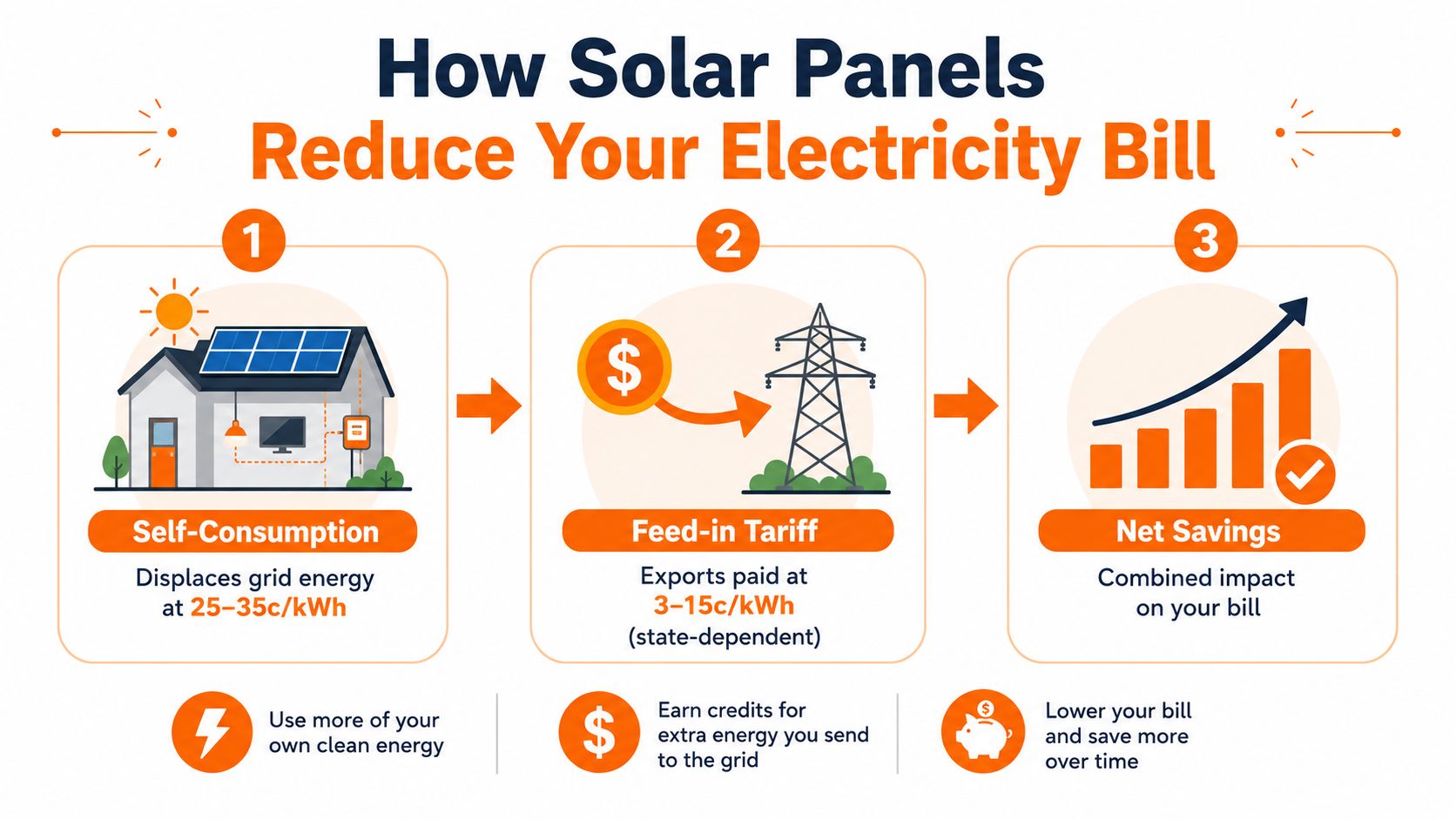
A solar system cuts a household bill through three separate transactions: electricity used immediately, surplus sent to the grid, and grid purchases avoided later through storage or controlled demand. Treating all generated electricity as equally valuable produces an unreliable savings estimate.
Three mechanisms households should separate
Self-consumption is the first value to calculate. A dishwasher, refrigerator, pool pump or heat pump can use solar electricity as it is generated, reducing the volume bought from the retailer at the applicable usage rate.
Solar export begins when generation exceeds immediate household demand. The retailer credits exported electricity at the plan's feed-in tariff. That payment reduces the bill, but it is usually worth less than using the same electricity inside the home.
Peak demand reduction applies where tariffs charge more during particular periods or include a demand component. A battery can store surplus solar and discharge during those periods. Load control can also shift flexible appliances away from expensive windows. These are the core mechanisms explained in the Australian Government's guide to solar financial benefits and batteries.
A simple battery example
Suppose a home produces 27 kilowatt-hours on a sunny day. It uses 18 kilowatt-hours directly at 30 cents per kilowatt-hour and exports 9 kilowatt-hours at 6 cents per kilowatt-hour. Direct use is worth $5.40, while the export credit is 54 cents.
A 10 kilowatt-hour battery can store part of that surplus and supply the home during evening demand. The household then avoids higher-value grid purchases instead of receiving only the export credit. Battery losses, usage timing, tariff rules and export limits determine the final result. The distinction remains straightforward: avoiding a purchase is different from earning an export credit.
The federal analysis presented to the Australian Parliament shows how materially storage can change the result. In Victoria, rooftop solar reduced an average default bill by $687, or 39%, while adding a battery increased the saving to $1,322, or 75%. In NSW, rooftop solar reduced an average $2,106 default bill by $1,015, or 48%. An 8.5 kWh battery increased the saving to $2,123, or 101%, including income from exporting stored energy. The Household Savings Analysis presented to the Australian Parliament sets out why tariff design affects these outcomes.
Estimating Your Own Payback and Annual Savings
A calculator is only as good as its inputs. If it assumes a generous feed-in tariff, ignores supply charges or treats every generated kilowatt-hour as equally valuable, its payback result can look attractive while telling you little about your household.
Use a five-step calculation
Start with actual consumption. Download the last 12 months of usage from your retailer portal or smart meter data. Calculate the daily average, then identify whether most usage occurs during daylight, evening or variable periods.
Estimate generation conservatively. Use your proposed system size, roof orientation, shading and local conditions. A reputable calculator should let you adjust those assumptions rather than applying one statewide result.
Estimate self-consumption. Solar-only homes generally use less of their generation directly than homes with storage. Don't apply a battery outcome to a solar-only system.
Value each energy flow separately. Apply the relevant retail rate to self-consumed electricity and the actual feed-in tariff to exports. For time-of-use plans, use a weighted rate based on when the household imports energy.
Calculate net payback. Subtract finance, maintenance and relevant ongoing costs from annual bill reduction. Divide the net system price by the resulting annual benefit.
Use the Australian energy cost calculator as one input, then validate its assumptions against your own bills.
Worked payback example
The following example uses the requested inputs for a hypothetical household. It isn't a prediction for every 6.6 kW system, and the maintenance allowance is an assumption in the example rather than a universal cost.
| Input | Solar-only | Solar + 10 kWh battery |
|---|---|---|
| System price | $5,800 | $5,800 plus battery cost |
| First-year bill reduction | $1,650 | Depends on tariff, usage and battery dispatch |
| Yearly maintenance | $120 | $120 plus any battery-specific costs |
| Net annual reduction before battery economics | $1,530 | Must be calculated from actual battery value |
| Illustrative payback | 3.8 years | Requires battery price and measured incremental saving |
The $5,800 system, $1,650 first-year bill reduction and $120 yearly maintenance produce a stated 3.8-year payback when the calculation treats the net annual reduction as the relevant benefit. If the same household keeps a low feed-in tariff and ignores time-of-use shifting, the illustrative payback moves to 5.5 years.
Before trusting any online result, gather:
- Your annual imported and exported kilowatt-hours
- Your current supply charge and usage rates
- Your feed-in tariff, including stepped terms
- The proposed system size and battery usable capacity
- Roof orientation, shading and export constraints
- Finance, maintenance and warranty costs
- Any applicable rebate or certificate adjustment
Comparing Solar, Battery and VPP Outcomes in QLD and NSW
The decision isn't just “solar or no solar”. For an existing solar owner, the practical choices are usually to remain solar-only, add storage, or add storage and participate in a VPP. Each option changes how energy moves through the home and how the retailer values that energy.
The table below is a decision framework, not a universal forecast. The verified Australian evidence supports a clear direction: batteries can materially increase savings by shifting energy into household use, while VPP outcomes depend on the retailer's allowance structure, dispatch rules, customer priority and contract terms.
| Setup | QLD annual savings | QLD payback (yrs) | NSW annual savings | NSW payback (yrs) | 10-year cumulative benefit |
|---|---|---|---|---|---|
| Solar-only | Must be calculated from the household bill | Must be calculated | Must be calculated from the household bill | Must be calculated | Depends on annual savings and system cost |
| Solar + battery | Higher than solar-only when storage displaces grid imports | Depends on battery cost and incremental saving | Higher than solar-only when storage displaces grid imports | Depends on battery cost and incremental saving | Depends on dispatch, tariff and battery cost |
| Solar + battery + VPP | Depends on allowance, dispatch and export value | Depends on contract terms and system cost | Depends on allowance, dispatch and export value | Depends on contract terms and system cost | Depends on allowance, dispatch and contract terms |
What the NSW evidence tells you
The federal analysis provides a concrete NSW benchmark. Rooftop solar reduced the average default bill by $1,015, or 48%, and an 8.5 kWh battery increased the stated saving to $2,123, or 101%, including stored-energy export value. Those figures show why a battery's marginal value can exceed the value of adding more panels when the main problem is evening imports. See the HighFlow Energy solar battery VPP explanation for the operating model of a retailer-based VPP.
Queensland requires the same discipline
Queensland households face the same core choice, but the result depends on local tariff terms, consumption timing, network conditions and export settings. A household that works from home may use more solar directly. A household that is empty during the day may gain more from storage or managed dispatch.
A VPP shouldn't be assessed only by its headline payment. Check whether the arrangement provides a bill allowance, how it treats supply charges, how often the battery can be dispatched, and whether the household retains priority access. A transparent structure should also explain what happens when you exceed the allowance and how the retailer handles network or wholesale events.
Key Factors That Move Your Savings Up or Down
Two homes can have identical panels and different outcomes. The difference usually sits in consumption timing, tariff design and battery operation rather than panel nameplate capacity.
The household load comes first
A solar system earns more value when the home uses generation directly. Run flexible loads during production hours where practical, but don't change behaviour blindly. The goal is to move discretionary consumption into solar periods while preserving comfort and normal household routines.
Battery size matters too. A battery with more nameplate capacity isn't automatically better if the household rarely needs the stored energy, export limits prevent full charging, or the retailer's VPP schedule conflicts with evening use. Usable capacity, round-trip efficiency, reserve settings and cycling rules all affect the result.
Tariffs and exports change the maths
A flat tariff is simple to model. A time-of-use tariff can reward evening discharge, but only if the battery retains enough energy for that period. A demand tariff can make short high-use intervals important, while network export limits can restrict how much solar or battery energy leaves the property.
Feed-in tariffs also need careful reading. A stepped plan may offer one rate for an initial export volume and another after that threshold. Compare the whole plan, not the most prominent rate in the advertisement.
The federal Cheaper Home Batteries Program reduced the installed cost of a typical battery by about 30% from 1 July 2025, with government and industry sources estimating around $4,000 off a typical battery. The program information reported by the Australian Labor Party also states that around one million batteries are expected by 2030, which is a projection, not a current installation count.
Check the contract, not just the battery: A VPP's value depends on dispatch permissions, household priority, allowance rules, warranty treatment and exit conditions.
Watch the video below for a visual explanation of the factors that influence system value.
If you're reviewing the broader financial position of a home energy investment, keep tax treatment separate from electricity savings. A qualified accountant can help you maximise your Australian tax refund where relevant, but tax advice shouldn't be mixed into a bill-reduction estimate without checking your circumstances. For a broader equipment-cost reference, see solar panels and battery cost information.
Common Misconceptions About Solar Savings
“Solar pays for itself” is not a usable buying decision. A credible estimate separates generation, self-use, exports, tariffs, system cost and ongoing operation, then tests those assumptions against the household's actual bills.
A high feed-in tariff drives the savings
Directly using solar usually matters more than exporting it. In NSW and Queensland, feed-in values are around 3 cents per kilowatt-hour, while avoided electricity purchases are about 30.2 cents in NSW and 25.4 cents in Queensland. As noted earlier, the comparison shows why households should prioritise daytime consumption and battery storage over maximising exports.
Bigger systems always save more
A larger array produces more electricity, but the extra output may be exported rather than used at home. Where export payments are low, adding panels without enough daytime demand or storage can produce a weaker return than expected.
An installer payback is guaranteed
An installer's payback figure is a scenario, not a promise. It depends on assumed consumption, tariffs, weather, export limits and system performance. Your result will change if your routine, retailer plan or network settings change.
Batteries always pay for themselves
A battery can reduce imports after sunset and increase the share of solar used at home. Its financial result still depends on usable capacity, cycling, tariff structure and purchase cost. Battery value varies sharply between households, so compare the expected bill reduction with the installed price rather than accepting a generic payback claim.
Solar eliminates the bill
Solar can cut usage charges substantially, while supply and network charges may remain. A VPP allowance can cover specified charges or usage under its contract, but it does not guarantee a zero bill for every household.
Every VPP pays the same
VPP offers differ in dispatch frequency, allowance design, wholesale exposure, grid-service revenue, reserve settings and customer priority. Review how the offer handles battery access and household use during high-price periods. The headline payment matters less than the amount of bill reduction and compensation your contract provides.
Practical Next Steps to Maximise Your Solar Savings
Start with your bills, not an advertised payback. Download the last four quarterly bills and interval data from your retailer app or smart meter portal. Record daylight imports, exports and the periods when household demand peaks. These figures show whether extra panels, a battery or VPP participation can reduce your bill further.
Model three operating cases
Compare:
- Solar-only: Panels reduce direct imports and earn the applicable export credit.
- Solar plus battery: Storage shifts surplus generation into later household use.
- Solar plus battery plus VPP: The battery retains household priority while supporting eligible grid activity under the retailer's terms.
Use the AER's Consumer Guide to Solar PV, Energy Made Easy and reputable Australian calculators such as Solar Choice or Selectra. Treat each output as a comparison, not a promise. Check every assumption against your tariff and interval data, particularly export rates, battery capacity and VPP payments.
Prepare a better quote brief
Ask installers and retailers to itemise:
- Proposed system size and expected annual generation
- Roof orientation, shading and inverter design
- Battery usable capacity and reserve settings
- Export limits and network approval assumptions
- Flat, time-of-use or demand tariff recommendations
- STC treatment and any applicable state battery incentive
- VPP eligibility, allowance rules and bonus payments
- Warranty protection during VPP participation
- Dispatch control, customer override and exit conditions
Review the system after 12 months. Compare actual imports, exports, self-consumption, supply charges and battery cycling with the original estimate. If the results differ, test a new tariff, load schedule or battery strategy before blaming the equipment.
Set targets for annual bill reduction, self-consumption and battery use, based on your household's needs. High export volume is not automatically the best outcome. The stronger result is reliable value after household use, network constraints and contract conditions.
HighFlow Energy is an Australian electricity retailer for eligible Queensland and New South Wales households with rooftop solar and a compatible battery. It connects those batteries to a BYOB Virtual Power Plant while prioritising household energy needs. Visit HighFlow Energy to check eligibility and review the allowance structure for your system.