


Custom Solar Power: Optimising Your Home Battery
The popular advice about custom solar power usually ends when the panels and battery are installed. That's the wrong finish line. For Australian households with existing rooftop solar and storage, the system's long-term value depends increasingly on software, tariff alignment, battery dispatch and access to grid services.
Australia's rooftop fleet has already reached national scale. By June 2025, households and small businesses had installed 4.2 million rooftop solar systems, representing 26.8 GW of capacity, while rooftop solar supplied 12.8% of total electricity generation in the first half of that year. Queensland added 326 MW and New South Wales added 321 MW during the same period, with NSW reaching about 7.5 GW of installed rooftop capacity and Queensland close behind at 7.2 GW and more than 1.1 million installations. (Clean Energy Council rooftop solar and storage report)
The practical question is no longer just whether your roof faces the right direction. It's whether your existing assets respond intelligently to household demand, time-of-use tariffs, export limits and National Electricity Market conditions.
Redefining Custom Solar Power for Modern Australian Homes
Customisation continues after installation
A physical system can be customised through panel orientation, inverter selection and battery capacity. Those decisions matter, but they only describe the starting configuration. A household's financial outcome is shaped over years by what happens after installation, including when the battery charges, when it discharges, how much energy it reserves and whether it can participate in a coordinated energy program.
That makes custom solar power an operating strategy, not just a hardware specification. Two homes with similar panels and batteries can produce different financial results because they have different load profiles, tariffs, export settings and control arrangements.
Australia's electricity system has also changed. Rooftop generation is no longer a minor behind-the-meter feature. The national fleet reached 28.3 GW of installed rooftop capacity in 2025, and rooftop solar supplied 14.2% of Australia's electricity in the second half of that year, compared with 7.2% in 2020. (Clean Energy Council rooftop solar and storage report for July to December 2025)
That scale creates a two-way relationship with the grid. Homes export surplus energy during solar-rich periods, then draw from the grid when household demand rises. Batteries can alter that pattern by absorbing surplus, reducing evening imports and responding to external signals.
Practical rule: The best customisation decision may be a better dispatch plan, not another panel on the roof.
The software layer has become the control centre
Modern battery optimisation uses data from the meter, inverter, battery management system, tariff and, where available, wholesale market signals. The software can create a daily plan that balances several competing priorities:
- Household protection: Keep sufficient stored energy for evening demand and unexpected consumption.
- Tariff alignment: Charge or discharge in response to time-of-use pricing and supply charges.
- Export management: Avoid sending energy into the grid when local export limits or weak feed-in rates reduce its value.
- Grid participation: Make spare battery capacity available for demand response or virtual power plant events.
- Battery discipline: Avoid unnecessary cycling when the expected financial return is too small.
This is similar to the broader value of unlock business growth with custom software. The useful outcome comes from fitting software to a real operating environment, rather than treating technology as a generic add-on. In energy, the operating environment includes weather, household habits, network constraints and market volatility.
Homeowners assessing their existing system can also compare generation performance and retail arrangements through High Flow Energy's direct solar power information. The important distinction is that custom solar power doesn't require replacing functioning equipment. It often starts by understanding what the current system is doing, then changing the rules that govern it.
Aligning System Design with Household Load Profiles
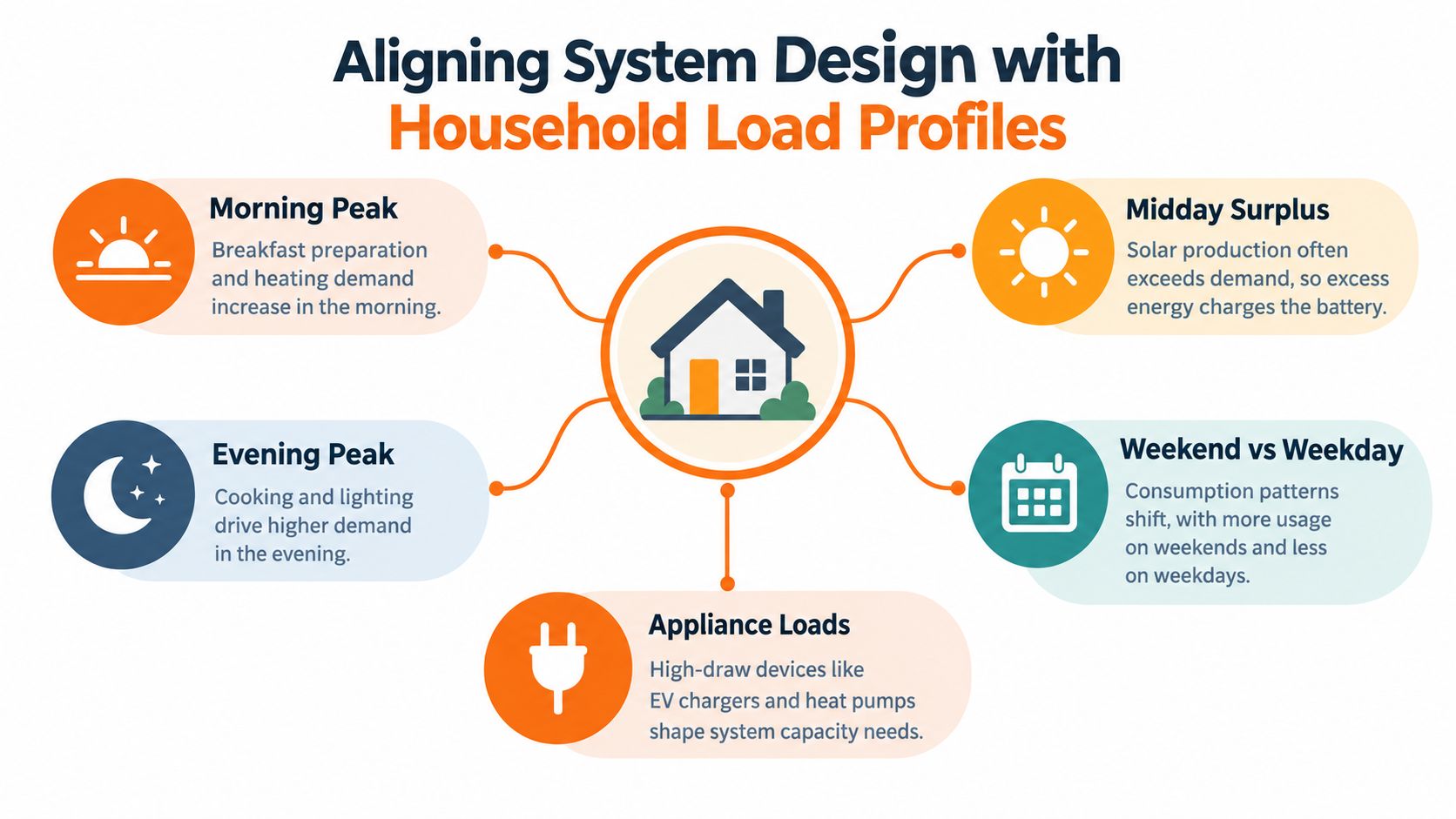
A battery is valuable only when its stored energy reaches the right load at the right time. A household that consumes most of its electricity during the day may have little need for aggressive evening discharge. A family that cooks, heats, cools and charges an electric vehicle after sunset may place a much higher value on stored energy.
Start with behaviour, not roof area
The first useful audit is a simple timeline of household demand. Mark the periods when the home uses the most energy, then identify which loads can move without affecting comfort.
- Morning demand: Hot water, heating, cooking and school preparation can create an early import period before solar production rises.
- Midday surplus: Solar output can exceed household demand, creating a choice between export, battery charging and flexible appliance use.
- Evening demand: Cooking, lighting, entertainment, heating and cooling often coincide after solar production falls.
- Vehicle charging: An electric vehicle can absorb substantial daytime surplus if charging is scheduled rather than left to begin automatically at night.
- Pool and heating equipment: Pool pumps, heat pumps and similar loads may be shifted into solar production periods where the household routine allows it.
A battery should not discharge because it can. It should discharge when the value of avoiding grid imports is greater than the value of preserving energy for a later event. That decision depends on the retail tariff, expected demand, forecast solar production and the battery's reserve settings.
Queensland and NSW require local judgement
Queensland and New South Wales both have large rooftop fleets, but a homeowner's network conditions still depend on the local distributor, connection settings and export approval. A system that can produce substantial midday energy may not be able to export all of it at the same time. Export constraints can make self-consumption and battery charging more valuable than a strategy built around sending every surplus kilowatt-hour to the grid.
The right audit therefore records more than total daily consumption. Review the interval data and look for:
- Imports during solar hours, which may indicate poorly timed appliance use or a control issue.
- Exports during low-value periods, which may indicate that the battery is filling too late or remains unavailable.
- Evening imports, which show how much stored energy could displace peak usage.
- Unexpected battery inactivity, which may point to firmware, communications or tariff configuration problems.
- Different weekday and weekend patterns, because a single schedule may suit neither routine.
A household energy review should then match each flexible load with a likely solar soak period, tariff window or battery dispatch opportunity. You can use a structured household energy audit to identify where the existing system is losing value before considering any equipment change.
A larger battery won't solve a timing problem if the control strategy doesn't understand the household.
Integrating Home Batteries with Virtual Power Plants
A Virtual Power Plant, or VPP, connects many distributed batteries through communications software and coordinates them as a flexible energy resource. Each battery remains at the home, but an authorised operator can adjust charging or discharge behaviour within agreed limits.
The Australian Energy Market Operator describes aggregated distributed energy resources, including batteries, controllable loads, microgrids and VPPs, as assets that can contribute to reliable and secure supply. Its DER Register is intended to capture technical specifications and locations, helping the market integrate these devices with greater visibility. (AEMO DER Program)
What happens during a VPP event
A well-designed BYOB VPP should apply household priorities before making spare capacity available to the grid. The sequence usually looks like this:
- The system checks the household state. It reviews battery state of charge, current load, forecast solar generation and the configured reserve.
- The operator identifies a useful event. This could involve a high-demand period, a network constraint or a need for coordinated export or charging.
- The battery receives a dispatch instruction. The instruction may alter charging or discharging within the limits agreed with the customer.
- The household retains protected capacity. Reserve settings prevent the program from using energy allocated for household needs, subject to the terms of the specific VPP.
- The system returns to normal operation. After the event, the battery can resume its household schedule, including replenishing its reserve from solar or the grid where permitted.
This differs from a passive feed-in tariff. A feed-in tariff pays for exported energy under a retailer's rate structure. A VPP can use the battery as a controllable asset, allowing the operator to respond to system conditions and potentially create additional value through coordinated services.
The trade-off is control. Customers need to know what the operator can change, what reserve level applies, whether manual overrides are available and how the arrangement treats battery warranty conditions. Participation shouldn't mean surrendering priority access to stored energy.
Technical and regulatory prerequisites
A compatible inverter and battery aren't enough on their own. The system also needs reliable communications, supported firmware and a meter arrangement that allows the retailer or operator to measure relevant energy flows. Stable internet connectivity matters because a remote dispatch instruction is useful only if the system can receive and confirm it.
The federal small-scale technology certificate rules also make VPP capability a specific eligibility issue. The Clean Energy Regulator states that a grid-connected solar battery must be technically capable of participating in a VPP. The same applies to an off-grid system within 1 kilometre of the grid, while properties more than 1 kilometre from the grid don't need to meet that VPP-capability requirement. (Clean Energy Regulator solar battery requirements)
Before enrolling, review the system integration requirements for the relevant connection and communications conditions.
Financial Realities and Value Stacking Strategies
Battery economics are often discussed as if there were one value stream. In practice, a battery can serve several purposes, but those purposes compete for the same stored energy.
A battery may reduce imports during expensive periods, protect the household from future price exposure, absorb surplus solar, respond to a VPP event or support a retailer's allowance structure. The best operating plan assigns priority to the highest-value use that still protects household comfort and battery availability.
Battery value streams compared
| Value Stream | Mechanism | Financial Impact |
|---|---|---|
| Self-consumption | Stores surplus solar and supplies household loads later | Reduces purchases from the grid |
| Peak displacement | Discharges during high-demand household periods | Limits exposure to peak pricing |
| Tariff alignment | Charges or discharges around time-of-use periods | Matches battery operation to retail rates |
| VPP participation | Makes spare capacity available for coordinated grid services | May create allowances, credits or other agreed value |
| Export management | Holds energy when exporting is less attractive | Preserves energy for a higher-value household or market use |
Traditional feed-in tariffs remain simple, but simplicity can hide an opportunity cost. Exporting every surplus kilowatt-hour may produce a modest payment while the same energy could later offset a household import at a higher retail value. On the other hand, storing everything can also be inefficient if the battery remains full when a useful grid event occurs or if the expected benefit doesn't justify additional cycling.
Australian evidence shows why the operating model matters. The ACCC analysis cited by the Clean Energy Council found that households with rooftop solar and a battery paid an average of $323 per quarter, while households in a VPP saved an additional $106 per quarter, bringing the average bill to $217 per quarter. (Clean Energy Council analysis of home battery and VPP bills)
Those figures are an observed comparison, not a promise for every home. Results depend on the tariff, usage, battery compatibility, VPP rules and dispatch performance.
Homeowners researching the commercial side of the sector may also encounter broader material such as solar marketing for UK trades, but Australian customers need to separate marketing claims from the actual mechanics of their retailer agreement.
The useful question isn't “How much energy did my battery move?” It's “What value did each dispatch decision create?”
A proper review should compare the current feed-in tariff, supply charge, usage rates, battery reserve and VPP allowance or credit. It should also identify whether the retailer has any restrictions that prevent participation in another energy program.
Optimising Performance with AI and App-Based Control
Manual battery management is difficult to sustain. Household routines change, cloud cover shifts solar production and wholesale conditions can move quickly. A fixed schedule may work on a typical day and perform poorly when the family returns early, an electric vehicle needs charging or a hot evening creates unexpected demand.

What automated dispatch should consider
An AI-assisted energy platform should do more than display a graph. It should use several inputs to create and revise a practical dispatch plan:
- Forecast solar production: Estimate whether the battery is likely to refill from rooftop generation.
- Household history: Recognise recurring morning, afternoon and evening demand.
- Current load: Detect unusual consumption and avoid discharging too aggressively.
- Tariff structure: Identify periods when importing or exporting energy has different value.
- Market conditions: Consider wholesale price volatility and potential demand events.
- Battery limits: Respect reserve levels, power limits and operating conditions set by the equipment.
The system should also explain its decisions in plain language. A customer ought to be able to see whether the battery is holding energy for evening use, charging from the grid under an approved strategy, or preserving capacity for a potential VPP event.
An app adds visibility, but visibility isn't the same as control. Look for clear manual override options, event notifications, reserve settings and a record of dispatched energy. If an app shows only a savings headline without explaining the underlying energy flows, it doesn't provide enough information for a serious performance review.
The following video can help homeowners understand the role of digital control in a modern home energy system.
Protecting performance rather than chasing every event
Automation should not treat every wholesale price movement as an instruction to cycle the battery. Charging and discharging have technical limits, and aggressive activity can conflict with household reserve requirements or the manufacturer's operating conditions.
A sensible controller ranks decisions. Household needs come first, then tariff value, then grid participation where spare capacity exists. The software should also account for the possibility that a later event may offer more value than an immediate discharge.
That is the difference between optimisation and activity. A battery that moves constantly isn't necessarily earning more. It may just be following a poorly prioritised schedule.
Assessing Your Current Setup for VPP Eligibility
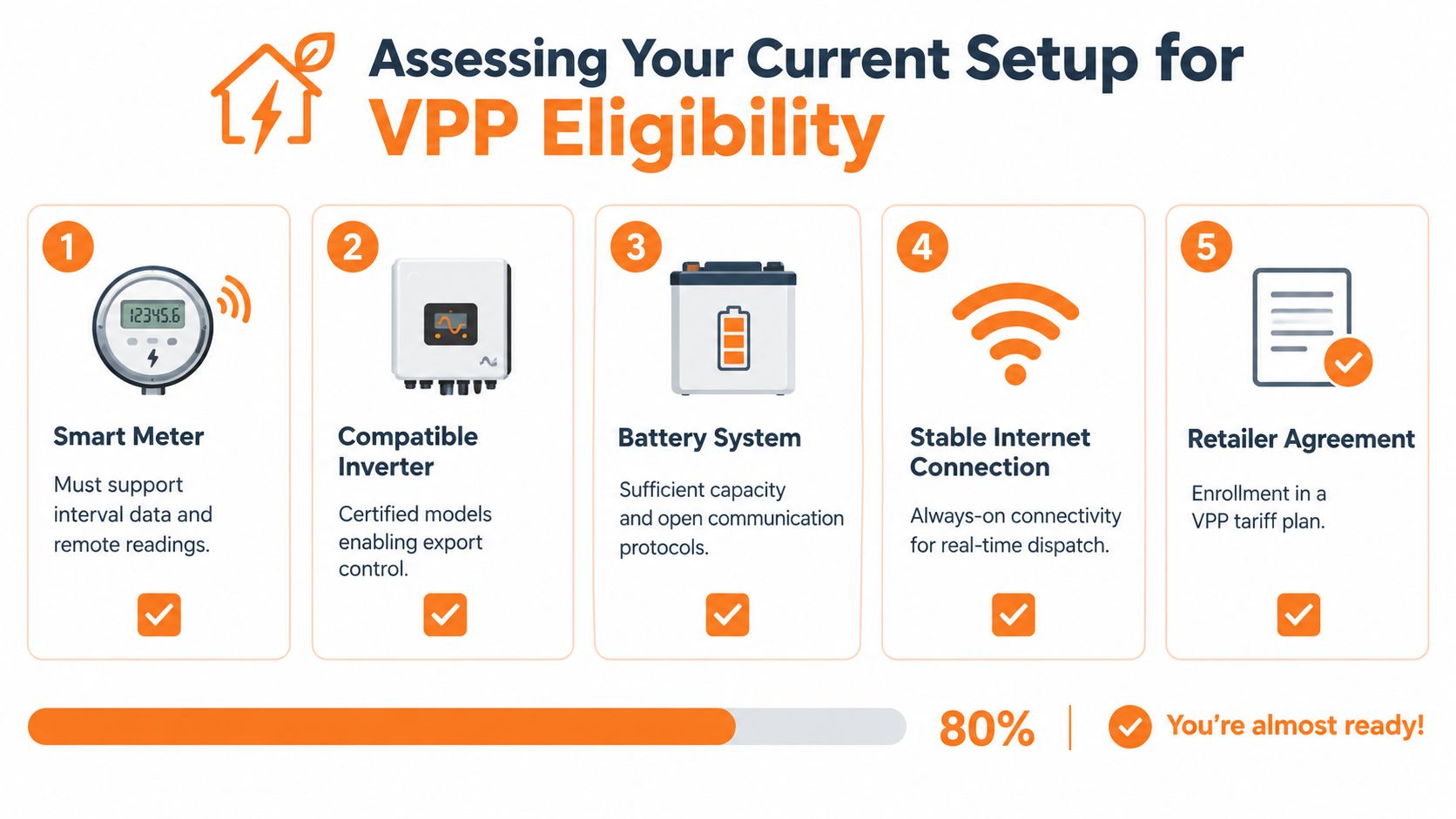
VPP eligibility starts with the equipment already installed. Homeowners in NSW and Queensland don't need to assume that a new battery is required, but they do need to confirm that the existing inverter, battery, meter and communications systems can work with the selected program.
A practical eligibility checklist
1. Confirm the battery model. Record the manufacturer, model, usable capacity and installation date. The program operator can then determine whether the battery is supported and whether its operating limits suit coordinated dispatch.
2. Check the inverter and firmware. A compatible battery connected to an unsupported inverter won't provide a reliable VPP connection. Ask the installer or manufacturer whether remote control, export management and the relevant communications interface are enabled.
3. Test the communications path. The battery needs stable internet connectivity for live monitoring and dispatch instructions. Review fault notifications rather than assuming that an app connection proves the system is always available.
4. Review the meter and connection. Interval data helps the retailer distinguish household imports, solar exports and battery activity. Network approval and export settings may also affect how much the system can respond during an event.
5. Read the retailer agreement. Check the current supply rates, feed-in tariff, exit provisions, VPP terms, reserve rules, allowance structure and manual override policy. A low headline rate can conceal a weak overall value proposition if the plan doesn't suit the household's load pattern.
Questions worth asking before enrolment
Ask who owns the stored energy, who sets the reserve, who can initiate a dispatch event and whether the customer can override the system. Request a plain-English explanation of how household demand is prioritised during a peak event.
Warranty protection also deserves attention. The VPP operator should explain how its control strategy works within the battery manufacturer's warranty conditions and what happens if the communications service fails. Transparency is more valuable than a broad savings estimate that doesn't show the assumptions.
Australia's battery market is moving quickly. The Clean Energy Regulator reported 43,517 solar batteries installed by 5 September 2025, with an average nominal battery size of 19.0 kWh and total nominal capacity of 825 MWh, after batteries became eligible under the Small-scale Renewable Energy Scheme on 1 July 2025. (Clean Energy Regulator battery installation update) More recent market reporting also indicates that battery adoption has accelerated beyond rooftop solar growth, making operating strategy increasingly important for existing owners. (Clean Energy Regulator consumer energy resources report for the June quarter of 2026)
Frequently asked questions
Can I join a VPP if I already own my battery?
Often, yes, provided the battery and inverter are compatible with the program and meet the required communications and regulatory conditions. A technical eligibility check is necessary before enrolment.
Will a VPP use all of my stored energy?
A properly documented program should define a reserve level and household priority rules. The operator may control available capacity, but customers should confirm exactly what remains protected for household use.
Does VPP participation replace my solar retailer?
Some VPPs are retailer-based and combine electricity supply with battery coordination. Others operate alongside a separate retailer. Compare the full tariff, allowance, export and control terms rather than looking only at the VPP payment.
Can I override automated battery control?
That depends on the program. Confirm whether the app allows temporary overrides, whether an override affects eligibility and how quickly the system returns to its normal schedule.
Is a VPP suitable for every battery owner?
No. A household with limited spare capacity, unreliable internet, restrictive equipment or a strong preference for fully manual control may not suit every VPP. The value should be assessed against the customer's actual load profile and priorities.
What should I check in NSW or Queensland?
Check the local network connection settings, export limits, meter arrangement, equipment compatibility and retailer terms. State location matters, but the individual distributor connection and household behaviour matter just as much.
Does a VPP guarantee bill elimination?
No. Any allowance or credit depends on the specific retailer plan and household usage. Energy used above an allowance may remain payable at standard rates, and customers should treat projected savings as conditional rather than guaranteed.
Key takeaways
- Custom solar power continues after installation. Software, tariffs and dispatch rules can change the value of existing hardware.
- Load profile comes first. Evening demand, electric vehicle charging, pool equipment and climate control determine when stored energy is most useful.
- A VPP is active orchestration. It coordinates batteries for grid services within agreed technical and household limits.
- Control terms matter. Check reserve levels, override rights, warranty treatment and event rules before enrolling.
- Value stacking has trade-offs. Self-consumption, peak displacement, export and grid services compete for the same stored energy.
- Automation needs transparency. An app should show what the battery is doing and why, not only display a savings figure.
- Eligibility is technical. Confirm the battery, inverter, firmware, meter, internet connection and retailer agreement.
HighFlow Energy provides a Bring Your Own Battery electricity retail and VPP service for eligible rooftop solar and battery owners in Queensland and New South Wales, with household priority settings, app-based visibility, automated optimisation and no requirement to install new hardware. You can review your existing system and request an eligibility assessment through HighFlow Energy to determine whether your battery is underutilised and what value a coordinated tariff and VPP arrangement could provide.