

Battery Power vs Energy: What Australian Battery Owners Need
Can a battery have enough stored electricity for your evening, yet still fail to run the appliances you need at the same time? That's the practical question behind battery power vs energy, and it's one many Australian homeowners miss when comparing solar and battery systems.
Battery specifications usually show two different measurements. Power, measured in kilowatts, or kW, describes how quickly electricity can flow. Energy, measured in kilowatt-hours, or kWh, describes how much electricity the battery can store or deliver over time. A system needs enough of both to match your household load profile.
| Measurement | Unit | What it tells you | Household question |
|---|---|---|---|
| Battery power | kW | Maximum rate of charge or discharge | Can it run the air conditioner, oven and kettle together? |
| Battery energy | kWh | Total usable electricity stored | How long can it support the home? |
| Continuous power | kW | Sustained output | Can it maintain the load over an evening? |
| Peak power | kW | Short-duration output | Can it handle appliance start-up or brief surges? |
Australia's battery fleet makes this distinction more important than ever. The Clean Energy Council's battery market update reported 454,753 household battery installations by the end of 2025, after 183,245 units were sold in the second half of 2025 alone. AEMO later reported that installed battery capacity in the National Electricity Market exceeded 9,000 MW by the end of Q2 2026, with the fleet adding 4,640 MW and 12,353 MWh between Q2 2025 and Q2 2026. Those figures describe both the speed of delivery and the quantity of stored energy, not one interchangeable measure.
Why Battery Power and Energy Are Not the Same Thing
Marketing pages often make battery capacity look like the whole story. A large kWh figure sounds reassuring, but it doesn't tell you whether the system can deliver enough electricity at the precise moment your household demand rises.
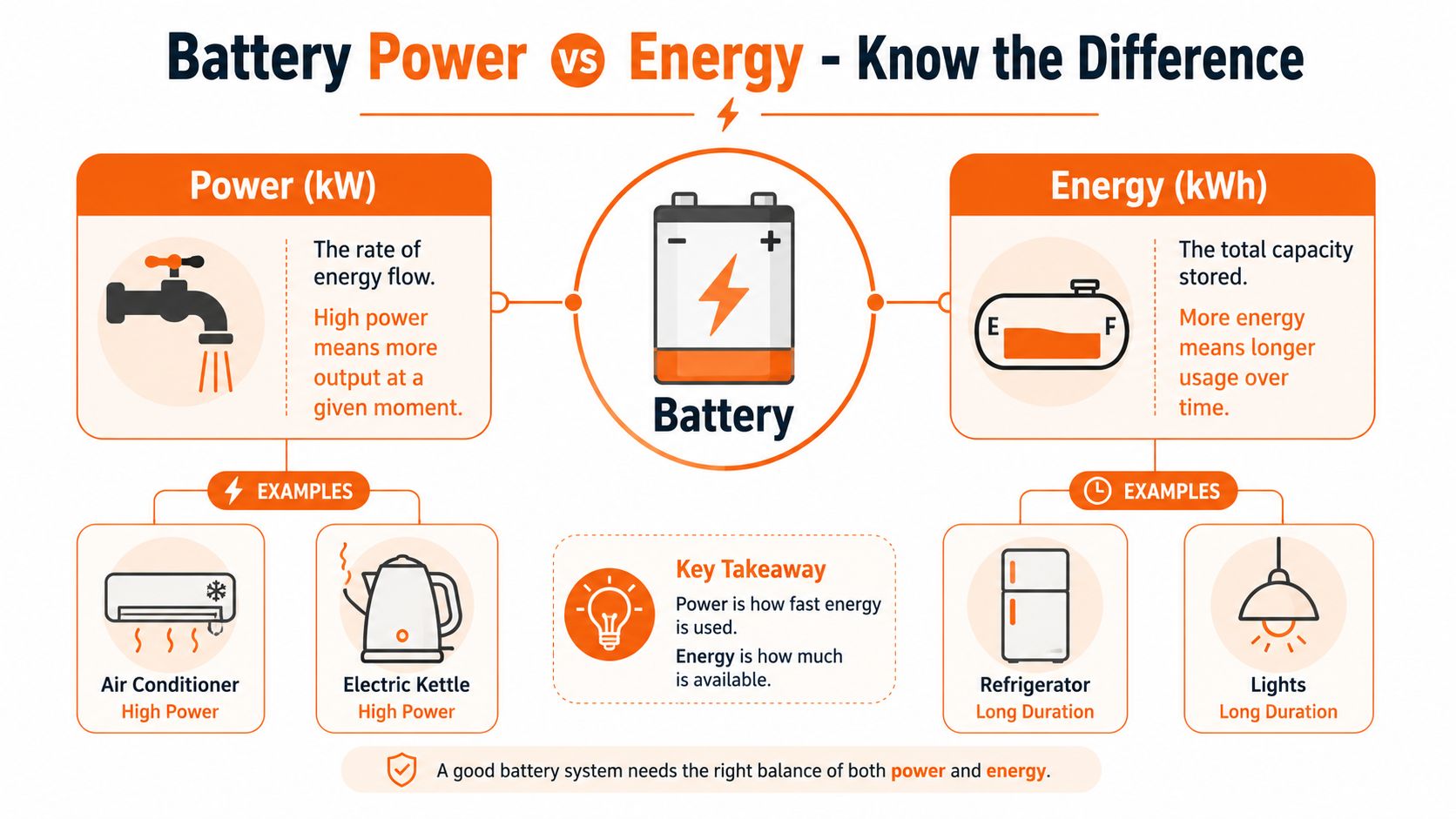
Power is the rate of energy flow. A battery rated at 5 kW can deliver electricity at a maximum continuous rate of 5 kW, subject to its inverter, operating conditions and system settings. That rating affects what can run simultaneously.
Energy is the total amount stored or delivered. A battery rated at 13.5 kWh contains a larger energy reserve than one rated at 5 kWh, although the usable amount may be lower after operating limits and protection reserves are applied. The Australian explanation of kW and kWh uses a 13.5 kWh battery with a 5 kW discharge rate to show why capacity and delivery speed must be considered together.
A water tank provides a useful analogy. The tank volume represents kWh, because it determines how much water is available overall. The pipe diameter represents kW, because it controls how quickly water can flow out. A large tank with a narrow pipe can supply water for a long time, but not at a high rate. A small tank with a wide pipe can deliver strongly, but it empties quickly.
The two questions every specification sheet should answer
A battery owner needs to ask:
- How much can the battery deliver at once? This is the power question, measured in kW.
- How long can it continue delivering that output? This is the energy question, measured in kWh.
A battery with high energy but low power may leave you importing from the grid when several heavy appliances operate together. A high-power battery with limited energy may cover a sharp peak but run out before the evening ends.
The distinction affects solar self-consumption, backup duration, time-of-use charging and VPP participation. Before comparing brands, review both figures in the kilowatt versus kWh guide, then examine how the battery and inverter work as one system.
Practical rule: kW determines what the battery can do now. kWh determines how long it can keep doing it.
How kW and kWh Work Together in Real Battery Specs
A battery's nameplate capacity doesn't operate in isolation. The inverter determines how electricity moves between the battery, the home and the grid, while the battery management system controls safe operating limits. That's why the relevant comparison is usually the system's usable energy and continuous AC power, not the cell capacity.
The SolarQuotes explanation of kW and kWh gives the Tesla Powerwall 2 as a familiar Australian example, with 13.5 kWh of energy and a 5 kW power rating. At a steady 2 kW household load, a simple ideal calculation is 13.5 divided by 2, or 6.75 hours. At a full 5 kW draw, the same calculation gives 2.7 hours.
Those are theoretical durations. Conversion losses, reserve settings, temperature, battery condition and inverter limits reduce the energy available to the home. Australian guidance commonly describes round-trip efficiency qualitatively as less than 100%, so a nameplate figure shouldn't be treated as a guaranteed delivered amount.
Worked examples
Consider three operating patterns:
- Moderate evening load: A 5 kW battery supplying a 2 kW average load can use its energy reserve over a longer period.
- Heavy simultaneous demand: The same battery may reach its power limit when cooking, cooling and charging equipment operate together.
- Short peak followed by light demand: A system may handle the initial surge and then preserve energy for later household use.
The BYD Battery-Box Premium HVS is another useful example because it's configured across a range of energy capacities, from 5.1 kWh to 12.8 kWh, with a stated power figure of 5.76 kW in the supplied comparison. Its configuration shows why adding modules can increase energy availability, while the inverter and system architecture still determine how much power reaches the home.
| Battery model | Usable energy | Continuous power | Estimated runtime at 3 kW |
|---|---|---|---|
| Tesla Powerwall 2 | 13.5 kWh | 5 kW | 4.5 hours, before losses and reserves |
| BYD Battery-Box Premium HVS | 5.1 to 12.8 kWh configuration range | 5.76 kW | Approximately 1.7 to 4.3 hours, before losses and reserves |
The table uses simple energy divided by load calculations, not guaranteed operating results. Actual runtime changes with usable capacity, discharge limits and the household's changing demand.
Why system-level ratings matter
Cell-level performance can look stronger than the output available through the installed system. The inverter may cap discharge power, and backup circuits may be separated from the whole-home supply. Check whether the specification refers to DC battery power, AC output, continuous power or a short peak rating.
A system with more kWh isn't automatically better for every household. If your main issue is a short high-demand period, power may matter more. If your priority is carrying essential loads through a long evening, energy capacity and load management become more important.
Power-Limited vs Energy-Limited Batteries in Australian Homes
Australian households rarely have a flat load profile. Demand changes as people return home, cooling starts, cooking begins, pool equipment operates and vehicles charge. The right battery must match both the height of the demand peaks and the total energy used across the period.
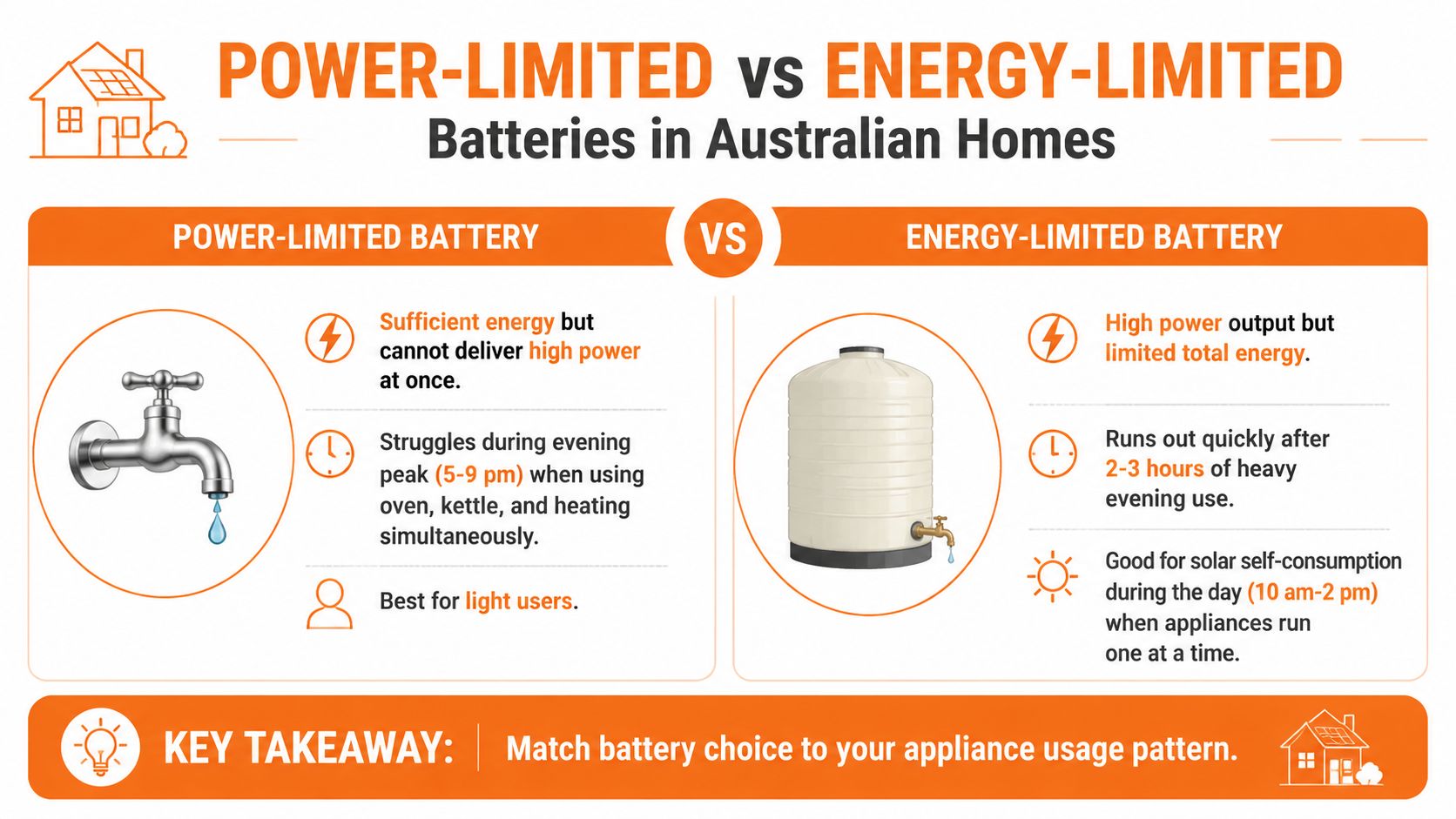
A power-limited battery has enough stored energy but cannot deliver electricity quickly enough for the largest simultaneous load. A 10 kWh battery with a 3.3 kW power rating could still require grid imports if the household demand reaches 6 kW. The battery may have energy remaining, but its delivery path is too narrow.
An energy-limited battery has a stronger power rating but a smaller reserve. A 5 kWh battery with a 5 kW power rating can cover a 5 kW peak in principle, but sustained heavy use consumes its stored energy rapidly.
Evening peak behaviour
The evening window from 5 pm to 9 pm often combines the most demanding appliances. Ducted air conditioning, electric cooking, kettles, hot-water systems and pool equipment can overlap. The exact load depends on the property and the way occupants use appliances, so a battery assessment should use interval data rather than assumptions.
| Battery type | Strength | Limitation | Likely household effect |
|---|---|---|---|
| Power-limited | Holds energy for later use | Can't meet high simultaneous demand | Grid imports continue during appliance peaks |
| Energy-limited | Handles a strong short load | Runs out sooner | Peak is covered, but later evening demand returns to the grid |
A power-limited system may benefit from load scheduling. Separating electric vehicle charging or pool pumping from cooking and cooling can keep total demand within the battery's output ceiling.
Midday solar absorption
The same issue appears during the solar window from 10 am to 2 pm. If a solar inverter produces more excess electricity than the battery can accept, the battery's charge power limit becomes the constraint. The household may export the remainder, and network export limits or curtailment rules may reduce the value of that energy.
Adding battery modules can move a system towards an energy-limited profile by increasing stored capacity. It doesn't automatically solve every power constraint, because the inverter and charging architecture may still impose a ceiling. The battery discharge rate guide is useful when checking whether the system can respond to actual household peaks.
A battery is correctly sized only when its power rating and energy capacity both fit the household's load shape.
What Power and Energy Mean for VPP Participation
A Virtual Power Plant coordinates many distributed batteries so they can respond to electricity system needs. Each household battery contributes according to its available power, state of charge, connection settings and program rules. The VPP operator can't draw more power than the battery and inverter can safely deliver, and it can't use more energy than the available reserve allows.
A dispatch event therefore has two dimensions:
- Dispatch rate, measured in kW: how quickly the VPP charges or discharges the battery.
- Dispatch depth, measured in kWh: how much total energy the event uses.
A 13.5 kWh battery dispatched at 3 kW for 2 hours uses 6 kWh in a simple calculation. If the battery started with 13.5 kWh available and no other limits applied, 7.5 kWh would remain. At a later 2 kW household load, that remaining amount represents 3.75 hours of theoretical coverage.
| Dispatch rate | Duration | Energy used | Remaining energy from 13.5 kWh | Peak coverage left at 2 kW |
|---|---|---|---|---|
| 2 kW | 1 hour | 2 kWh | 11.5 kWh | 5.75 hours |
| 3 kW | 2 hours | 6 kWh | 7.5 kWh | 3.75 hours |
| 5 kW | 1 hour | 5 kWh | 8.5 kWh | 4.25 hours |
These are arithmetic illustrations, not promises about a particular program. Real dispatch also depends on reserve floors, inverter efficiency, solar production, household demand and the operator's access limits.
The VPP trade-off
VPP participation can create value through grid services, but a dispatch event may change how much energy remains for later self-consumption. Australian VPP arrangements can set explicit use limits. In one example reviewed by IEEFA's Australian VPP report, Origin's Loop VPP capped access at 200 kWh of discharge per year. A later ENGIE offer used annual charge and discharge caps that varied by power capability, including 400 kWh each for batteries between 5 kW and 9.99 kW, and 800 kWh each for systems from 10 kW to 15 kW.
The commercial question isn't whether the VPP pays. It's whether the dispatch rules match your household priorities. A household may prefer to preserve energy before an evening peak, while a VPP may need flexibility during a grid event. Transparent allowance structures, reserve settings and dispatch caps help customers evaluate that trade-off.
AEMO's reporting shows why this market is developing. Estimated net revenue from grid-scale batteries reached AU$130.6 million in Q2 2025 and AU$111.9 million in Q3 2025, while average battery discharge in Q3 2025 was 215 MW, up 150% year-on-year according to the AEMO Q3 2025 Quarterly Energy Dynamics report. Those figures concern grid-scale batteries, but they demonstrate the value placed on dispatchable flexibility.
How to Read Battery Specs and Choose the Right Settings
Specification sheets become easier to compare when you read them in a fixed order. Start with the figures that describe delivery, then check the figures that describe duration and operating limits.
Follow the rating hierarchy
- Find continuous power output. This is the sustained AC output the system can provide. Compare it with the household's measured evening demand, not just the largest individual appliance.
- Locate peak power output. Peak power may support brief start-up events, such as motor or compressor activation. It shouldn't be treated as continuous capacity.
- Identify usable energy. Usable kWh is the amount available within the manufacturer's operating limits. It may be lower than nominal or installed capacity.
- Check round-trip efficiency. Charging and discharging involve losses, so the electricity returned to the home is lower than the energy originally sent into the battery.
- Read the inverter conditions. Confirm whether the stated power applies to grid-connected operation, backup operation, one phase or the whole home.
Depth of discharge, or DoD, describes how much of the battery's nominal capacity the system allows you to use. A manufacturer may retain energy at the top or bottom of the operating range to protect the battery and maintain reliable operation. The battery depth of discharge guide explains why nominal and usable figures shouldn't be treated as identical.
Match settings to the household
Review at least one representative period of interval data. Look for the highest simultaneous demand, the duration of the evening load and the amount of solar that remains after daytime household consumption.
Reserve settings should reflect priorities rather than a universal formula:
- Backup priority: Set a higher reserve so the battery retains more energy for outages or high-demand periods.
- Bill reduction priority: Use a lower reserve where reliable grid supply makes more stored energy available for daily offsetting.
- VPP participation: Check the operator's minimum state-of-charge requirement and dispatch limits before changing settings.
- Solar export constraints: Configure charging to absorb excess solar where permitted, while respecting inverter and network limits.
Don't choose a setting solely because it produces the highest daily battery throughput. Cycling should serve a clear financial or resilience purpose, and the warranty conditions should remain visible when adjusting operating limits.
Common Misconceptions About Battery Capacity and Dispatch
Battery owners often ask one simple question, “How many hours will it run?” The correct answer starts with the load, not the capacity label.
Myth one, a 10 kWh battery runs a home for 10 hours
A 10 kWh battery could theoretically supply a 1 kW load for 10 hours, before losses and operating reserves. At a 3 kW load, the same arithmetic gives roughly 3.3 hours, as shown in the supplied battery comparison infographic. A home rarely consumes a constant amount, so the actual duration changes as appliances start and stop.
Myth two, a VPP drains the battery completely
VPP dispatch isn't automatically a full discharge. Operators can set power limits, energy limits and reserve floors, and customers should check how those settings operate in Queensland and New South Wales.
The Ausgrid Battery VPP progress report illustrates why VPP reporting separates power and energy. Its Battery VPP recorded 3.4 MW of total battery power and 7.3 MWh of storage capacity across about 750 customers. A fleet must have both the rate of response and the total stored energy to provide useful grid support.
Myth three, more kWh always means better value
More energy helps when the household needs longer coverage. It may not solve a short, high-power peak if the inverter can't deliver enough kW. A smaller battery with a stronger output can sometimes reduce imports during a brief demand spike more effectively than a larger battery with a lower power ceiling.
VPP value also depends on dispatch terms, not only physical size. A program may reward available flexibility, set annual access limits or prioritise certain operating windows. The right comparison includes usable kWh, continuous kW, reserve requirements, export rules and the household's actual tariff structure.
Key Takeaways and Next Steps for Battery Owners
Battery power and battery energy solve different problems. Power, measured in kW, determines how quickly electricity can enter or leave the system. Energy, measured in kWh, determines how long the system can sustain a load.
That distinction affects every operating decision:
- Evening peak coverage: Check continuous kW against simultaneous appliance demand.
- Solar absorption: Compare charging power with excess midday solar output.
- Backup duration: Use usable kWh and the expected essential-load profile.
- VPP dispatch: Review both the dispatch rate and the total energy access allowed.
- Bill optimisation: Consider whether stored energy is more valuable for household consumption, time-of-use shifting or an agreed grid service.
Australia's planning forecasts reinforce the same principle at system scale. The Australian Energy Council's summary of AEMO storage forecasts reported a projected requirement of at least 22 GW of storage by 2030, rising to 49 GW by 2050. For the NEM, the cited projection was 36 GW and 522 GWh by 2034–35, increasing to 56 GW and 660 GWh by 2049–50. GW describes power, while GWh describes energy duration.
HighFlow Energy is an Australian electricity retailer offering a BYOB VPP for eligible existing solar and battery owners in Queensland and New South Wales. Its service coordinates spare battery capacity for grid support, while using allowance structures and household priority settings to connect dispatch activity with electricity billing. Customers should still assess compatibility, reserve settings, warranty conditions, authorised retail arrangements and the specific terms of any VPP before enrolling.
Review your battery's continuous power, usable energy, reserve floor and dispatch limits against your actual household load profile. Then compare your current electricity performance with the value available from controlled battery participation, rather than judging the system by its kWh label alone.
If you own solar and a compatible battery in Queensland or New South Wales, assess whether your system is being underused for both household consumption and grid services. HighFlow Energy can help you review BYOB VPP eligibility, battery dispatch settings and the allowance structure available for your existing energy assets.